
ENG 230 Final, Fall 2004
American University of Beirut · Language in Society · 10 pages
More ENG 230 files
Show the text of this final exam
eet
ce Chemistry 225
Final Examination
Time: 2.5 hr. February 8. 1996
M.J.Haddadin
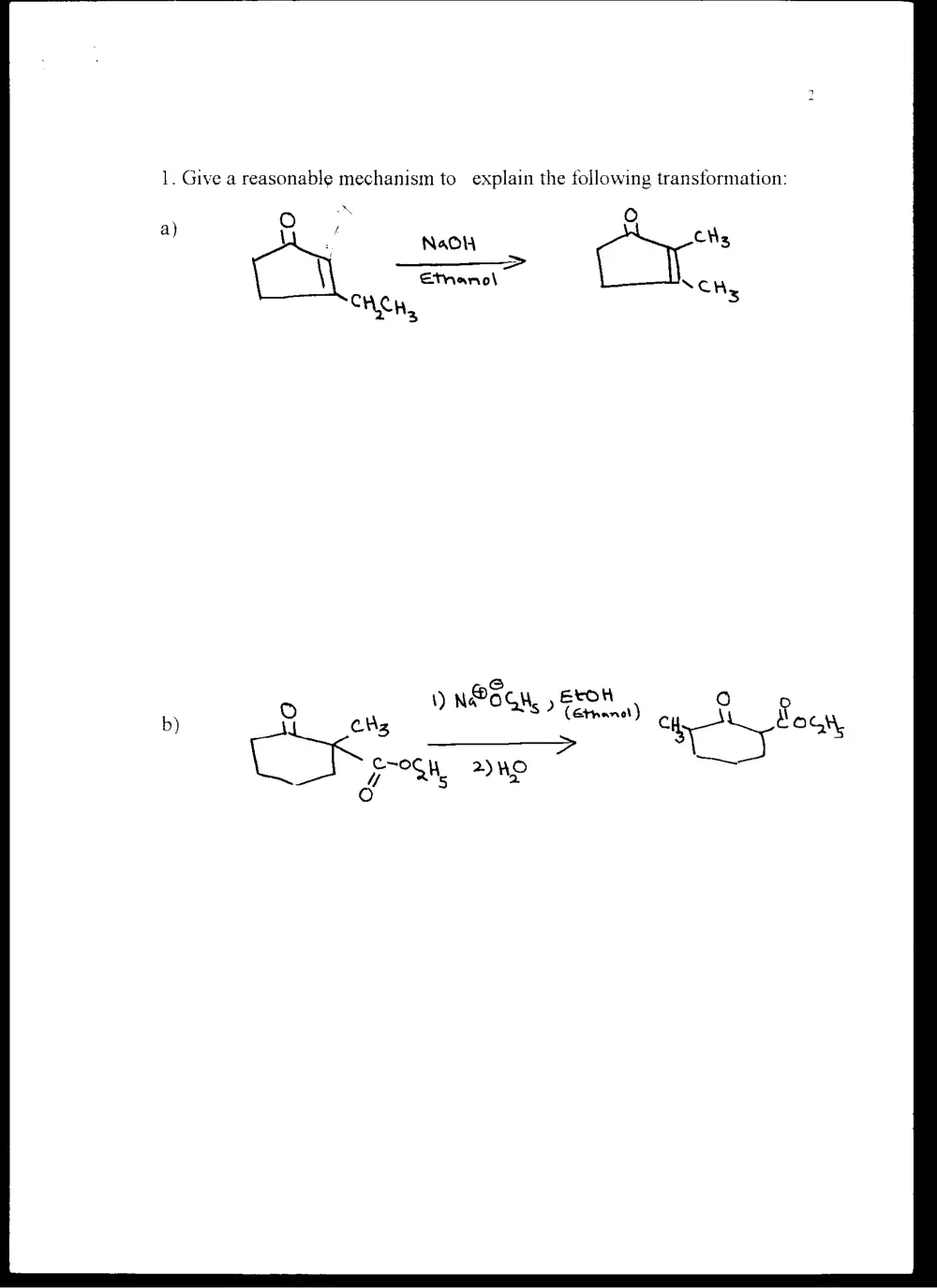
1. Give a reasonable mechanisin to explain the following transformation:
o > ©
f
a) We, Naot Cs
=>
EmManol\ Nc As
SACK,
\) rteateg » FON)
ie)
(Ethanol) Nt
b) CH Coa
ory c-oGh, =A 2) WO sy
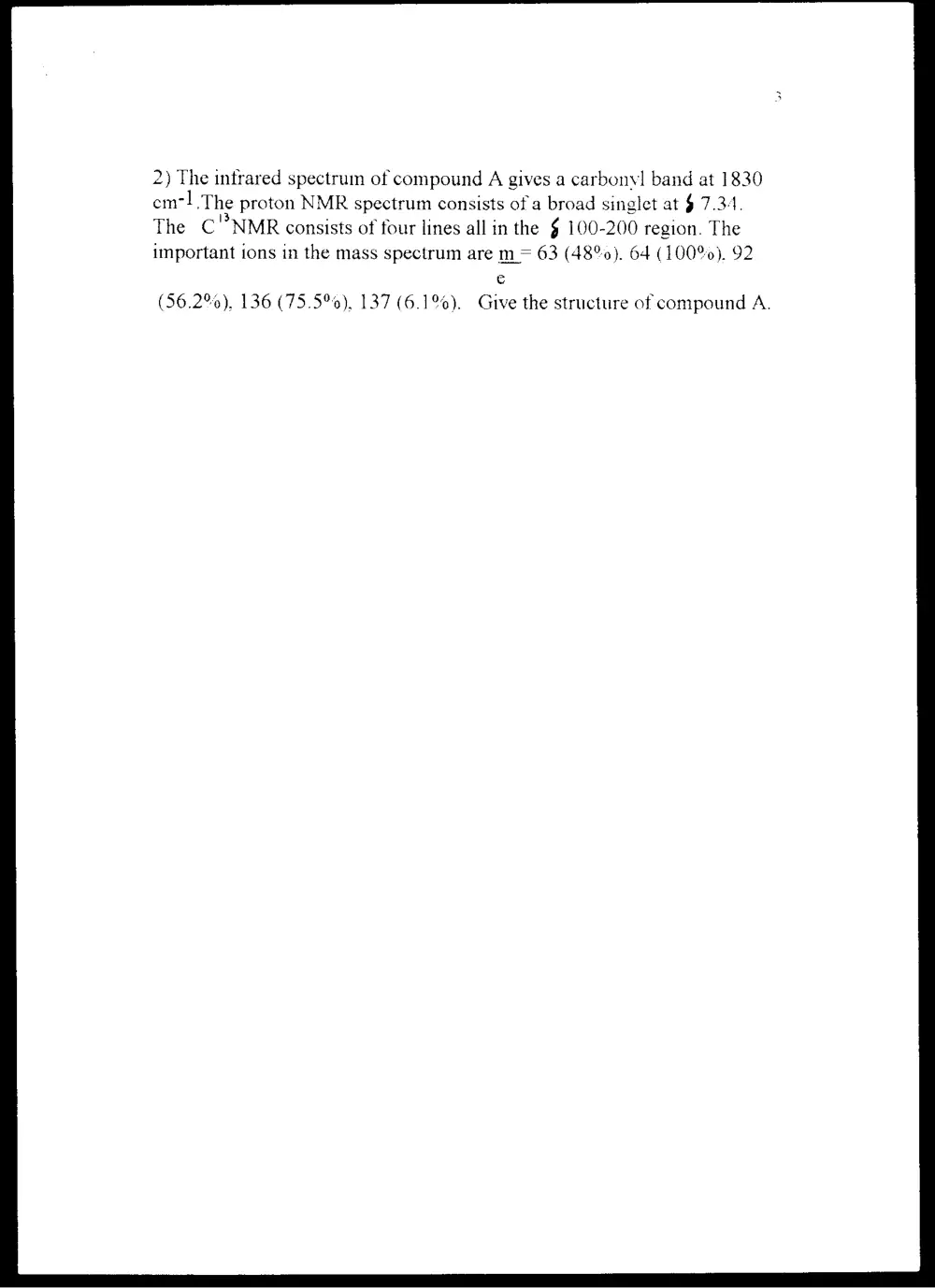
2) The infrared spectrum of compound A gives a carbonyl band at 1830
cm-l. The proton NMR spectrum consists of a broad singlet at § 7.34.
The C'*NMR consists of four lines all in the § 100-200 region. The
important ions in the mass spectrum are m = 63 (48%). 64 (100%). 92
€
(56.2%), 136 (75.5%), 137 (6.19). Give the structure of compound A.
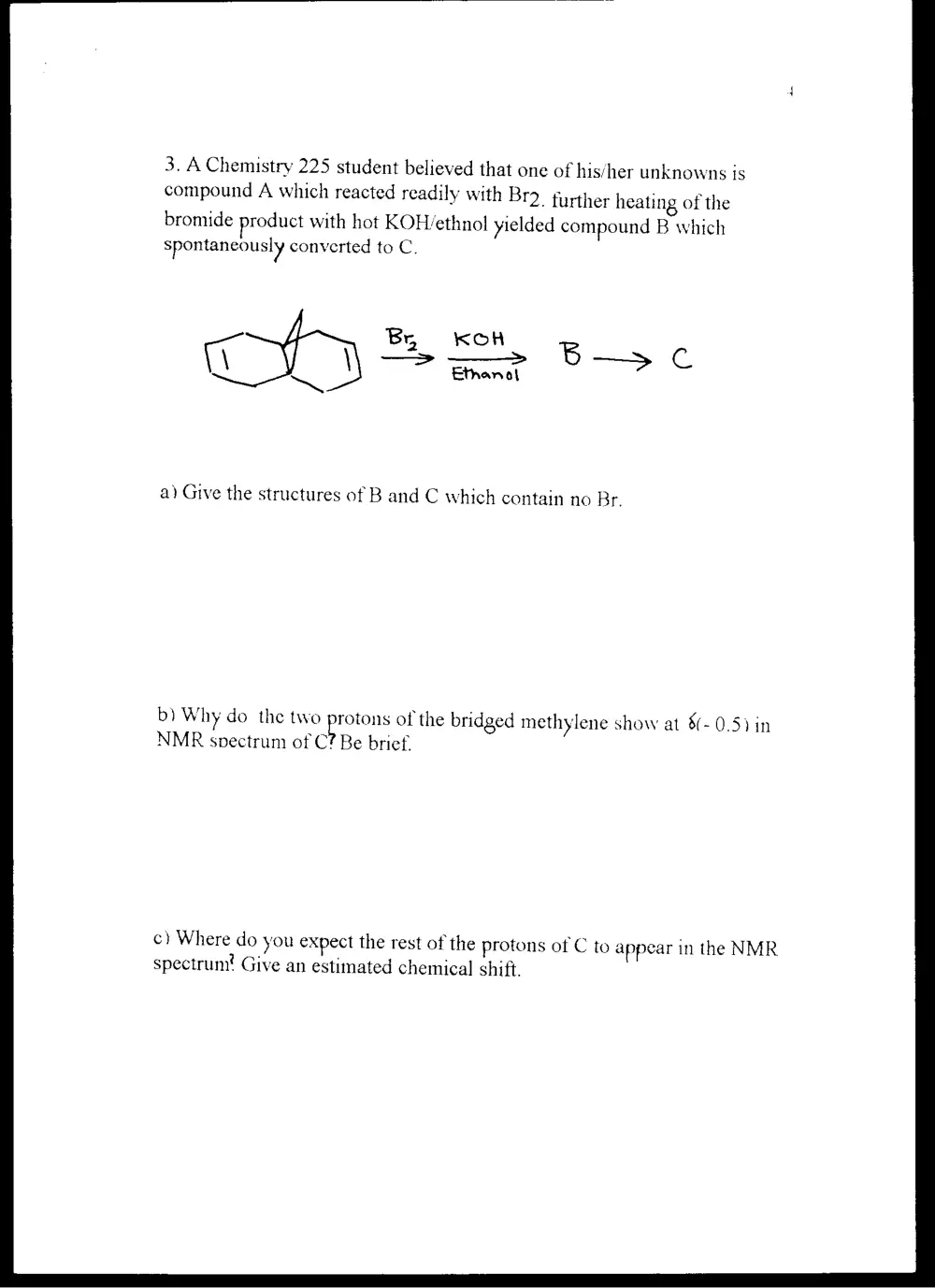
3. A Chemistry 225 student believed that one of his/her unknowns js
compound A which reacted readily with Bro. further heating of the
bromide product with hot KOH /ethnol yielded compound B which
Spontaneously converted to C.
a) Give the structures of B and C which contain no Br.
b) Why do the two protons of the bridged methylene show at &- 0.5) in
NMR spectrum of C? Be brief.
c) Where do you expect the rest of the protons of C to appear in the NMR
spectrum’ Give an estimated chemical shift.
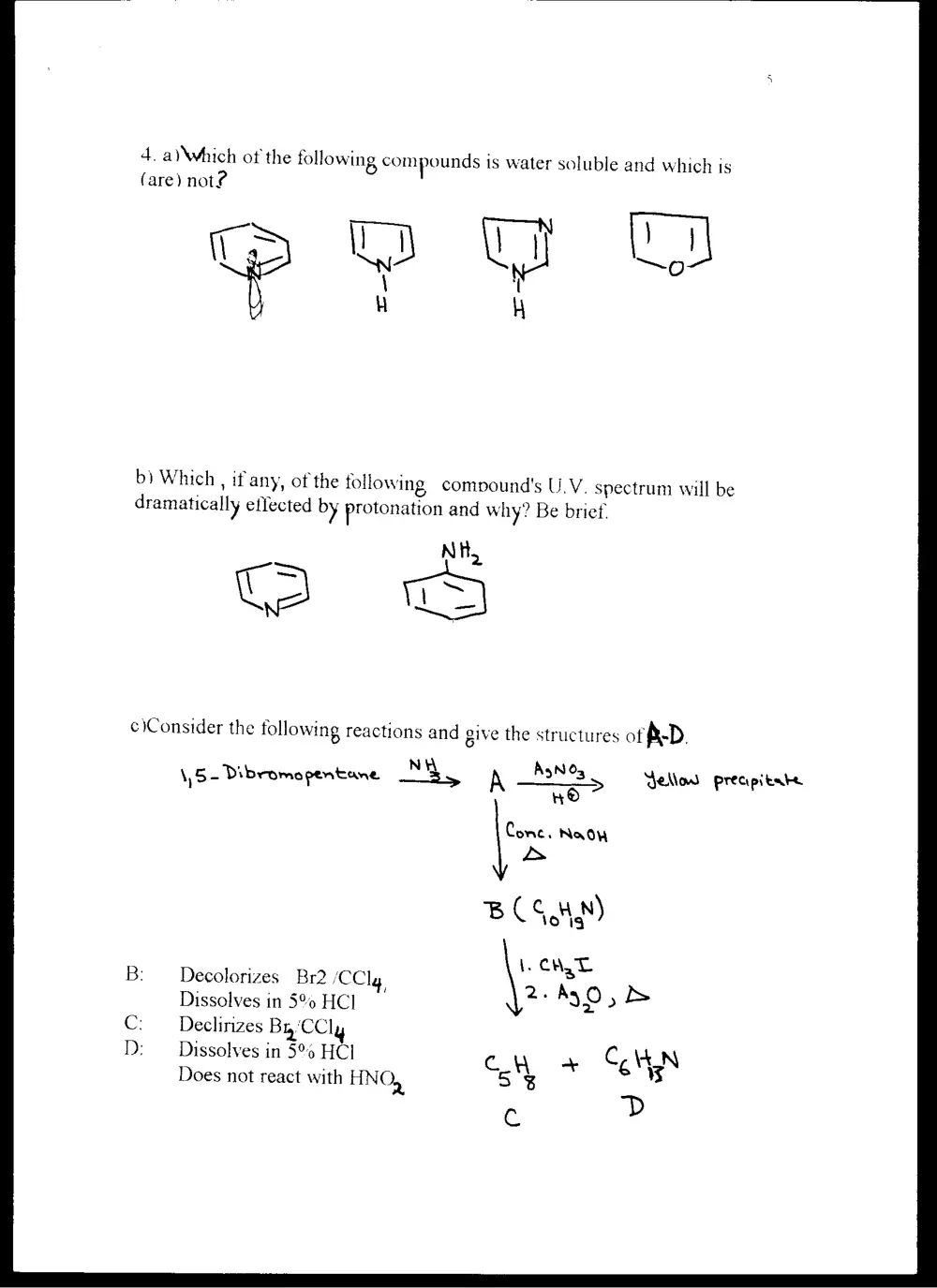
4. a) Which otf the following compounds is water soluble and which is
(are) not?
Wo
\
i)
b) Which , if any, of the following compound's U.V. spectrum will be
dramatically elfected by protonation and why? Be brief.
go
c)Consider the following reactions and give the structures of &D.
\,5- Dibromopentane SY A tees ellos precipitabe
hk
Conc. Nady
a
BCG HN)
\. cht
Decolorizes Br2 (CClg,
Dissolves in 5% HCI 2-A90,
Declirizes Ba ‘CCly
Dissolves in 5% HCl
Does not react with HN’ Oy
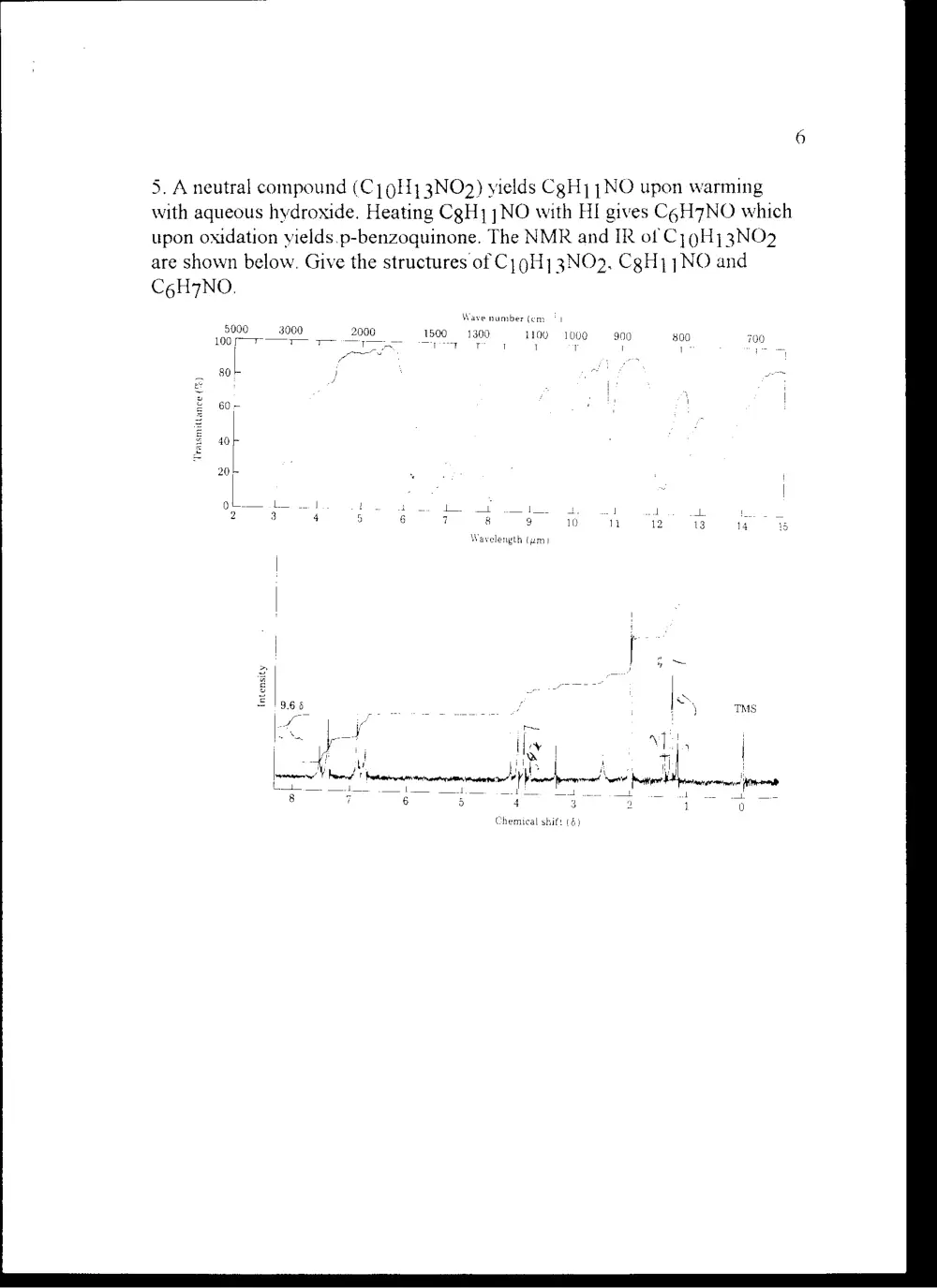
5. A neutral compound (Cj gH] 3NO2) yields CgH] jNO upon warming
with aqueous hydroxide. Heating CgH NO with HI gives CgH7NO which
upon oxidation yields.p-benzoquinone. The NMR and IR of CyQH ,3NO92
are shown below. Give the structures of C} QH] 3NO2, CgH11NO and
Wave number (cm 1
5000 3000 2000 1500 1300 110 f
- @ 1000 90 7
100 [71 i rr ns 1 1 T i ” me =~
— Ces
80 ! -
Ss a
2 60-
= 40
“r
1 Le 1 ae ae 7 al a
: 4 5 6 7 8 9 10 n 12 13 14
Wavelength (um
| | ~
ra 5 ~
3 _
= loes - sy TMS
aL j —
~ iw Nba |
i ® +
[orate a” hee" beteneom - y wel ‘ 4 ‘uliaiatteel
sada nae naeeta rao mand we
Lio — A. 1 . lin os atte fate 1
8 7 6 5 4 3 ns rr
Chemical shift (8)
6. Compound A (C1 9H 120) which, among other peaks in its proton NMR
spectrum, has a singlet at 62.2 (3H). Upon heating at 200°c it was converted
to a base soluble B (Cj Qf, 20). Heating of B with NaOH followed by
aciditication gave C (C1QH 20). Treatment of
B with a solution of aniline.
sodium nitrite and HCl at 5°c and adjustment of the pli of the solution to 9.
followed bv acidification gave a bright vellow product which upon reduction
with Sn, HCI yielded D (C] 6H] gON2).Ozono
ysis of B followed by
reduction of the ozonide gave E (Co H}Q02). E reacted with ammoniacal
silver nitrate to give, after acidification, F whic
vielded G (Cg HgO9). F showed the same sing
hot 5% NaOH.
Give the structures of A-G,
1 upon heating with HCI
let (3H) of A and dissolved in
7. A compound (A), containing only carbon, hydrogen , and oxygen, was
found to react with acetyl chloride but not with phenylhydrazine. Oxidation
with periodic acid converted it to a new compound (B), which reduced
Tollens but not Fehling’s reagent. Treatment of B with potassium cyanide in
aqueous ethanol converted it to a new compound (C). which gave positive
tests with acetyl chloride and phenvlhydrazine. Oxidation of C with Fehling's
solution or nitric acid converted it to a yellow compound (D) that vielded a
derivative with o-phenylenediamine. When D was treated with hydrogen
peroxide it yielded an acid () having a neutralization equivalent of 151-1.
Catalytic hydrogenation of C or D produced the original compound (A). The
nmy spectrum of compound B (in CDCI3) showed § 3.42. 3H, s; 6.9. 2H. d
(J= 10 Hz); 7.56, 2H. d(J=10 Hz); 9.81, 1H. s.
Give the structures of A-Br
9
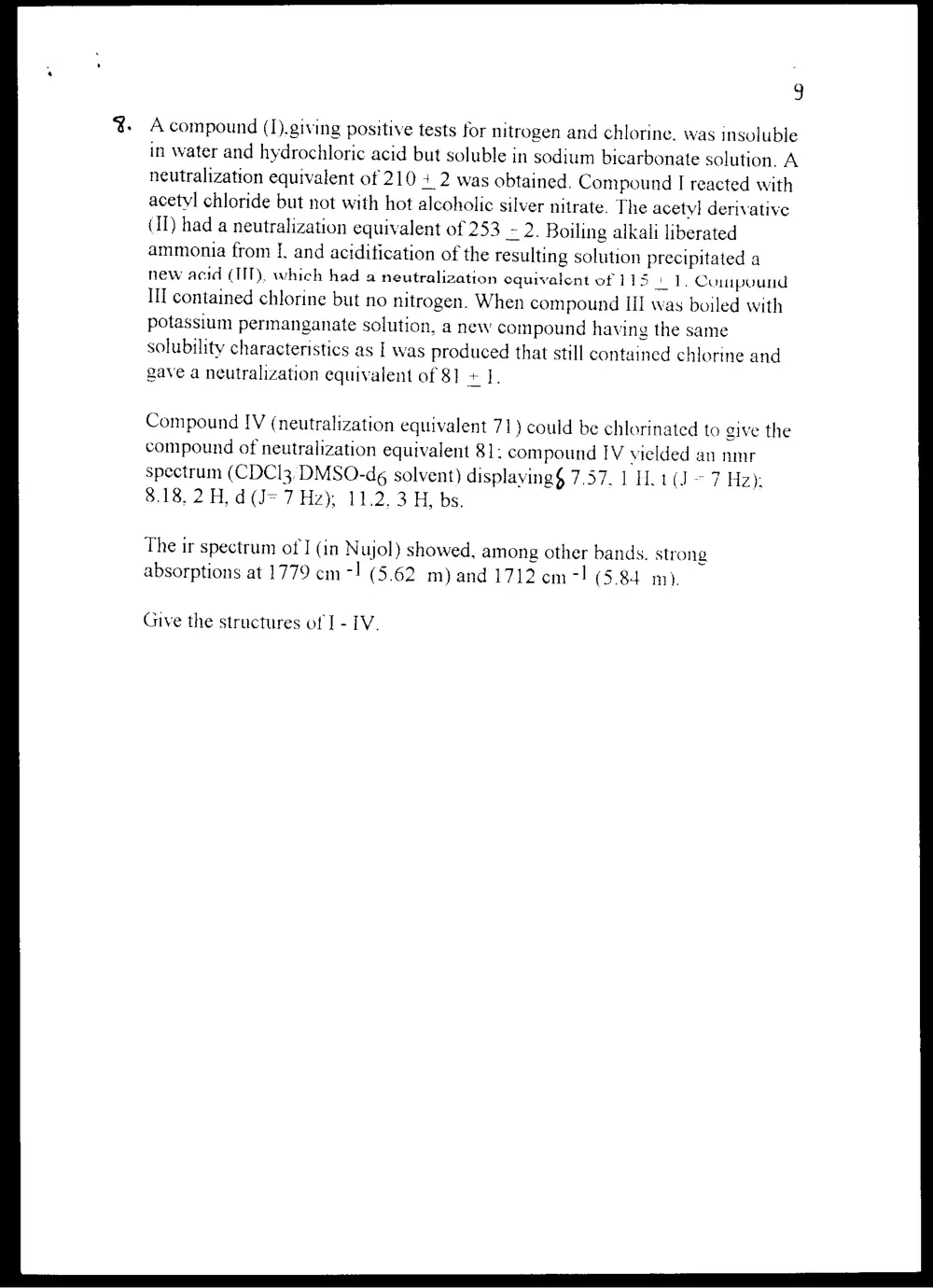
%. A compound (1).giving positive tests for nitrogen and chlorine. was insoluble
in water and hydrochloric acid but soluble in sodium bicarbonate solution. A
neutralization equivalent of 210 + 2 was obtained. Compound I reacted with
acetyl chloride but not with hot alcoholic silver nitrate. The acetyl derivative
(II) had a neutralization equivalent of 253 - 2. Boiling alkali liberated
ammonia from I, and acidification of the resulting solution precipitated a
new acid (TIT), which had a neutralization equivalent of 115 | 1, Compound
II contained chlorine but no nitrogen. When compound III was boiled with
potassium permanganate solution, a new compound having the same
solubility characteristics as I was produced that still contained chlorine and
gave a neutralization equivalent of 81 + 1,
Compound IV (neutralization equivalent 71 ) could be chlorinated to give the
compound of neutralization equivalent 81. compound IV yielded an nmr
spectrum (CDCI3, DMSO-d¢ solvent) displaving§ 7.57. 1 H.t (J - 7 Hz):
8.18, 2 H, d(J= 7 Hz), 11.2, 3 H, bs.
The ir spectrum of I (in Nujol) showed, among other bands. strong
absorptions at 1779 cm -! (5.62 m) and 1712 cm-! (5.84 m).
Give the structures of ] - IV.
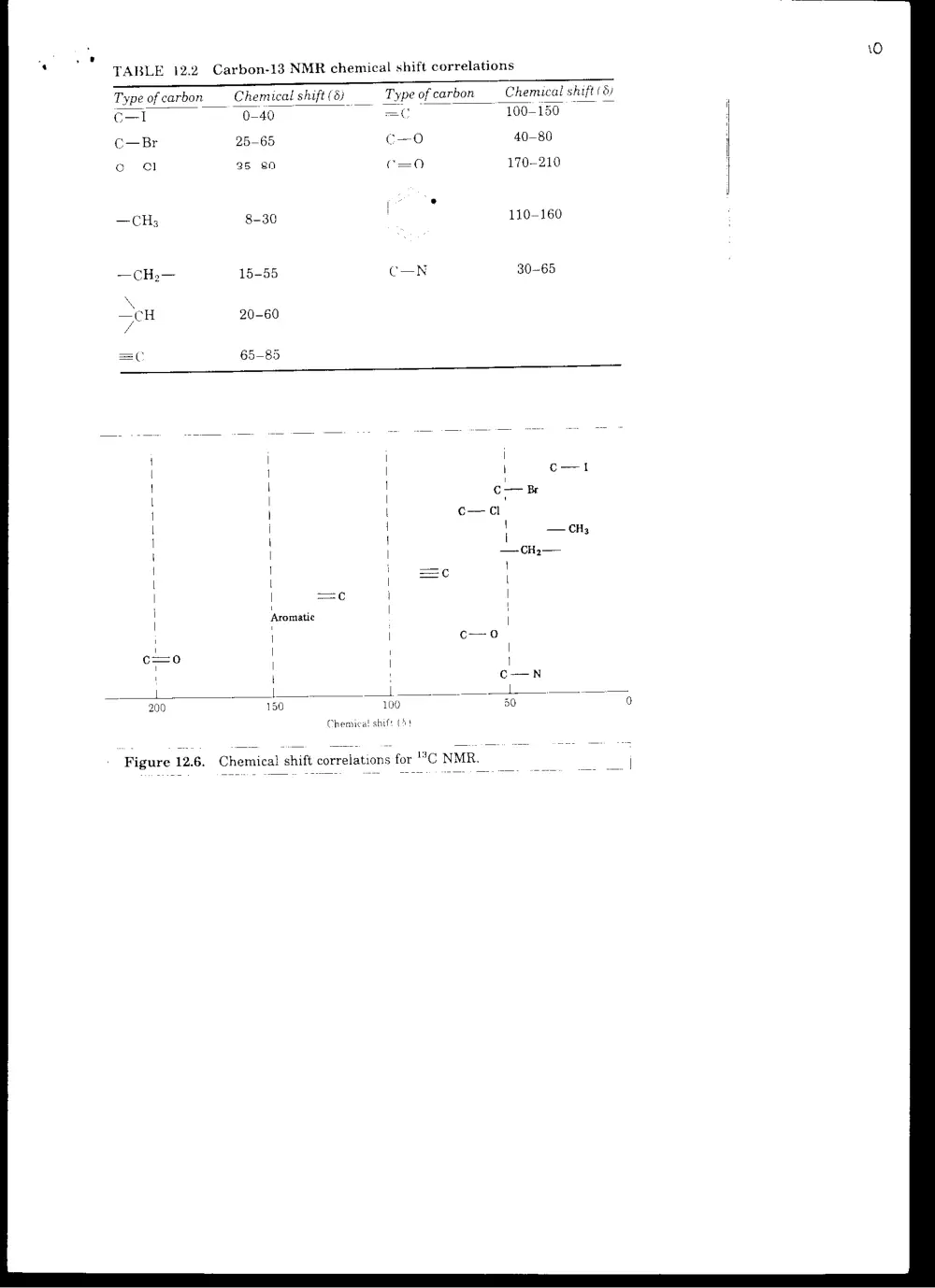
TABLE 12.2 Carbon-13 NMR chemical shift correlations
Type of carbon Chemical shift (8) Type of carbon Chemical shift (8)
C—l 0-40 =C 100-150
C—Br 25-65 C—O 40-80
o cl 95 2n c=0 170-210
— CH, 110-160
—CH,—
CH
100
Chemica! shift (44
Figure 12.6. Chemical shift correlations for C NMR.