
ENG 230 Final, Fall 2003
American University of Beirut · Language in Society · 2 pages

More ENG 230 files
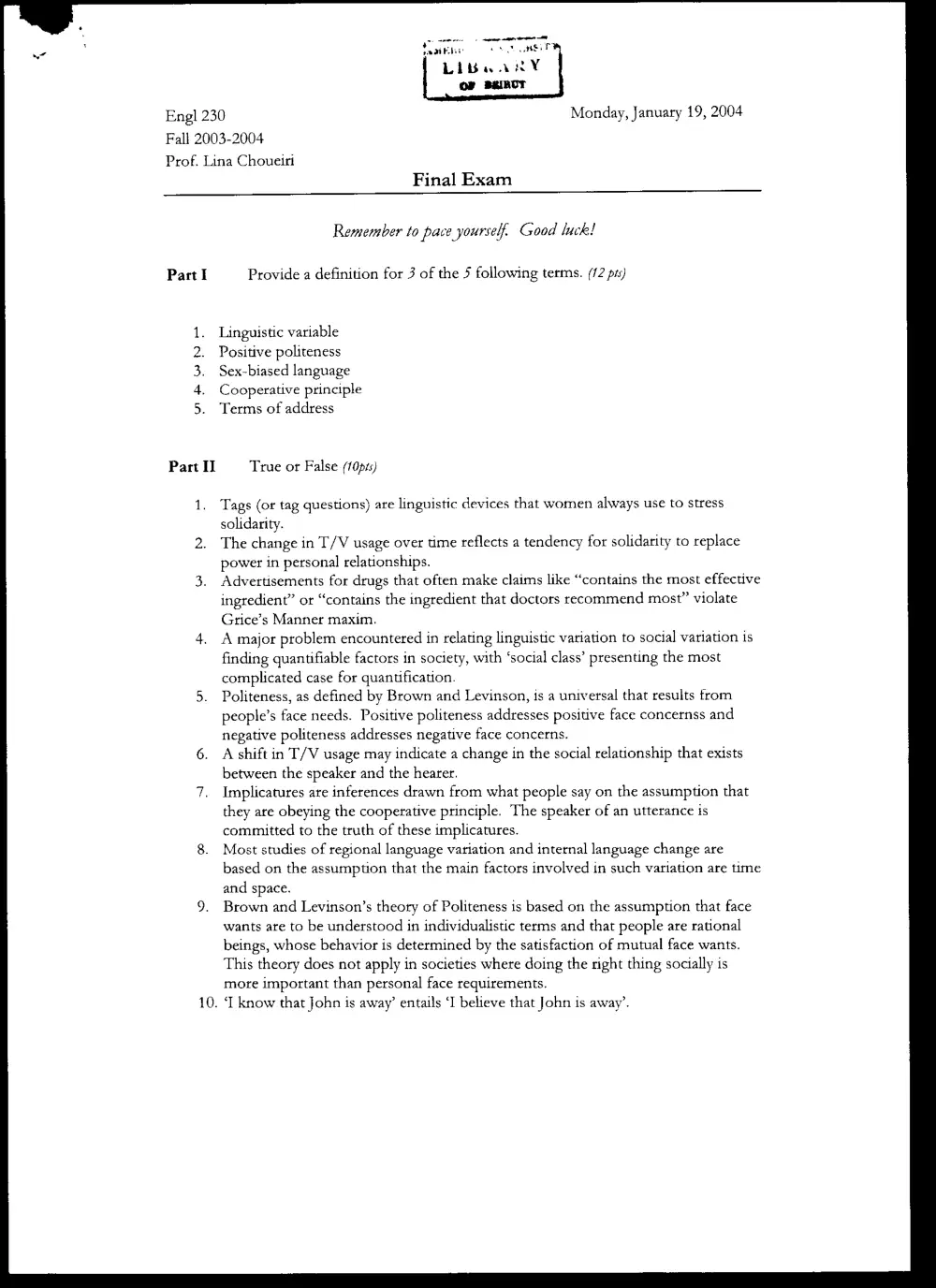
Show the text of this final exam
Engl 230 Monday, January 19, 2004
Fall 2003-2004
Prof. Lina Choueiri
Final Exam
PartI
Part II
10.
Remember to pace yourself. Good luck!
Provide a definition for 3 of the 5 following terms. (12 pis)
Linguistic variable
Positive politeness
Sex-biased language
Cooperative principle
Terms of address
True or False (10pss)
Tags (or tag questions) are linguistic devices that women always use to stress
solidarity.
The change in T/V usage over time reflects a tendency for solidarity to replace
power in personal relationships.
Advertisements for drugs that often make claims like “contains the most effective
ingredient” or “contains the ingredient that doctors recommend most” violate
Grice’s Manner maxim.
A major problem encountered in relating linguistic variation to social variation is
finding quantifiable factors in society, with ‘social class’ presenting the most
complicated case for quantification.
Politeness, as defined by Brown and Levinson, is a universal that results from
people’s face needs. Positive politeness addresses positive face concernss and
negative politeness addresses negative face concerns.
A shift in T/V usage may indicate a change in the social relationship that exists
between the speaker and the hearer.
Implicatures ate inferences drawn from what people say on the assumption that
they are obeying the cooperative principle. The speaker of an utterance is
committed to the truth of these implicatures.
Most studies of regional language variation and internal language change are
based on the assumption that the main factors involved in such variation are time
and space.
Brown and Levinson’s theory of Politeness is based on the assumption that face
wants are to be understood in individualistic terms and that people are rational
beings, whose behavior is determined by the satisfaction of mutual face wants.
This theory does not apply in societies where doing the right thing socially is
more important than personal face requirements.
‘I know that John is away’ entails ‘I believe that John is away’.
PartIII Answer wo of the following three questions. (28 pts)
1.
Studies of the use of address terms have led researchers to conclude that
solidarity is more important than power in personal relationships. What
arguments can you provide forand against such a conclusion? What role do
address terms play in relating language to society?
How does the following excerpt from Tannen’s You Just Don’t Understand (1990,
pp. 212-213) (1) illustrate the cross-cu/tura/ differences between men and women in
conversation and (2) reflect the relative power of men and women in society?
Zoe is talking to a recently divorced man named Earl whom her sister has fixed her up with,
Earl asks, ‘What's your favorite joke?” This 7s what happens next:
"Uh, my favorite joke is probably- O.K., all right. This guy goes into a doctor's office, and-“
"I think I know this one,” interrupted Earl, eagerly. He wanted to tell it himself. “A guy
goes into a doctor's office, and the doctor tells him he’s got some good news and some bad news.
that one, right?”
"T'm not sure,” said Zoe. “This might be a different version.”
So, the guy says, ‘Give me the bad news first,’ and the doctor says, O.K. You've got three
weeks to live.’ And the guy cries, Three weeks to live! Doctor, what is the good news?’ And
the doctor says, ‘Did you see that secretary out front? I finally fucked her.’”
Zoe frowned.
"That's not the one you were thinking of?”
No.” There was accusation in her voice. ‘Mine was different.”
"Oh,” said Earl. He looked away and then back. again.
What kind of history do you teach?”
We often infer that two propositions are related to each other even when that
relationship is not explicitey stated. In the following pairs of sentences, for
example, we are likely to infer some relationship between the two propositions
even though none is explicitely stated.
(a) I stopped at the bank on the way home from work. I withdrew $200.
(b) Tleft because I wanted to. If I hadn’t wanted to, I wouldn’t have left.
(©) I went into the kitchen. The cookies burned.
After identifying the possible relationship between the propositions in the above
sentence pairs, use the Gricean maxims to account for the inferred relationships.
Which Gricean maxims are violated? Which ones are obeyed? How do inferences
arise?