
GEOL 201 Final, Fall 1996
American University of Beirut · Physical Geology · 11 pages



Showing the first 10 of 11 pages. Download the PDF to see all of it.
More GEOL 201 files
Show the text of this final exam
Geology 201 Final 96/97
Loo Sf Time Allowed: 2 hours
Exam rules apply:
\Y Section A (40 marks)
Answer the questions in this section on the sheet provided. Note that 2 marks will be
given for a correct answer and 1/2 mark will be deducted for an incorrect answer.
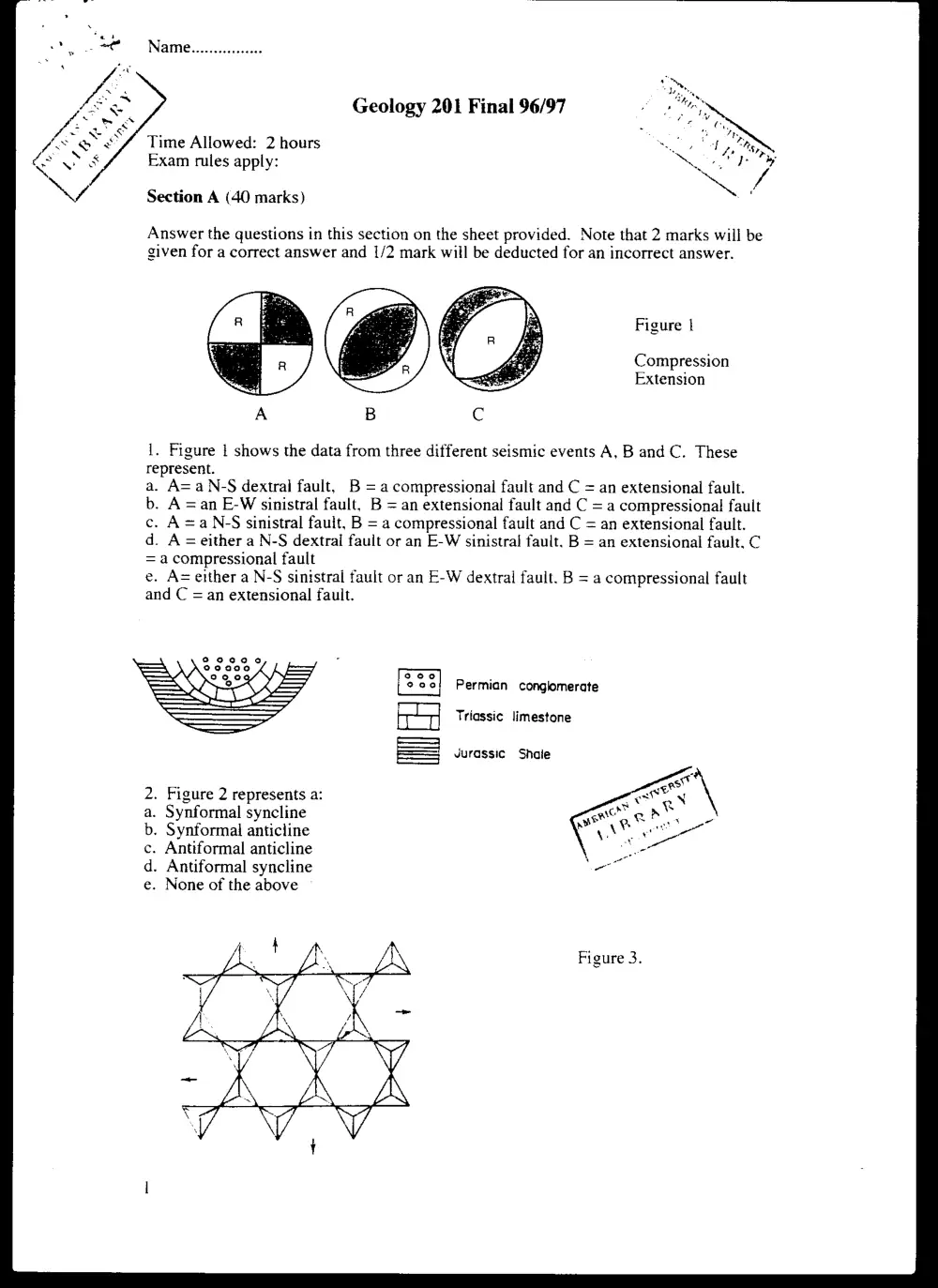
Figure |
Compression
Extension
1. Figure 1 shows the data from three different seismic events A, B and C. These
represent.
a. A=a N-S dextral fault, B =a compressional fault and C = an extensional fault.
b. A=an E-W sinistral fault, B = an extensional fault and C = a compressional fault
c. A=aN-S sinistral fault, B = a compressional fault and C = an extensional fault.
d. A =either a N-S dextral fault or an E-W sinistral fault, B = an extensional fault, C
=a compressional fault
e. A=either a N-S sinistral fauit or an E-W dextrai fault. B = a compressional fault
and C = an extensional fault.
eoo .
200} Permian conglomerate
— Triassic limestone
= Jurassic Shale
Figure 2 represents a:
Synformal syncline
Synformai anticline
Antiformal anticline
Antiformal syncline
None of the above
eae SPN
Figure 3.
3. Figure 3 shows the structure of one of the silicate mineral groups. This group is
represented by:
. Feldspars
. Micas
. Clays
. Feldspars + Micas
. Micas + Clays
. The Plagioclase feldspar group of minerals includes two end members these are:
. KAISi30g and NaAISi30g
. KAISi30 and CaA12Sin0g
. NaAISi30g and CaA13Si20g
. (Mg, Fe) SiO4 and NaAISi30g
. (Mg, Fe)2 SiO4 and Ca (Mg, Fe. Al) [(Si. Al) O3|>
Figure 4
Figure 4 is a cross-section through the outer layers of the upper crust showing the
disposition of the various strata relative to one another. Use the information from the
diagram to answer questions 5-8.
5. There are two interconnected basalt units in the stratigraphic sequence shown in
figure 4. These are D and G. Which of the following statements is true.
a. D is definitely a dyke and G is definitely a sill.
b. Disa dyke and G is a sill because unit I shows evidence of contact
metamorphism.
c. Disa dyke and G is a lava flow because unit I shows evidence of contact
metamorphism
d. D could be either a dyke or a volcanic plug and G is a lava flow because unit I
shows evidence of contact metamorphism.
e. D could be either a dyke or a volcanic plug and G could be either a lava flow ora
sill because unit | shows evidence of contact metamorphism.
6. The strata in figure 4 shows which of the following stratigraphic relationships (not
including faulting).
a. The beds were laid down in a continuous sequence with no break in deposition at
any time.
b. The history of the area is compiex. A nonconformity can be identified in the upper
sequences.
c. The history of the area is complex. A disconformity can be identified within the
sequence.
d. The history of the area is complex. An angular unconformity can be identified
with the sequence.
e. The history of the area is complex. A nonconformity. a disconformity and an
angular unconformity can all be identified within the sequence.
. The two faults shown in figure 4 are
. Both extensional
. Both compressional
. Both strike-slip
. Ais strike-slip and B is compressional
. A is compressional and B is extensional.
. The sequence of events depicted in the stratigraphic sequence shown in figure 4
are:
a. C,P,O,N.M. L.A, K,S.HOEF.
b. C,P,O,N,M.L.A, KJ, H, 1D, G, F
ce. C.P.O,N.M. ALL. K.J, HOE F.D.G
d. Either A or B could be correct.
e. Either B or C could be correct.
| Anelashe Se
i
: Vv
OQ’
| 7
» Elasine
hay OS
D,G.BLE
BLE
BLE
ie
Sttuss —~
ZL
Figure 5 - Stress strain curve.
9. Two rocks A and B have been subjected to different amounts of stress resulting in
different amounts of strain. The data collected has been plotted on the stress-strain
curve in figure 5. What will happen in each case once the stress is removed.
a. Nothing
b. Both materials will behave elastically and return to their original shapes.
c. A will immediately return to its original shape and will show no record of the
deformation. B will be permanently deformed.
d. A will return to its original shape with time and will show no record of the
deformation. B will be permanently deformed.
e. A will return to its original shape with time and will show no record of the
deformation. B will undergo a period of anelastic and elastic recovery but will never
recover its original shape.
10) If rock B were subjected to the same amount of stress. but under conditions of
low temperature, low confining pressures and high strain rates the outcome would
most likely be:
a. Elastic deformation - B would regain its original shape
b. Anelastic deformation - B would regain its original shape with time
c. Ductile deformation - B would be permanently deformed.
d. Brittle deformation - B would undergo rupture
e. All of the above - B would undergo a period of recovery once the stress had been
removed but it would show evidence of permanent ductile and brittle deformation.
11. The seismic discontinuity at the mesosphere. outer core boundary is known as:
a. Mohorovic
b. Conrad
c. Gutenburg
d. 920 km
e. 430km
12. Continental nfts may be
a. A precursor to an ocean
b. A result of passive rifting
c. A result of active nfting
d. A result of continental collision
e. All of the above.
Figure 6 shows the spatial distribution of the main lithospheric plates.
EURASIAN
cone
“PACIFI ct
INDIAN f . AMERICAN
Absolute
Divergent Transform 40 plate
boundary boundary velocity
(mma)
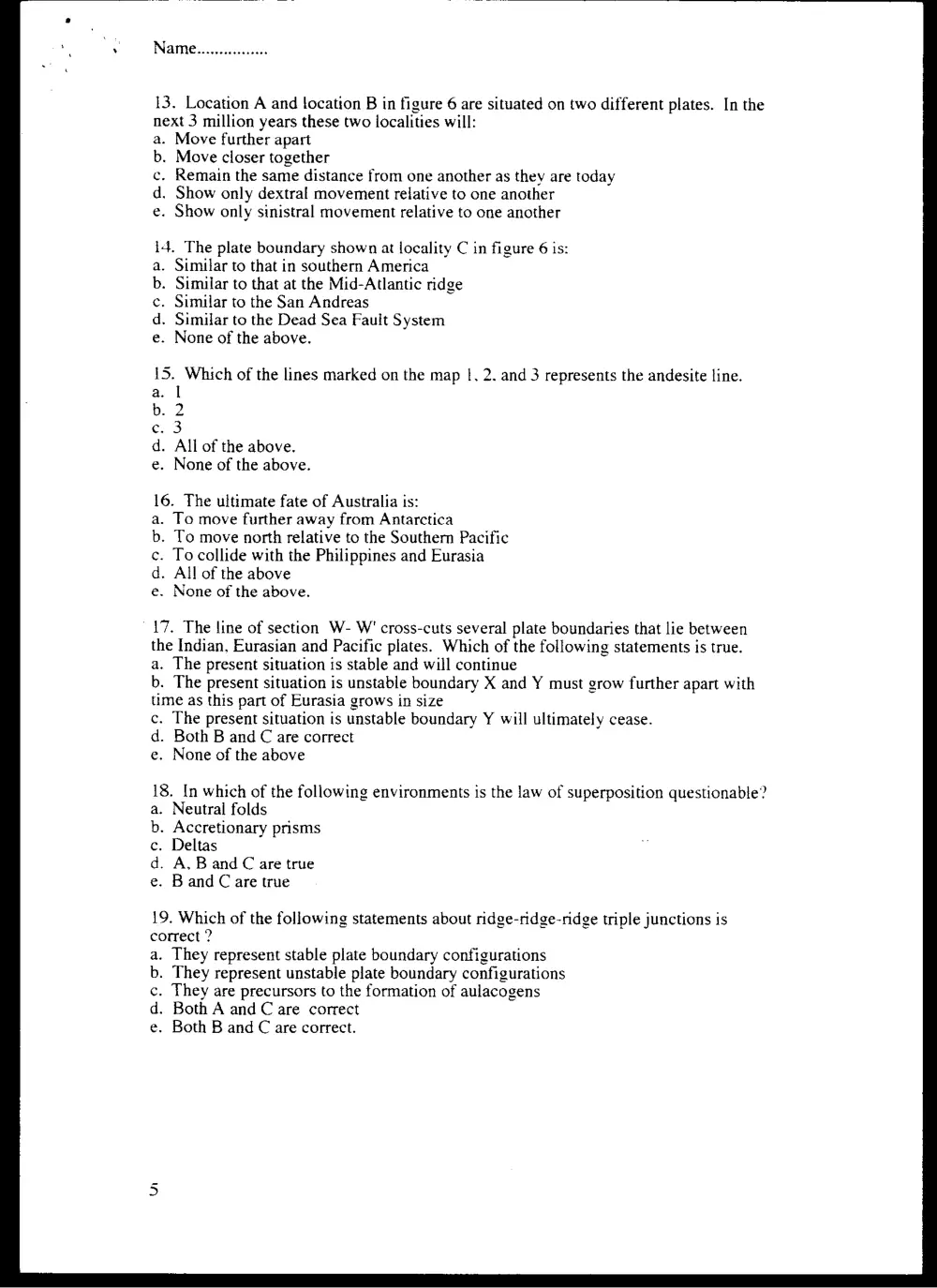
13. Location A and location B in figure 6 are situated on two different plates. In the
next 3 million years these two localities will:
a. Move further apart
b. Move closer together
c. Remain the same distance from one another as they are today
d. Show only dextral movement relative to one another
e
. Show only sinistral movement relative to one another
i4. The plate boundary shown at locality C in figure 6 is:
a. Similar to that in southern America
. Similar to that at the Mid-Atlantic ridge
b
c. Similar to the San Andreas
d. Similar to the Dead Sea Fault System
e. None of the above.
15. Which of the lines marked on the map |. 2. and 3 represents the andesite line.
a. |
b. 2
c. 3
d. All of the above.
e. None of the above.
16. The ultimate fate of Australia is:
a. To move further away from Antarctica
. To move north relative to the Southern Pacific
. To collide with the Philippines and Eurasia
b
c
d. All of the above
e. None of the above.
17. The line of section W- W' cross-cuts several plate boundaries that lie between
the Indian, Eurasian and Pacific plates. Which of the following statements is true.
a. The present situation is stable and will continue
b. The present situation is unstable boundary X and Y must grow further apart with
time as this part of Eurasia grows in size
c. The present situation is unstable boundary Y will ultimately cease.
d. Both B and C are correct
e. None of the above
18. In which of the following environments is the law of superposition questionable?
a. Neutral folds
b. Accretionary prisms
c. Deltas
d. A, B and C are true
e
. Band C are true
19. Which of the following statements about ridge-ridge-ridge triple junctions is
correct ?
a. They represent stable plate boundary configurations
b. They represent unstable plate boundary configurations
c. They are precursors to the formation of aulacogens
d. Both A and C are correct
e. Both B and C are correct.
5
20. Mount Lebanon is an example of
a. A continental margin orogen
. An intercontinental collision orogen
"A structure formed on the restraining bend of a continental transform
b
c. A structure formed on the releasing bend of a continental transform
d
e
. A Precambrian craton.
Section B. (15 marks)
Complete the following diagrams/tabies and where possibie give examples.
i. The rock cycie ( 4 marks)
2. Sedimentary facies (4.5 marks)
Glacier
Meitwater
SITEAMS a4
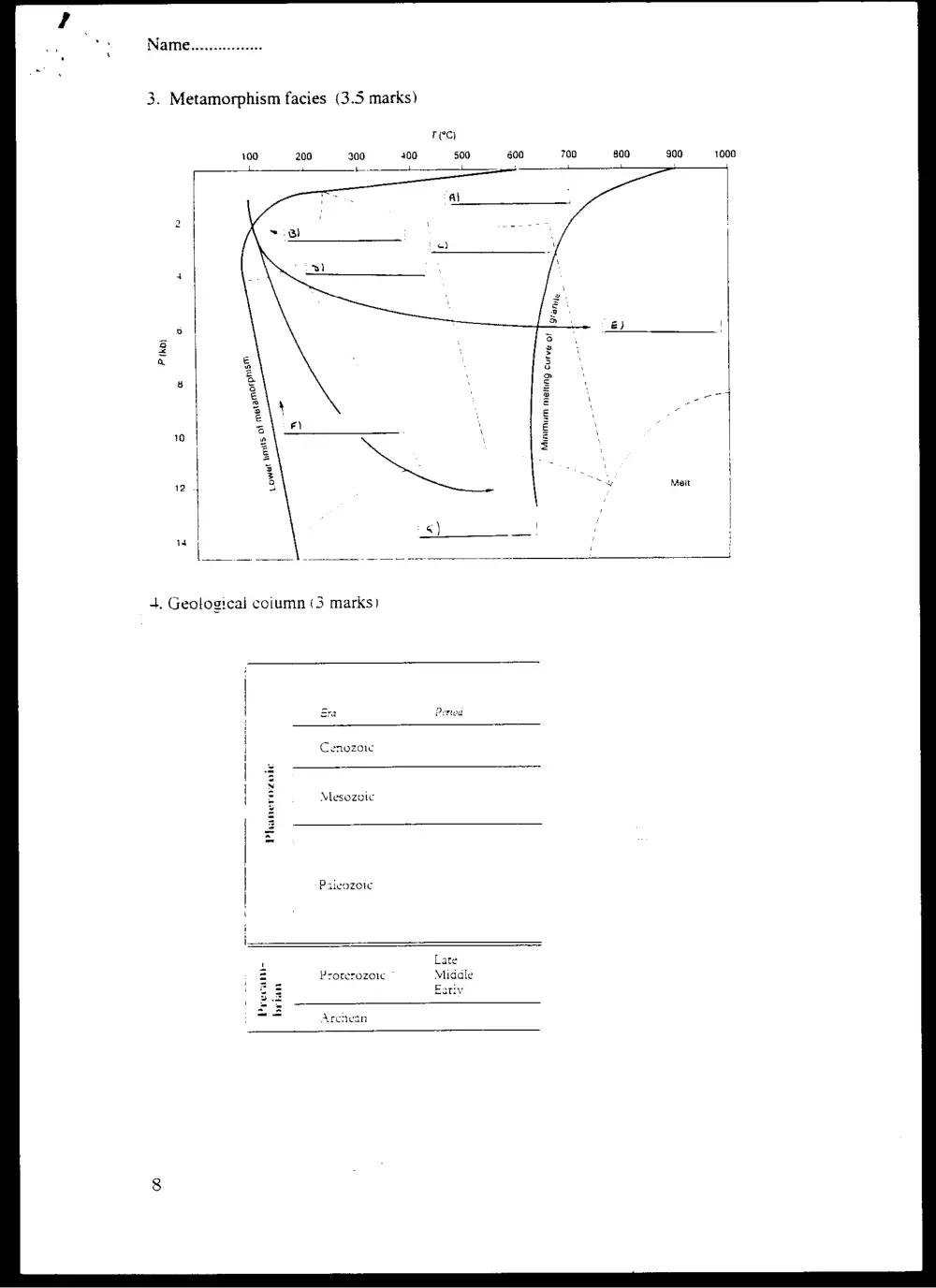
3. Metamorphism facies (3.5 marks)
* Minimum
Cenozoic
Mesozoic
Paleozoic
Proterozoic
Archean
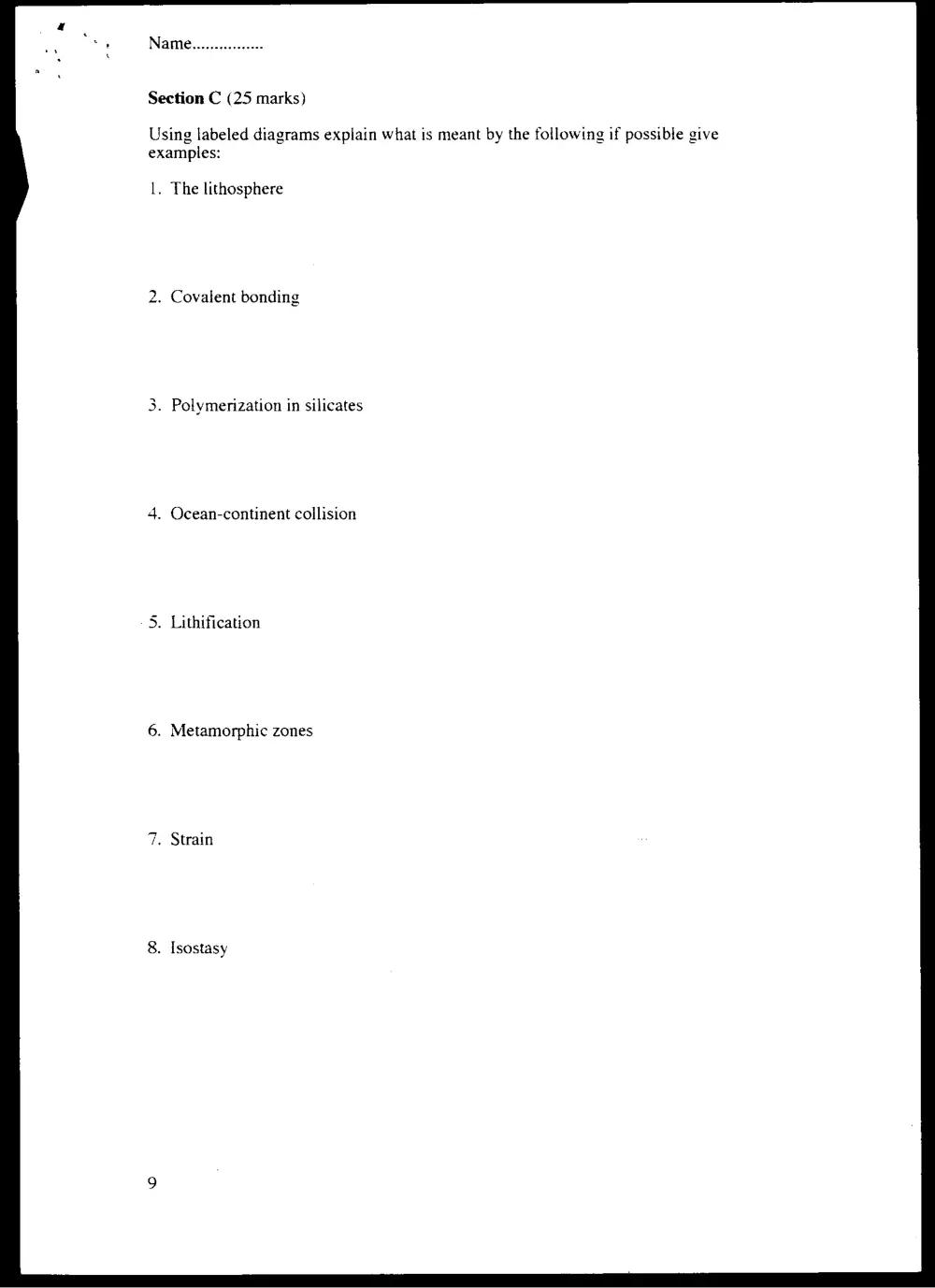
Section C (25 marks)
Using labeled diagrams explain what is meant by the following if possible give
examples:
lL. The lithosphere
. Covalent bonding
. Polymerization in silicates
. Ocean-continent collision
. Lithification
. Metamorphic zones
. Tsostasy
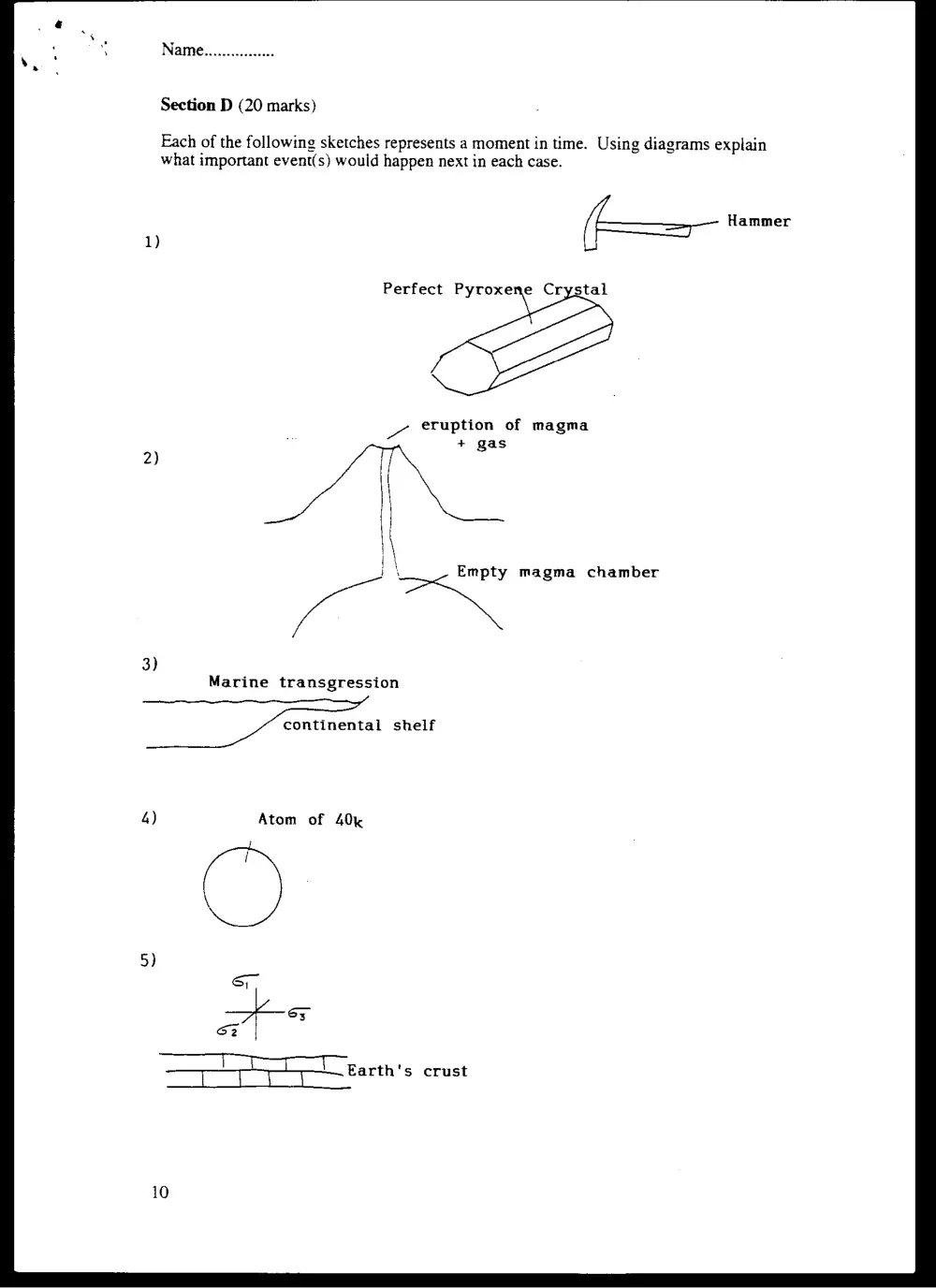
Section D (20 marks)
Each of the following sketches represents a moment in time. Using diagrams explain
what important event(s) would happen next in each case.
(— = Hammer
1)
Perfect Pyroxene Crystal
2 eruption of magma
+ gas
2)
ae magma chamber
3)
Marine transgression
eontinenta shelf
4) Atom of 40,
5)
S
os
St
= '
T Col Earth's crust
10