
GEOL 201 Final, Fall 1998
American University of Beirut · Physical Geology · 9 pages
More GEOL 201 files
Show the text of this final exam
Name..........-.05-
v
Geology 201 Final Exam, Fall 1999 ~
Exam rules apply. o
Time allowed: Two hours :
Section A: (60 marks)
Answer the questions on the sheet provided. Note that two marks will be given for each correct
answer and half a mark will be deducted for each incorrect answer.
The mineral Dolomite is an example of a:
Sulphate.
Phosphate.
Carbonate.
Double chain silicate.
Sheet silicate.
sao Cf
N
Which of the following statements regarding a silicate mineral that has the basic formula
(Si,Ojo) is true?
Each silicate tetrahedron shares one oxygen atom.
Each silicate tetrahedron shares two oxygen atoms
Each silicate tetrahedron shares three oxygen atoms
Each silicate tetrahedron shares four oxygen atoms.
None of the above.
one sR
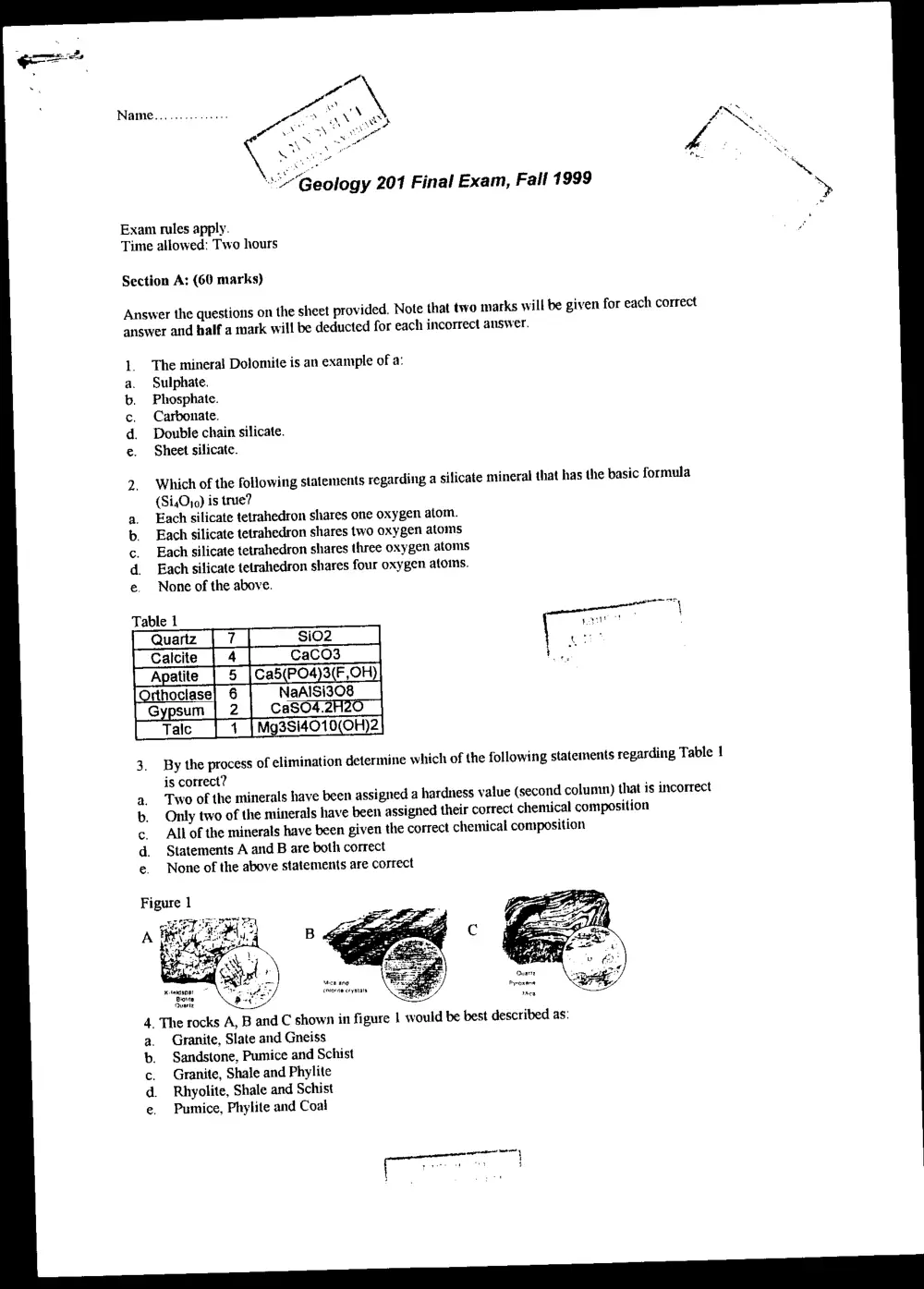
Table 1 enn
Quariz [7 SiOz
Calcite 4 CaCO3
Apatite _| 5 | Ca5(PO4)3(F,OH)
6
2
1
Orthoclase NaAISi308
Gypsum CaS
Talc Mg3Si4010(0H)2
w
By the process of elimination determine which of the following statements regarding Table !
is correct?
a. Two of the minerals have been assigned a hardness value (second colunin) that is incorrect
b. Only two of the minerals have been assigned their correct chemical composition
c. Allof the minerals have been given the correct chemical composition
d, Statements A and B are both correct
e. None of the above statements are correct
wen an
Klektsoar crete crystals
Bitte
Quartz
4, The rocks A, B and C shown in figure | would be best described as:
Granite, Slate and Gneiss
Sandstone, Pumice and Schist
Granite, Shale and Phylite
Rhyolite, Shale and Schist
Pumice, Phylite and Coal
enog®e
5. Aa is best described as:
a. Anash flow
b. A low viscosity lava flow with a ropey texture
c. Apyroclastic flow with a blocky texture
d. All of the above
e. None of the above
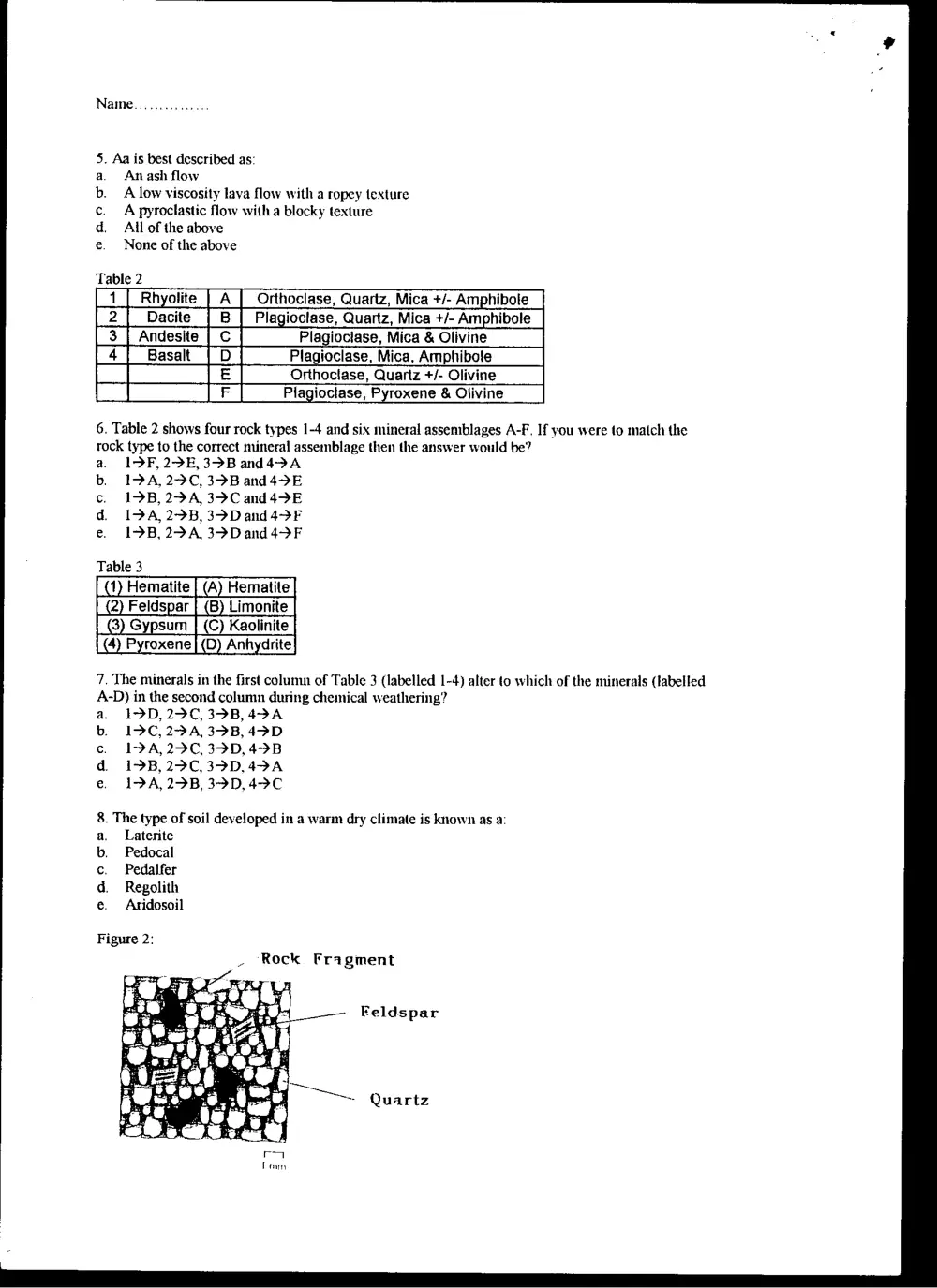
Table 2
1_| Rhyolite | A_| Orthoclase, Quartz, Mica +/- Amphibole
Dacite B | Plagioctase, Quartz, Mica +/- Amphibole
3 | Andesite | C Plagiociase, Mica & Olivine
4 | Basalt | D Plagioclase, Mica, Amphibole
E Orthoclase, Quartz +/- Olivine
LF Plagioclase, Pyroxene & Olivine
6. Table 2 shows four rock types 1-4 and six mineral assemblages A-F. If you were to match the
rock type to the correct mineral assemblage then the answer would be?
a. 1OF,29E,3>Band49A
b. 19A,29C, 3B and45E
c 19B,23A,39Cand49E
d. 193A, 2B, 39D and 49F
e. 19B, 239A, 39D and 49F
Table 3
1) Hematite | (A) Hematite
(2) Feldspar | (B) Limonite
(3) Gypsum | (C) Kaolinite
(4) Pyroxene] (D) Anhydrite
7. The minerals in the first column of Table 3 (labelled 1-4) alter (o which of the minerals (labelled
A-D) in the second column during chemical weathering?
a. 19D,29C,39B,49A
b. 19C,23A,39B, 49D
c. 19A,29C, 39D, 49B
d 19B, 29C, 39D, 490A
e. 19A,29B,39D,49C
8. The type of soil developed in a warm dry climate is known as a:
a. Laterite
b. Pedocal
c, Pedalfer
d. Regolith
e. Aridosoil
Figure 2:
- Rock. Fragment
foam
Name..............,
9. The clastic rock shown in figure 2 would be best described asa:
eS ROT = saa ge SP ROTs- eA oe Fao pS
snoop
15.
Monomict ortho-pebble-breccia
Siltstone
Arkose
Quartz arenite
Greywacke
. Which of the following sediments is not a biochemical sediment
Oil shale
Calcareous ooze
Gypsum
Biomicrite
Fossiliferous limestone
. A single angular clast of limestone (size 84mm) is known as a:
Boulder grayel
Cobble
Pebble breccia
Boulder congtomerate
Sand
. Which type of coal contains the highest percentage of carbon?
Peat
Anthracite
Lignite
Bituminous
Subbituminous
. Metamorphism in a subduction zone is associated with:
High temperatures and high pressures
High temperatures and low pressures
Low temperature and low pressures
Low temperature and high pressures
None of the above
. Which of the following metamorphic rocks belongs to the greenschist facies?
Granulite
Gneiss
Schist
Slate
Eclogite
Which of the following minerals is not used as an index mineral when determining
metamorphic zones?
a.
b
c.
d.
e.
16.
a.
sa0f
Chlorite
Staurolite
Garnet
Muscovite
Sillimanite
What is the name given to a large crystal in a metamorphic rock?
Phenocryst
Porphry
Porphyroblast
Pegmatitite
Pyroxene
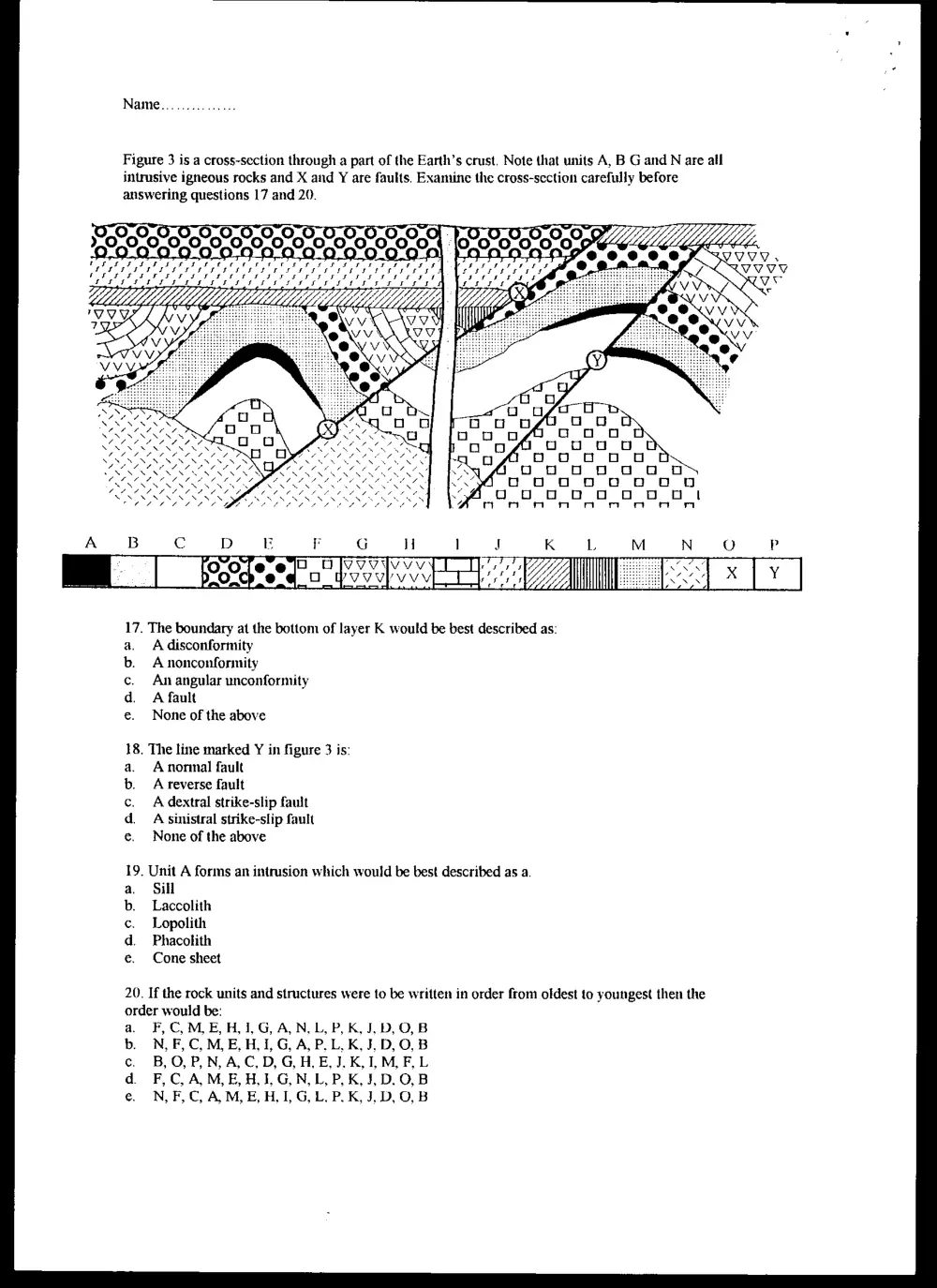
Figure 3 is a cross-section through a part of the Earth’s crust. Note that units A, B G and N are all
intrusive igneous rocks and X and Y are faults. Examine the cross-section carefully before
answering questions 17 and 20.
aM
VVVIVVV
oO vvyvvpvvyv
17. The boundary at the bottom of layer K would be best described as:
A disconformity
A nonconformity
An angular unconformity
A fault
None of the above
18. The line marked Y in figure 3 is:
A normal fault
A reverse fault
A dextral strike-slip fault
A sinistral strike-slip fault
None of the above
19. Unit A forms an intrusion which would be best described as a.
Sill
Laccolith
Lopolith
Phacolith
Cone sheet
20. If the rock units and structures were to be written in order from oldest to youngest then the
order would be:
Name... 2...
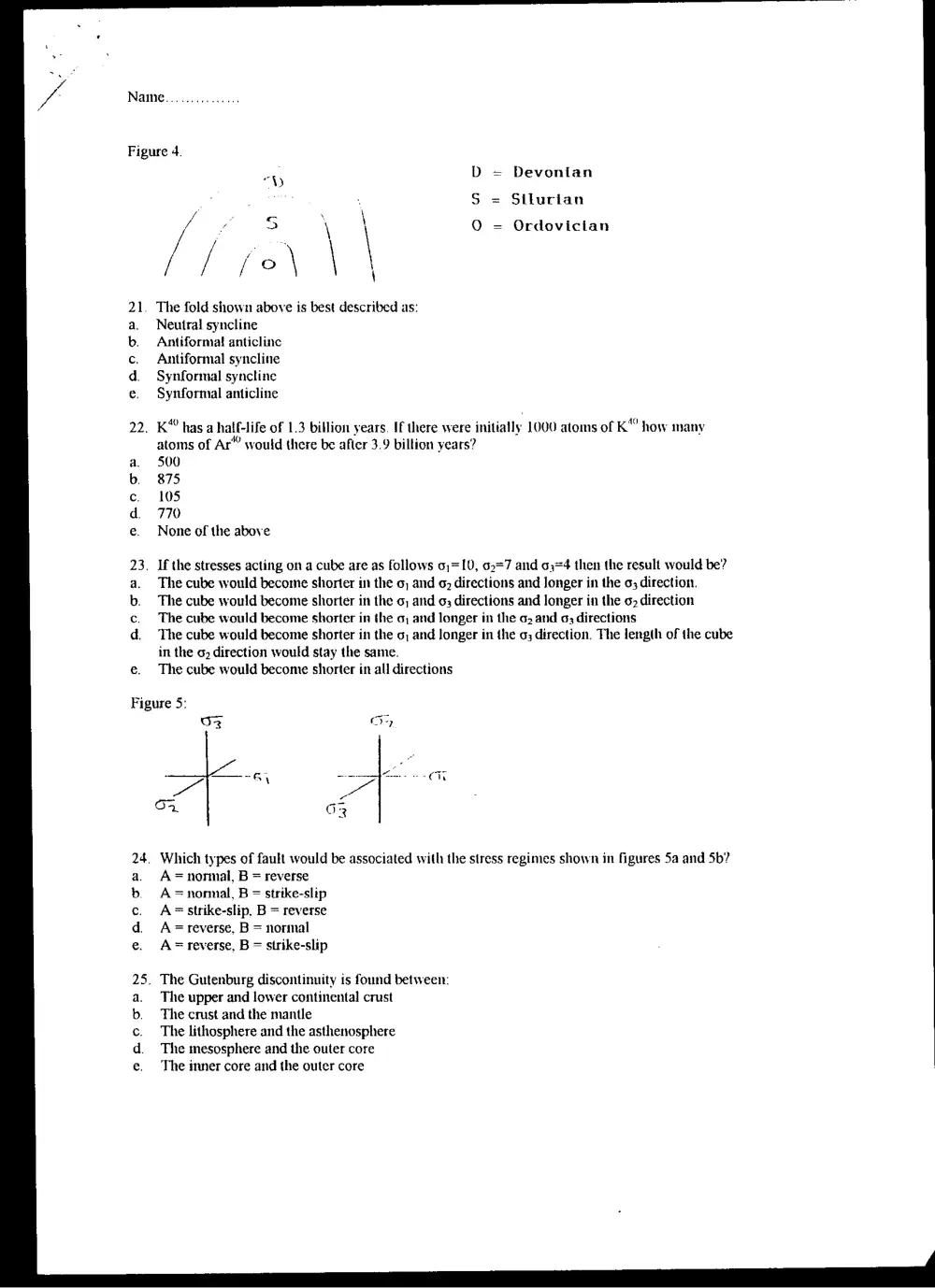
Figure 4.
. D = Devonian
“’)
S = Silurian
/ vy S ‘ \ O = Ordovician
/ / jo\ \ \
1. The fold shown above is best described as:
Neutral syncline
Antiformal! anticline
Antiformal syncline
Synformal syncline
Synformal anticline
eS ROTPN
N
2. K* has a half-life of 1.3 billion years. If there were initially 1000 atoms of K“’ how many
atoms of Ar’ would there be afier 3.9 billion years?
500
875
105
770
None of the above
eno FB
N
3. If the stresses acting on a cube are as follows o)=10, o2=7 and o3=4 then the result would be?
The cube would become shorter in the o, and 0, directions and longer in the 6; direction.
The cube would become shorter in the o, and 0; directions and longer in the 02 direction
The cube would become shorter in the a; and longer in the a and a; directions
The cube would become shorter in the o; and longer in the a; direction, The length of the cube
in the «2 direction would stay the same.
e. The cube would become shorter itt all directions
aoop
Figure 5:
tory On
-6y nn anne co re
ea a
On GR
24. Which types of fault would be associated with the stress regimes shown in figures 5a and 5b?
A =normai, B = reverse
A=normal, B = strike-slip
A= strike-slip, B = reverse
A = reverse, B = normal
A= reverse, B = strike-slip
2 ao FP
5, The Gutenburg discontinuity is found between:
The upper and lower continental crust
The crust and the mantle
The lithosphere and the asthenosphere
The mesosphere and the outer core
The inner core and the outer core
PROT Ey
Name.......00....
26.
egos
Nn
ean0og8
Ne
es aogE
NX
eno Tp
saerDp
7.
8.
9,
The geographic point on the Earth’s surface directly above the point at which slip initiates is
known as the:
Focus
Rebound point
Slip point
Epicentre
Seismocentre
The natural floatational balance of lithosphcric plates on the asthenosphere is known as:
Stoping
Isostacy
Buoyancy
Sag
Viscosity
Which of the following statements is true with respect to divergent plate margins?
They are associated with shallow earthquakes
The prominent type of metamorphism is high pressure, low temperature
The characteristic igneous rocks are basaltic
All of the above are correct
Only a and c are correct
What was the name of the supercontinent that existed in the late Proterozoic
Laurasia
Gondwanaland
Pangaea
Rodinia
Panthalassa
At which of the following plate boundaries would you expect to see an accretionary prism?
Ocean-ocean divergent
Ocean-ocean convergent
Continental-continental transform
Ocean-ocean transform
Continent-continent divergent
Answer the questions for section A itt the table below. Remember that two marks will be given
for each correct answer and half a mark will be deducted for cach incorrect answer,
t
a
a
a
a
a
a
a
a
a
a
a
a
O] ON Ofc] &] oo] po]
=
o
leo SH SS HS
12
13
14
15
QFOIQALOLOPFAIMO AIH [APH [OHO JaAlAJaOlAl[OlAJAJALAL[AIAsAFaAiajajaja
log toutes bogies logted fogied tog logiogiog logics tegen ies toutes fog ted lod ion ion toslod log tod ion
RBlalaialjaiaianlaqialaianianiglajaliajaiajaiasajajajajaiqialjalaja
DIDIDIDIDID I D/D{D/DEDID/Dl/DIDED/ DIDI Dl D/O] DID O9IDig|oaja/a
Name...............
Section B (20 marks) Name:
Using labelled diagrams and examples explain what is meant by (he following: (Remember no
diagram = no grade)
1. Metamorphic aureole
2. Rhythmic bedding
3. Deep-sea oozes
4. Unconformity
5. Radiometric dating
Name...............
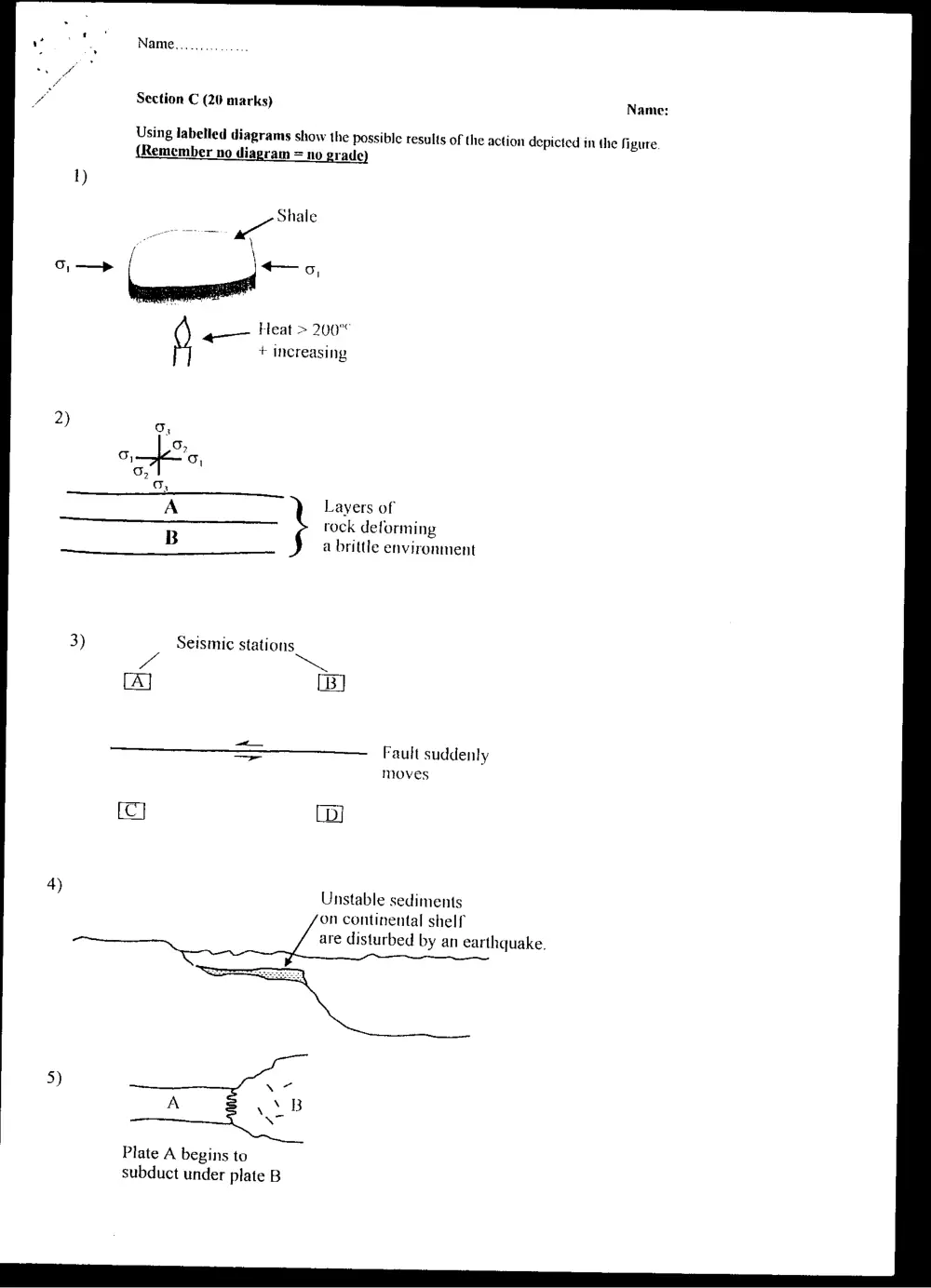
Section C (20 marks) Name:
Using labelled diagrams show the possible results of the action depicted in the figure.
(Remember no diagram = no grade)
Shale
\
Heat > 200°¢
+ increasing
Layers of
rock deforming
a brittle environment
Seismic stations
“4
Fault suddenly
moves
[D]
Unstable sediments
on continental shelf
Ls" disturbed by an earthquake.
SE
Plate A begins to
subduct under plate B