
GEOL 201 Final, Fall 1997
American University of Beirut · Physical Geology · 9 pages

More GEOL 201 files
Show the text of this final exam
Geology 201 Final Exam, Fall 1997/1998
Exam rules apply.
Time allowed: Two hours
Section A: (40 marks)
Answer the questions on the sheet provided. Note that two marks will be given for each correct
answer and half a mark will be deducted for each incorrect answer,
1. A radioactive isotope with an atomic number of 90 and an atomic mass of 232 undergoes
decay by «-emision. The resultant isotope has:
An atomic number of 92 and an atomic mass of 232.
An atomic number of 91 and an atomic mass of 231.
An atomic number of 89 and an atomic mass of 232
An atomic number of 88 and an atomic mass of 228.
An atomic number of 86 and an atomic mass of 226.
Three atoms A. B and C have atomic numbers of 28, 9 and 3 respectively. They are likely to
interact in which of the following ways?
Atom A will share one electron with atom B and share one electron with atom C.
Atom A will share one electron with atom B, Atom C will not bond,
Atom A will transfer two electrons to atom B and share one electron with atom C.
Atom B will share one electron with atom C. Atom A will not bond.
Atom C will transfer one electron to atom B. Atom A will not bond.
A silicate mineral has the following basic formula SiO3, How inany oxygens does each
tetrahedra share?
One
Two
Three
Four
None
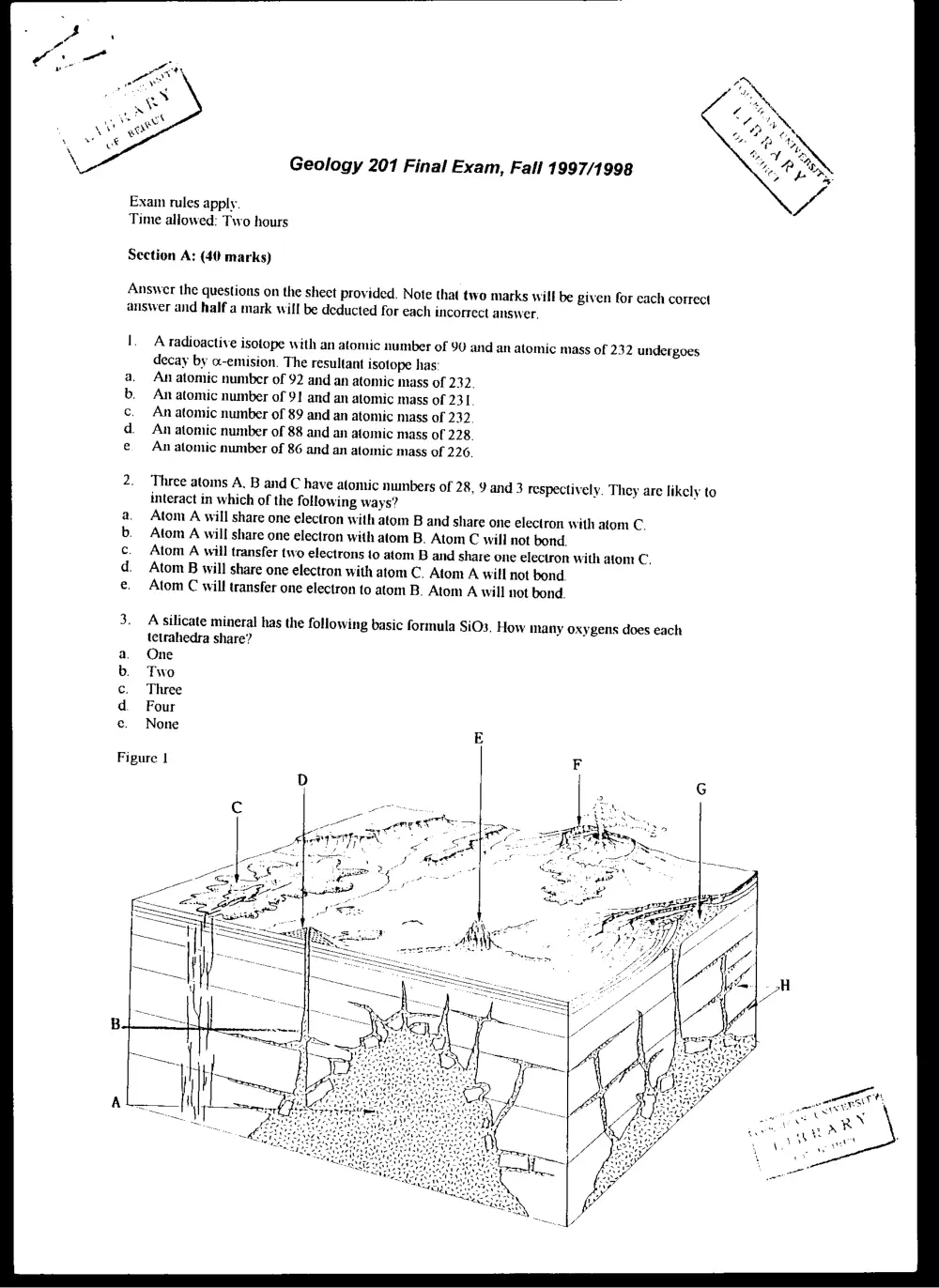
Figure |
4. Figure 1 is a diagrammatic section of part of the crust showing the various types of igneous
rock bodies and the landforms developed on igneous rock. Assign each of the features A—H
with the appropriate term selected from the list below:
1) Diatreme
2) Fissure eruption
3) Dyke
4) Sill
5) Batholith
6) Strato volcano
7) Caldera
8) Laccolith
pS
a=
“I
AAANAA
oa wea
enw
Ne
WN em Na
ey TY Ty ey ot
se
ww oD
aoaaa
iouwonouou
>>>>>
Wouok wor
Mw — UA OO
vouugy
tot ot won
odaoenow
NM
tot id aot
PN
mmo
uouo ow rou
Wwwhan
ww
ht mm
NN
eu
Li)
5
N
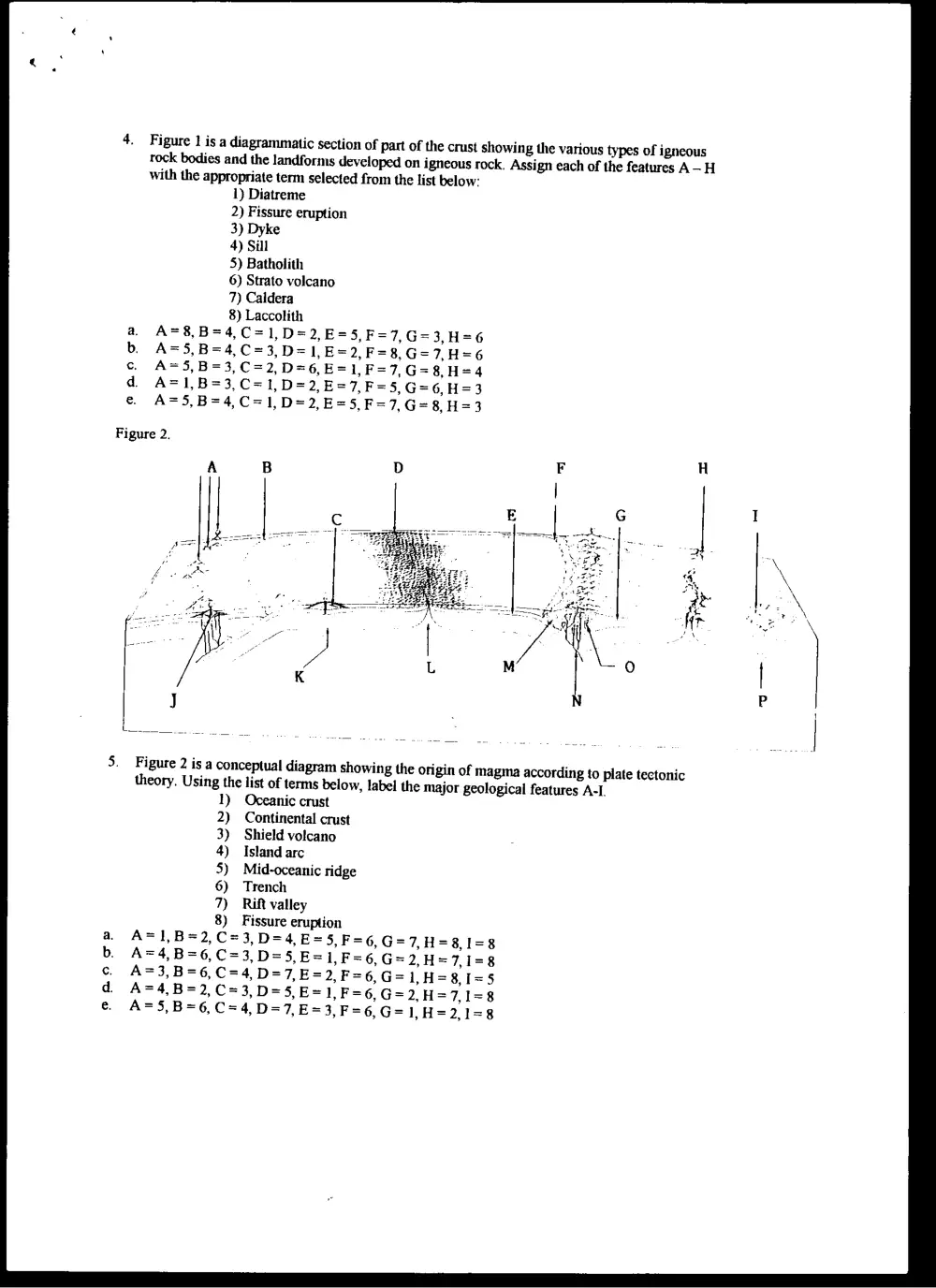
Figure 2 is a conceptual diagram showing the origin of magma according to plate tectonic
theory. Using the list of terms below, label the major geological features A-I.
1)
2)
3)
4)
5)
6)
7)
Oe oe Saad
CDouwow
DAAN
AaAaNnae
Ue ee
to wow ot
> >>> yD
1
AN
Oceanic crust
Continental crust
Shield volcano
Island arc
Mid-oceanic ridge
Trench
Rift valley
Fissure eruption
ing
Ld et Nee
ico es Me> Me? eo)
ow wa
NA
tt tm tt tm
Hon d
Pw eww
ouUucY
NS
tout ow
I
sla
“
aaana
ot uorou
Ng
Wot
SN
Tmrot
touounwu
DAXAN
-Nhe
ee ee
0 2 A oo 00
NN 90
ueoaoa
With reference to figure 2 and the list below, label the areas J-P where the following processes
occur. Note that any given process may occur in more than one environment.
1) Generation of basaltic magma
2) Generation of rhyolitic magma
3) Andesitic volcanism
4) Granitic intrusions
5) Compression and folding
Vesicles - ~ K-feldspar ~
Biotite
Grass” Quartz
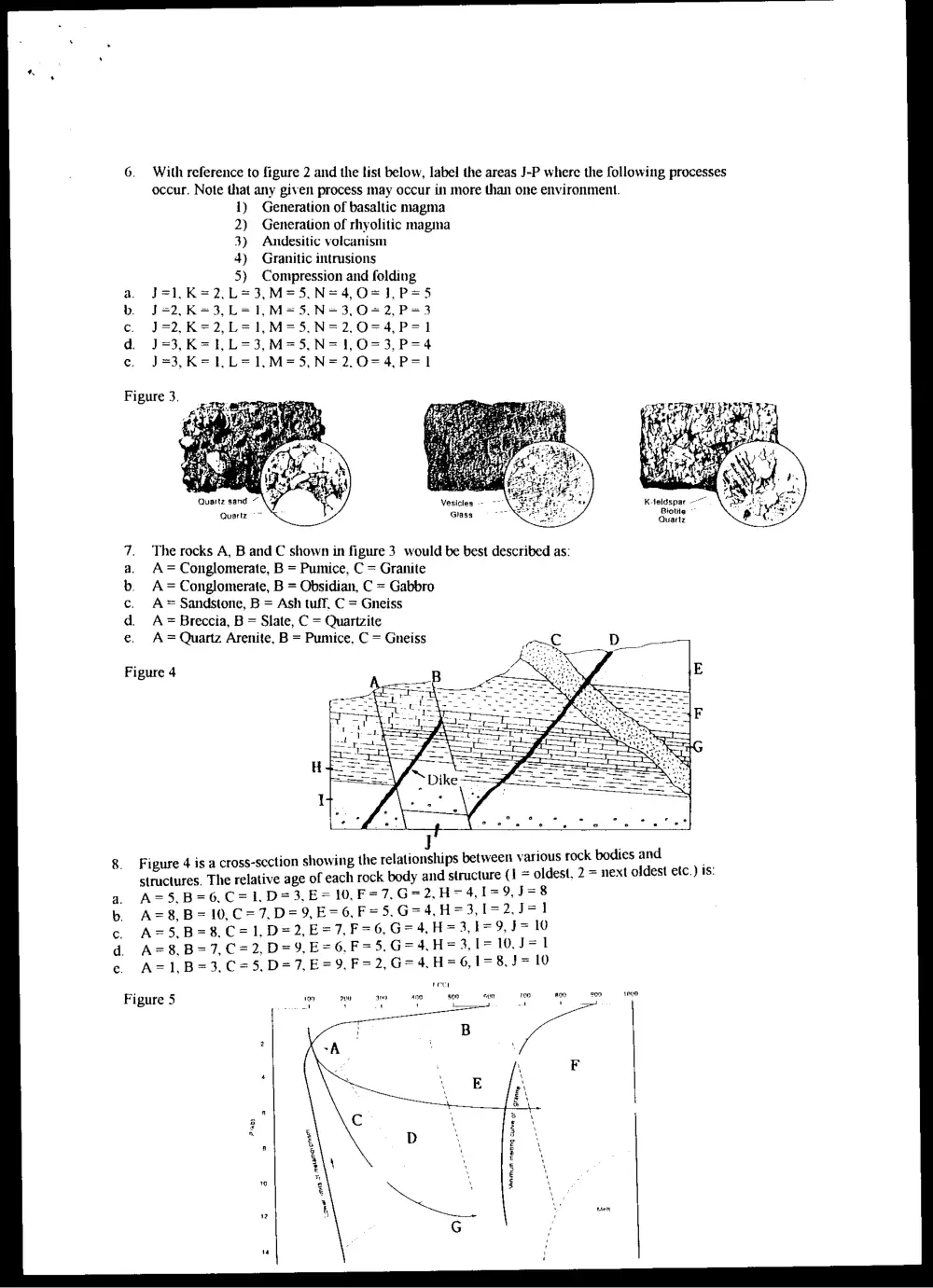
The rocks A, B and C shown in figure 3. would be best described as:
A= Conglomerate, B = Pumice, C = Granite
A= Conglomerate, B = Obsidian, C = Gabbro
A= Sandstone, B = Ash tuff, C = Gneiss
A= Breccia, B = Slate, C = Quartzite
A = Quartz Arenite, B = Pumice, C = Gneiss
Figure 4
various rock bodies and
= oldest, 2 = next oldest etc.) is:
Figure 4 is a cross-section showing the relationships between v
structures, The relative age of each rock body and structure (i
A=5,B=6,C=1,.D=3,E= 10, F=7,G=2,H=4,1=9,5=8
=6,F=5,G=4,H =2,J=1
\anenuen maring curve ot
9. Figure 5 is a diagram showing how metamorphic facies A — G are related to temperature and
pressure. Using the list below, identify the correct position for each metamorphic facies
1) Eclogite
2) Amphibolite
3) Blueschist
4) Greenschist
5) Zeolite
6) Hornfels
Triassic
yan \\ 223% Jurassic
ls of ye \\ \
° ALA “\\ \ FES cretaceous
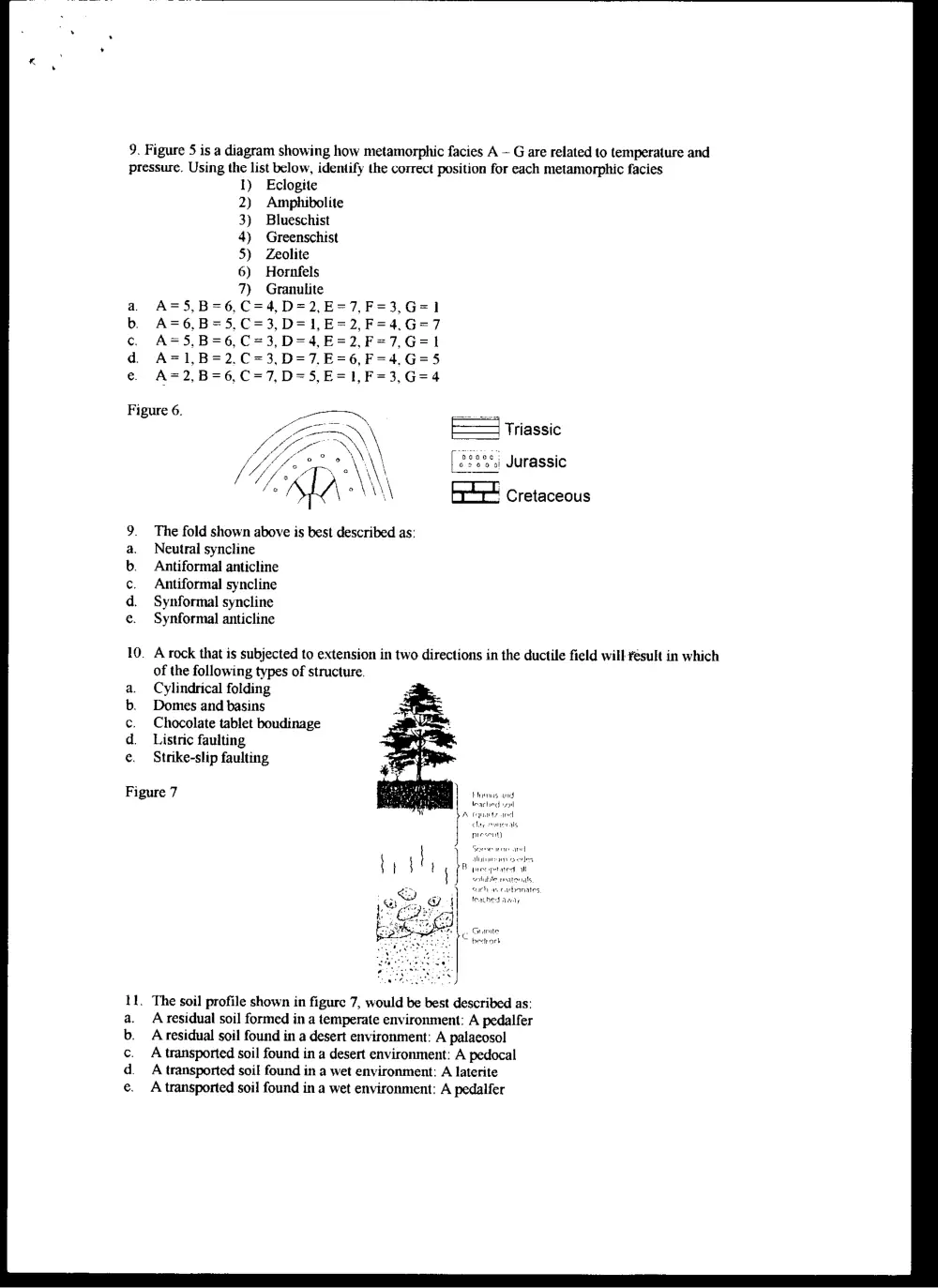
The fold shown above is best described as:
Neutral syncline
Antiformal anticline
Antiformal syncline
Synformal syncline
Synformal anticline
PaoTPps
10. A rock that is subjected to extension in two directions in the ductile field will fésult in which
of the following types of structure.
a. Cylindrical folding
b. Domes and basins
c. Chocolate tablet boudinage
d. Listric fauiting
e. Strike-slip faulting
Figure 7 Phas and
leached set
bectork
11. The soil profile shown in figure 7, would be best described as:
a. A residual soil formed in a temperate environment: A pedalfer
b. Aresidual soil found in a desert environment: A palaeosol
c. A transported soil found in a desert environment: A pedocal
dA transported soil found in a wet environment: A laterite
e. A transported soil found in a wet environment: A pedalfer
. The chemical reaction CaSO, > CaSO, .2H2O is:
A comunon oxidation reaction within the sulphides
A common dissolution reaction within the carbonates
A common reduction reaction in the sulphates
A common hydration reaction within the sulphates
A common hydration reaction within the sulphides
. A sedimentary rock is composed of 30% oolites, 50% fossils and 20% matrix (very fine
calcite that cannot be seen by the naked eye). The rock is best described as:
Dolomite
Bioclastic limestone
Biooomicrite
Oobiosparite
A fossiliferous marble
. The high temperature, high pressure polymorph of Kyanite is
Chlorite
Garnet
Staurolite
Sillimanite
Trydimite
Figure 8
15. Four fossils A, B, C and D are shown in figure 8. Fossil A was found in rocks belonging to the
Ordovician period. Fossil B was found in rocks belonging to the Tertiary period. Fossil C was
found in rocks belonging to the Carbonifcrous period and fossil D was found in rocks
belonging to the Silurian period. If we were to list the fossils in order from the oldest to the
youngest then the answer would be:
(C enn
Ernarocaden «S$
: ~
ees =
1
SHALLOW Manne
F Ereancxnacris
SESE Footprint
nee
ER Marine Fossils
oN SSO Ripples
oo
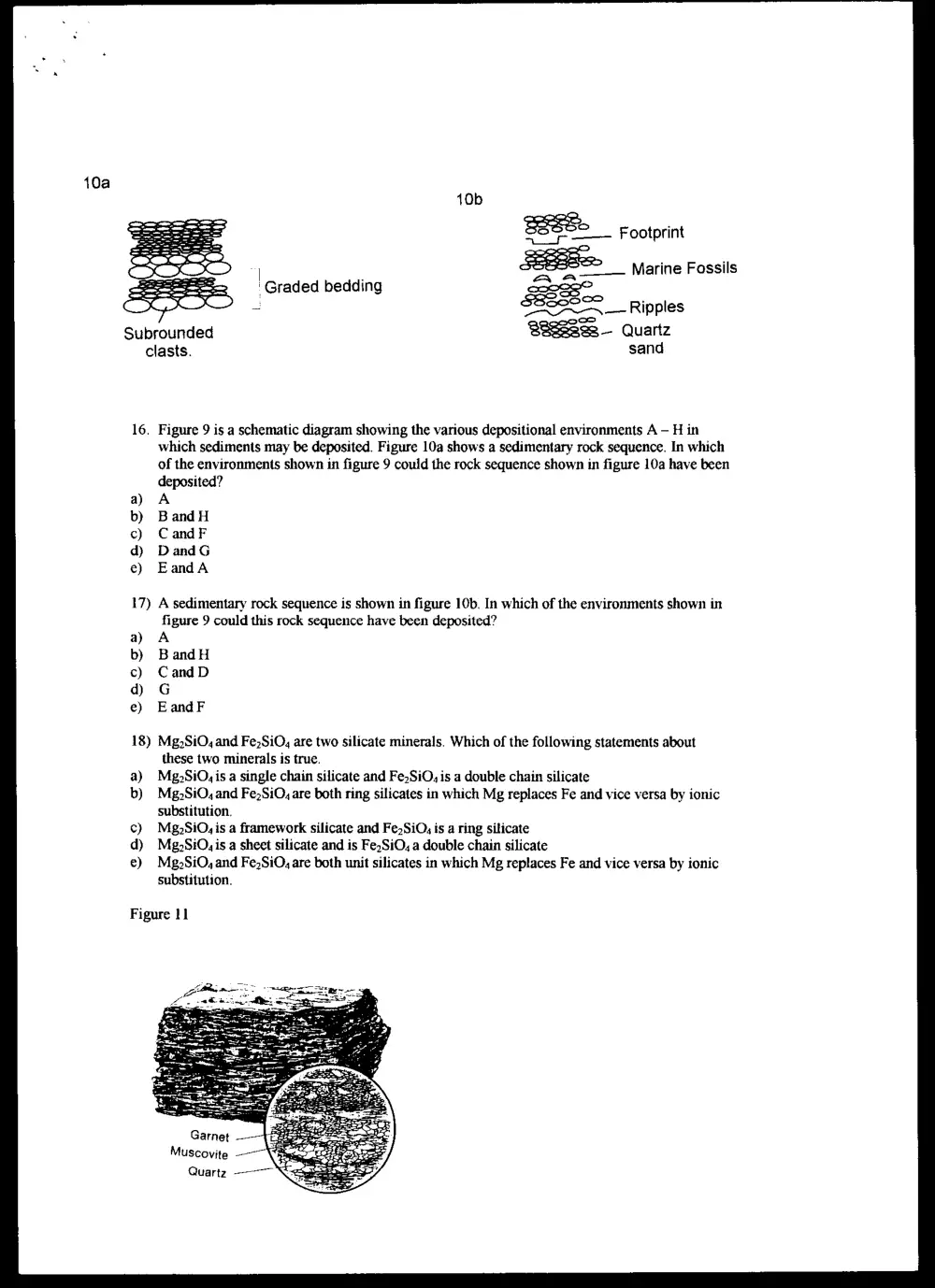
Subrounded Qeesse2— Quartz
clasts. sand
| Graded bedding
. Figure 9 is a schematic diagram showing the various depositional environments A — H in
which sediments may be deposited. Figure 10a shows a sedimentary rock sequence. In which
of the environments shown in figure 9 could the rock sequence shown in figure 10a have been
deposited?
A
B andH
C and F
D andG
EandA
A sedimentary rock sequence is shown in figure 10b. In which of the environments shown in
figure 9 could this rock sequence have been deposited?
A
B andH
Cand D
G
EandF
18) Mg,SiO, and Fe,SiO, are two silicate minerals. Which of the following statements about
these two minerals is true.
a) Mg,SiO,is a single chain silicate and Fe,SiO, is a double chain silicate
b) Mg,SiO,and Fe,SiO, are both ring silicates in which Mg replaces Fe and vice versa by ionic
substitution.
c) Mg,SiO, is a framework silicate and Fe2SiO, is a ring silicate
d) Mg,SiO,is a sheet silicate and is Fe,SiO,a double chain silicate
e) Mg,SiO, and Fe,SiO, are both unit silicates in which Mg replaces Fe and vice versa by ionic
substitution.
Figure 11
19. Figure 11 is a sketch of a metamorphic rock. The rock would best be described as:
a) Marble
b) Slate
c) Green schist
da) Schist
e) Gneiss
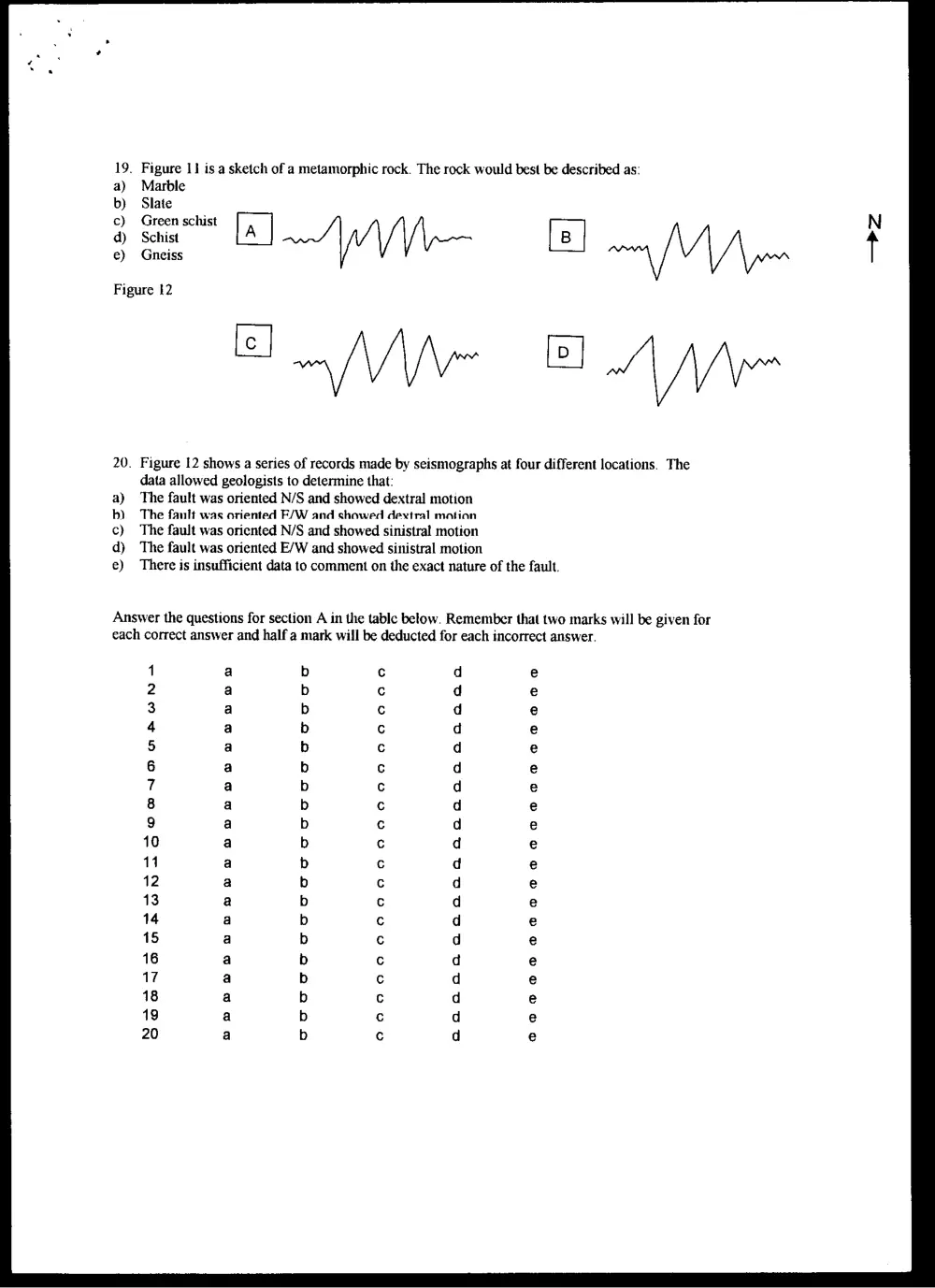
Figure 12
20. Figure 12 shows a series of records made by seismographs at four different locations. The
data allowed geologists to determine that:
a) The fault was oriented N/S and showed dextral motion
b) The fault was oriented F/W and showed dextral motion
c) The fault was oriented N/S and showed sinistral motion
d) The fault was oriented E/W and showed sinistral motion
e) There is insufficient data to comment on the exact nature of the fault.
Answer the questions for section A in the table below. Remember thal two marks will be given for
each correct answer and half a mark will be deducted for each incorrect answer.
ODNDOaAhWN =
aeroan nani ui
OOMOnNA Of WD =
a
a
a
a
a
a
a
a
a
10 a
a
a
a
a
a
a
a
a
a
a
cooucvevov 70 77 CO cv oOoOoOoO ee ood
eaoao0o0q0 ono 0 NN A HA M9 HMA HA A aA AaA4 oO
aaagnaanananinkaaaananaana
oo7T7 ODD DDPDAOPMDAMMDAAAMDAXOA
N
o
Section B (40 marks) Name:
Using labelled diagrams and examples explain what is meant by the following: (Remember no
diagram = no grade)
1. Acomplex ion
A pegmatitic granite
A greywacke
Viscosity of lava
Metamorphic zones
Magnetic polarity
Glacial moraine
Seismic waves
10. Isostacy
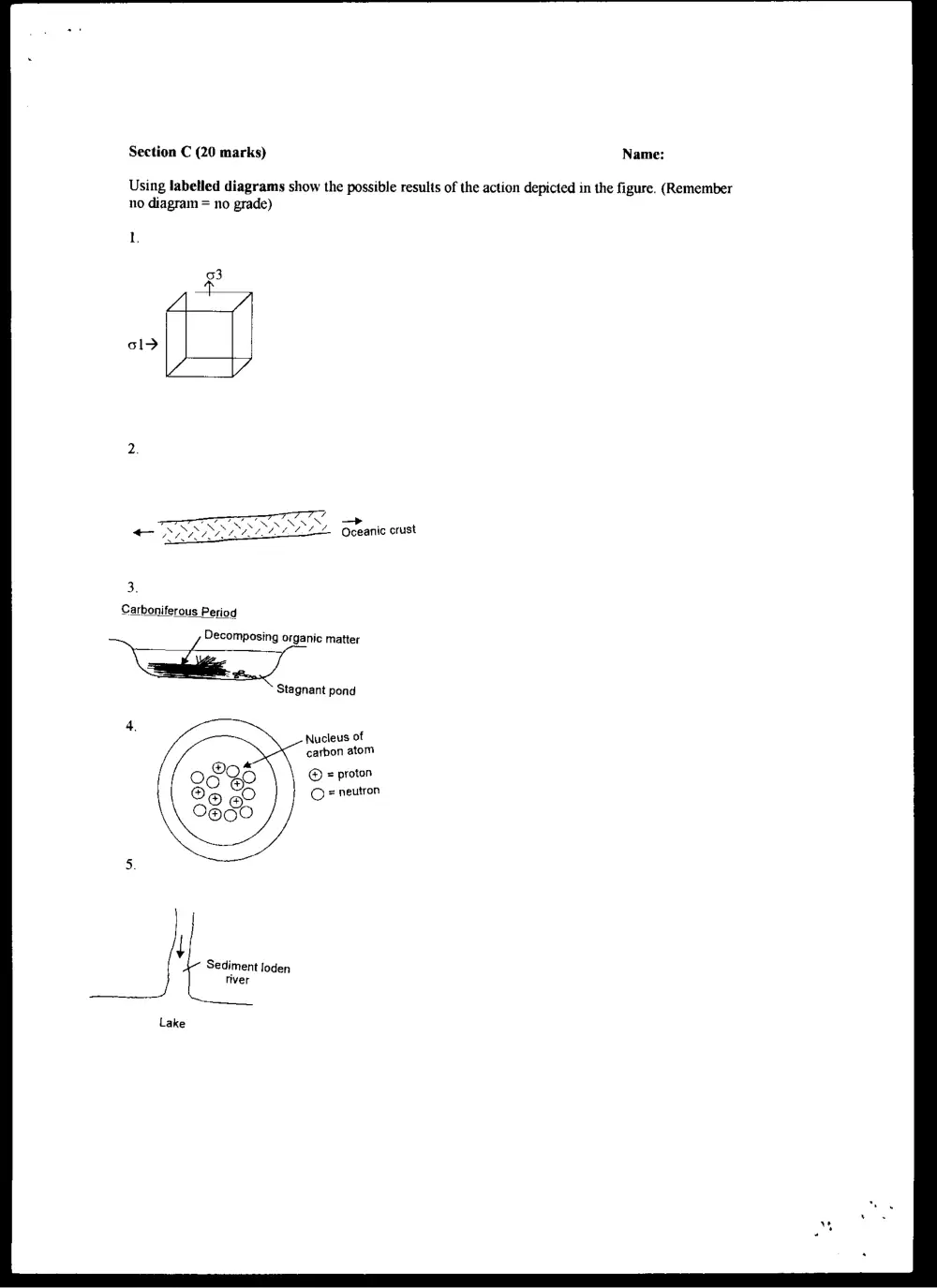
Section C (20 marks) Name:
Using labelled diagrams show the possible results of the action depicted in the figure. (Remember
no diagram = no grade)
1.
boniferous Period
Decomposing organic matter
Stagnant pond
Nucleus of
carbon atom
@ = proton
oO = neutron
Sediment loden
river
Lake