
GEOL 201 Final, Spring 1997
American University of Beirut · Physical Geology · 5 pages
More GEOL 201 files
Show the text of this final exam
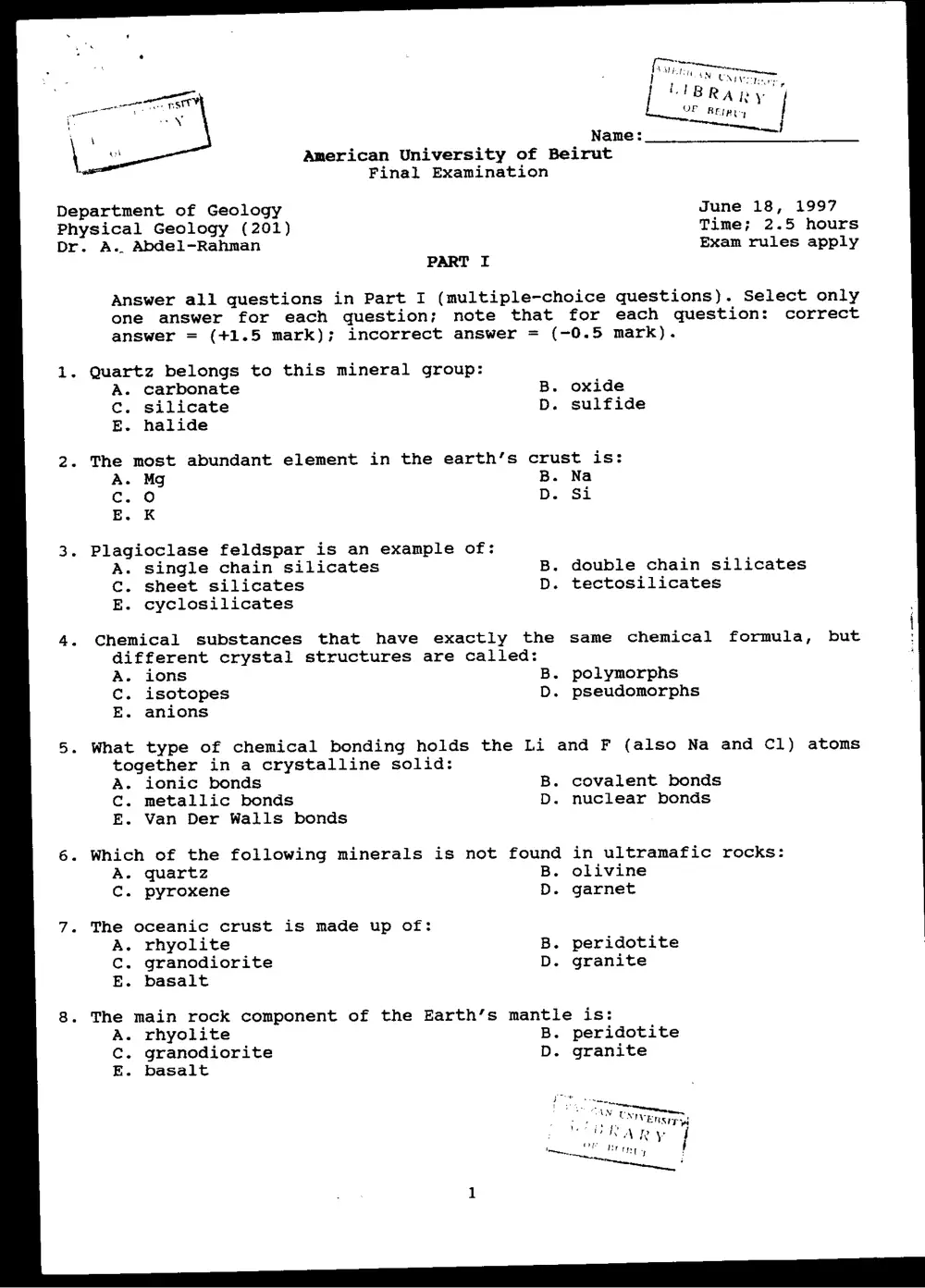
American University of Beirut
Final Examination
Department of Geology June 18, 1997
Physical Geology (201) Time; 2.5 hours
Dr. A.. Abdel-Rahman Exam rules apply
PART I
Answer all questions in Part I (multiple-choice questions). Select only
one answer for each question; note that for each question: correct
answer = (41.5 mark); incorrect answer = (-0.5 mark).
1. Quartz belongs to this mineral group:
A. carbonate B. oxide
c. silicate D. sulfide
E. halide
2. The most abundant element in the earth’s crust is:
A. Mg B. Na
c. 0 D. Si
E. K
3. Plagioclase feldspar is an example of:
A. single chain silicates . double chain silicates
c. sheet silicates . tectosilicates
E. cyclosilicates
4. Chemical substances that have exactly the same chemical formula, but
different crystal structures are called:
A. ions B. polymorphs
Cc. isotopes D. pseudomorphs
E. anions
5. What type of chemical bonding holds the Li and F (also Na and Cl) atoms
together in a crystalline solid:
A. ionic bonds B. covalent bonds
Cc. metallic bonds D. nuclear bonds
E. Van Der Walls bonds
6. Which of the following minerals is not found in ultramafic rocks:
A. quartz B. olivine
Cc. pyroxene D. garnet
7. The oceanic crust is made up of:
A. rhyolite B. peridotite
Cc. granodiorite D. granite
E. basalt
8. The main rock component of the Earth’s mantle is:
A. rhyolite B. peridotite
Cc. granodiorite D. granite
E. basalt
WN De
SIVERS ITY
ERAR y j
me Bree y
en
a
10.
11.
12.
13.
14.
15.
16.
17.
18.
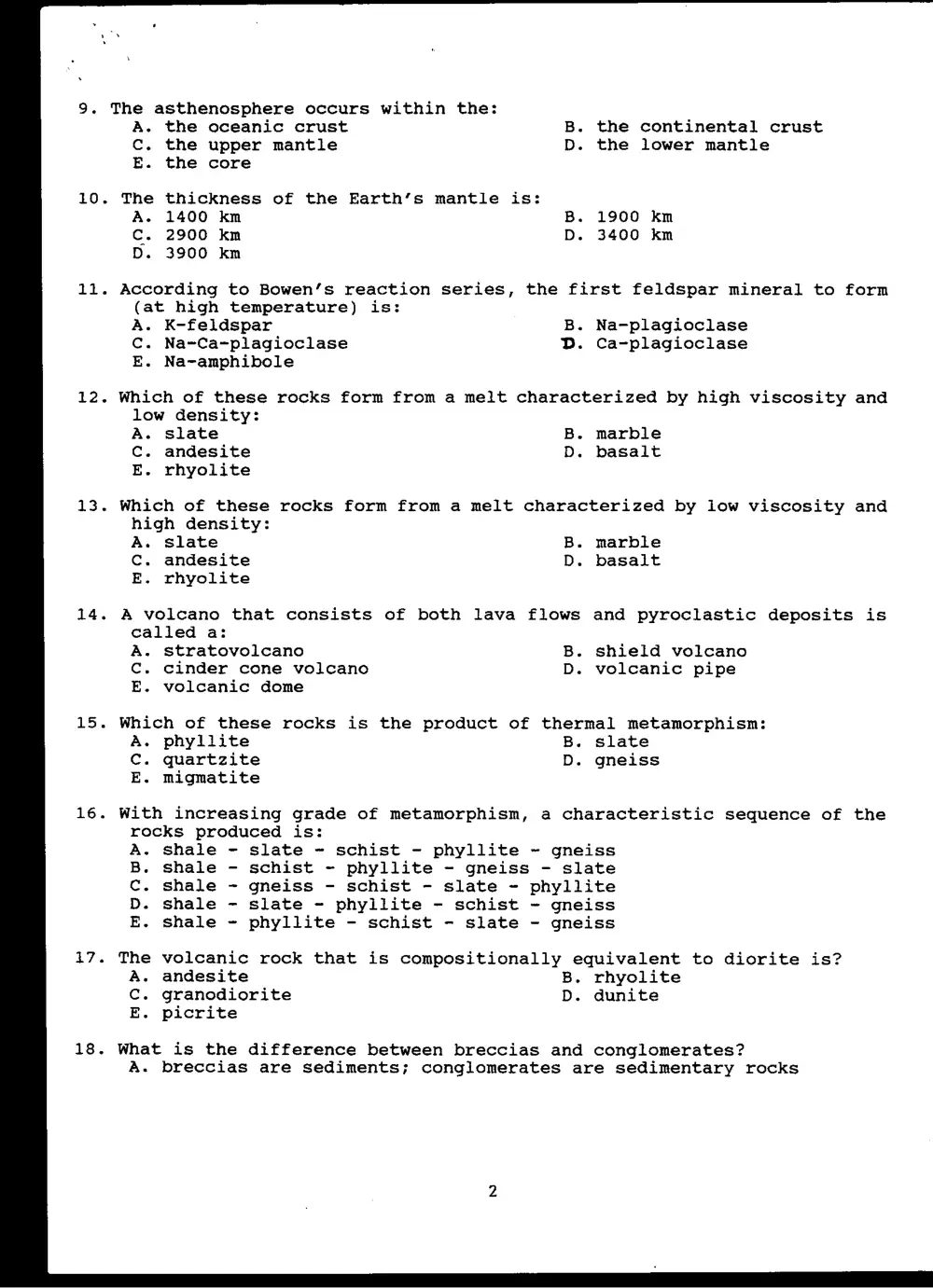
9. The asthenosphere occurs within the:
A. the oceanic crust B. the continental crust
Cc. the upper mantle D. the lower mantle
E. the core
The thickness of the Earth’s mantle is:
A. 1400 km B. 1900 km
Cc. 2900 km D. 3400 km
D. 3900 km
According to Bowen’s reaction series, the first feldspar mineral to form
(at high temperature) is:
A. K-feldspar B. Na-plagioclase
C. Na-Ca-plagioclase D. Ca-plagioclase
E. Na-amphibole
Which of these rocks form from a melt characterized by high viscosity and
low density:
A. slate B. marble
Cc. andesite D. basalt
E. rhyolite
Which of these rocks form from a melt characterized by low viscosity and
high density:
A. slate B. marble
Cc. andesite D. basalt
E. rhyolite
A volcano that consists of both lava flows and pyroclastic deposits is
called a:
A. stratovolcano B. shield volcano
Cc. cinder cone volcano D. volcanic pipe
E. volcanic dome
Which of these rocks is the product of thermal metamorphism:
A. phyllite B. slate
Cc. quartzite D. gneiss
E. migmatite
With increasing grade of metamorphism, a characteristic sequence of the
rocks produced is:
A. shale - slate ~ schist - phyllite ~ gneiss
B. shale - schist ~ phyllite - gneiss - slate
Cc. shale ~ gneiss - schist - slate - phyllite
D. shale - slate - phyllite - schist - gneiss
E. shale - phyllite - schist - slate - gneiss
The volcanic rock that is compositionally equivalent to diorite is?
A. andesite B. rhyolite
Cc. granodiorite D. dunite
E. picrite
What is the difference between breccias and conglomerates?
A. breccias are sediments; conglomerates are sedimentary rocks
19.
21.
23.
24.
25.
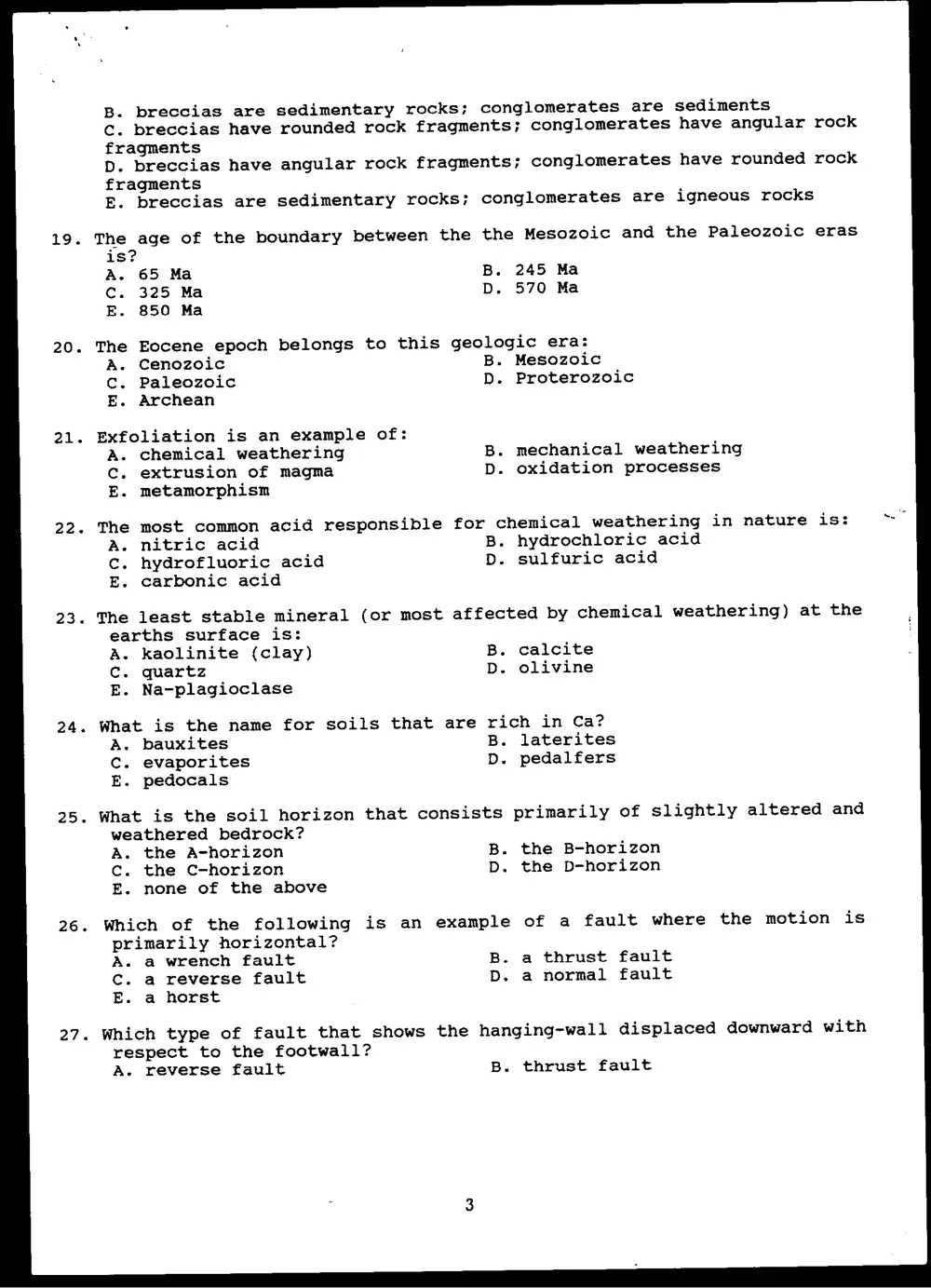
B. breccias are sedimentary rocks; conglomerates are sediments
Cc. breccias have rounded rock fragments; conglomerates have angular rock
fragments
D. breccias have angular rock fragments; conglomerates have rounded rock
fragments
E. breccias are sedimentary rocks; conglomerates are igneous rocks
The age of the boundary between the the Mesozoic and the Paleozoic eras
is?
A. 65 Ma B. 245 Ma
325 Ma D. 570 Ma
850 Ma
Eocene epoch belongs to this geologic era:
Cenozoic B. Mesozoic
Paleozoic D. Proterozoic
Archean
Exfoliation is an example of:
chemical weathering B. mechanical weathering
extrusion of magma D. oxidation processes
metamorphism
most common acid responsible for chemical weathering in nature is:
nitric acid B. hydrochloric acid
hydrofluoric acid D. sulfuric acid
carbonic acid
The least stable mineral (or most affected by chemical weathering) at the
earths surface is:
A. kaolinite (clay) B. calcite
c. quartz D. olivine
E. Na-plagioclase
What is the name for soils that are rich in Ca?
A. bauxites B. laterites
Cc. evaporites D. pedalfers
E. pedocals
What is the soil horizon that consists primarily of slightly altered and
weathered bedrock?
A. the A-horizon B. the B-horizon
c. the C-horizon D. the D-horizon
E. none of the above
26. Which of the following is an example of a fault where the motion is
27.
primarily horizontal?
A. a wrench fault B. a thrust fault
c. a reverse fault D. a normal fault
E. a horst
Which type of fault that shows the hanging-wall displaced downward with
respect to the footwall?
A. reverse fault B. thrust fault
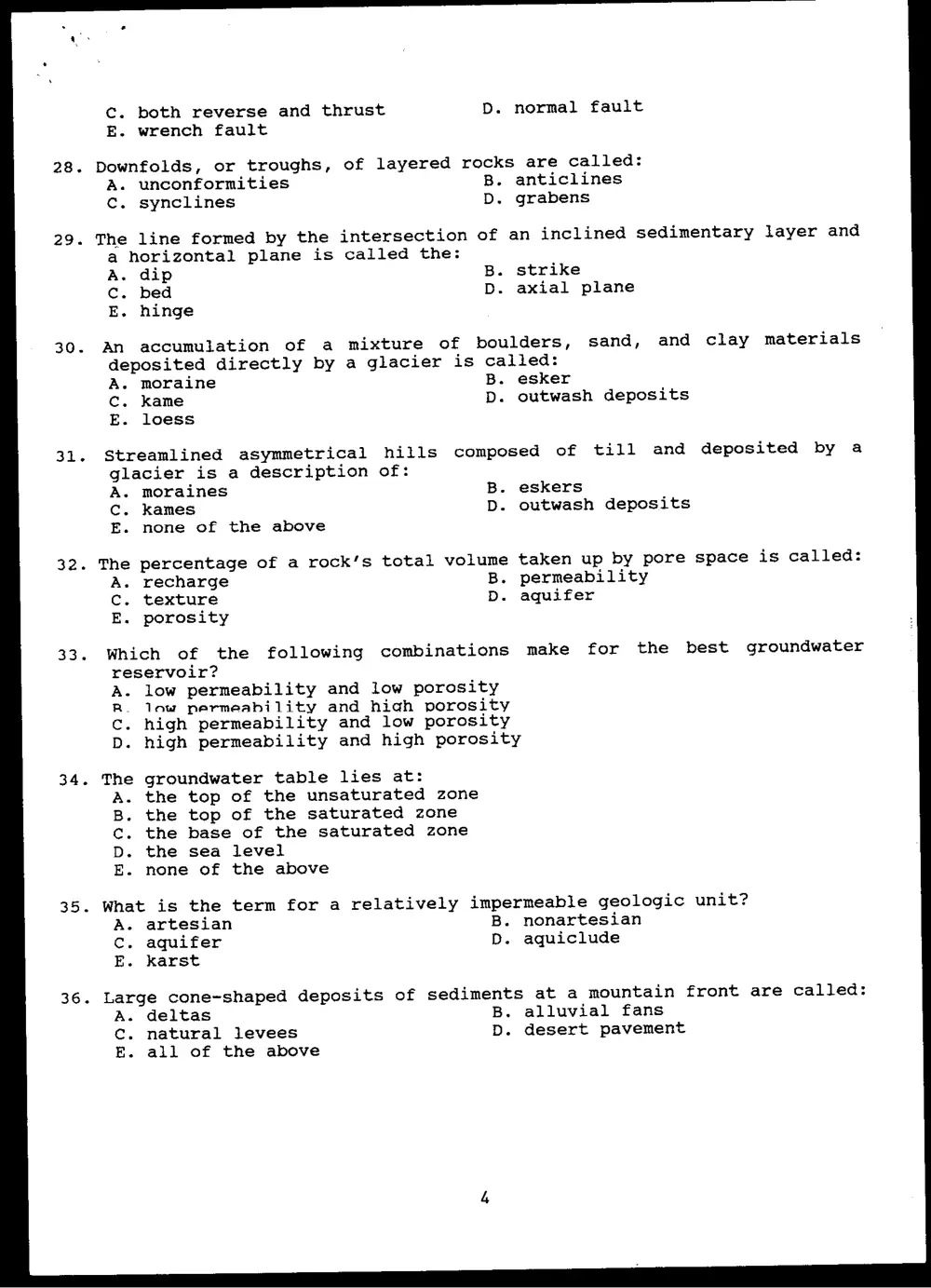
Cc. both reverse and thrust D. normal fault
E. wrench fault
28. Downfolds, or troughs, of layered rocks are called:
A. unconformities B. anticlines
c. synclines D. grabens
29. The line formed by the intersection of an inclined sedimentary layer and
a horizontal plane is called the:
A. dip B. strike
Cc. bed D. axial plane
E. hinge
30. An accumulation of a mixture of boulders, sand, and clay materials
deposited directly by a glacier is called:
A. moraine B. esker
c. kame D. outwash deposits
E. loess
31. Streamlined asymmetrical hills composed of till and deposited by a
glacier is a description of:
A. moraines B. eskers
c. kames D. outwash deposits
E. none of the above
32. The percentage of a rock’s total volume taken up by pore space is called:
A. recharge B. permeability
c. texture D. aquifer
E. porosity
33. Which of the following combinations make for the best groundwater
reservoir?
A. low permeability and low porosity
R. law permeability and hiah porosity
Cc. high permeability and low porosity
D. high permeability and high porosity
34. The groundwater table lies at:
A. the top of the unsaturated zone
B. the top of the saturated zone
Cc. the base of the saturated zone
D. the sea level
E. none of the above
35. What is the term for a relatively impermeable geologic unit?
A. artesian B. nonartesian
c. aquifer D. aquiclude
E. karst
36. Large cone-shaped deposits of sediments at a mountain front are called:
A. deltas B. alluvial fans
c. natural levees D. desert pavement
E. all of the above
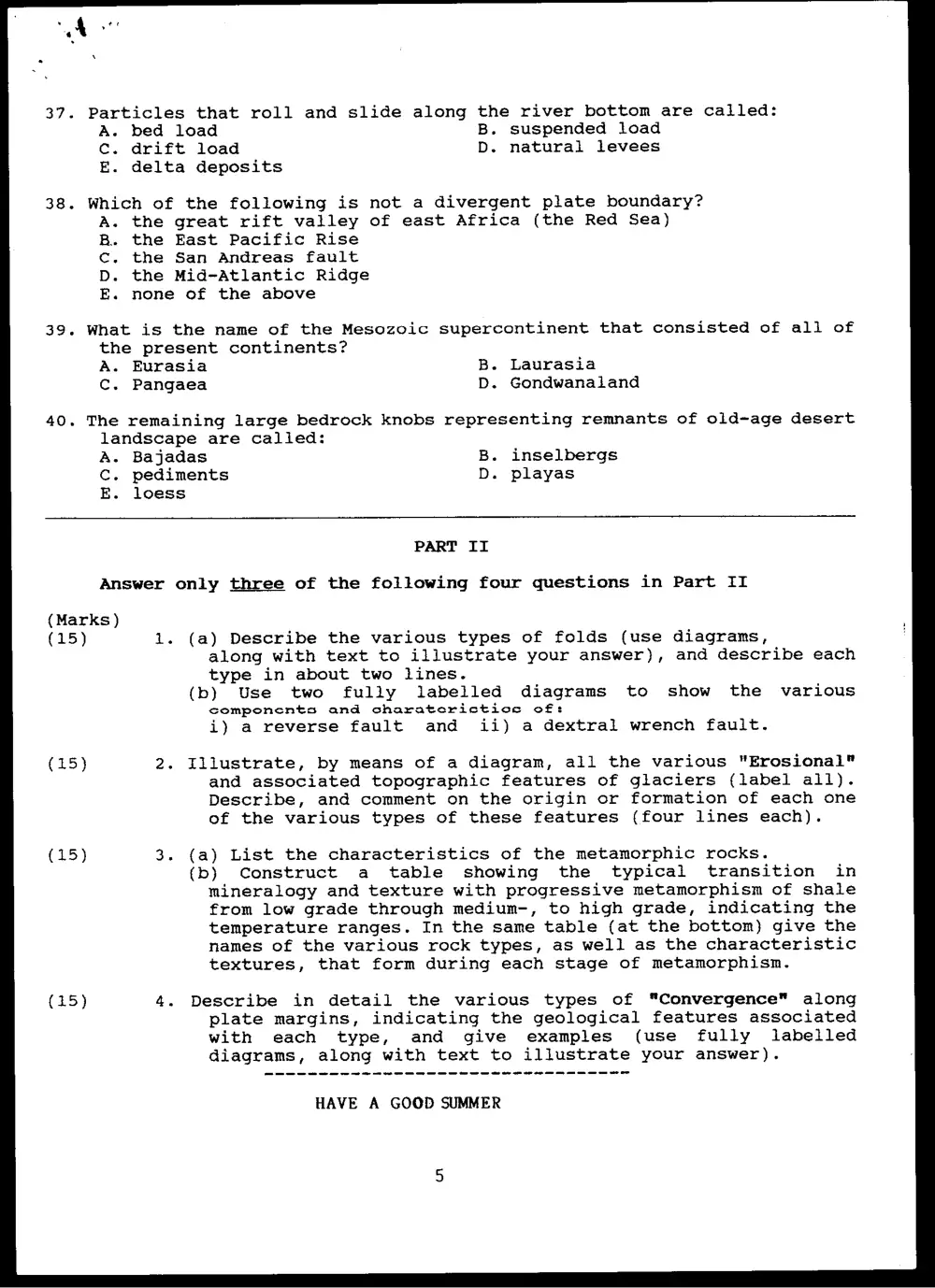
Particles that roll and slide along the river bottom are called:
A. bed load B. suspended load
c. drift load D. natural levees
E. delta deposits
Which of the following is not a divergent plate boundary?
A.
B.
Cc.
D.
E.
the great rift valley of east Africa (the Red Sea)
the East Pacific Rise
the San Andreas fault
the Mid-Atlantic Ridge
none of the above
What is the name of the Mesozoic supercontinent that consisted of
the present continents?
A. Eurasia B. Laurasia
Cc. Pangaea D. Gondwanaland
. The remaining large bedrock knobs representing remnants of old-age desert
landscape are calied:
A. Bajadas B. inselbergs
Cc. pediments D. playas
E.
loess
PART II
Answer only three of the following four questions in Part II
(Marks)
(15)
i.
(a) Describe the various types of folds (use diagrams,
along with text to illustrate your answer), and describe each
type in about two lines.
(b) Use two fully labelled diagrams to show the various
components and charaterictice of:
i) a reverse fault and ii) a dextral wrench fault.
Illustrate, by means of a diagram, all the various "Erosional"
and associated topographic features of glaciers (label all).
Describe, and comment on the origin or formation of each one
of the various types of these features (four lines each).
(a) List the characteristics of the metamorphic rocks.
(b) Construct a table showing the typical transition in
mineralogy and texture with progressive metamorphism of shale
from low grade through medium-, to high grade, indicating the
temperature ranges. In the same table (at the bottom) give the
names of the various rock types, as well as the characteristic
textures, that form during each stage of metamorphism.
Describe in detail the various types of "Convergence" along
plate margins, indicating the geological features associated
with each type, and give examples (use fully labelled
diagrams, along with text to illustrate your answer).
HAVE A GOOD SUMMER