
INDE 301 Midterm, Spring 2017
American University of Beirut · Engineering Economy · 3 pages
More INDE 301 files
Show the text of this exam
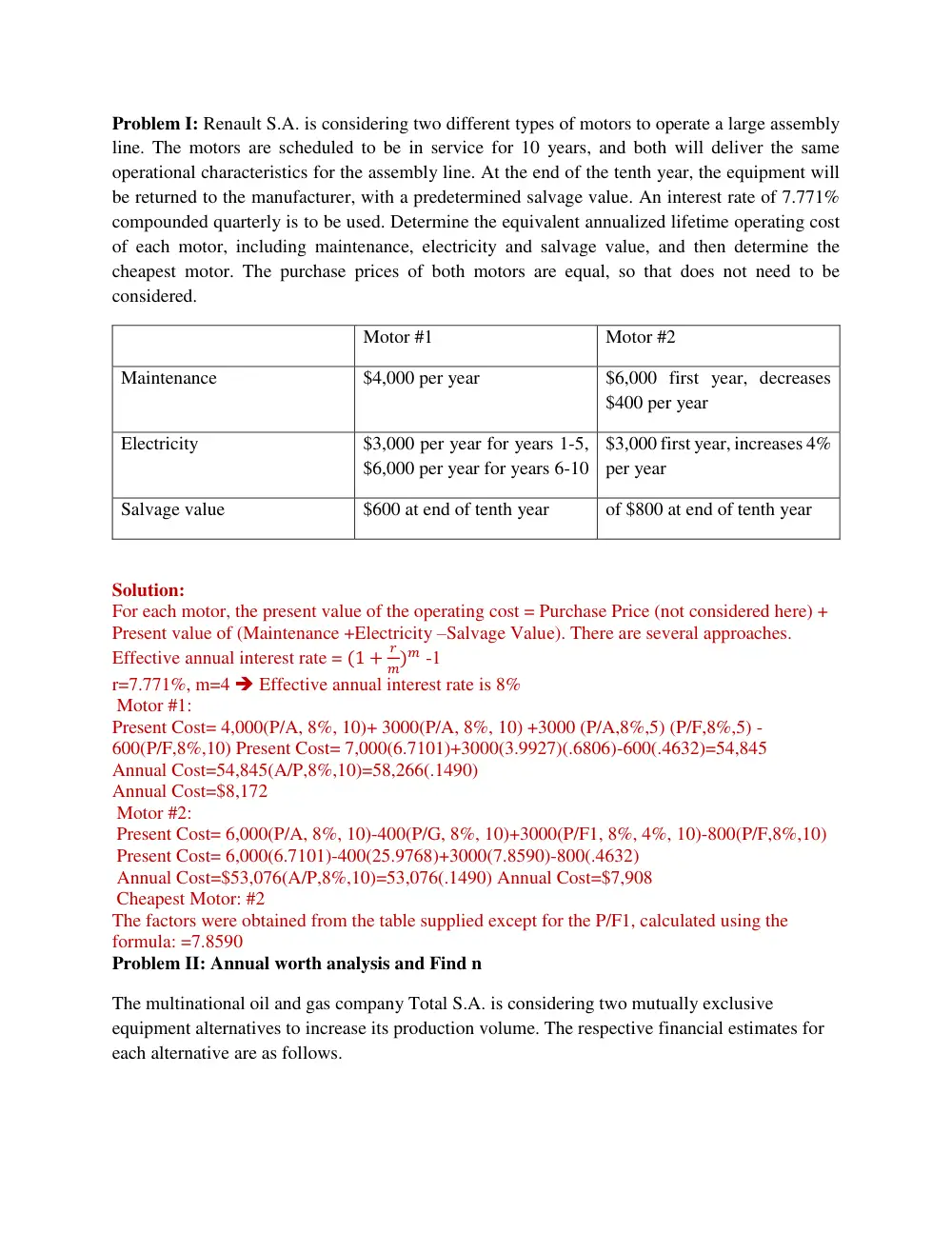
Problem I: Renault S.A. is considering two different types of motors to operate a large assembly
line. The motors are scheduled to be in service for 10 years, and both will deliver the same
operational characteristics for the assembly line. At the end of the tenth year, the equipment will
be returned to the manufacturer, with a predetermined salvage value. An interest rate of 7.771%
compounded quarterly is to be used. Determine the equivalent annualized lifetime operating cost
of each motor, including maintenance, electricity and salvage value, and then determine the
cheapest motor. The purchase prices of both motors are equal, so that does not need to be
considered.
Motor #1
Motor #2
Maintenance
$4,000 per year
$6,000 first year, decreases
$400 per year
Electricity
$3,000 per year for years 1-5,
$6,000 per year for years 6-10
$3,000 first year, increases 4%
per year
Salvage value
$600 at end of tenth year
of $800 at end of tenth year
Solution:
For each motor, the present value of the operating cost = Purchase Price (not considered here) +
Present value of (Maintenance +Electricity –Salvage Value). There are several approaches.
Effective annual interest rate = (1 +
𝑟
𝑚)𝑚 -1
r=7.771%, m=4 Effective annual interest rate is 8%
Motor #1:
Present Cost= 4,000(P/A, 8%, 10)+ 3000(P/A, 8%, 10) +3000 (P/A,8%,5) (P/F,8%,5) -
600(P/F,8%,10) Present Cost= 7,000(6.7101)+3000(3.9927)(.6806)-600(.4632)=54,845
Annual Cost=54,845(A/P,8%,10)=58,266(.1490)
Annual Cost=$8,172
Motor #2:
Present Cost= 6,000(P/A, 8%, 10)-400(P/G, 8%, 10)+3000(P/F1, 8%, 4%, 10)-800(P/F,8%,10)
Present Cost= 6,000(6.7101)-400(25.9768)+3000(7.8590)-800(.4632)
Annual Cost=$53,076(A/P,8%,10)=53,076(.1490) Annual Cost=$7,908
Cheapest Motor: #2
The factors were obtained from the table supplied except for the P/F1, calculated using the
formula: =7.8590
Problem II: Annual worth analysis and Find n
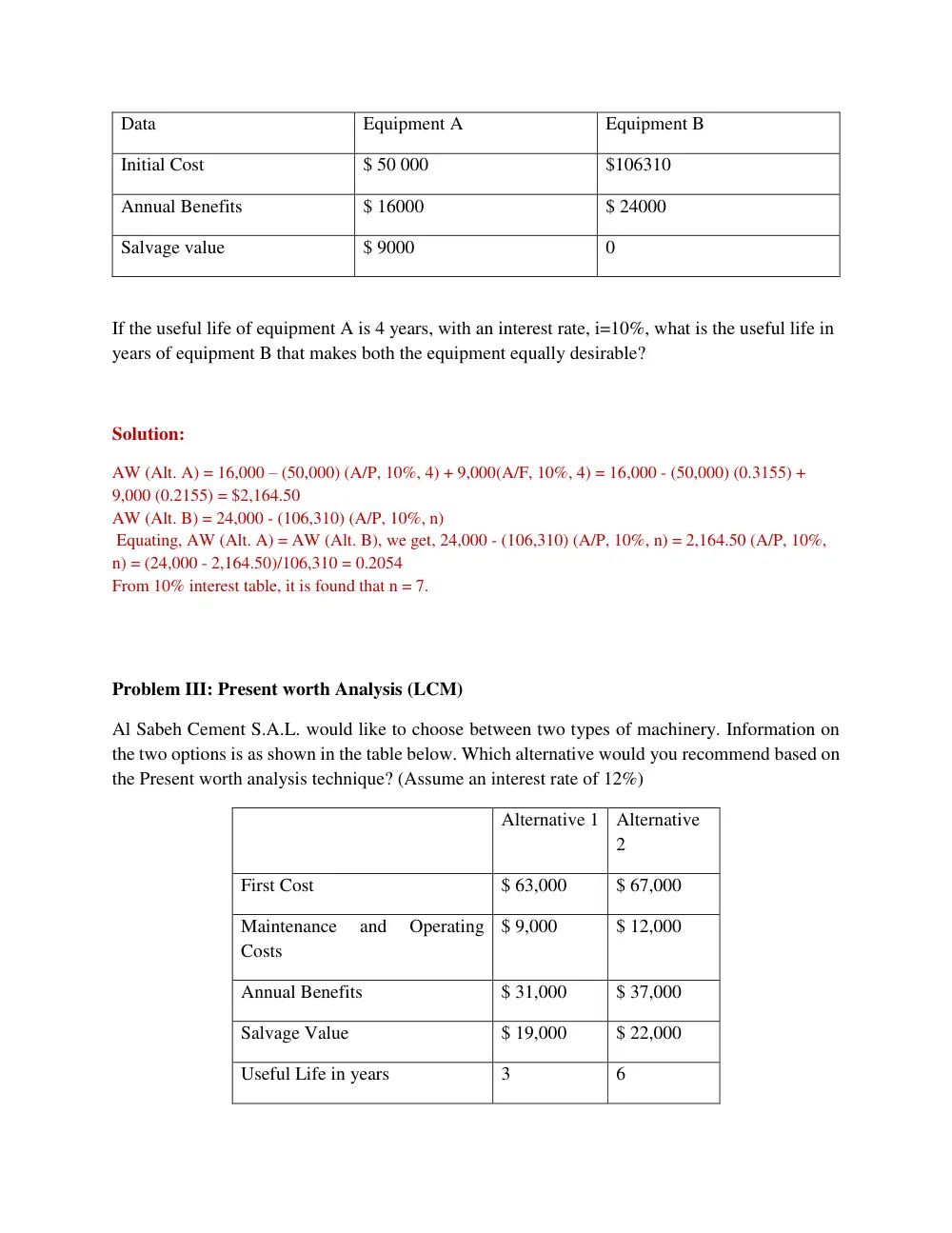
The multinational oil and gas company Total S.A. is considering two mutually exclusive
equipment alternatives to increase its production volume. The respective financial estimates for
each alternative are as follows.
Data
Equipment A
Equipment B
Initial Cost
$ 50 000
$106310
Annual Benefits
$ 16000
$ 24000
Salvage value
$ 9000
0
If the useful life of equipment A is 4 years, with an interest rate, i=10%, what is the useful life in
years of equipment B that makes both the equipment equally desirable?
Solution:
AW (Alt. A) = 16,000 – (50,000) (A/P, 10%, 4) + 9,000(A/F, 10%, 4) = 16,000 - (50,000) (0.3155) +
9,000 (0.2155) = $2,164.50
AW (Alt. B) = 24,000 - (106,310) (A/P, 10%, n)
Equating, AW (Alt. A) = AW (Alt. B), we get, 24,000 - (106,310) (A/P, 10%, n) = 2,164.50 (A/P, 10%,
n) = (24,000 - 2,164.50)/106,310 = 0.2054
From 10% interest table, it is found that n = 7.
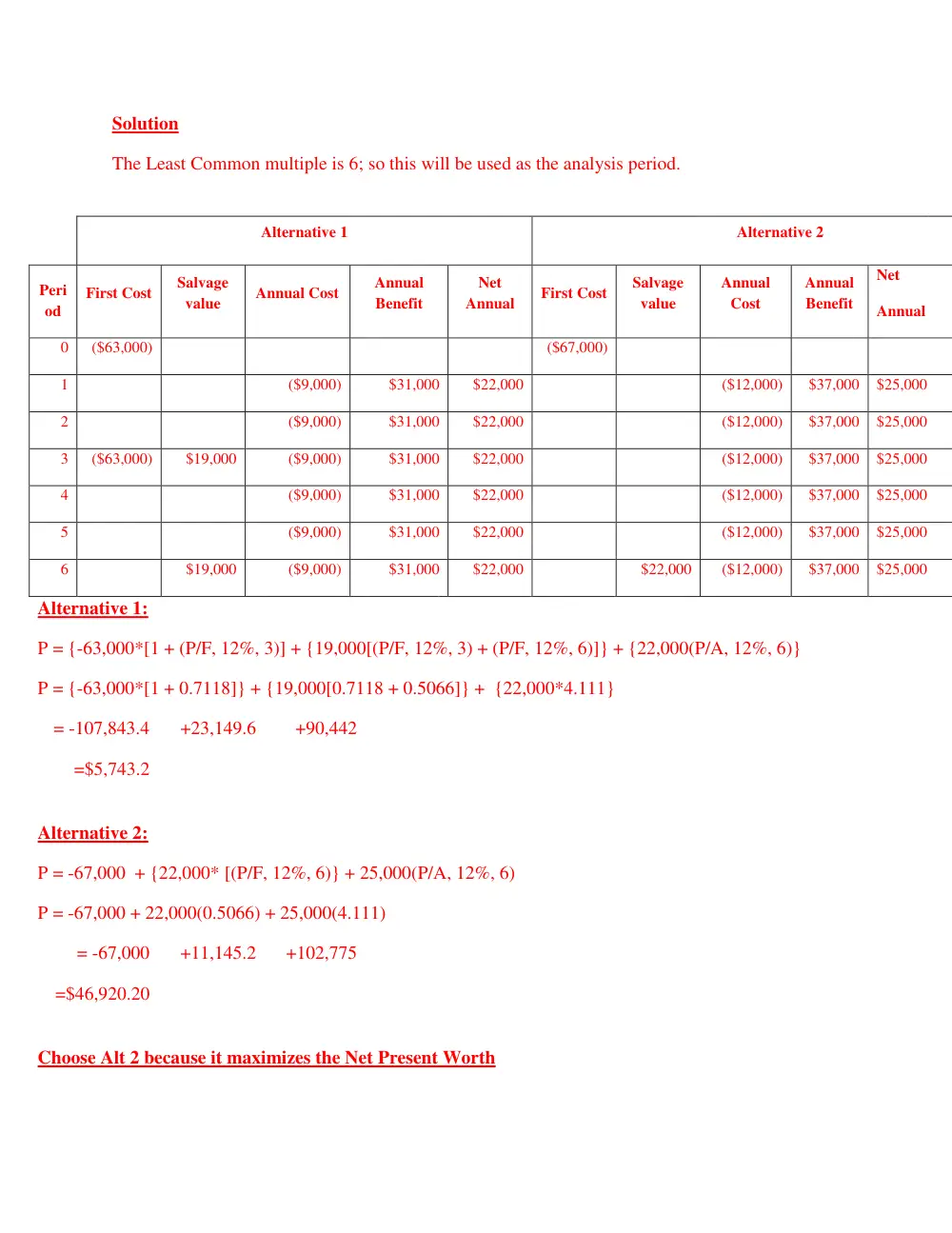
Problem III: Present worth Analysis (LCM)
Al Sabeh Cement S.A.L. would like to choose between two types of machinery. Information on
the two options is as shown in the table below. Which alternative would you recommend based on
the Present worth analysis technique? (Assume an interest rate of 12%)
Alternative 1 Alternative
2
First Cost
$ 63,000
$ 67,000
Maintenance
and
Operating
Costs
$ 9,000
$ 12,000
Annual Benefits
$ 31,000
$ 37,000
Salvage Value
$ 19,000
$ 22,000
Useful Life in years
3
6
Solution
The Least Common multiple is 6; so this will be used as the analysis period.
Alternative 1
Alternative 2
Peri
od
First Cost
Salvage
value
Annual Cost
Annual
Benefit
Net
Annual
First Cost
Salvage
value
Annual
Cost
Annual
Benefit
Net
Annual
0
($63,000)
($67,000)
1
($9,000)
$31,000
$22,000
($12,000)
$37,000 $25,000
2
($9,000)
$31,000
$22,000
($12,000)
$37,000 $25,000
3
($63,000)
$19,000
($9,000)
$31,000
$22,000
($12,000)
$37,000 $25,000
4
($9,000)
$31,000
$22,000
($12,000)
$37,000 $25,000
5
($9,000)
$31,000
$22,000
($12,000)
$37,000 $25,000
6
$19,000
($9,000)
$31,000
$22,000
$22,000
($12,000)
$37,000 $25,000
Alternative 1:
P = {-63,000*[1 + (P/F, 12%, 3)] + {19,000[(P/F, 12%, 3) + (P/F, 12%, 6)]} + {22,000(P/A, 12%, 6)}
P = {-63,000*[1 + 0.7118]} + {19,000[0.7118 + 0.5066]} + {22,000*4.111}
= -107,843.4
+23,149.6
+90,442
=$5,743.2
Alternative 2:
P = -67,000 + {22,000* [(P/F, 12%, 6)} + 25,000(P/A, 12%, 6)
P = -67,000 + 22,000(0.5066) + 25,000(4.111)
= -67,000
+11,145.2
+102,775
=$46,920.20
Choose Alt 2 because it maximizes the Net Present Worth