
INDE 301 Midterm, Spring 2017
American University of Beirut · Engineering Economy · 4 pages
More INDE 301 files
Show the text of this exam
1
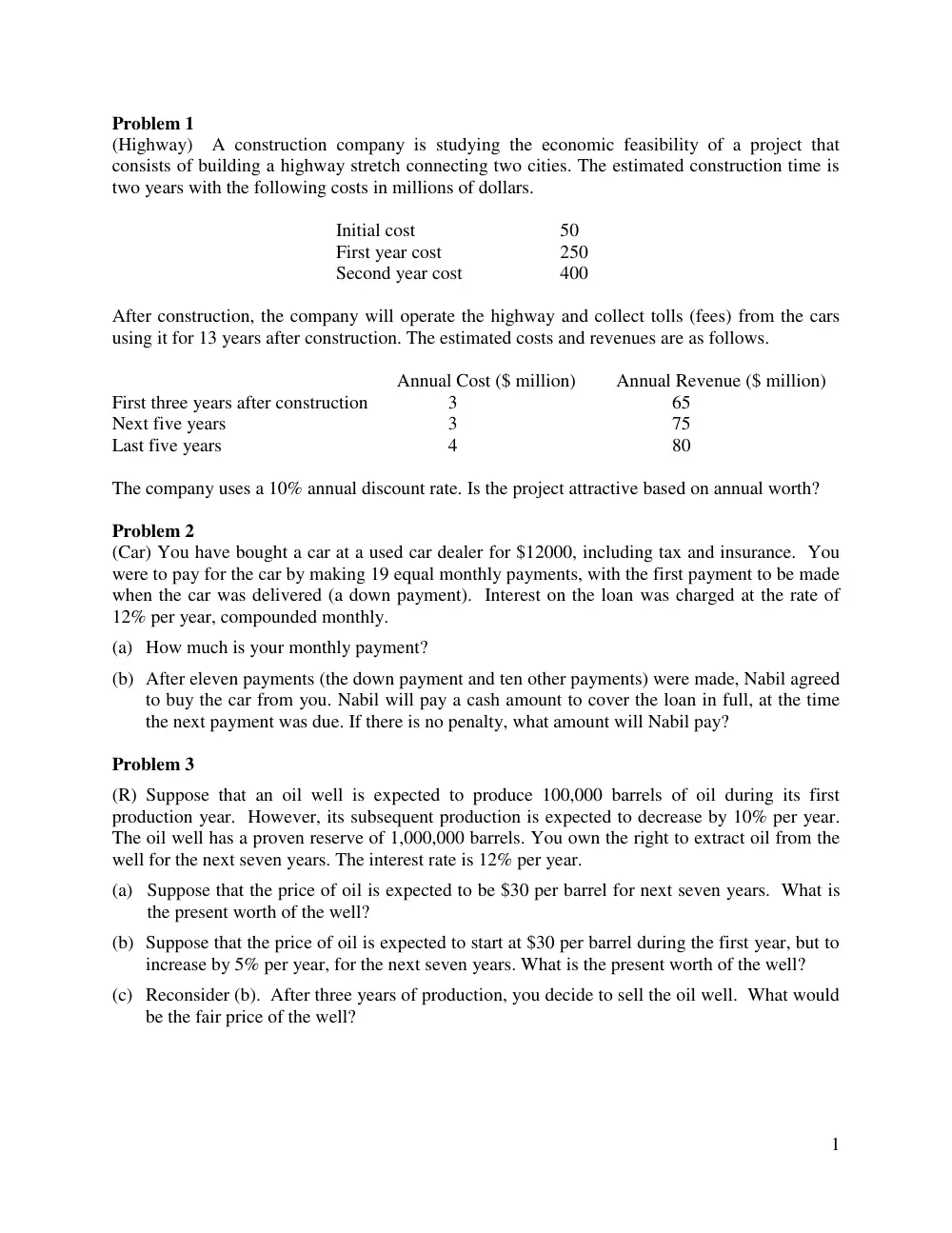
Problem 1
(Highway) A construction company is studying the economic feasibility of a project that
consists of building a highway stretch connecting two cities. The estimated construction time is
two years with the following costs in millions of dollars.
Initial cost
50
First year cost
250
Second year cost
400
After construction, the company will operate the highway and collect tolls (fees) from the cars
using it for 13 years after construction. The estimated costs and revenues are as follows.
Annual Cost ($ million)
Annual Revenue ($ million)
First three years after construction
3
65
Next five years
3
75
Last five years
4
80
The company uses a 10% annual discount rate. Is the project attractive based on annual worth?
Problem 2
(Car) You have bought a car at a used car dealer for $12000, including tax and insurance. You
were to pay for the car by making 19 equal monthly payments, with the first payment to be made
when the car was delivered (a down payment). Interest on the loan was charged at the rate of
12% per year, compounded monthly.
(a) How much is your monthly payment?
(b) After eleven payments (the down payment and ten other payments) were made, Nabil agreed
to buy the car from you. Nabil will pay a cash amount to cover the loan in full, at the time
the next payment was due. If there is no penalty, what amount will Nabil pay?
Problem 3
(R) Suppose that an oil well is expected to produce 100,000 barrels of oil during its first
production year. However, its subsequent production is expected to decrease by 10% per year.
The oil well has a proven reserve of 1,000,000 barrels. You own the right to extract oil from the
well for the next seven years. The interest rate is 12% per year.
(a) Suppose that the price of oil is expected to be $30 per barrel for next seven years. What is
the present worth of the well?
(b) Suppose that the price of oil is expected to start at $30 per barrel during the first year, but to
increase by 5% per year, for the next seven years. What is the present worth of the well?
(c) Reconsider (b). After three years of production, you decide to sell the oil well. What would
be the fair price of the well?
2
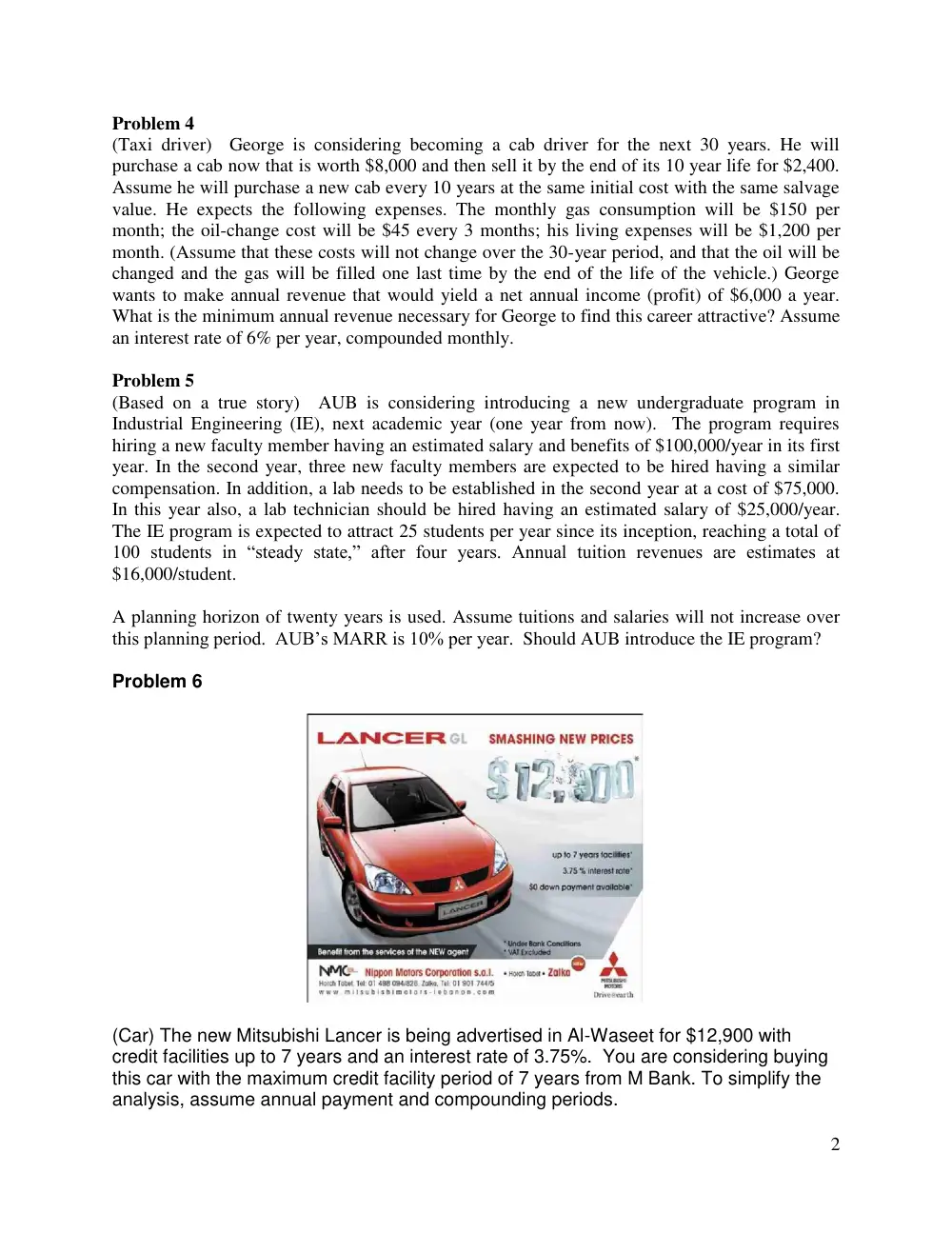
Problem 4
(Taxi driver) George is considering becoming a cab driver for the next 30 years. He will
purchase a cab now that is worth $8,000 and then sell it by the end of its 10 year life for $2,400.
Assume he will purchase a new cab every 10 years at the same initial cost with the same salvage
value. He expects the following expenses. The monthly gas consumption will be $150 per
month; the oil-change cost will be $45 every 3 months; his living expenses will be $1,200 per
month. (Assume that these costs will not change over the 30-year period, and that the oil will be
changed and the gas will be filled one last time by the end of the life of the vehicle.) George
wants to make annual revenue that would yield a net annual income (profit) of $6,000 a year.
What is the minimum annual revenue necessary for George to find this career attractive? Assume
an interest rate of 6% per year, compounded monthly.
Problem 5
(Based on a true story) AUB is considering introducing a new undergraduate program in
Industrial Engineering (IE), next academic year (one year from now). The program requires
hiring a new faculty member having an estimated salary and benefits of $100,000/year in its first
year. In the second year, three new faculty members are expected to be hired having a similar
compensation. In addition, a lab needs to be established in the second year at a cost of $75,000.
In this year also, a lab technician should be hired having an estimated salary of $25,000/year.
The IE program is expected to attract 25 students per year since its inception, reaching a total of
100 students in “steady state,” after four years. Annual tuition revenues are estimates at
$16,000/student.
A planning horizon of twenty years is used. Assume tuitions and salaries will not increase over
this planning period. AUB’s MARR is 10% per year. Should AUB introduce the IE program?
Problem 6
(Car) The new Mitsubishi Lancer is being advertised in Al-Waseet for $12,900 with
credit facilities up to 7 years and an interest rate of 3.75%. You are considering buying
this car with the maximum credit facility period of 7 years from M Bank. To simplify the
analysis, assume annual payment and compounding periods.
3
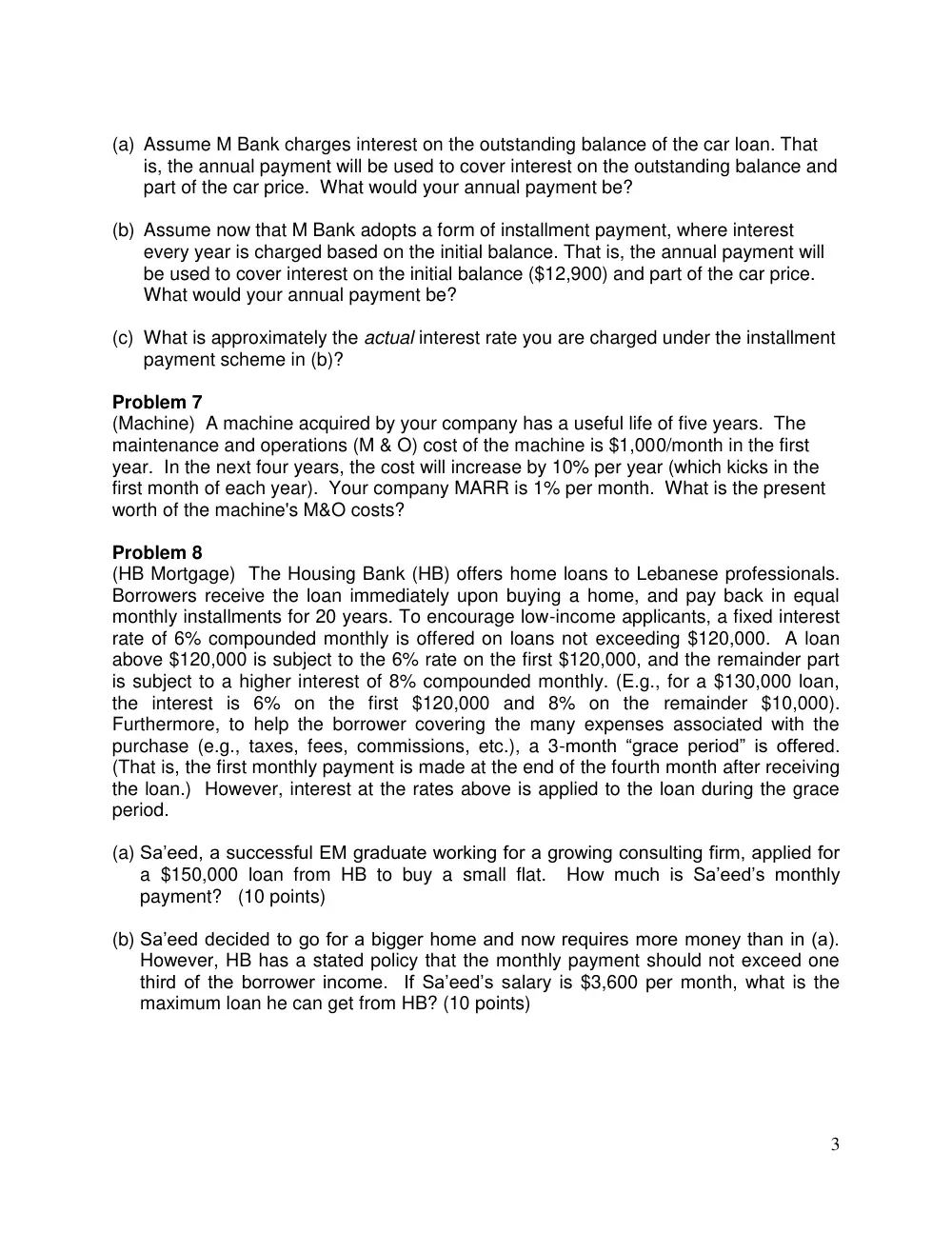
(a) Assume M Bank charges interest on the outstanding balance of the car loan. That
is, the annual payment will be used to cover interest on the outstanding balance and
part of the car price. What would your annual payment be?
(b) Assume now that M Bank adopts a form of installment payment, where interest
every year is charged based on the initial balance. That is, the annual payment will
be used to cover interest on the initial balance ($12,900) and part of the car price.
What would your annual payment be?
(c) What is approximately the actual interest rate you are charged under the installment
payment scheme in (b)?
Problem 7
(Machine) A machine acquired by your company has a useful life of five years. The
maintenance and operations (M & O) cost of the machine is $1,000/month in the first
year. In the next four years, the cost will increase by 10% per year (which kicks in the
first month of each year). Your company MARR is 1% per month. What is the present
worth of the machine's M&O costs?
Problem 8
(HB Mortgage) The Housing Bank (HB) offers home loans to Lebanese professionals.
Borrowers receive the loan immediately upon buying a home, and pay back in equal
monthly installments for 20 years. To encourage low-income applicants, a fixed interest
rate of 6% compounded monthly is offered on loans not exceeding $120,000. A loan
above $120,000 is subject to the 6% rate on the first $120,000, and the remainder part
is subject to a higher interest of 8% compounded monthly. (E.g., for a $130,000 loan,
the interest is 6% on the first $120,000 and 8% on the remainder $10,000).
Furthermore, to help the borrower covering the many expenses associated with the
purchase (e.g., taxes, fees, commissions, etc.), a 3-month “grace period” is offered.
(That is, the first monthly payment is made at the end of the fourth month after receiving
the loan.) However, interest at the rates above is applied to the loan during the grace
period.
(a) Sa’eed, a successful EM graduate working for a growing consulting firm, applied for
a $150,000 loan from HB to buy a small flat. How much is Sa’eed’s monthly
payment? (10 points)
(b) Sa’eed decided to go for a bigger home and now requires more money than in (a).
However, HB has a stated policy that the monthly payment should not exceed one
third of the borrower income. If Sa’eed’s salary is $3,600 per month, what is the
maximum loan he can get from HB? (10 points)
4
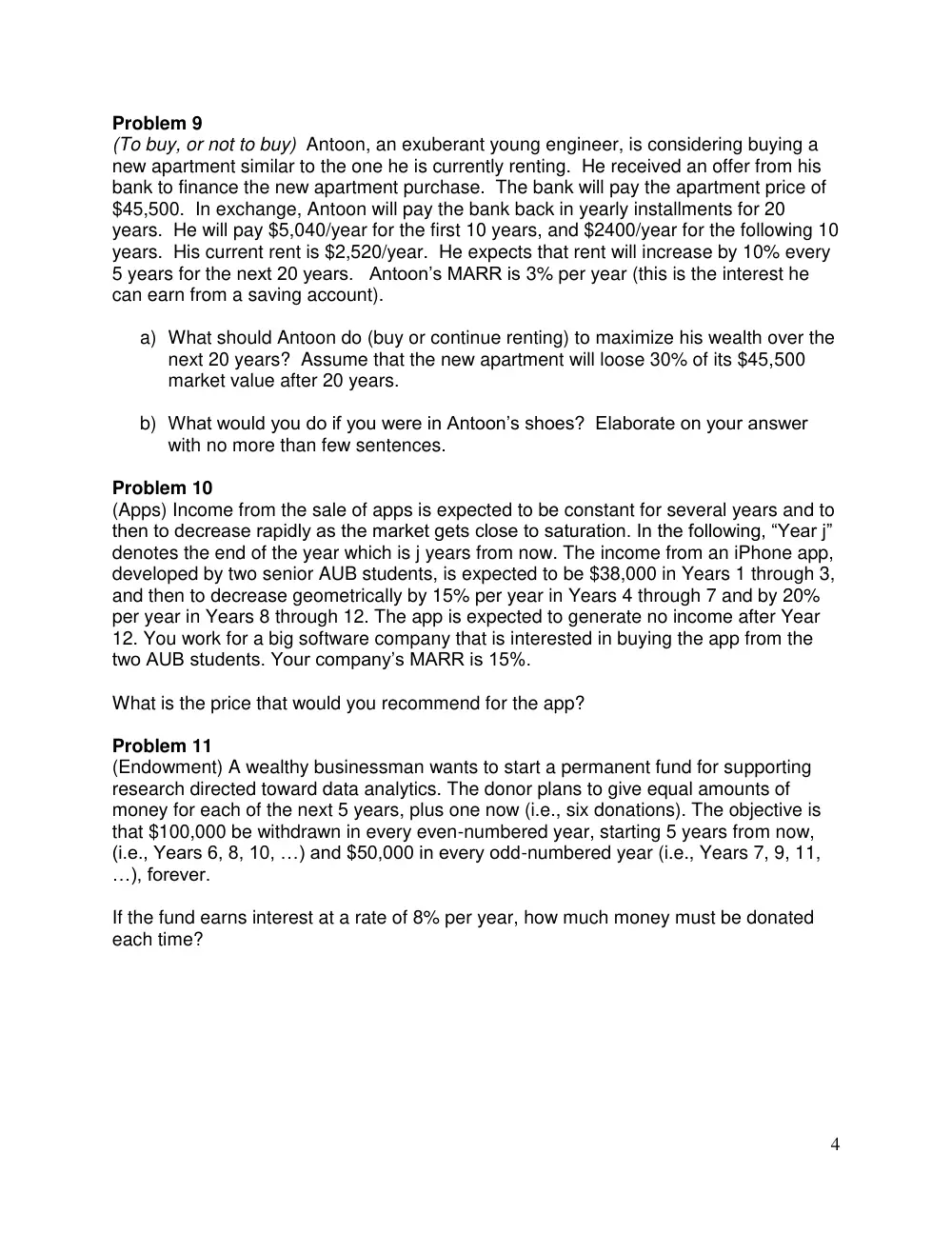
Problem 9
(To buy, or not to buy) Antoon, an exuberant young engineer, is considering buying a
new apartment similar to the one he is currently renting. He received an offer from his
bank to finance the new apartment purchase. The bank will pay the apartment price of
$45,500. In exchange, Antoon will pay the bank back in yearly installments for 20
years. He will pay $5,040/year for the first 10 years, and $2400/year for the following 10
years. His current rent is $2,520/year. He expects that rent will increase by 10% every
5 years for the next 20 years. Antoon’s MARR is 3% per year (this is the interest he
can earn from a saving account).
a) What should Antoon do (buy or continue renting) to maximize his wealth over the
next 20 years? Assume that the new apartment will loose 30% of its $45,500
market value after 20 years.
b) What would you do if you were in Antoon’s shoes? Elaborate on your answer
with no more than few sentences.
Problem 10
(Apps) Income from the sale of apps is expected to be constant for several years and to
then to decrease rapidly as the market gets close to saturation. In the following, “Year j”
denotes the end of the year which is j years from now. The income from an iPhone app,
developed by two senior AUB students, is expected to be $38,000 in Years 1 through 3,
and then to decrease geometrically by 15% per year in Years 4 through 7 and by 20%
per year in Years 8 through 12. The app is expected to generate no income after Year
12. You work for a big software company that is interested in buying the app from the
two AUB students. Your company’s MARR is 15%.
What is the price that would you recommend for the app?
Problem 11
(Endowment) A wealthy businessman wants to start a permanent fund for supporting
research directed toward data analytics. The donor plans to give equal amounts of
money for each of the next 5 years, plus one now (i.e., six donations). The objective is
that $100,000 be withdrawn in every even-numbered year, starting 5 years from now,
(i.e., Years 6, 8, 10, …) and $50,000 in every odd-numbered year (i.e., Years 7, 9, 11,
…), forever.
If the fund earns interest at a rate of 8% per year, how much money must be donated
each time?