
INDE 301 Midterm, Spring 2017
American University of Beirut · Engineering Economy · 5 pages
More INDE 301 files
Show the text of this exam
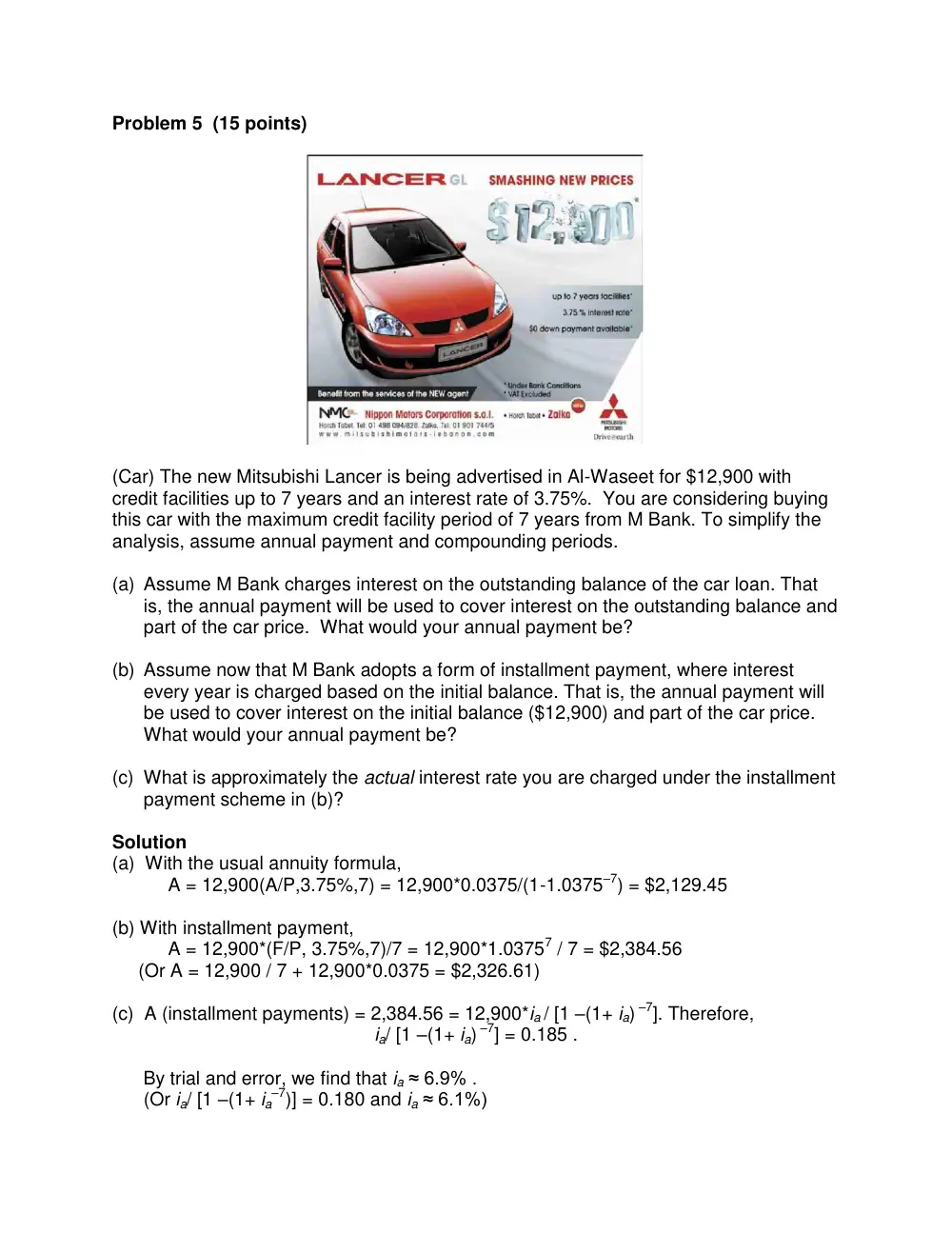
Problem 5 (15 points)
(Car) The new Mitsubishi Lancer is being advertised in Al-Waseet for $12,900 with
credit facilities up to 7 years and an interest rate of 3.75%. You are considering buying
this car with the maximum credit facility period of 7 years from M Bank. To simplify the
analysis, assume annual payment and compounding periods.
(a) Assume M Bank charges interest on the outstanding balance of the car loan. That
is, the annual payment will be used to cover interest on the outstanding balance and
part of the car price. What would your annual payment be?
(b) Assume now that M Bank adopts a form of installment payment, where interest
every year is charged based on the initial balance. That is, the annual payment will
be used to cover interest on the initial balance ($12,900) and part of the car price.
What would your annual payment be?
(c) What is approximately the actual interest rate you are charged under the installment
payment scheme in (b)?
Solution
(a) With the usual annuity formula,
A = 12,900(A/P,3.75%,7) = 12,900*0.0375/(1-1.0375–7) = $2,129.45
(b) With installment payment,
A = 12,900*(F/P, 3.75%,7)/7 = 12,900*1.03757 / 7 = $2,384.56
(Or A = 12,900 / 7 + 12,900*0.0375 = $2,326.61)
(c) A (installment payments) = 2,384.56 = 12,900*ia / [1 –(1+ ia) –7]. Therefore,
ia/ [1 –(1+ ia) –7] = 0.185 .
By trial and error, we find that ia ≈ 6.9% .
(Or ia/ [1 –(1+ ia
–7)] = 0.180 and ia ≈ 6.1%)
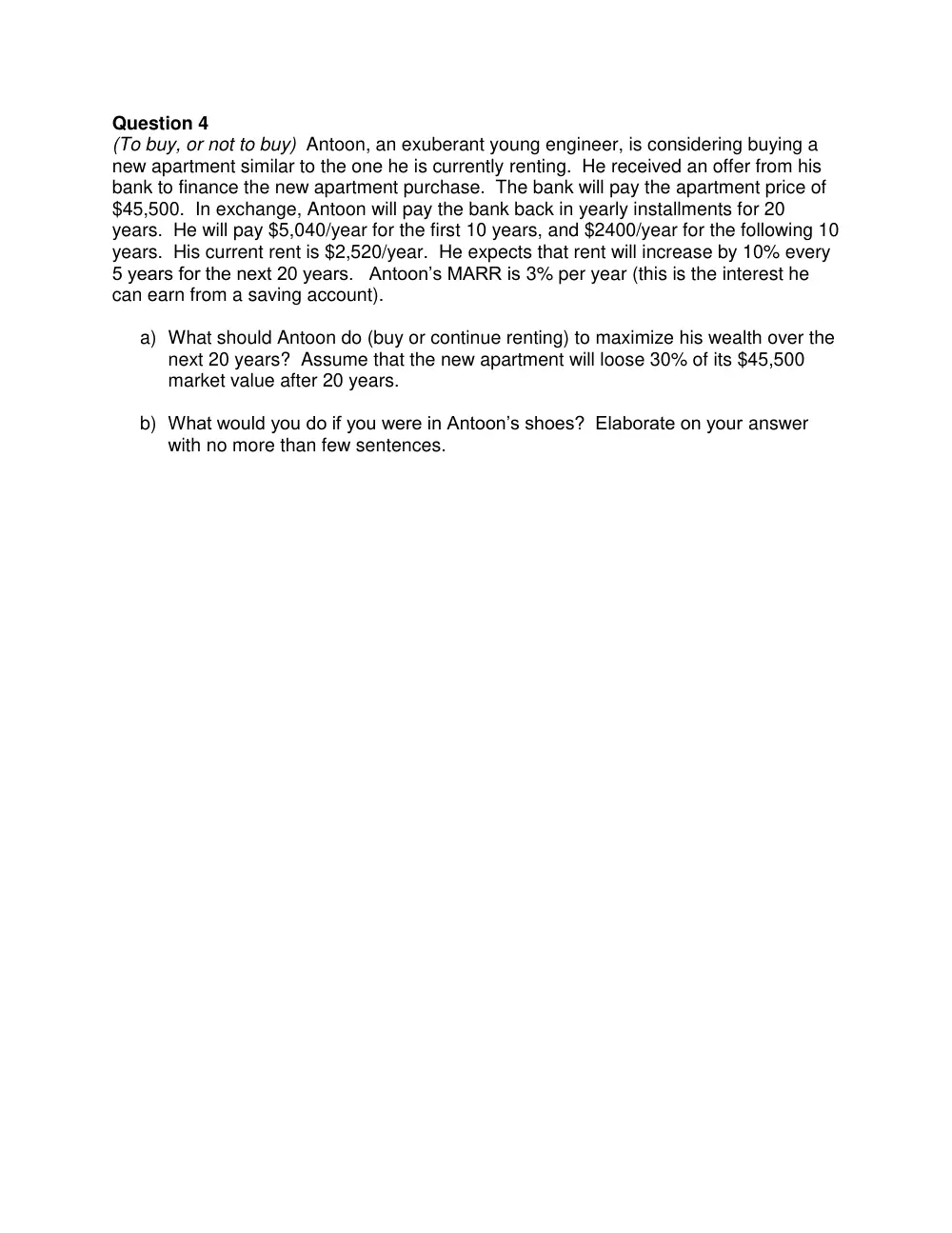
Question 4
(To buy, or not to buy) Antoon, an exuberant young engineer, is considering buying a
new apartment similar to the one he is currently renting. He received an offer from his
bank to finance the new apartment purchase. The bank will pay the apartment price of
$45,500. In exchange, Antoon will pay the bank back in yearly installments for 20
years. He will pay $5,040/year for the first 10 years, and $2400/year for the following 10
years. His current rent is $2,520/year. He expects that rent will increase by 10% every
5 years for the next 20 years. Antoon’s MARR is 3% per year (this is the interest he
can earn from a saving account).
a) What should Antoon do (buy or continue renting) to maximize his wealth over the
next 20 years? Assume that the new apartment will loose 30% of its $45,500
market value after 20 years.
b) What would you do if you were in Antoon’s shoes? Elaborate on your answer
with no more than few sentences.
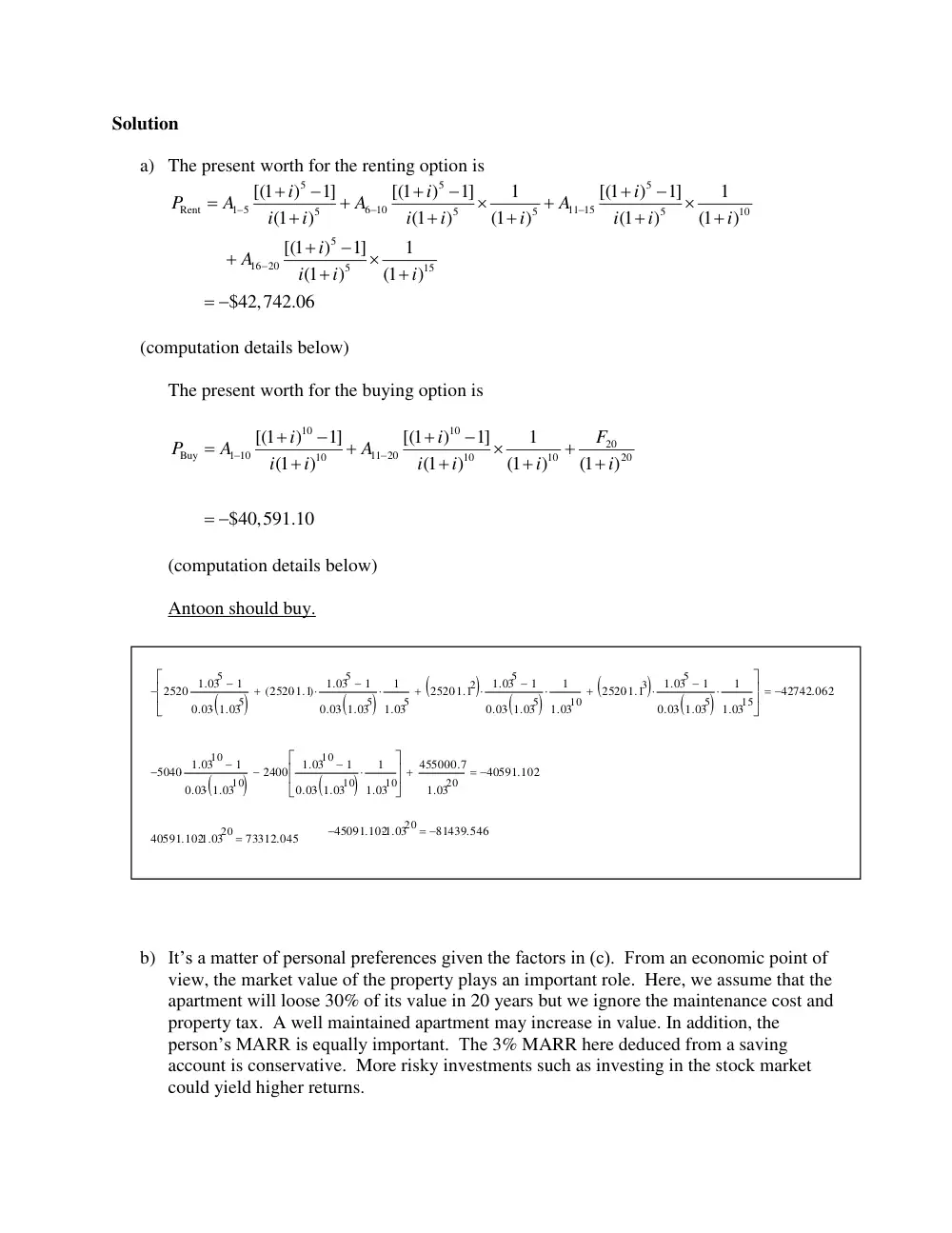
Solution
a) The present worth for the renting option is
5
5
5
Rent
1 5
6 10
11 15
5
5
5
5
10
5
16 20
5
15
[(1
)
1]
[(1
)
1]
1
[(1
)
1]
1
(1
)
(1
)
(1
)
(1
)
(1
)
[(1
)
1]
1
(1
)
(1
)
$42,742.06
i
i
i
P
A
A
A
i
i
i
i
i
i
i
i
i
A
i
i
i
(computation details below)
The present worth for the buying option is
10
10
20
Buy
1 10
11 20
10
10
10
20
[(1
)
1]
[(1
)
1]
1
(1
)
(1
)
(1
)
(1
)
$40,591.10
F
i
i
P
A
A
i
i
i
i
i
i
(computation details below)
Antoon should buy.
b) It’s a matter of personal preferences given the factors in (c). From an economic point of
view, the market value of the property plays an important role. Here, we assume that the
apartment will loose 30% of its value in 20 years but we ignore the maintenance cost and
property tax. A well maintained apartment may increase in value. In addition, the
person’s MARR is equally important. The 3% MARR here deduced from a saving
account is conservative. More risky investments such as investing in the stock market
could yield higher returns.
2520
1.035
1
0.03 1.035
25201.1
(
)
1.035
1
0.03 1.035
1
1.035
25201.12
1.035
1
0.03 1.035
1
1.0310
25201.13
1.035
1
0.03 1.035
1
1.0315
42742.062
5040
1.0310
1
0.03 1.0310
2400
1.0310
1
0.03 1.0310
1
1.0310
455000.7
1.0320
40591.102
45091.102
1.0320
81439.546
40591.1021.0320
73312.045
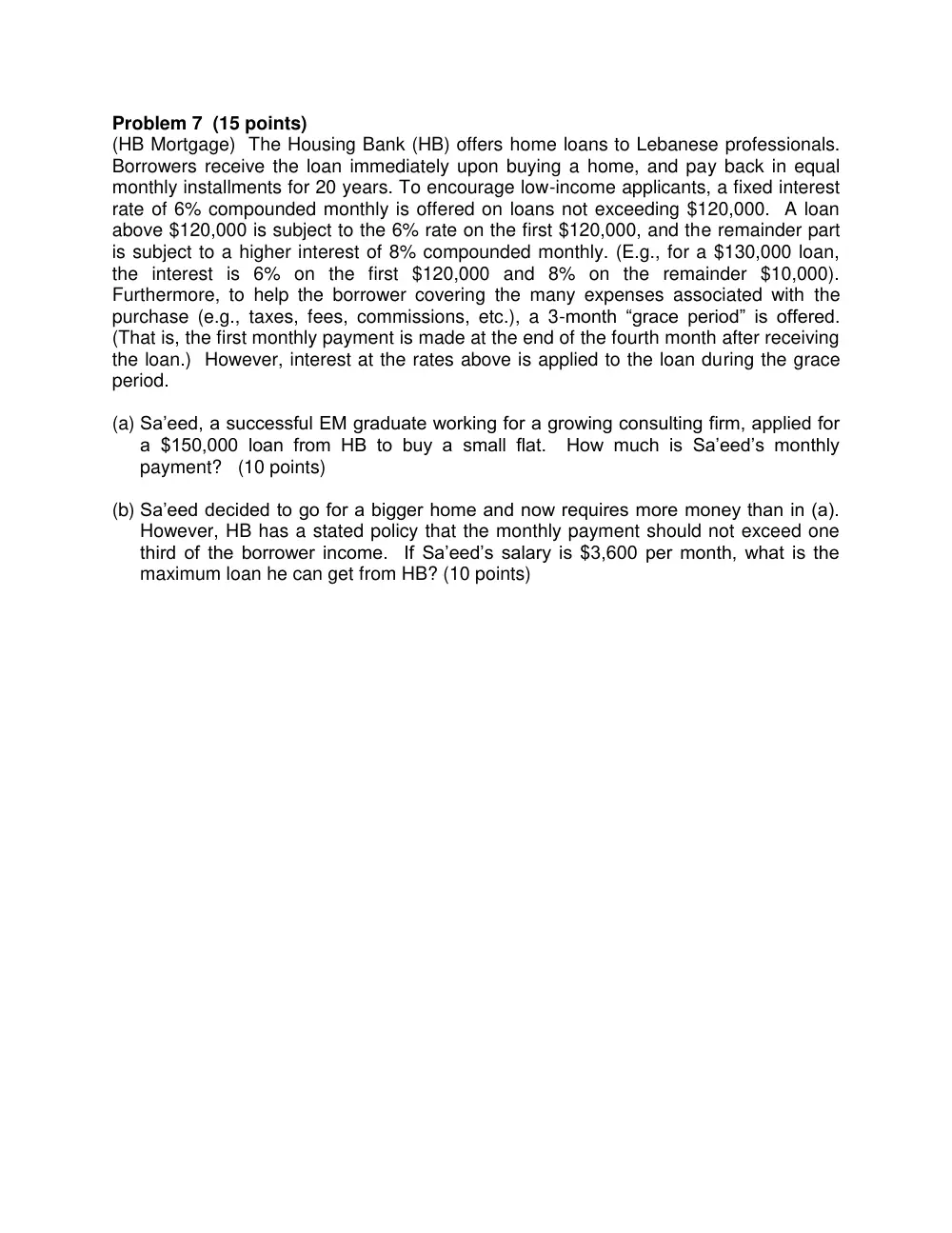
Problem 7 (15 points)
(HB Mortgage) The Housing Bank (HB) offers home loans to Lebanese professionals.
Borrowers receive the loan immediately upon buying a home, and pay back in equal
monthly installments for 20 years. To encourage low-income applicants, a fixed interest
rate of 6% compounded monthly is offered on loans not exceeding $120,000. A loan
above $120,000 is subject to the 6% rate on the first $120,000, and the remainder part
is subject to a higher interest of 8% compounded monthly. (E.g., for a $130,000 loan,
the interest is 6% on the first $120,000 and 8% on the remainder $10,000).
Furthermore, to help the borrower covering the many expenses associated with the
purchase (e.g., taxes, fees, commissions, etc.), a 3-month “grace period” is offered.
(That is, the first monthly payment is made at the end of the fourth month after receiving
the loan.) However, interest at the rates above is applied to the loan during the grace
period.
(a) Sa’eed, a successful EM graduate working for a growing consulting firm, applied for
a $150,000 loan from HB to buy a small flat. How much is Sa’eed’s monthly
payment? (10 points)
(b) Sa’eed decided to go for a bigger home and now requires more money than in (a).
However, HB has a stated policy that the monthly payment should not exceed one
third of the borrower income. If Sa’eed’s salary is $3,600 per month, what is the
maximum loan he can get from HB? (10 points)
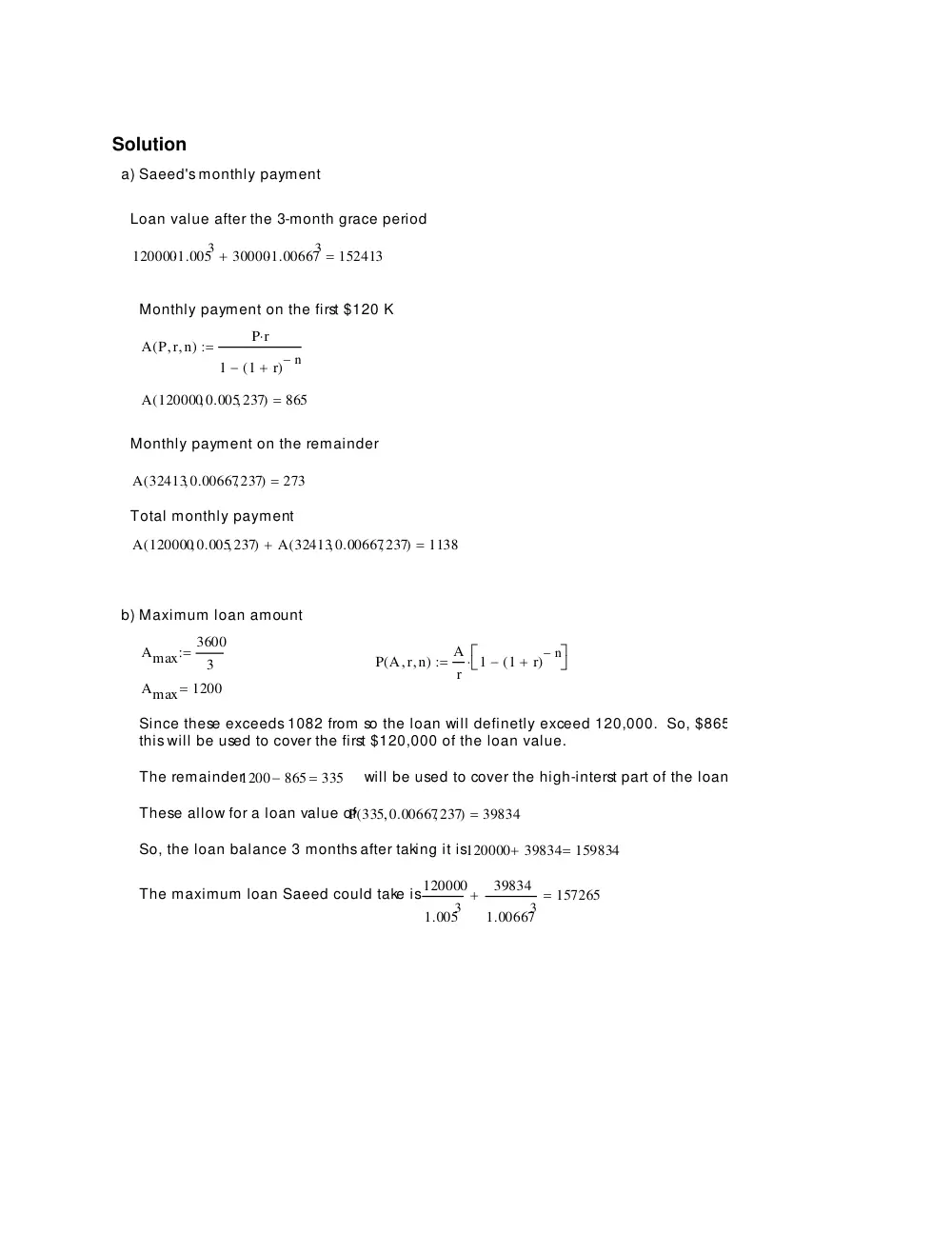
Solution
120000
1.0053
39834
1.006673
157265
The maximum loan Saeed could take is
120000
39834
159834
So, the loan balance 3 months after taking it is
P 335 0.00667
237
(
)
39834
These allow for a loan value of
will be used to cover the high-interst part of the loan.
1200
865
335
The remainder
Since these exceeds 1082 from so the loan will definetly exceed 120,000. So, $865 out of
this will be used to cover the first $120,000 of the loan value.
Amax
1200
P A r
n
(
)
A
r
1
1
r
(
)
n
Amax
3600
3
b) Maximum loan amount
A 120000 0.005
237
(
)
A 32413 0.00667
237
(
)
1138
Total monthly payment
A 32413 0.00667
237
(
)
273
Monthly payment on the remainder
A 120000 0.005
237
(
)
865
A P r
n
(
)
P r
1
1
r
(
)
n
Monthly payment on the first $120 K
1200001.0053
300001.006673
152413
Loan value after the 3-month grace period
a) Saeed's monthly payment