
MATH 202 Useful File, Fall 1998
American University of Beirut · Differential Equations · 5 pages

More MATH 202 files
- Useful File Summary · Spring 2016FileView
- Useful File Summary · Spring 2015FileView
- Useful File Quiz 1 Sample · Spring 2014FileView
- Useful File Elementary Rules of Differentiation · Spring 2011FileView
- Useful File Solution Manual · Spring 2011File · with solutionView
- Other · Spring 2008FileView
- Exam Solution to Sample Exam I · Spring 2019Exam · with solutionView
- Syllabus · Spring 2019LabView
Show the text of this file
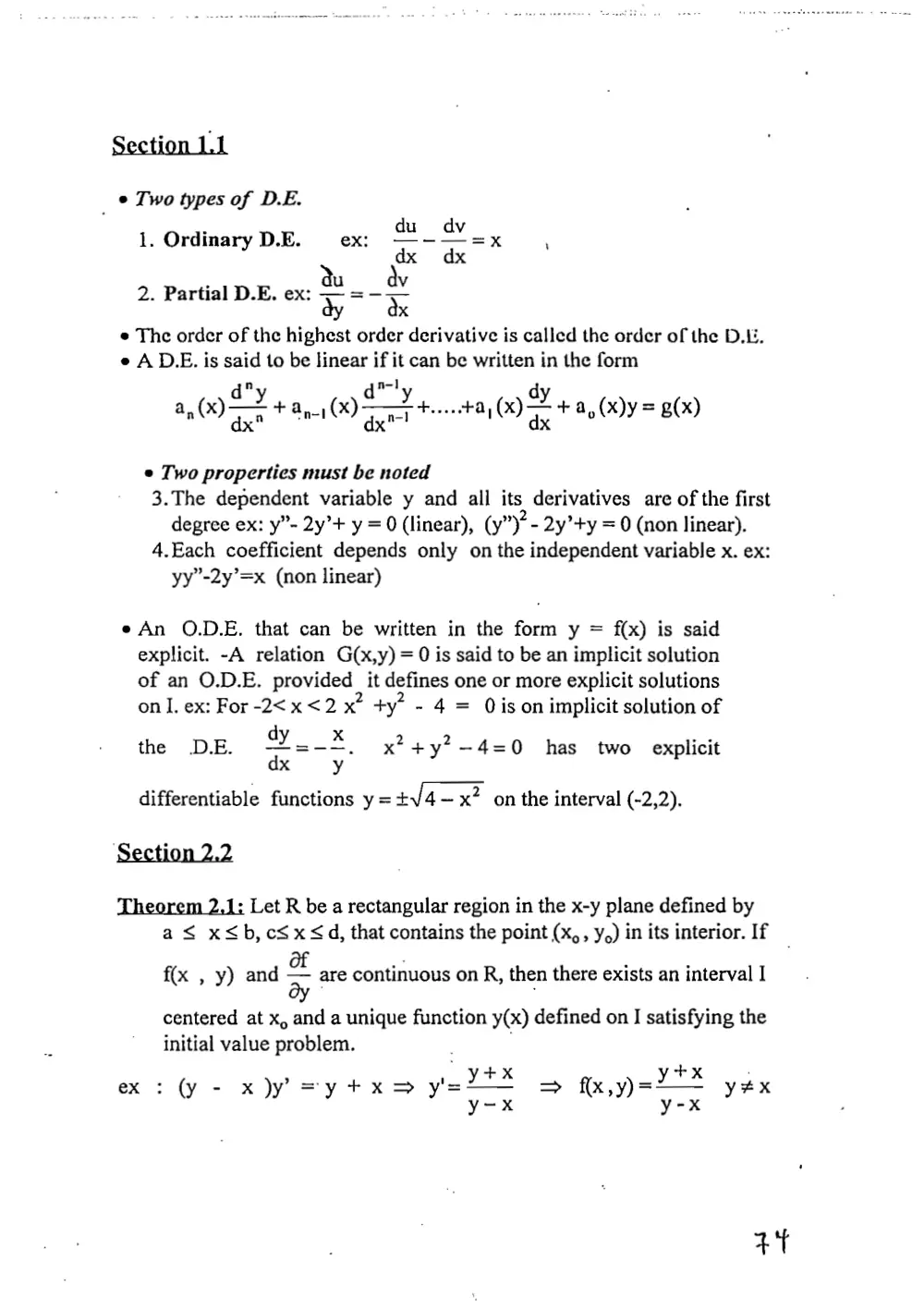
Section L.1
e Two types of D.E.
dus dv
1. Ordinary D.E. ex! ——-—-=x ;
, ea dx
2. Partial D.E. ex: y =->
e The order of the highest order derivative is called the order of the D..
e ADL. is oe to be linear if it can be written in the form
ar? » (X)¥ = B(x)
© Two properties must be noted
3.The dependent variable y and all its derivatives are of the first
degree ex: y”- 2y’+ y = 0 (linear), (yy - 2y’+y = 0 (non linear).
4.Each coefficient depends only on the independent variable x. ex:
yy’-2y’=x (non linear)
e An O.D.E. that can be written in the form y = f(x) is said
explicit. -A relation G(x,y) = 0 is said to be an implicit solution
of an O.D.E. provided | it defines one or more explicit solutions
on I. ex: For -2<x <2 x’ +y’ - 4 = Ois on implicit solution of
the D.E. gy Xx x? +y?—4=0 has two. explicit
dx y
differentiable functions y =+V4—x? on the interval (-2,2).
Section 2.2
Theorem 2.1: Let R be a rectangular region in the x-y plane defined by
a < x<b,csx<d, that contains the point (x), y,) in its interior. If
of
f(x , y) and — are continuous on R, then there exists an interval I
centered at x, and a unique function y(x) defined on I satisfying the
initial value problem.
y+x +X
exi(y- xyrytxa y=" = tx y=%
y-xX y-x
y#xX
+t
of
2. that — =M
assume tha Ox (x,y)
3. f(x, y) = JM(x,y)dx + g(y)
of
4. x s JM(x, y)dx + g'(y) = N(x,y)
Section 2.5: = Lincar equation of order one.
e ADE. of the form a(x) fy a ayy = 2(x) is said to be a D.E. of order |.
e Divide by al(x) we get ey + p(x)y = f(x)
x
¢To solve this D.E. we have to find an integrating
~ ¢/P()dx
J-p(x)dx feIPCO8 gy + Cel -PCdx
The solution is
factor.
ye
Section 2.6 :
© Bernouilli’s equation ~ + p(x)y = f(x)y"
x
Devide by y" => y"dy/dx +p(xy'"=
f(x) Let w= y'™ => dw/dx = (1-n)y-
ndy/dx
> ~ +(1—n)p(x)w = (1- n)f(x) is a linar first order equation.
x
e Ricatti’s equation ° = p(x) + Q(x)y + R(x)y”
d
If y, is a known particular solution => y = y,tu and oy =o au
dx dx dx
=o —(a+2y,R)u= Ru? —-—--— which is Berouilli.
x
© Claireau equation : y = xy’+f(y’)
. =cx+f(c) general solution
x=-—f'(t) substituting y = f(t)-tf(t) singular solution.
Section 2,7 substitutions.
76
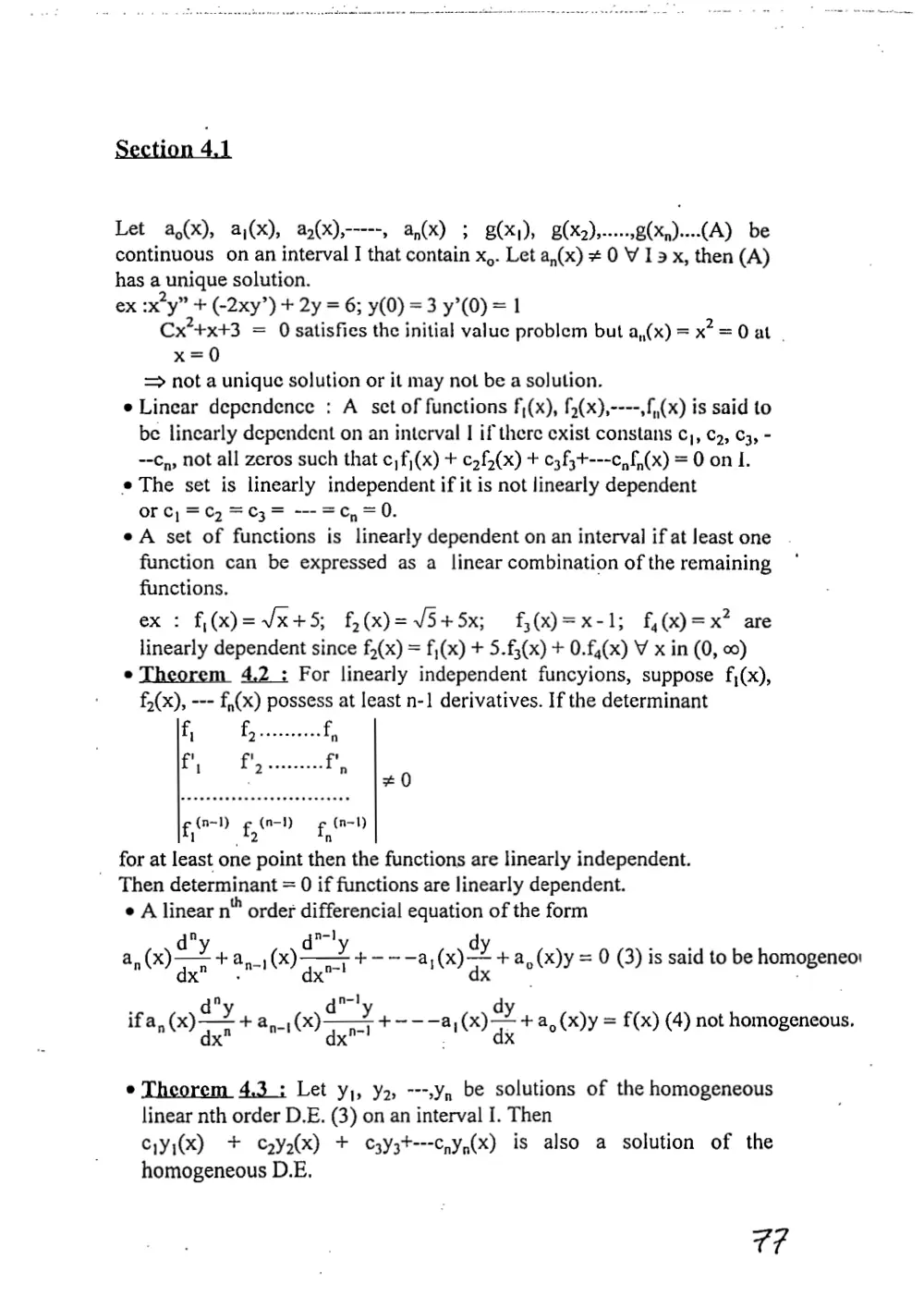
Section 4.1
Let a(x), a\(x), a(x), Toe > a,(x) > 2(X)), 2(X2), stone 28(X,)--.-(A) be
continuous on an interval J that contain x,. Let a,(x) # 0 V 13 x, then (A)
has a unique solution.
ex ix'y” + (-2xy’) + 2y = 6; y(0)=3 yO) = 1
Cx?+x+3 = 0 satisfies the initial value problem but a,(x) = x? =O at
x=0
=> not a unique solution or it may not be a solution.
e Linear dependence : A set of functions f,(x), f(x),----,f,(x) is said to
be linearly dependent on an interval | if there exist constans c;, C2, C3, -
--c,, not all zeros such that c)f,(x) + c2f,(x) + c3f3+---c, f(x) = 0 on 1.
© The set is linearly independent if it is not linearly dependent
Orc; =C, =; = ---=c, =0.
eA set of functions is linearly dependent on an interval ifat least one .
function can be expressed as a linear combination of the remaining
functions.
ex : f,(x)=Vx+5; f,(x)=V5+5x; £,()=x-1; f(x) =x? are
linearly dependent since f,(x) = f,(x) + 5.f;(x) + 0.f,(x) V x in (0, 00)
e Theorem 4.2 : For linearly independent funcyions, suppose f;(x),
f,(x), --- f,(x) possess at least n-1 derivatives. If the determinant
fo"? £,°? f (n-1)
n
_ for at least one point then the functions are linearly independent.
Then determinant = 0 if functions are linearly dependent.
e A linear n™ order differencial equation of the form
n n-]
a, (x) d’y +a,_,(x) d y +--—a, (x) +a,(x)y = 0 (3) is said to be homogeneo:
dx". dx" dx * ;
n n-1
ifa, (x) d’y +a,_1(x) d y +---a, (x) +a,(x)y = £(x) (4) not homogeneous.
dx" dx" dx
e Theorem 4.3; Let y,, y2, ---,y, be solutions of the homogeneous
linear nth order D.E. (3) on an interval I. Then
C1y¥;(x) + coyo(x) + c3y3t---c,y,(x) is also a solution of the
homogeneous D.E.
77
Corollaries
a) A constant multiple y = c,y,(x) of a solution y,(x) of a homogeneous
linear D.E. is also a solution.
b) A homogeneous linear D.E. always possesses the trivial solution y =
0.
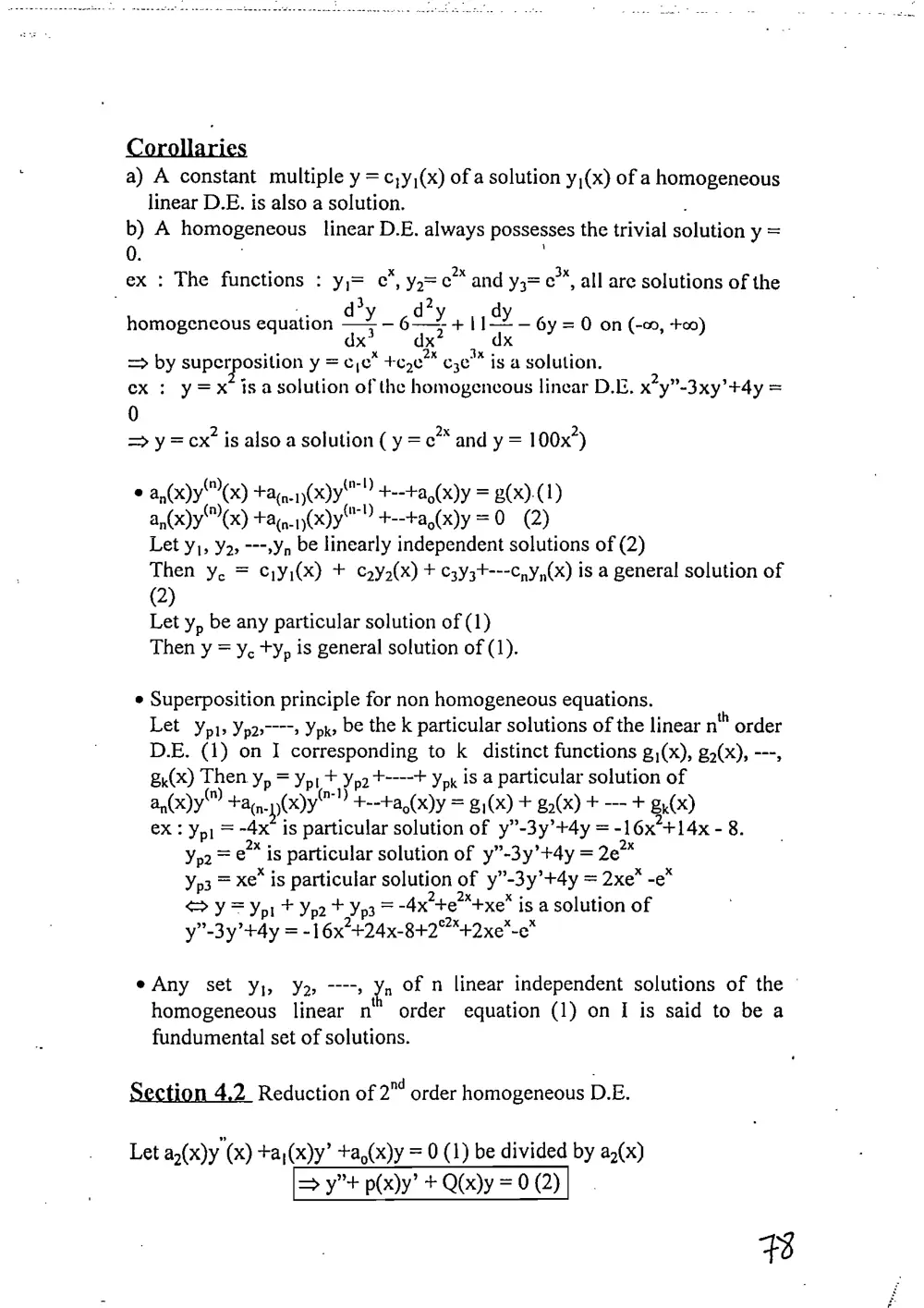
ex : The functions : y,= o*, y,=c™ and y,= ec”, all are solutions of the
d’y_.d’y dy
77 s+
dx dx 3 dx
=> by superposition y = co" +c,e™ c,e™ is a solution.
ex : y =x’ isasolution of the homogeneous linear D.L. x’y"-3xy’+4y =
0
=> y = cx’ is also a solution ( y = e** and y= 100x”)
6
homogencous equation — 6y = 0 on (-00, +00)
© a,)¥1() Haye (yt terFagy = B(%)-(1)
a,(x)y" (x) ta@.nQdy” ° +--ta,(x)y =O (2)
Let y,, ¥2, ---,¥, be linearly independent solutions of (2)
Then y, = cy,(x) + cyy2(x) + c3y3+---c,y,(x) is a general solution of
(2)
Let y, be any particular solution of (1)
Then y = y, ty, is general solution of (1).
e Superposition principle for non homogeneous equations.
Let Yp1s Ypzs----» Ypx» be the k particular solutions of the linear n” order
D.E. (1) on I corresponding to k distinct functions g,(x), g(x), ---,
&x(x) Then yp = yp + ¥p2 t----+ ypy is a particular solution of
an )¥™ Fan. yXy? +-FaODy = g1(x) + BC) + — + Bd)
€X : Yp, = ~4x° is particular solution of y”-3y’+4y = -16x’+14x - 8.
Ypo =e” is particular solution of y”-3y’+4y = 2e™
Yp3 = xe" is particular solution of y”-3y’+4y = 2xe* -e*
> ¥ =Ypi + Ypo + ¥p3 = -4x"te™+xe" is a solution of
y”-3y’+4y = -16x°+24x-8+2°"+2xe"-0"
e Any set y;, Y2, ----, ¥, of n linear independent solutions of the ©
homogeneous linear n' order equation (1) on I is said to be a
fundumental set of solutions.
Section 4.2 Reduction of 2™ order homogeneous D.E.
Let a,(x)y (x) ta,(x)y’ +a,(x)y = 0 (1) be divided by a(x)
= y+ p(xy’ + QO@y =0(2)]
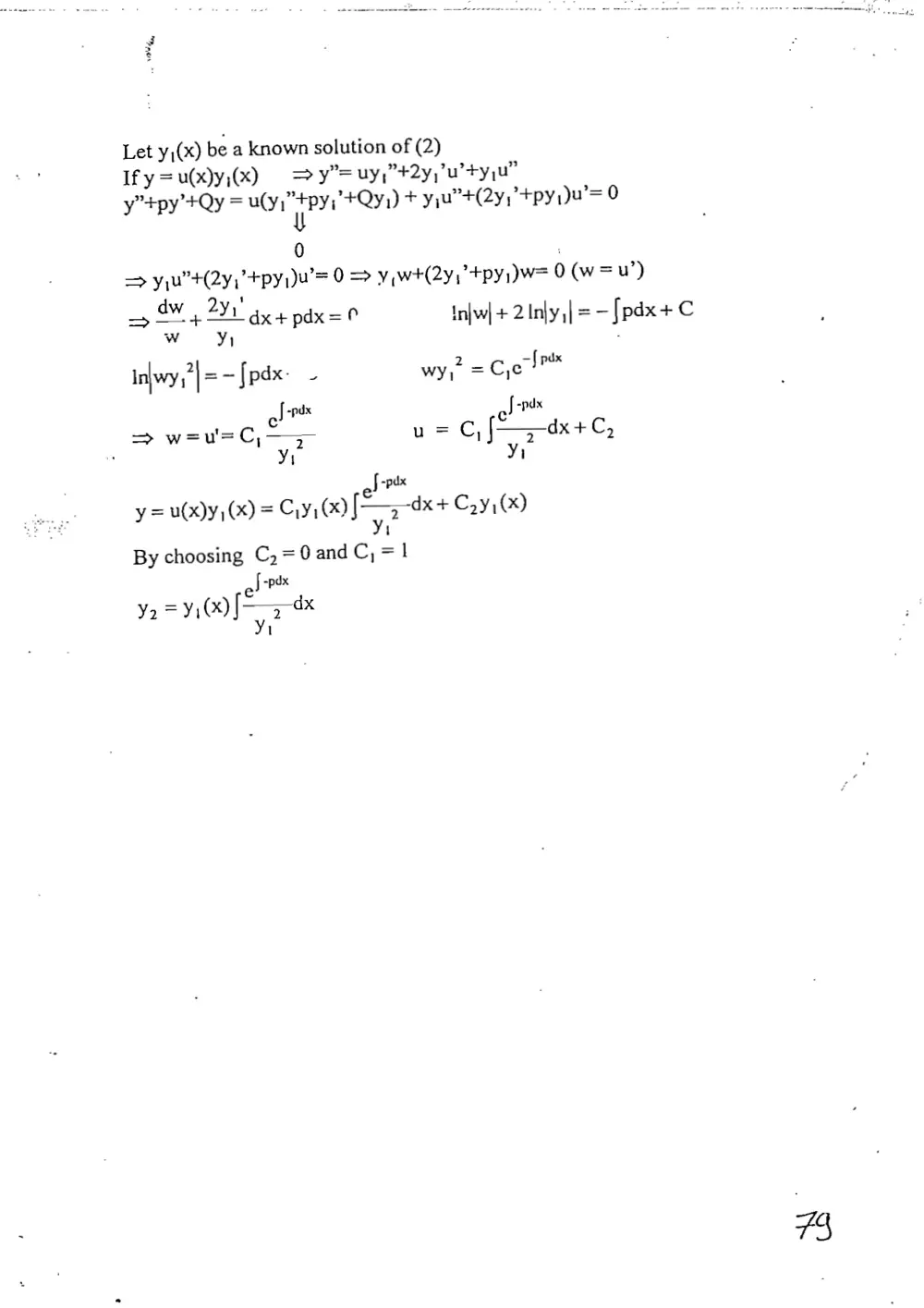
Let y,(x) be a known solution of (2)
Ify=uny (x) = y=uy)"+2y, "uty ,u”
y’tpy’+Qy = won" pyr On) + yyu’+(2y,’+pyi)u’= 0
0 .
=> yyu"t(2yy’+py w= 0 => ywt(2y,’+pyiw= 0 (w= w’)
_, Ow, 2% dx + pdx = Inw| + 2 Inly,| =—-Jpdx+C
w y1 .
Inlwy | =~ [pdx- L wy, = cel"
J -pdx ol Pe
= w=u=C,— 5 u=C,f 3 dx + C,
yi, yi
el
y=uxdyi(x) = Cy] 2 dx + Cyy1(x)
1
By choosing C, = 0 and C, = 1
a! Pex
yo =y¥(X)J—a-4x
¥1