
MATH 212 Exam 1, Spring 2016
American University of Beirut · Introductory Partial Differential Equations · 10 pages · Prof. Mohammad El Smaily
More MATH 212 files
Show the text of this exam
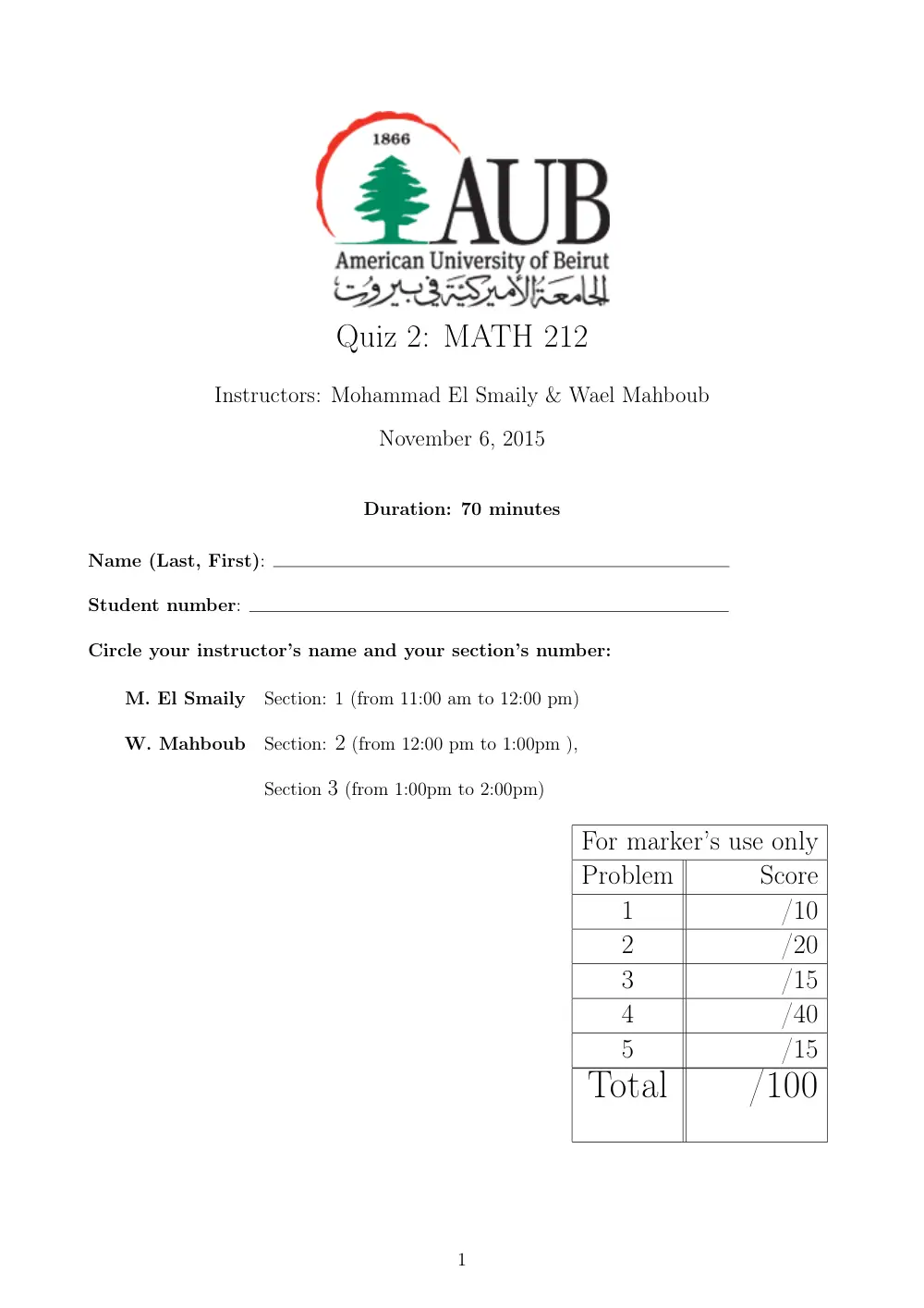
Quiz 2: MATH 212
Instructors: Mohammad El Smaily & Wael Mahboub
November 6, 2015
Duration: 70 minutes
Name (Last, First):
Student number:
Circle your instructor’s name and your section’s number:
M. El Smaily
Section: 1 (from 11:00 am to 12:00 pm)
W. Mahboub
Section: 2 (from 12:00 pm to 1:00pm ),
Section 3 (from 1:00pm to 2:00pm)
For marker’s use only
Problem
Score
1
/10
2
/20
3
/15
4
/40
5
/15
Total
/100
1
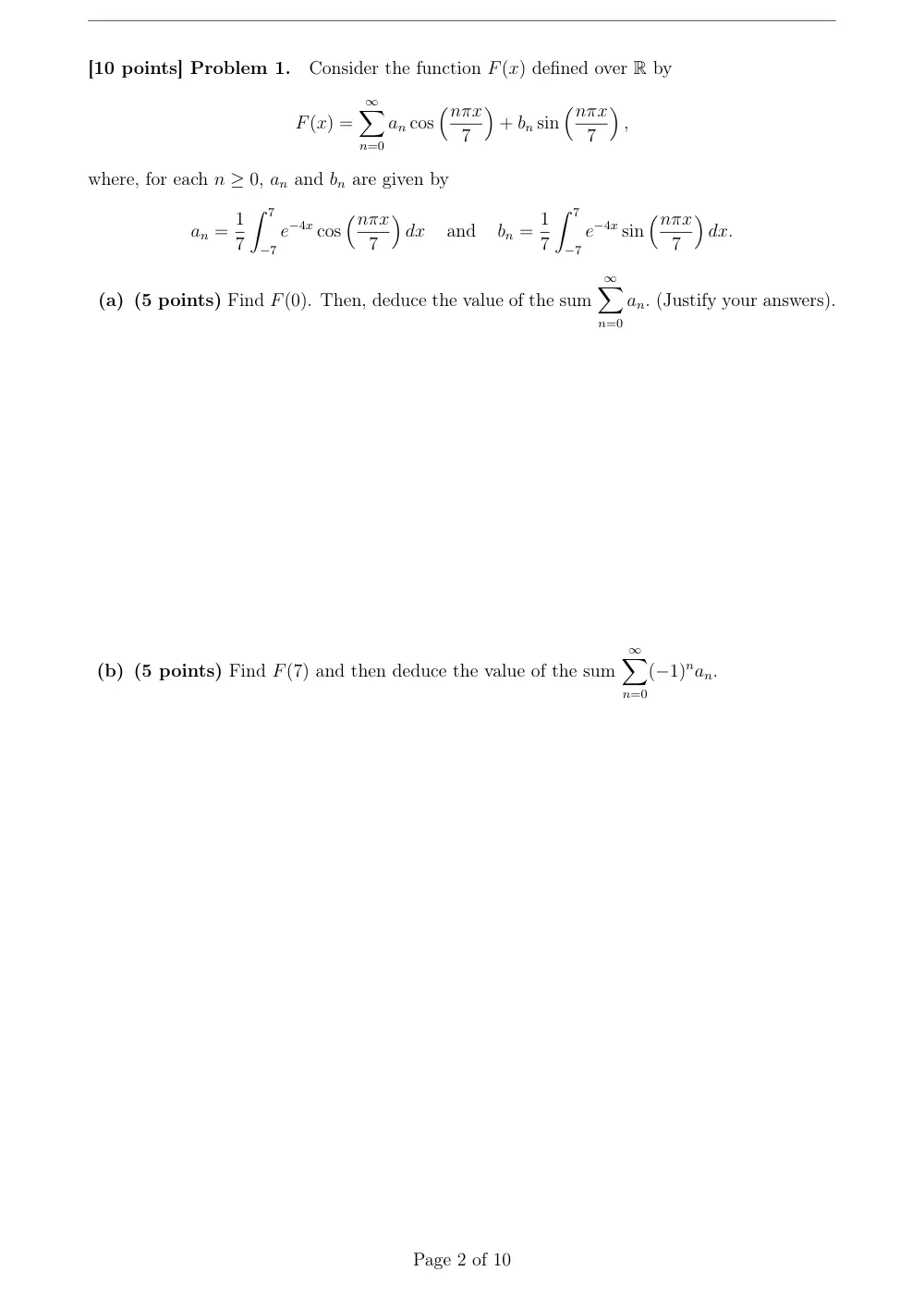
[10 points] Problem 1.
Consider the function F(x) defined over R by
F(x) =
∞
�
n=0
an cos
�nπx
7
�
+ bn sin
�nπx
7
�
,
where, for each n ≥ 0, an and bn are given by
an = 1
7
� 7
−7
e−4x cos
�nπx
7
�
dx
and
bn = 1
7
� 7
−7
e−4x sin
�nπx
7
�
dx.
(a) (5 points) Find F(0). Then, deduce the value of the sum
∞
�
n=0
an. (Justify your answers).
(b) (5 points) Find F(7) and then deduce the value of the sum
∞
�
n=0
(−1)nan.
Page 2 of 10
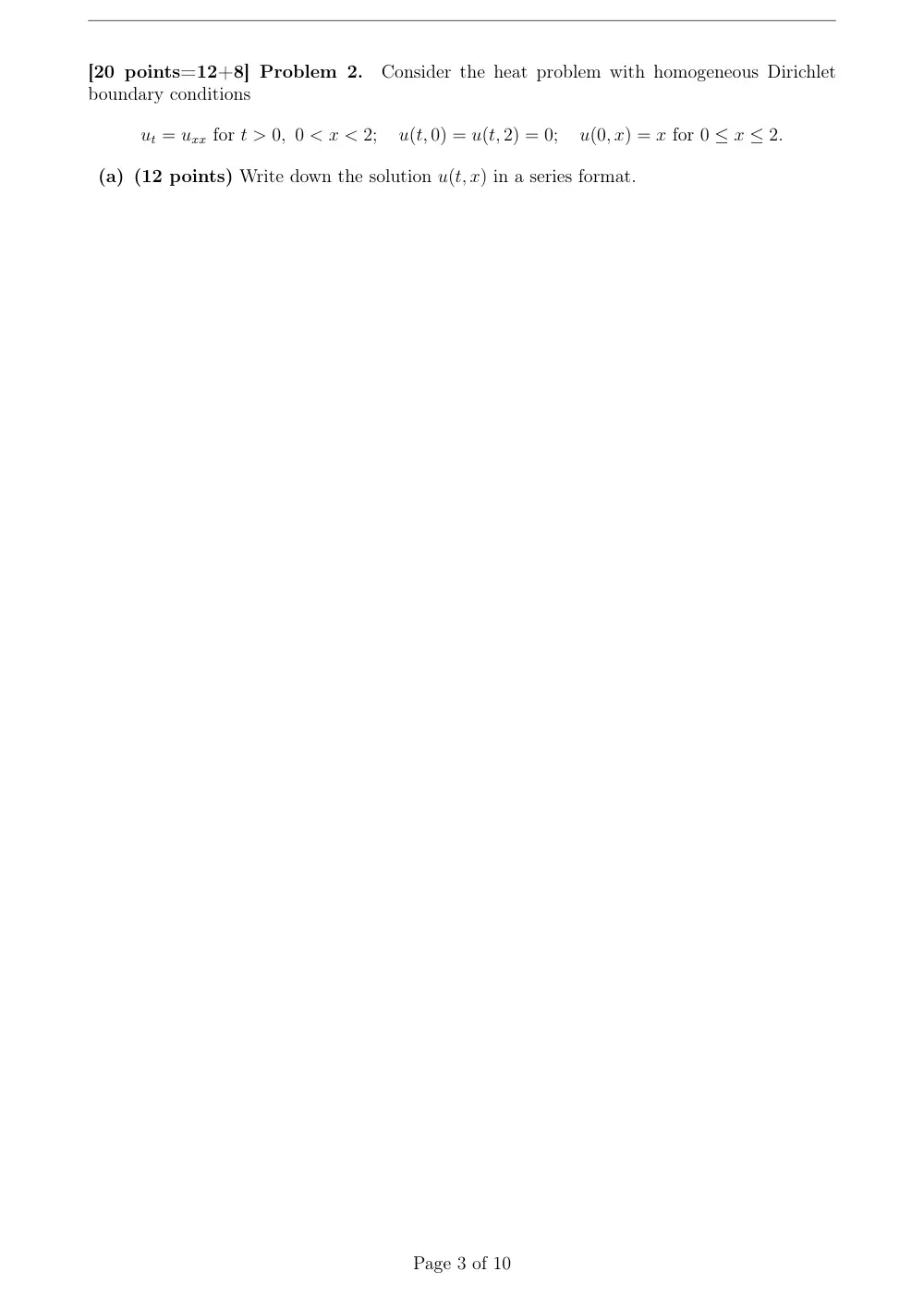
[20 points=12+8] Problem 2.
Consider the heat problem with homogeneous Dirichlet
boundary conditions
ut = uxx for t > 0, 0 < x < 2;
u(t, 0) = u(t, 2) = 0;
u(0, x) = x for 0 ≤ x ≤ 2.
(a) (12 points) Write down the solution u(t, x) in a series format.
Page 3 of 10
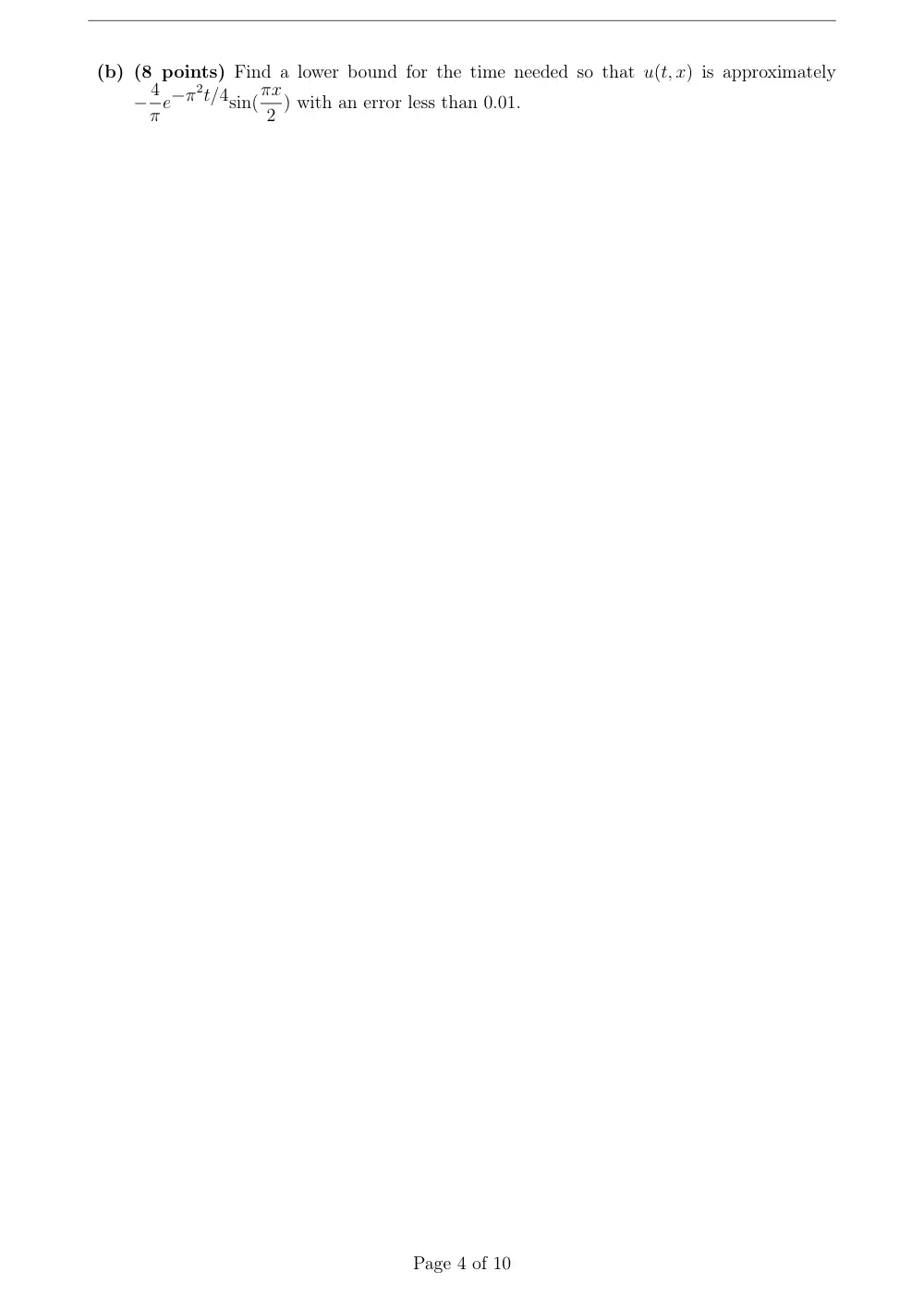
(b) (8 points) Find a lower bound for the time needed so that u(t, x) is approximately
− 4
πe−π2t/4sin(πx
2 ) with an error less than 0.01.
Page 4 of 10
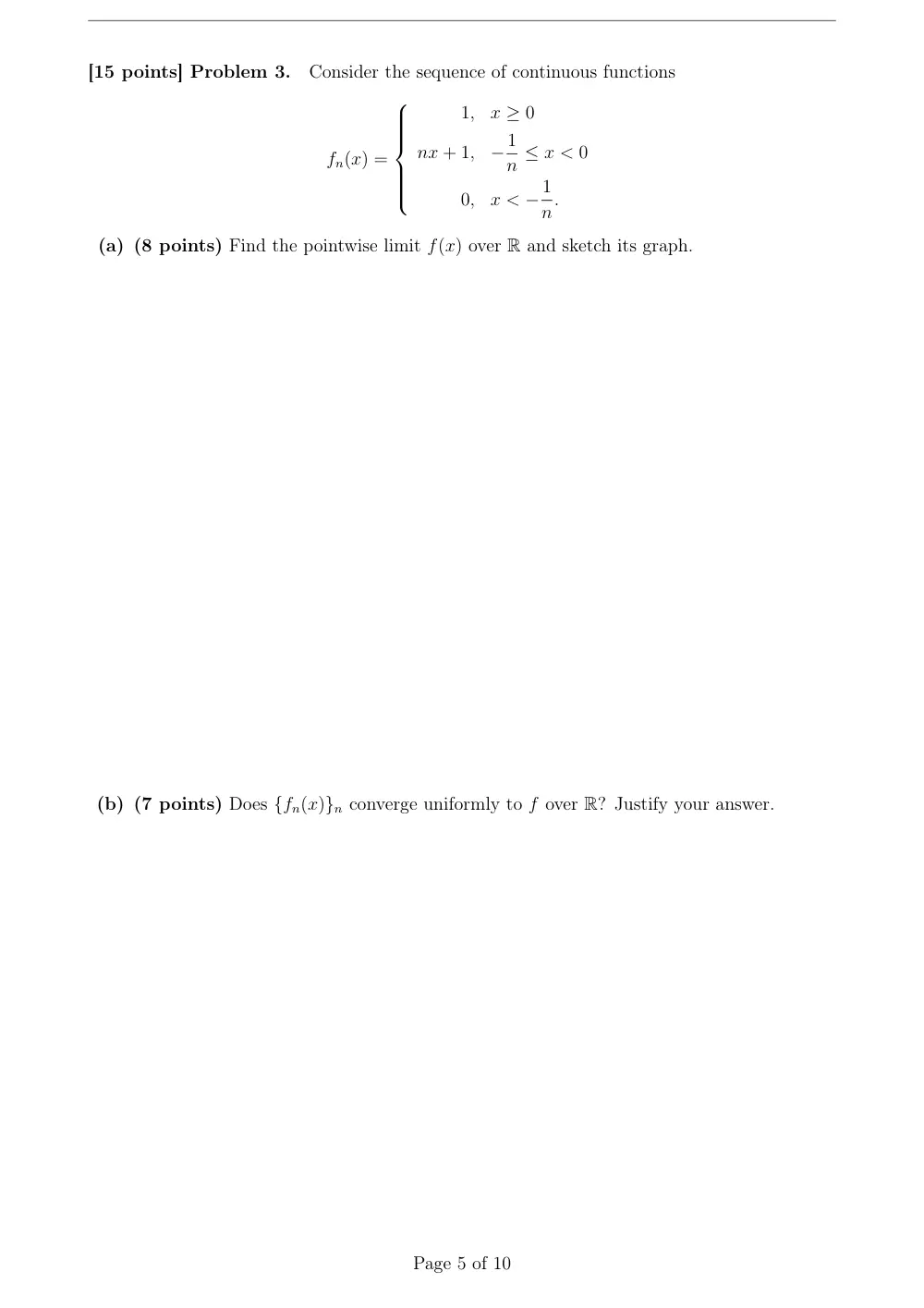
[15 points] Problem 3.
Consider the sequence of continuous functions
fn(x) =
1,
x ≥ 0
nx + 1,
−1
n ≤ x < 0
0,
x < −1
n.
(a) (8 points) Find the pointwise limit f(x) over R and sketch its graph.
(b) (7 points) Does {fn(x)}n converge uniformly to f over R? Justify your answer.
Page 5 of 10
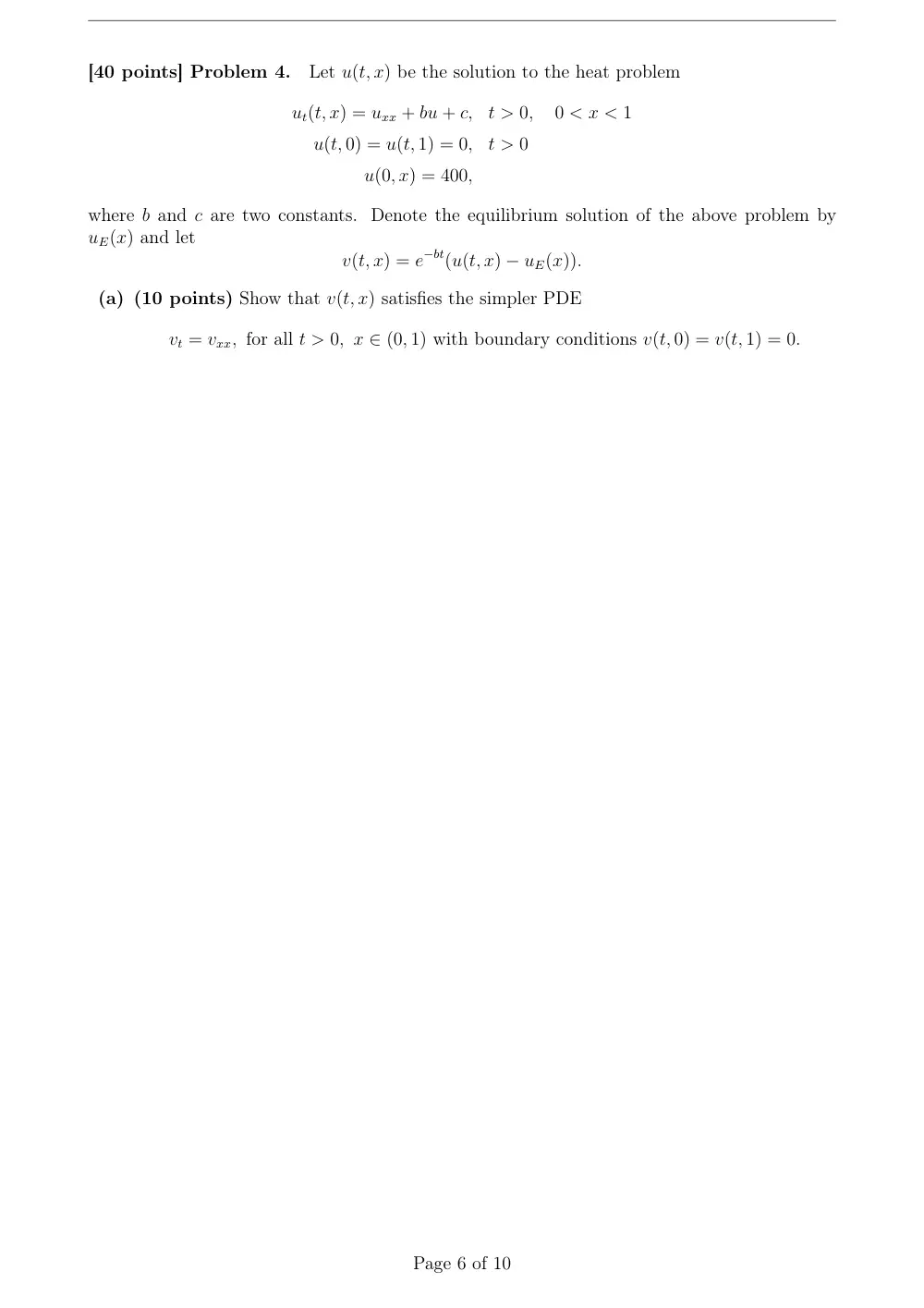
[40 points] Problem 4.
Let u(t, x) be the solution to the heat problem
ut(t, x) = uxx + bu + c,
t > 0,
0 < x < 1
u(t, 0) = u(t, 1) = 0,
t > 0
u(0, x) = 400,
where b and c are two constants. Denote the equilibrium solution of the above problem by
uE(x) and let
v(t, x) = e−bt(u(t, x) − uE(x)).
(a) (10 points) Show that v(t, x) satisfies the simpler PDE
vt = vxx, for all t > 0, x ∈ (0, 1) with boundary conditions v(t, 0) = v(t, 1) = 0.
Page 6 of 10
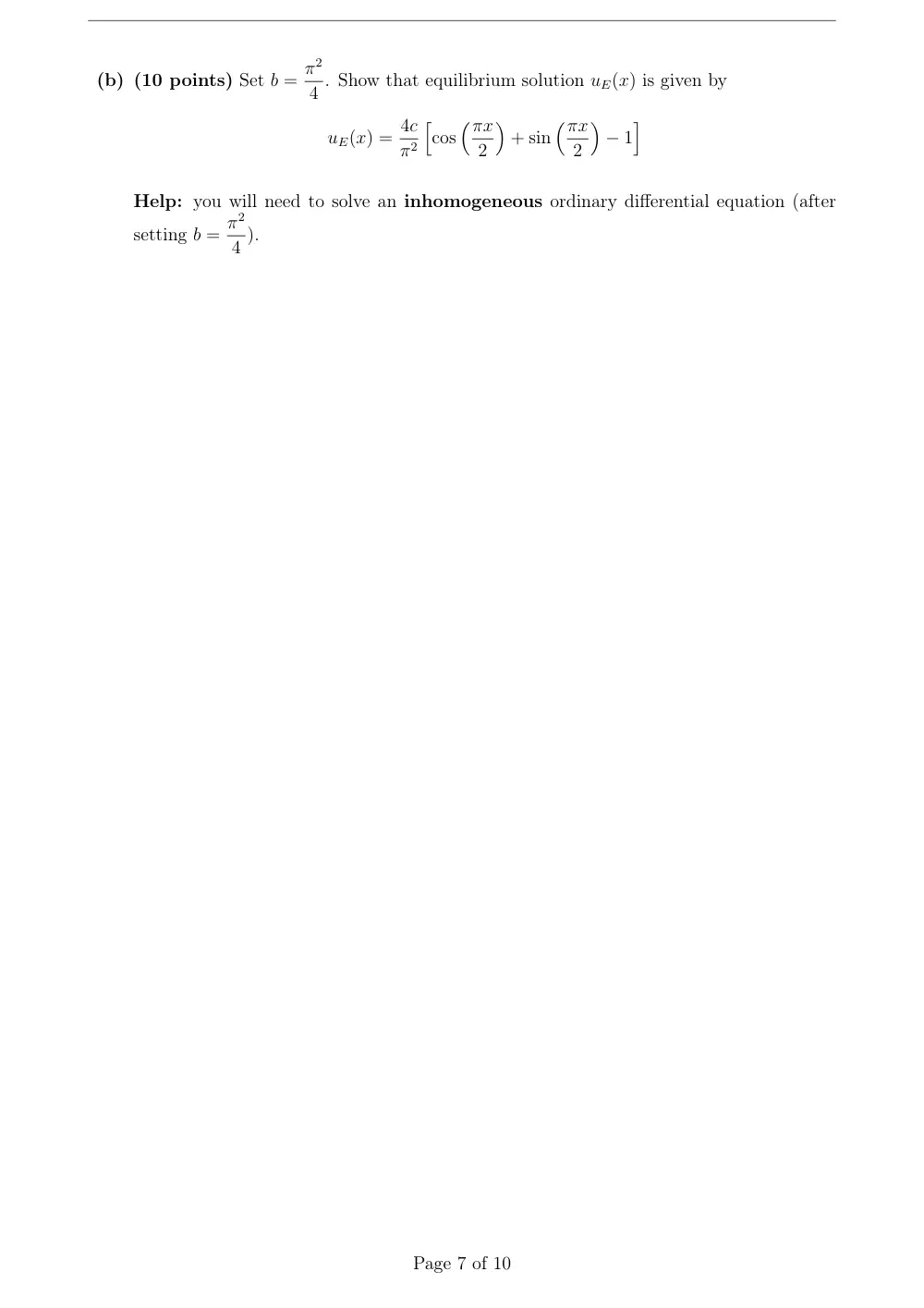
(b) (10 points) Set b = π2
4 . Show that equilibrium solution uE(x) is given by
uE(x) = 4c
π2
�
cos
�πx
2
�
+ sin
�πx
2
�
− 1
�
Help: you will need to solve an inhomogeneous ordinary differential equation (after
setting b = π2
4 ).
Page 7 of 10
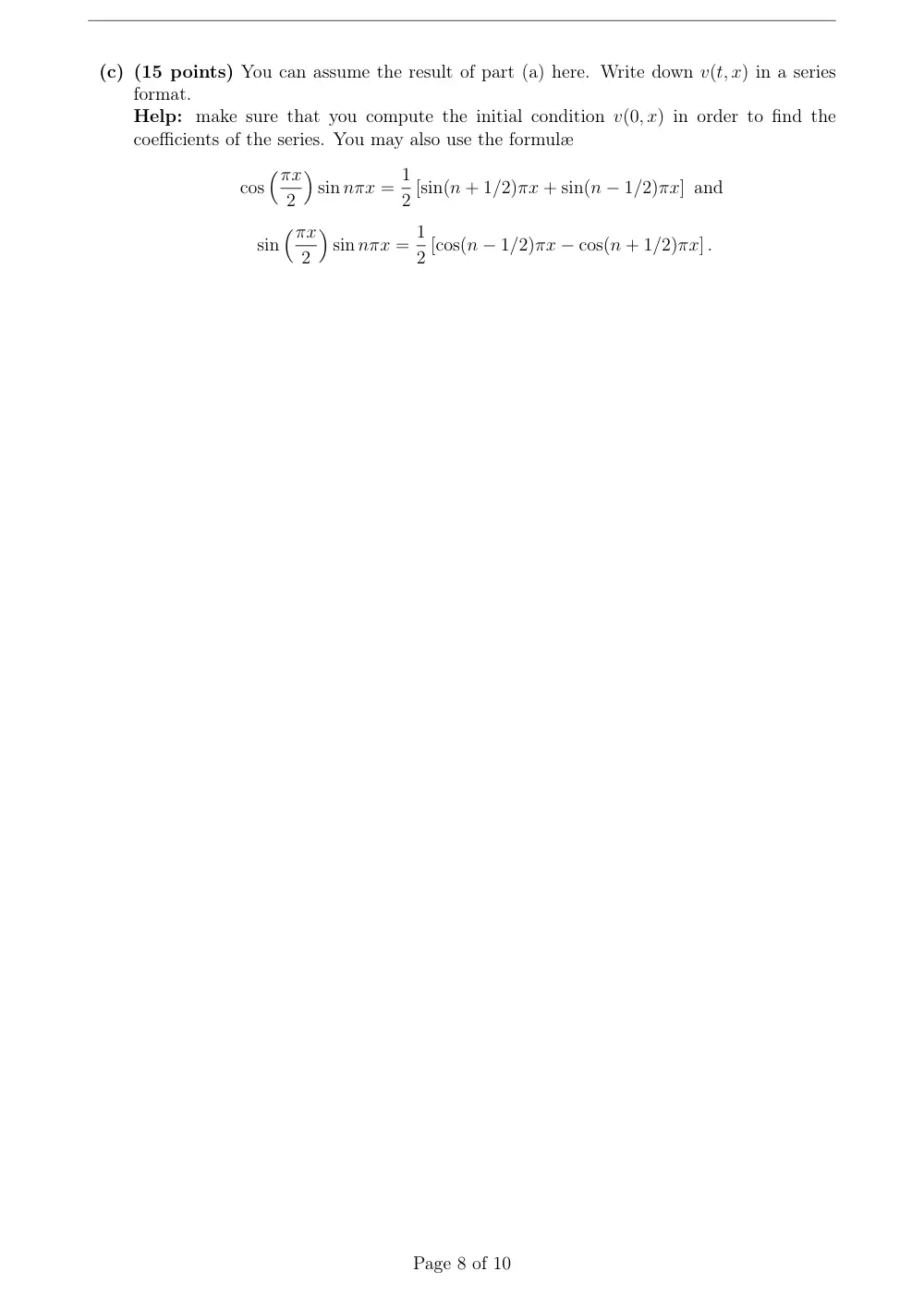
(c) (15 points) You can assume the result of part (a) here. Write down v(t, x) in a series
format.
Help: make sure that you compute the initial condition v(0, x) in order to find the
coefficients of the series. You may also use the formulæ
cos
�πx
2
�
sin nπx = 1
2 [sin(n + 1/2)πx + sin(n − 1/2)πx] and
sin
�πx
2
�
sin nπx = 1
2 [cos(n − 1/2)πx − cos(n + 1/2)πx] .
Page 8 of 10
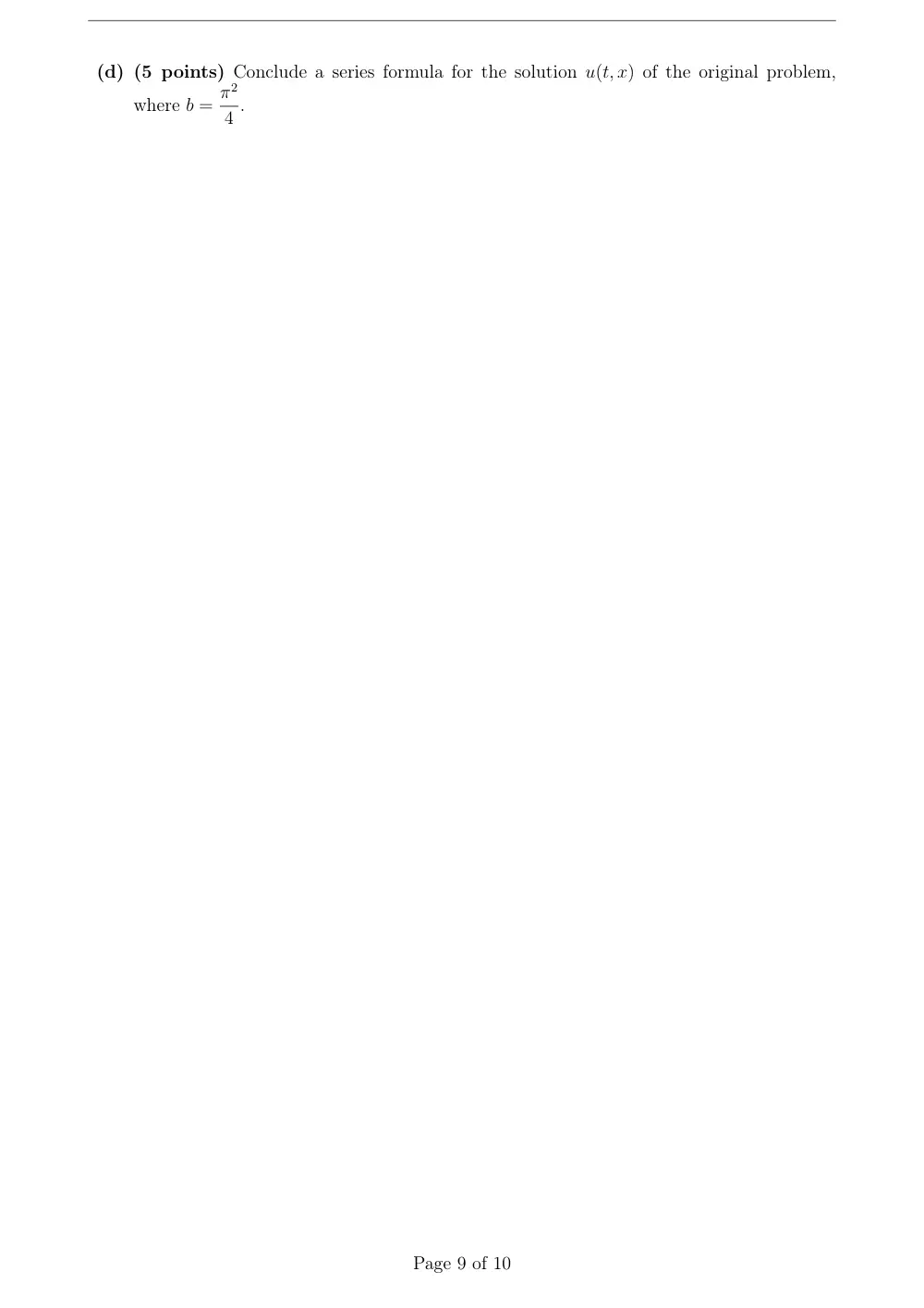
(d) (5 points) Conclude a series formula for the solution u(t, x) of the original problem,
where b = π2
4 .
Page 9 of 10
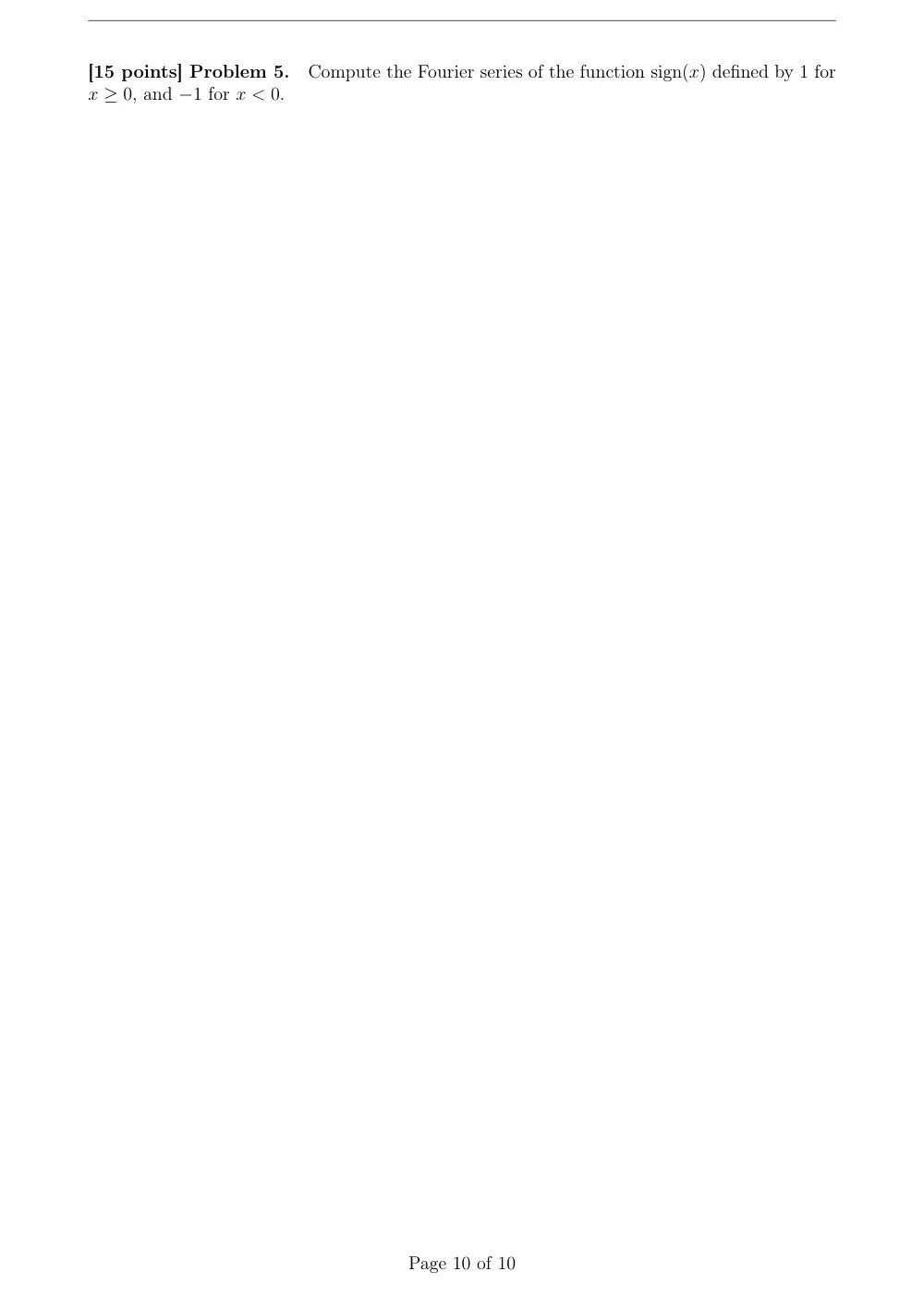
[15 points] Problem 5.
Compute the Fourier series of the function sign(x) defined by 1 for
x ≥ 0, and −1 for x < 0.
Page 10 of 10