
MATH 212 Exam 2, Spring 2011
American University of Beirut · Introductory Partial Differential Equations · 9 pages



More MATH 212 files
Show the text of this exam
Midterm Exam: MATH 212
Professor: Mohammad El Smaily
Beirut, November 1, 2014
Duration: 60 minutes
Last Name:
First Name:
Student number:
Lecture time (circle one of the following 3): 11:00 to 12:00
12:00 to 1:00
1:00 to 2:00
No Calculators or other aids are allowed
(cell phones must be turned off during this exam)
No credit will be given if the answers are not justified.
No books, no course notes, no cheat sheets are allowed
For marker’s use only
Question
Mark
1
/9
2
/4
3
/9
4
/3
Total
/25
1
[9=4+5 marks] Problem 1. (the parts of this problem are not related)
Let u = u(t, x) be a smooth solution of the following PDE (where x ∈ [0, 1] and t ≥ 0):
ut(t, x) =
uxx + λux,
for all t > 0,
0 < x < 1
u(t, 1) = u(t, 0) =
0
for all t > 0
u(0, x) =
f(x)
(1)
where f is a random C1, non constant, function which vanishes outside the interval
�1
4, 3
4
�
and
λ is a fixed real number. Define the quantity
m(t) :=
� 1
0
(u(t, x))2 dx.
1. (4 marks) Show that, if u is a smooth solution of the above problem, dm
dt (t) remains
strictly negative for all t (regardless of the sign of λ).
Page 2 of 9
2. (5 marks) In this part, replace the conditions on u(t, 0) and u(t, 1) (in the PDE (1)) by
the following:
ux(t, 1) = 0,
u(t, 1) = 1 and u(t, 0) = 0.
(Notice the difference between the current conditions and the ones in part 1). Show that
for all t ≥ 0,
m(t) ≤ λt +
� 1
0
(f(x))2 dx.
(Hint: upon an integration by parts of the PDE multiplied by u, observe first that m′(t)
is less than or equal to λ.)
Page 3 of 9
more space if needed
Page 4 of 9
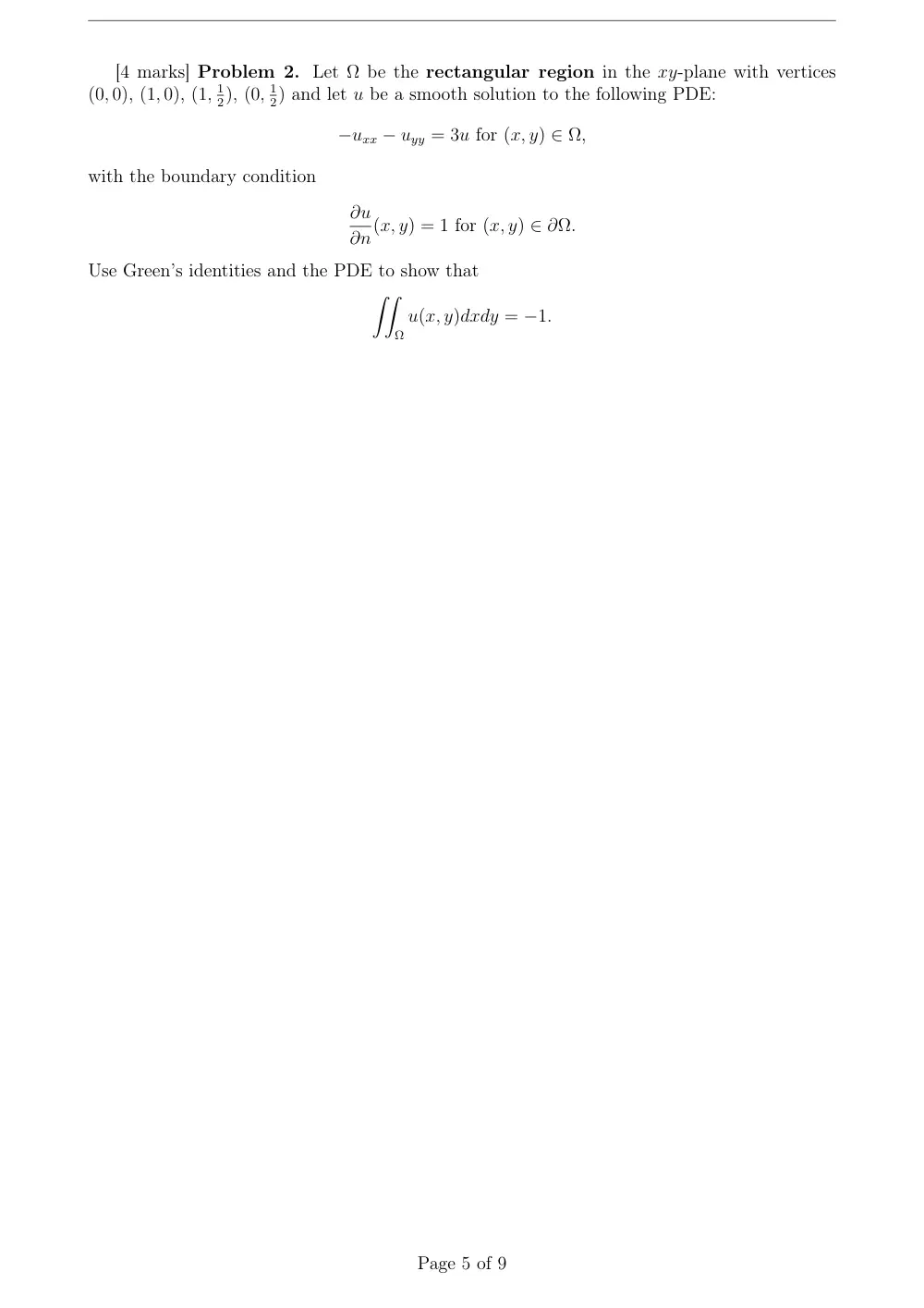
[4 marks] Problem 2. Let Ω be the rectangular region in the xy-plane with vertices
(0, 0), (1, 0), (1, 1
2), (0, 1
2) and let u be a smooth solution to the following PDE:
−uxx − uyy = 3u for (x, y) ∈ Ω,
with the boundary condition
∂u
∂n(x, y) = 1 for (x, y) ∈ ∂Ω.
Use Green’s identities and the PDE to show that
��
Ω
u(x, y)dxdy = −1.
Page 5 of 9
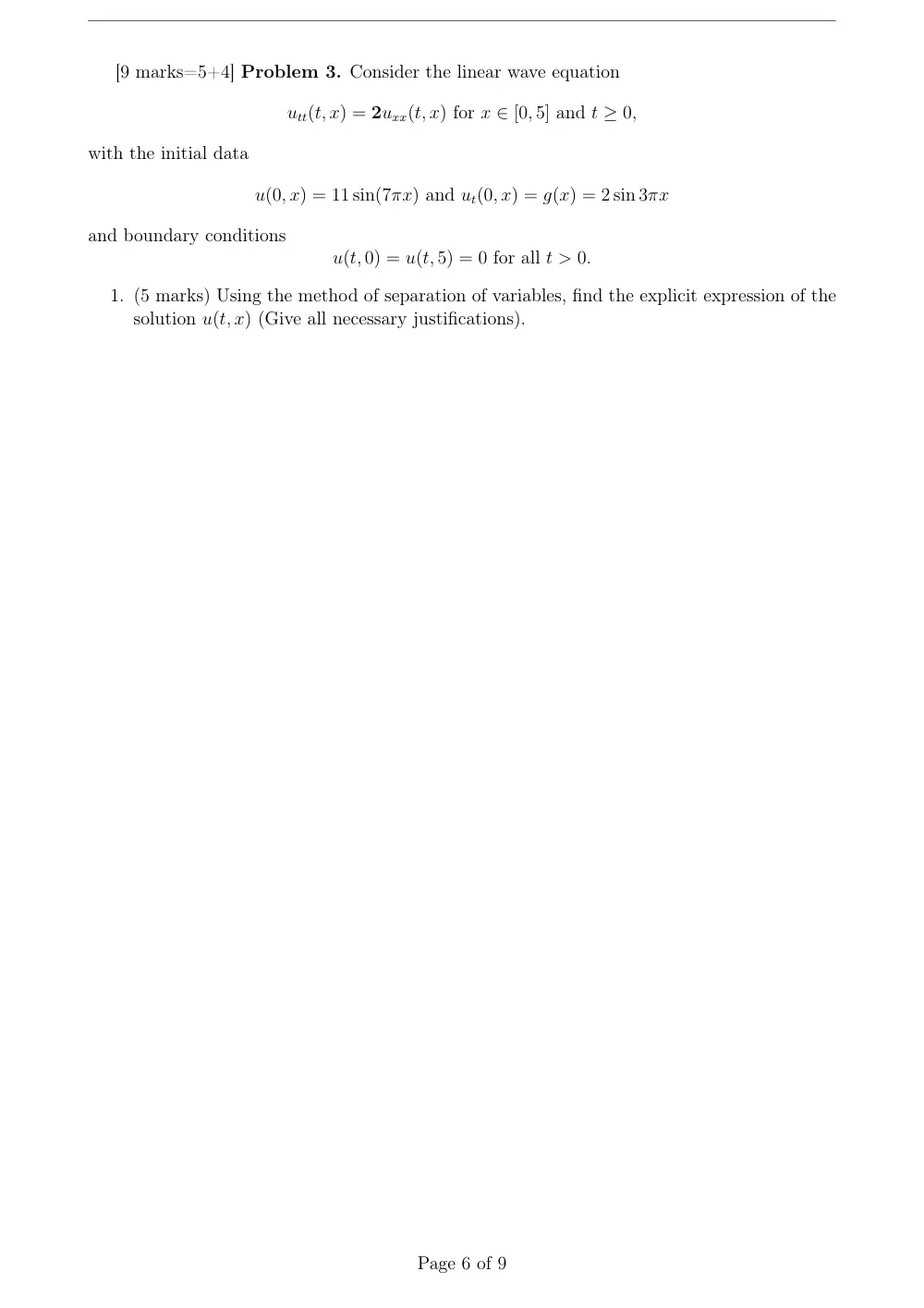
[9 marks=5+4] Problem 3. Consider the linear wave equation
utt(t, x) = 2uxx(t, x) for x ∈ [0, 5] and t ≥ 0,
with the initial data
u(0, x) = 11 sin(7πx) and ut(0, x) = g(x) = 2 sin 3πx
and boundary conditions
u(t, 0) = u(t, 5) = 0 for all t > 0.
1. (5 marks) Using the method of separation of variables, find the explicit expression of the
solution u(t, x) (Give all necessary justifications).
Page 6 of 9
2. (4 marks) Use D’Alembert’s formula to compute the function u(t, x) which solves the
same wave equation, given in the previous page, with same initial data and boundary
conditions.
Page 7 of 9
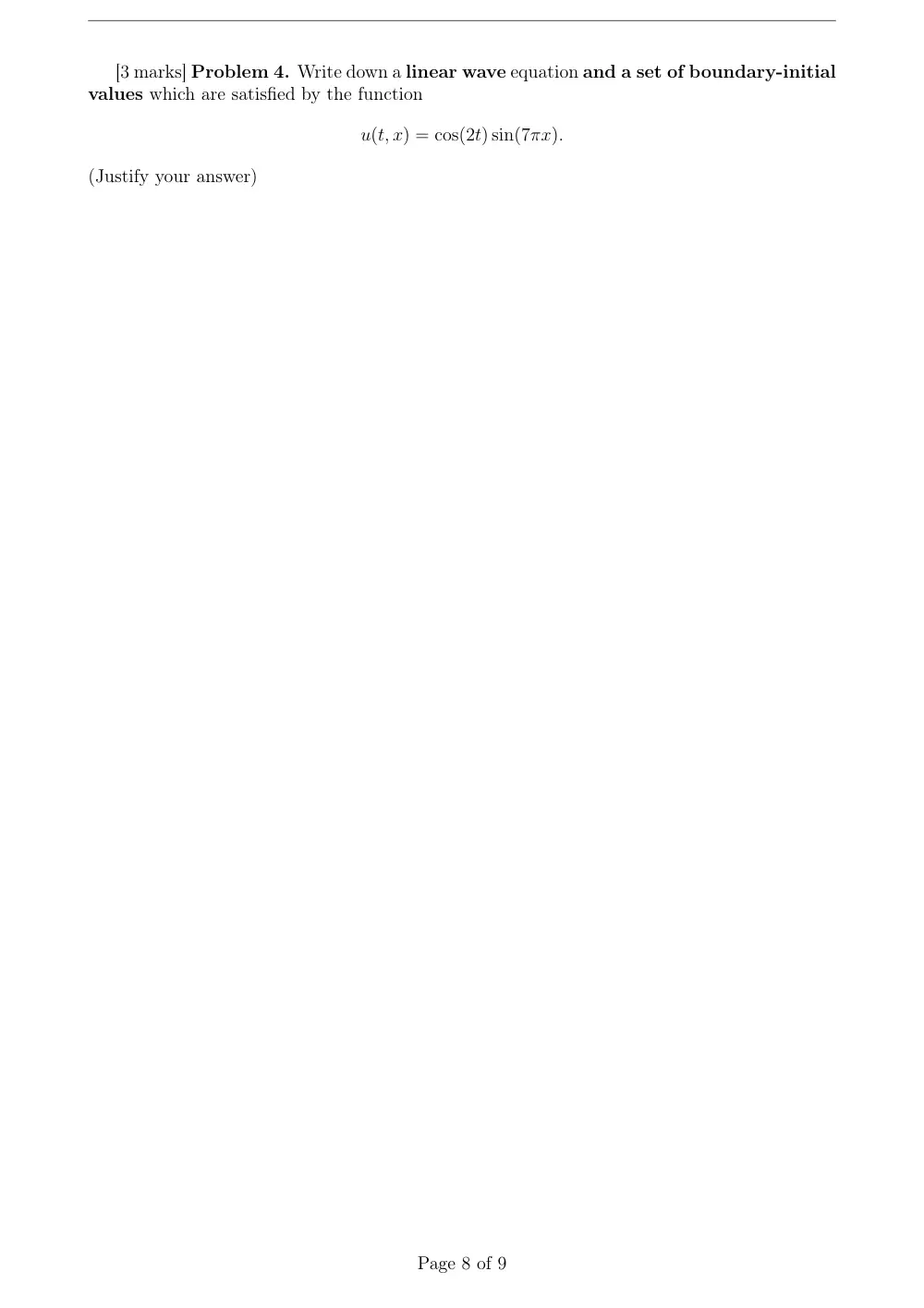
[3 marks] Problem 4. Write down a linear wave equation and a set of boundary-initial
values which are satisfied by the function
u(t, x) = cos(2t) sin(7πx).
(Justify your answer)
Page 8 of 9
Extra space
Page 9 of 9