
MATH 214 Final, Fall 2003
American University of Beirut · Topology I · 11 pages


Showing the first 10 of 11 pages. Download the PDF to see all of it.
More MATH 214 files
Show the text of this final exam
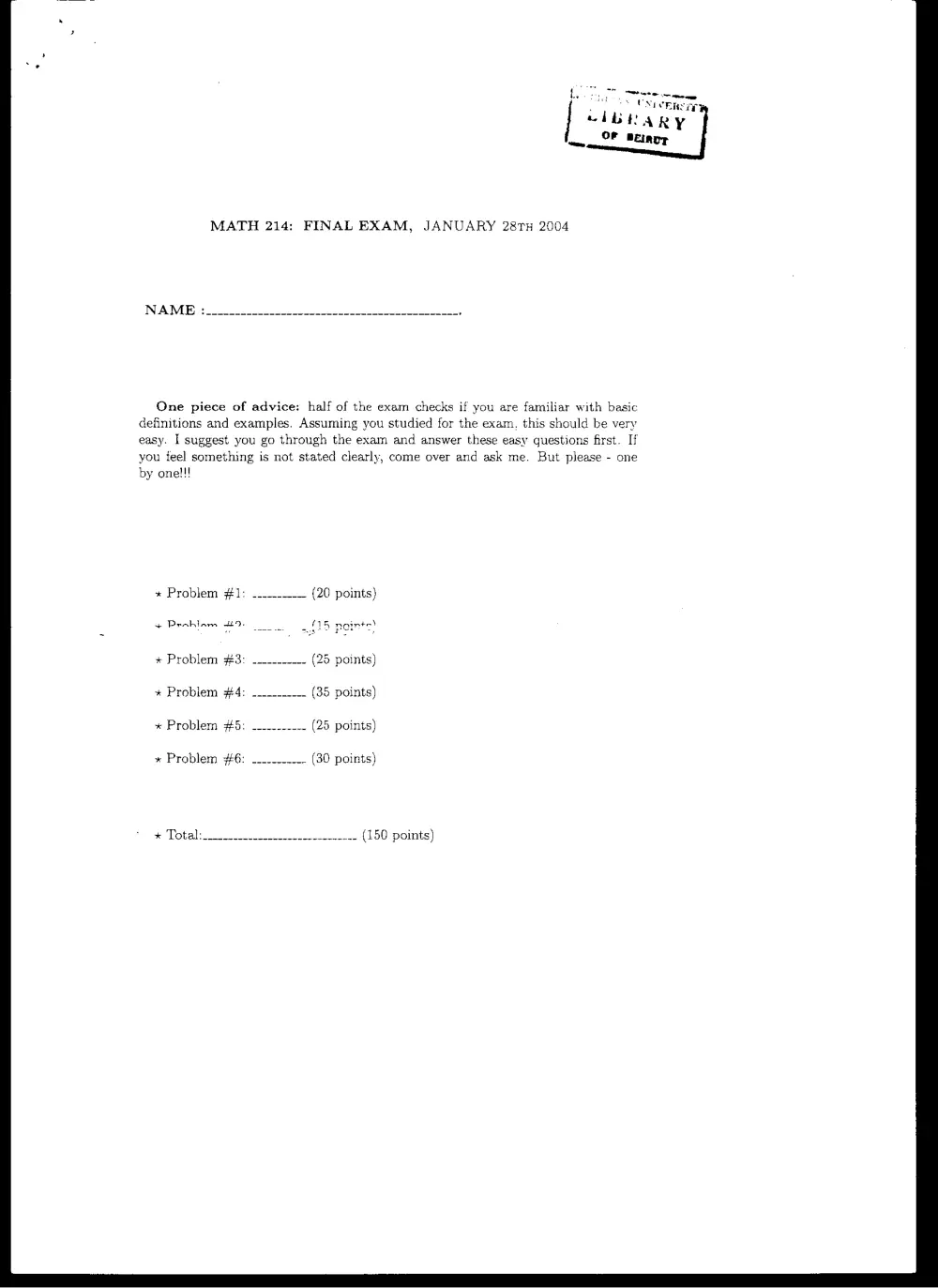
MATH 214: FINAL EXAM, JANUARY 28TH 2004
One piece of advice: half of the exam checks if you are familiar with basic
definitions and examples. Assuming you studied for the exam, this should be very
easy. I suggest you go through the exam and answer these easy questions first. If
you feel something is not stated clearly, come over and ask me. But please - one
by onel!!
» Problem #1: --------- (20 points)
rahlam 9- M15 nginte)
+P 4 JO5 points
* Problem #3: -_------- (25 points)
* Problem #4: ---------. (35 points)
* Problem #5: _-_----_ (25 points)
» Problem #6: ---------- (30 points)
* Total:___________________ (150 points)
{ “ibiagy
OF etiAagT
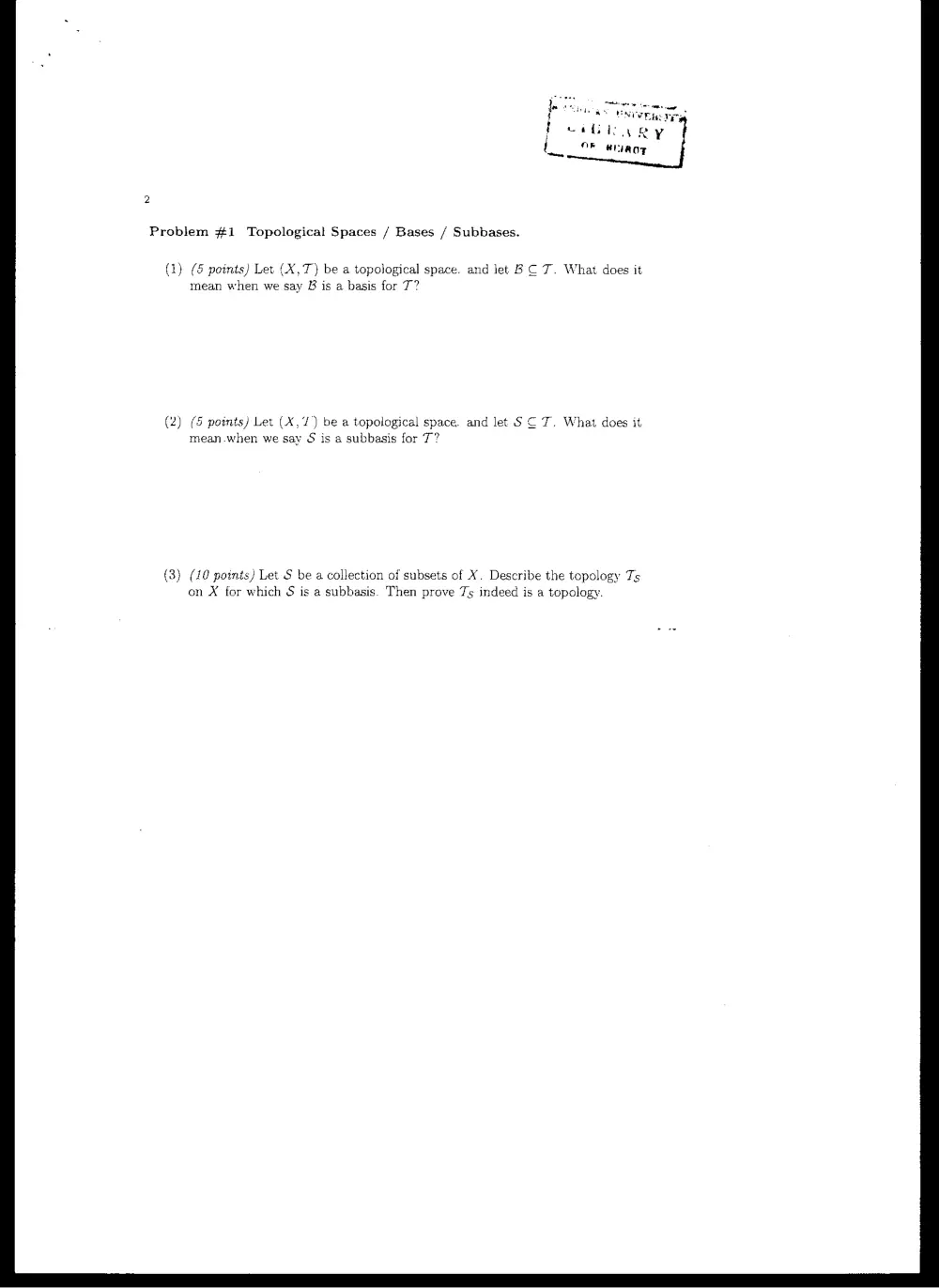
Problem #1 Topological Spaces / Bases / Subbases.
(1) (5 points) Let (X,T)} be a topological space. and let B C 7. What does it
mean when we say 8 is a basis for T?
(2) (5 points) Let (X,7) be a topological space. and let S C JT. What does it
mean.when we say S is a subbasis for 7?
(3) (£0 points) Let S be a collection of subsets of X. Describe the topology Ts
on X for which S is a subbasis. Then prove 7s indeed is a topology.
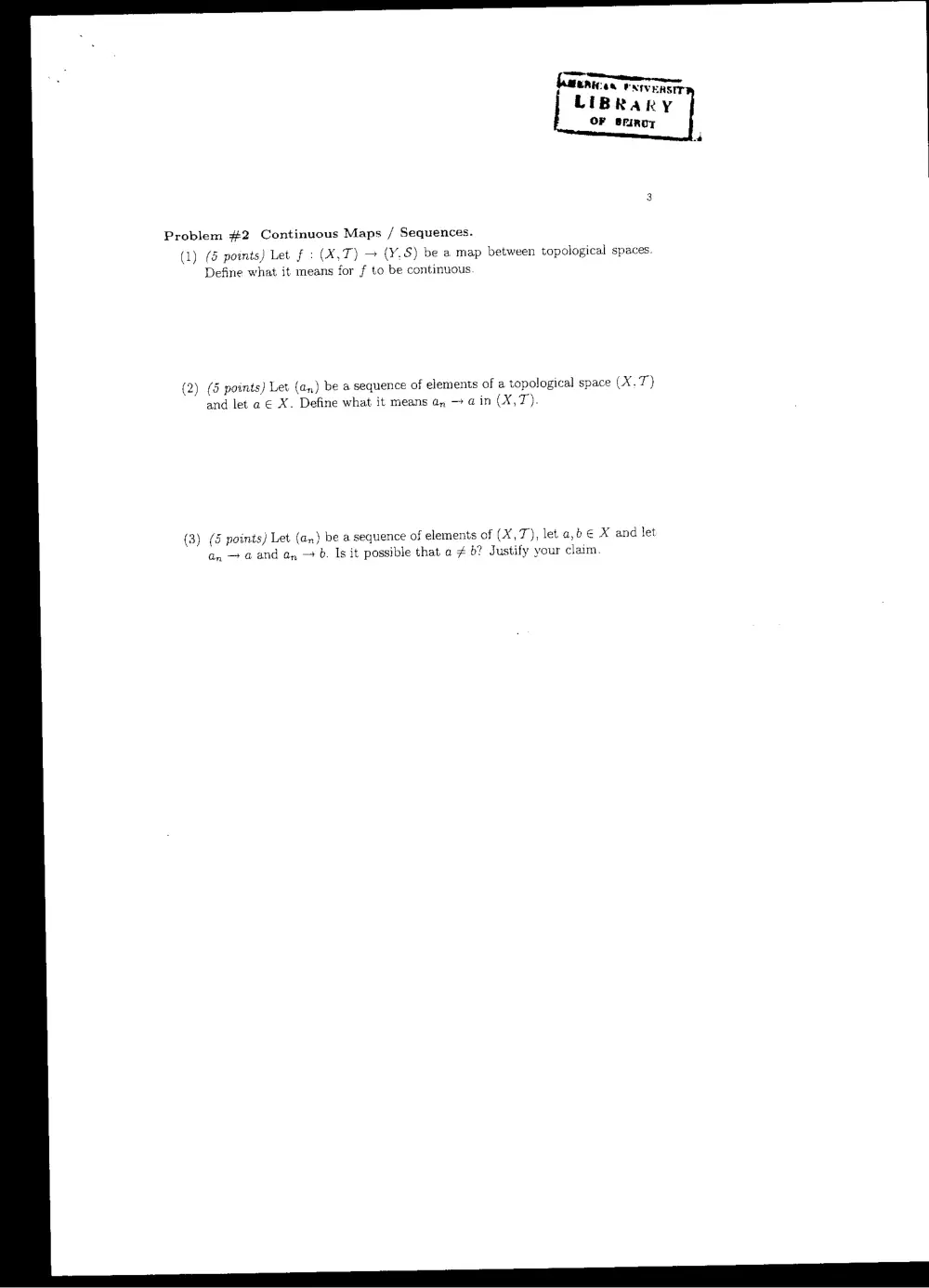
Problem #2 Continuous Maps / Sequences.
(1) (8 points) Let f : (X,T) > (¥,S) be a map between topological spaces.
Define what it means for f to be continuous
(2) (5 points) Let (a,) be a sequence of elements of a topological space (X.T)
and let a € X. Define what it means an — @ in (X,T).
(3) (5 points) Let (an) be a sequence of elements of (X,7), let a,b € X and let
a, — a and a, — b. Isit possible that a 4 5? Justify your claim.
m
a, ae
mete naa
huerican BNIVERSIT IS
i LIBRARY
( OF HIKE T
-—-—___!
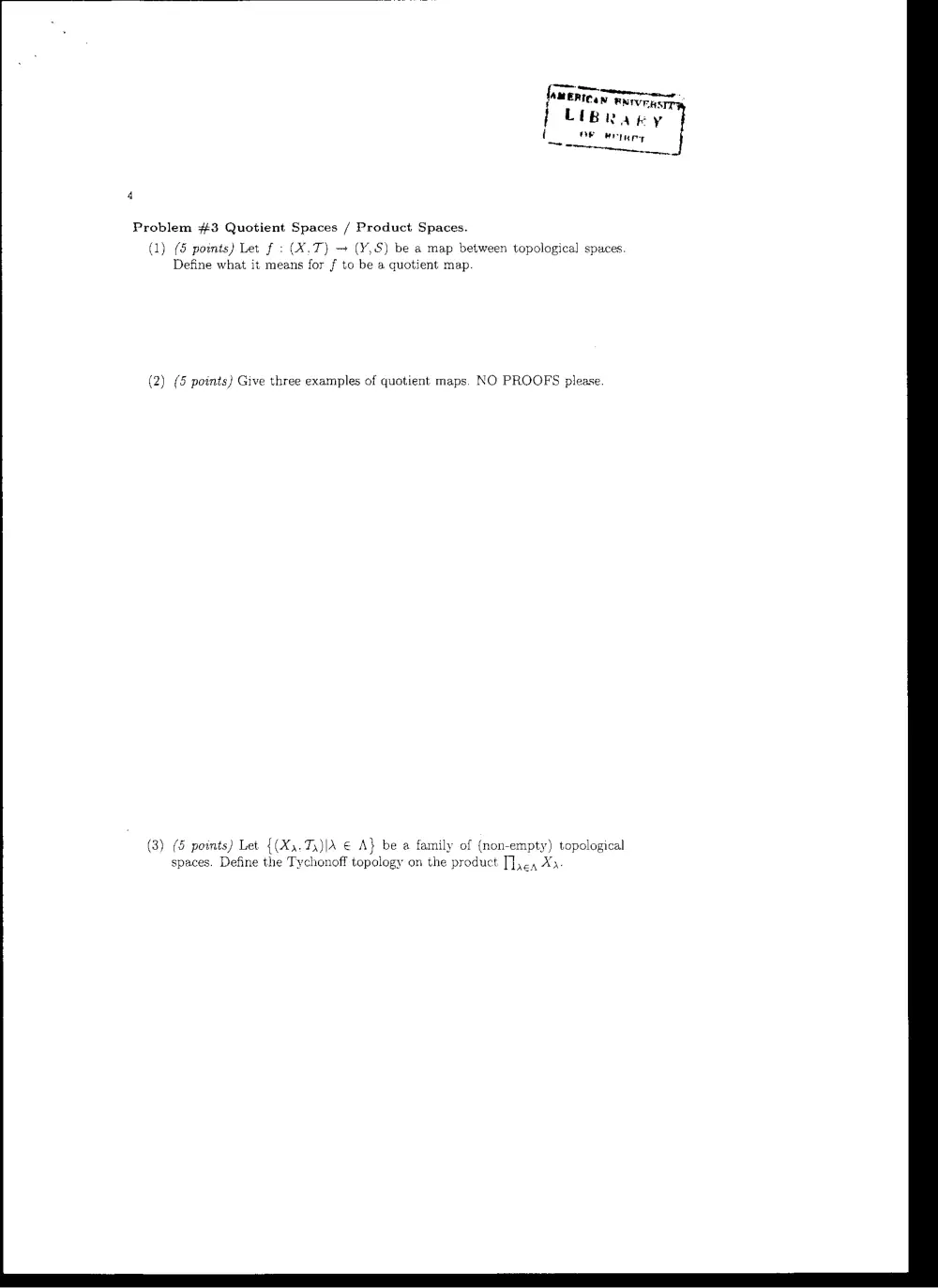
Problem #3 Quotient Spaces / Product Spaces.
(1) (5 points) Let f : (X.T) - (Y,S) be a map between topological spaces.
Define what it means for f to be a quotient map.
(2) (5 points) Give three examples of quotient maps. NO PROOFS please.
(3) (5 points) Let {(X,.T,)|A € A} be a family of (non-empty) topological
spaces. Define the Tychonoff topology on the product Thea X>».
AMERICAN tare “iat
(4) (10 points) Prove the projection maps
Pra I XX 6
EA
are quotient maps. If you find this hard, you may consider a simpler case
when A = {1,2} - for half the credit.
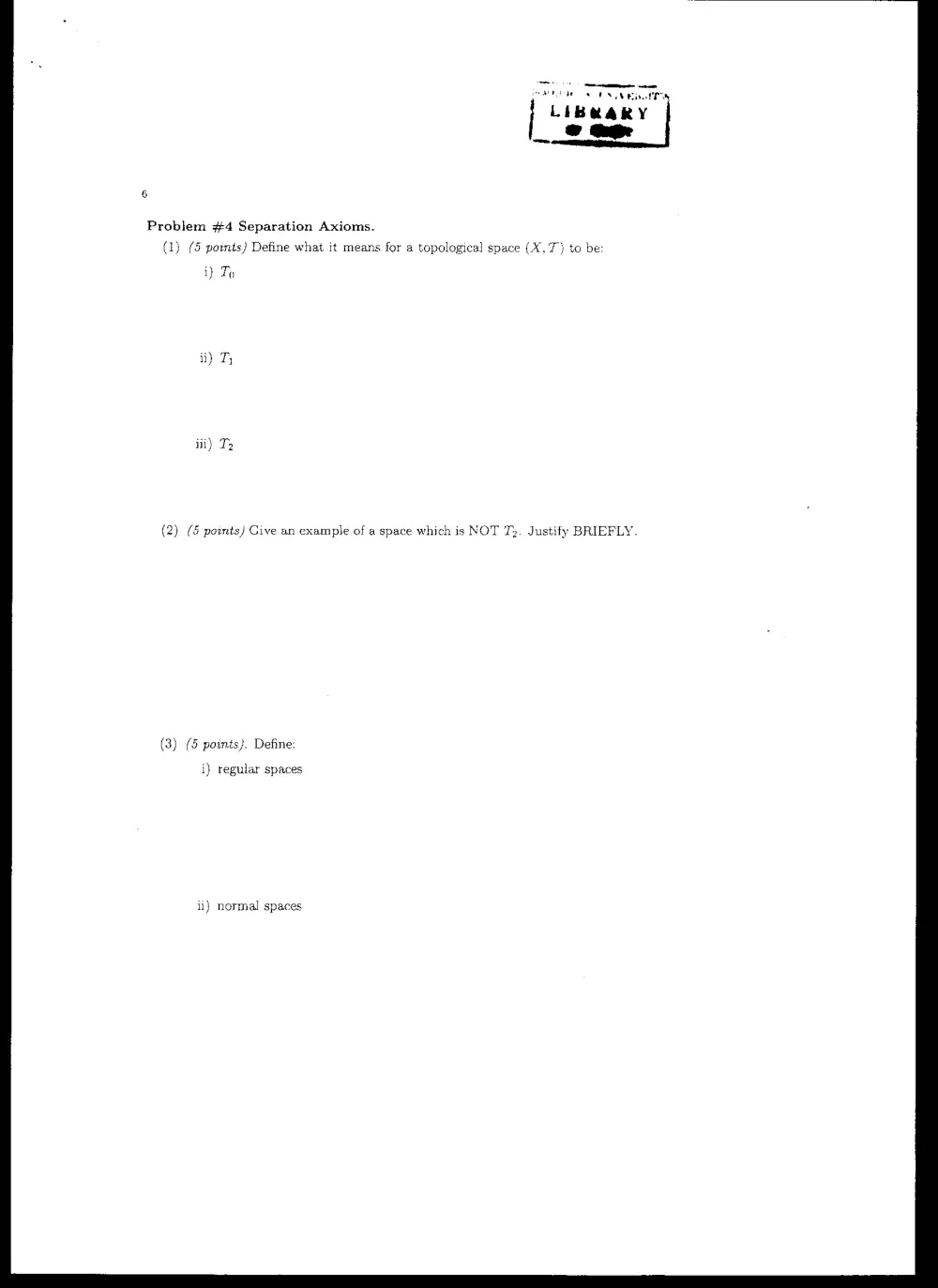
Problem #4 Separation Axioms.
(1) (5 points) Define what it means for a topological space (X,7) to be:
i) To
ii) Ty
iii) Tp
(2) (5 points) Give an example of a space which is NOT T). Justify BRIEFLY.
(3) (5 points). Define:
i) regular spaces
ii) normal spaces
7
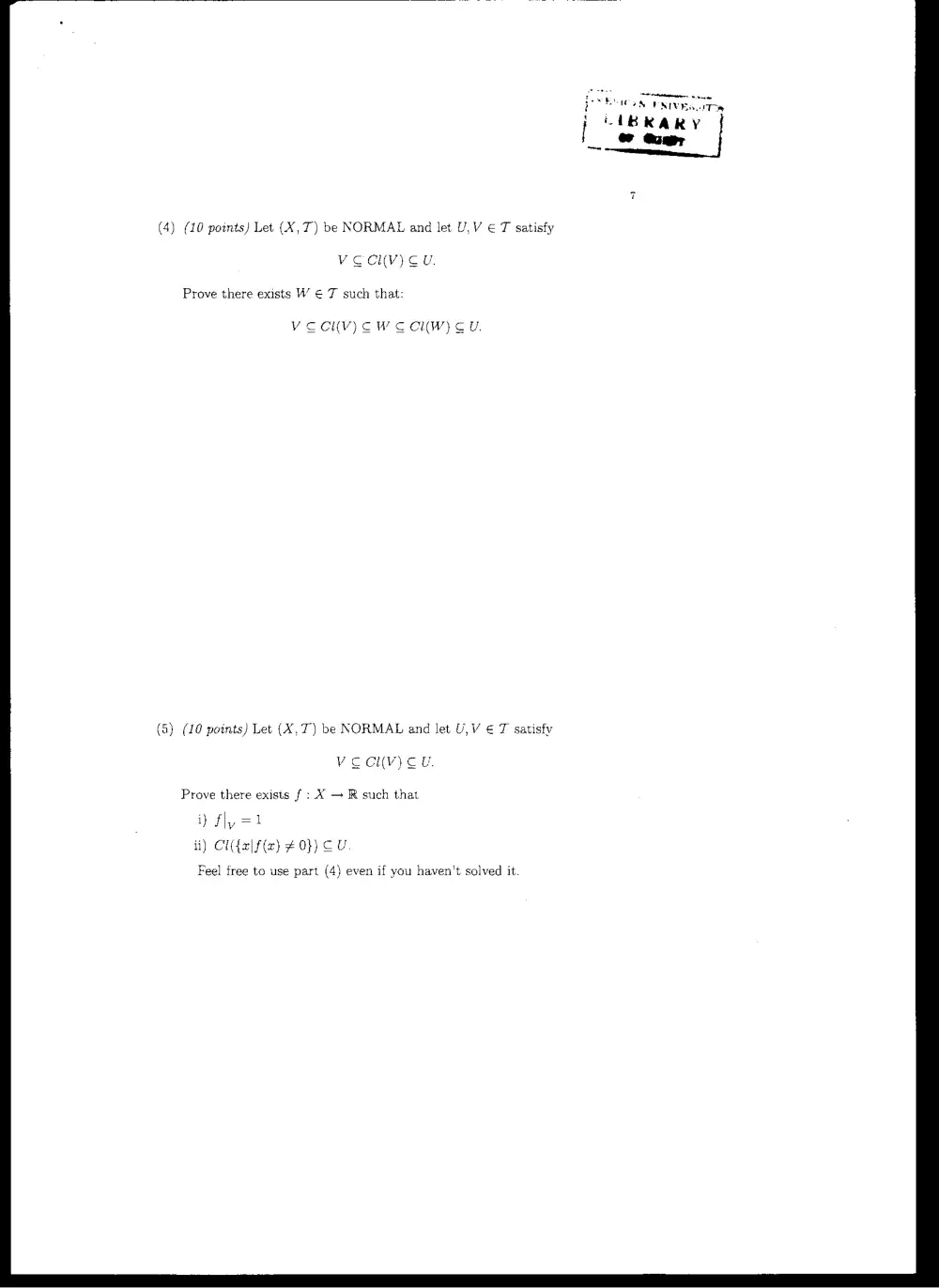
(4) (10 points) Let (X,T) be NORMAL and let U,V € T satisfy
VCOCKV) CU.
Prove there exists W € T such that:
VooCuvycw ccuw) cu.
(5) (10 points) Let (X,7) be NORMAL and let U,V € T satisfy
VCCUV) CH.
Prove there exists f : X — R such that
i) fly =l1
ii) Cl({x|f(e) 4 0}) CU
Feel free to use part (4) even if you haven't solved it.
8
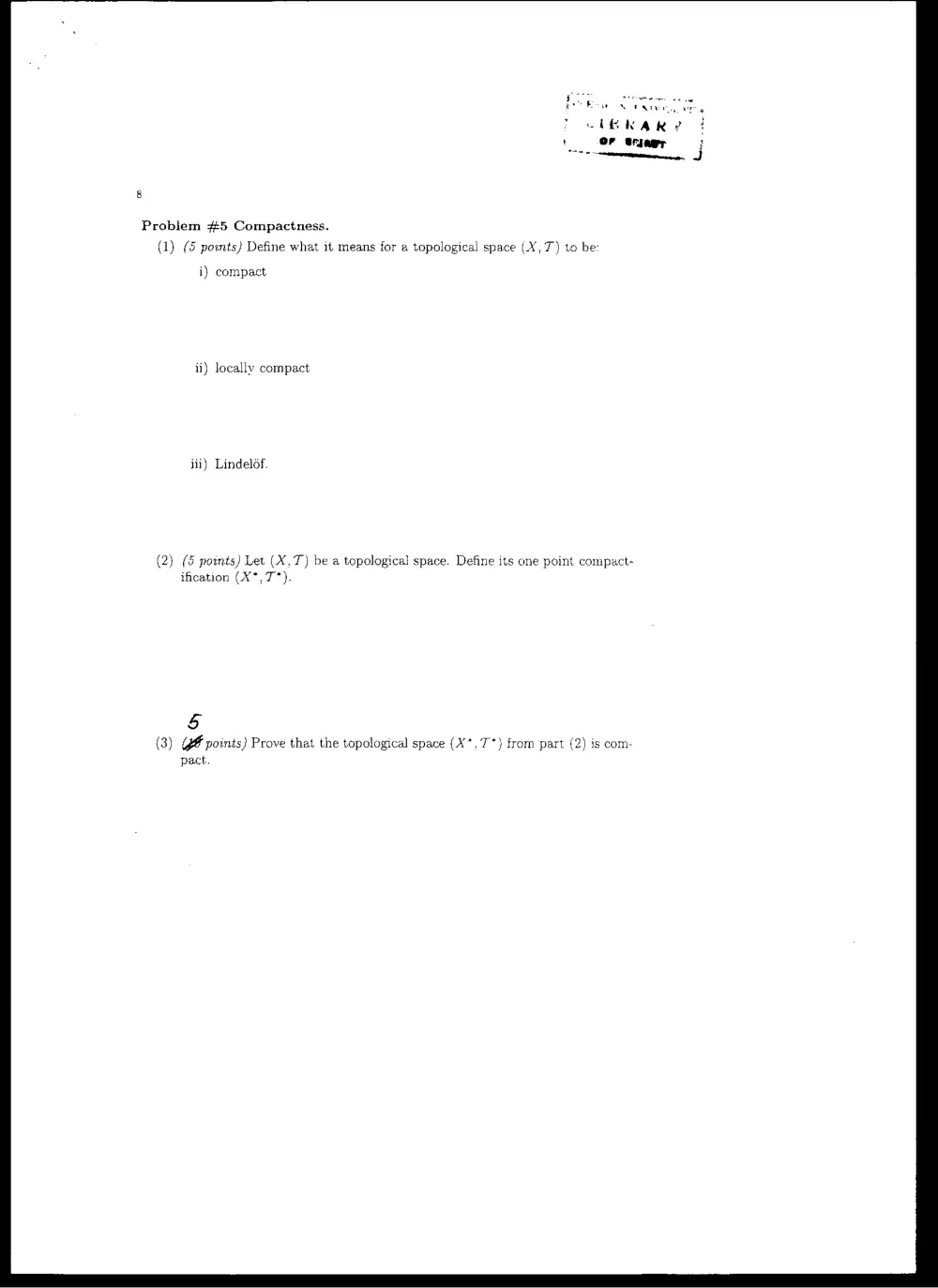
Problem #5 Compactness.
(1) (5 points) Define what it means for a topological space (X, 7) to be:
i} compact
ii) locally compact
iii) Lindeléf.
(2} (5 points) Let (X,T) be a topological space. Define its one point compact-
ification (X*,7*).
§
(3) G# points) Prove that the topological space (X*, 7”) from part (2) is com-
pact.
SOE
iB AR.
t or SADT .
* ete canw ae, a
9
(4) (10 points} Prove that the topological space (X*,7*) from part (2) is Haus-
dorff if and only if
i) (X,T) is Hausdorff and
ii) (X,T) is locally compact.
10
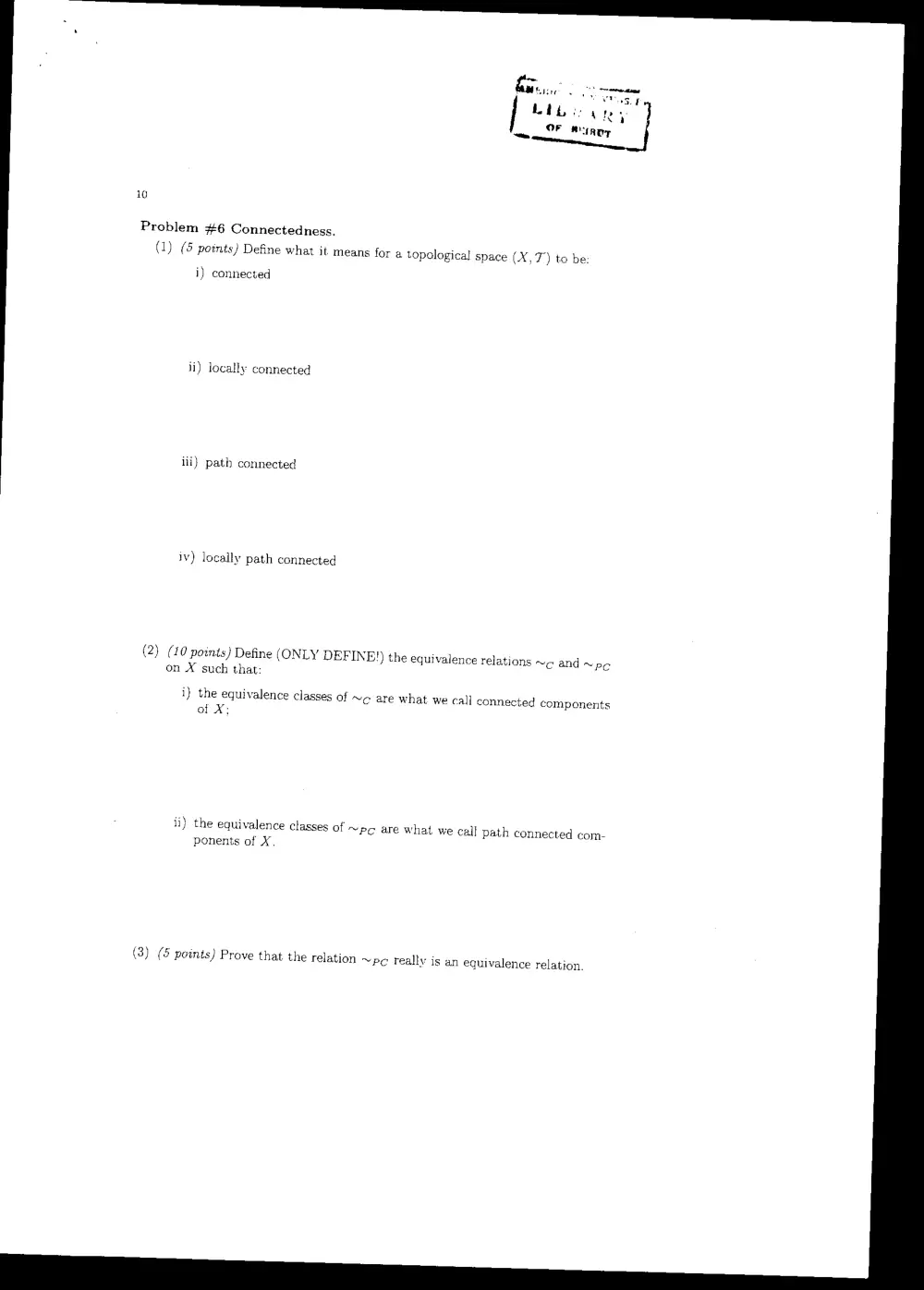
Problem #6 Connected ness.
(1) (8 potnts) Define what it means for a topological space (X, T) to be:
i) connected
ji) locally connected
iii) path connected
iv) locally path connected
(2) (10 points} Define (ONLY DEFINE!) the equivalence relations ~c and ~PC
on X such that:
i) the equivalence classes of
of X;
~c are what we call connected components
li) the equivalence classes of
~Pc are what we call path connected com-
ponents of X.
(3) (5 points) Prove that the relation ~pc Teally is an equivalence relation,