
MATH 214 Final, Fall 2018
American University of Beirut · Topology I · 2 pages · Dr. Richard Aoun

More MATH 214 files
Show the text of this final exam
Topology I - Math 214 Final
Dr. Richard Aoun - Fall 2018
Fall 2018
Exercise 1. Endow R? with the Euclidean metric dz. For every R > 0, we denote by S(0, R) the
sphere of center the origin and radius R and by B(0, R) the open ball of center the origin and radius
R.
*1. (a) (General question) Let X and Y be two topological spaces and f : X —> Y amap. Show
that if X is connected and f is continuous, then f(X) is connected.
(b) Using a suitable map f : [1, +00) x [0,27] —> R?, show that B(0,1)° := R? \ B(0,1)
is connected.
One can similarly prove (or deduce) that for every R > 0, B(0, R)° := R? \ B(O, R) is
connected. You can use this fact later on without producing a proof.
2. (a) Let f : R? —> R be a continuous map. Let a € R. Show that if f7*({a}) is bounded,
then there exists R > 0 such that
f (B(O, R)©) € (-c0,a) or f (B(0,R)®) € (a, +00).
(b) Let f : R? —> R be a continuous surjective map. Show that for every a € R, f-'({a})
is unbounded.
Hint: For every R > 0, B(0, R) has compact closure.
Exercise 2. A topological space X is said to be compactly generated if a subset A is closed in X
whenever AN K is closed in K for every compact subset K C X.
1. (Preliminary) Let X be any topological space. Let (tn)nen be a sequence in X converging to
some | € X. Show that
K := {anjn > 0} U {I}
is compact.
2. Deduce that any topological space that fulfills the conclusion of the sequence lemma (e.g. a
metrizable space) is compactly generated.
Exercise 3. We propose to find sufficient conditions for a continuous map between two topological
spaces to be closed (recall that a map from a space X to a space Y is said to be closed if the direct
image of any closed subset of X is closed in XS);
el: Show that if X is a compact topological space and Y is a Hausdorff topological space, then
any continuous map f : X — Y is closed.
2. A map f : X —>+ ¥ is said to be proper if for every compact subset K C Y, f~'(K) is
compact. Cent Mrsurr
(a) (Example) Show that ehiep f :R — Ris proper, if and only if, lim2|,400 |f(x)| = +00.
(b) Let X be a topological space, Y a Hausdorff space and f : X —+ Y a continuous proper
map.
Let C be a closed subset of X. Show that for every compact subset K CY, f(C) NK is
closed in Y.
Hint: You can adapt some steps made in Question 1. Better, you can use it directly but
in a suitable way.
Remark and conclusion: Using the terminology of Exercise 2, we deduce that any contin-
uous proper map f from a topological space X to a compactly generated Hausdorff space
Y is a closed map.
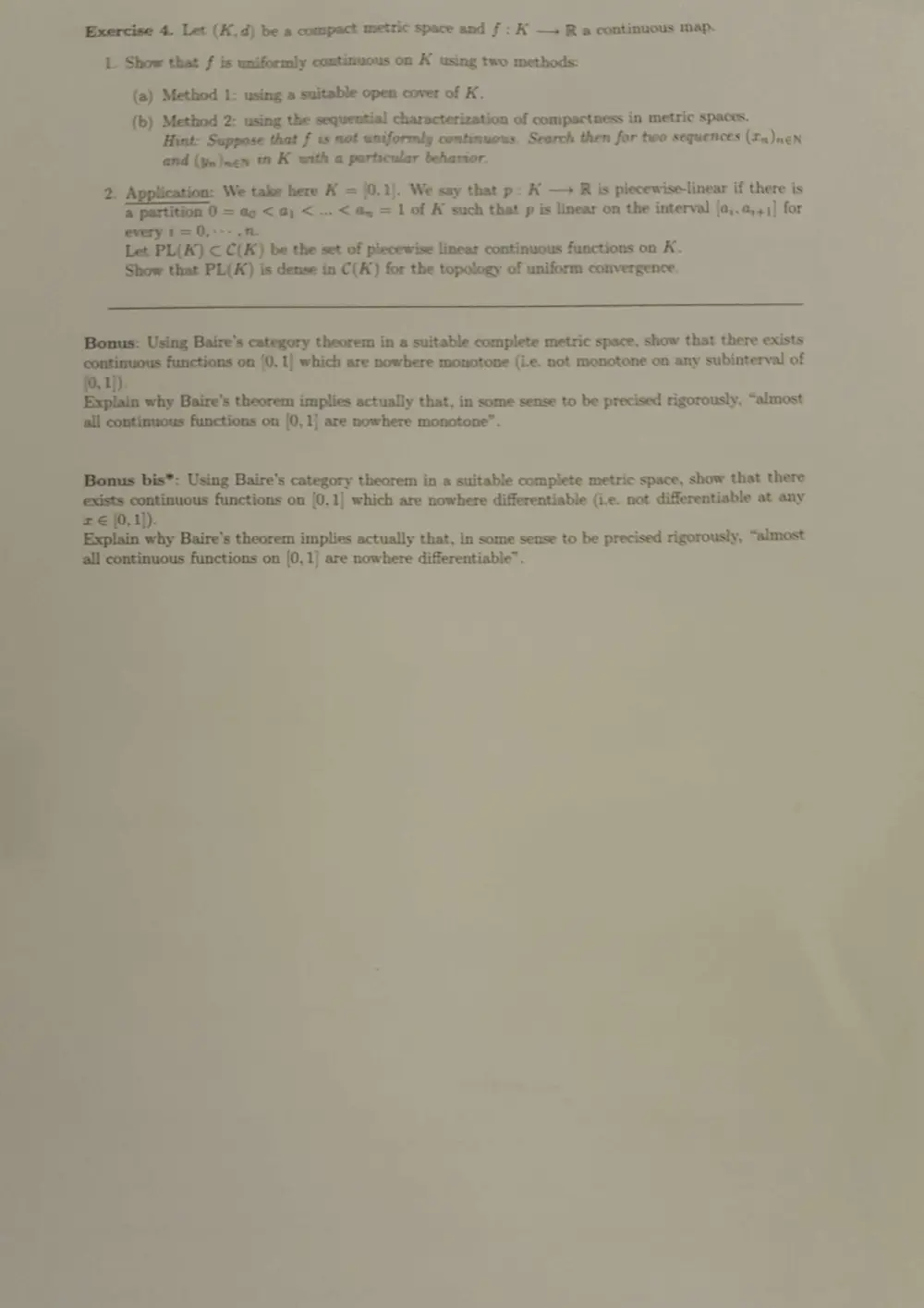
Exercise 4. Let (Kd) be a compact metric space and f : K —+ R a continuous map.
1. Show that f is uniformly continuous on K using two methods:
(2) Method 1: using a suitable open cover of K.
(b) Method 2: using the sequential characterization of compactness in metric spaces.
Hint: Suppose that f is not uniformly continuous. Search then for two sequences (Tn )nen
and (yn)een in K with a particular behavior.
2. Application: We take here K = [0,1!. We say that p: K —> R is piecewise-linear if there is
a partition 0 = ag < a; < ... <a, = 1 of K such that p is linear on the interval {a,.@,41} for
every 1 = 0,--- ,n.
Let PL(K) < C(K) be the set of piecewise linear continuous functions on K.
Show that PL(K) is dense in C(K) for the topology of uniform convergence.
Bonus: Using Baire’s category theorem in a suitable complete metric space, show that there exists
continuous functions on [0,1] which are nowhere monotone (i.e. not monotone on any subinterval of
(0,1).
Explain why Baire’s theorem implies actually that, in some sense to be precised rigorously, “almost
all continuous functions on [0,1] are nowhere monotone”.
Bonus bis*: Using Baire’s category theorem in a suitable complete metric space, show that there
—° ” [0.1] which are nowhere differentiable (i.e. not differentiable at any
x € (0, 1}).
Explain why Baire’s theorem implies actually that, in some sense to be precised rigorously, “almost
all continuous functions on {0,1} are nowhere differentiable”.