
MATH 214 Final, Fall 2016
American University of Beirut · Topology I · 2 pages · Dr. Richard Aoun

More MATH 214 files
Show the text of this final exam
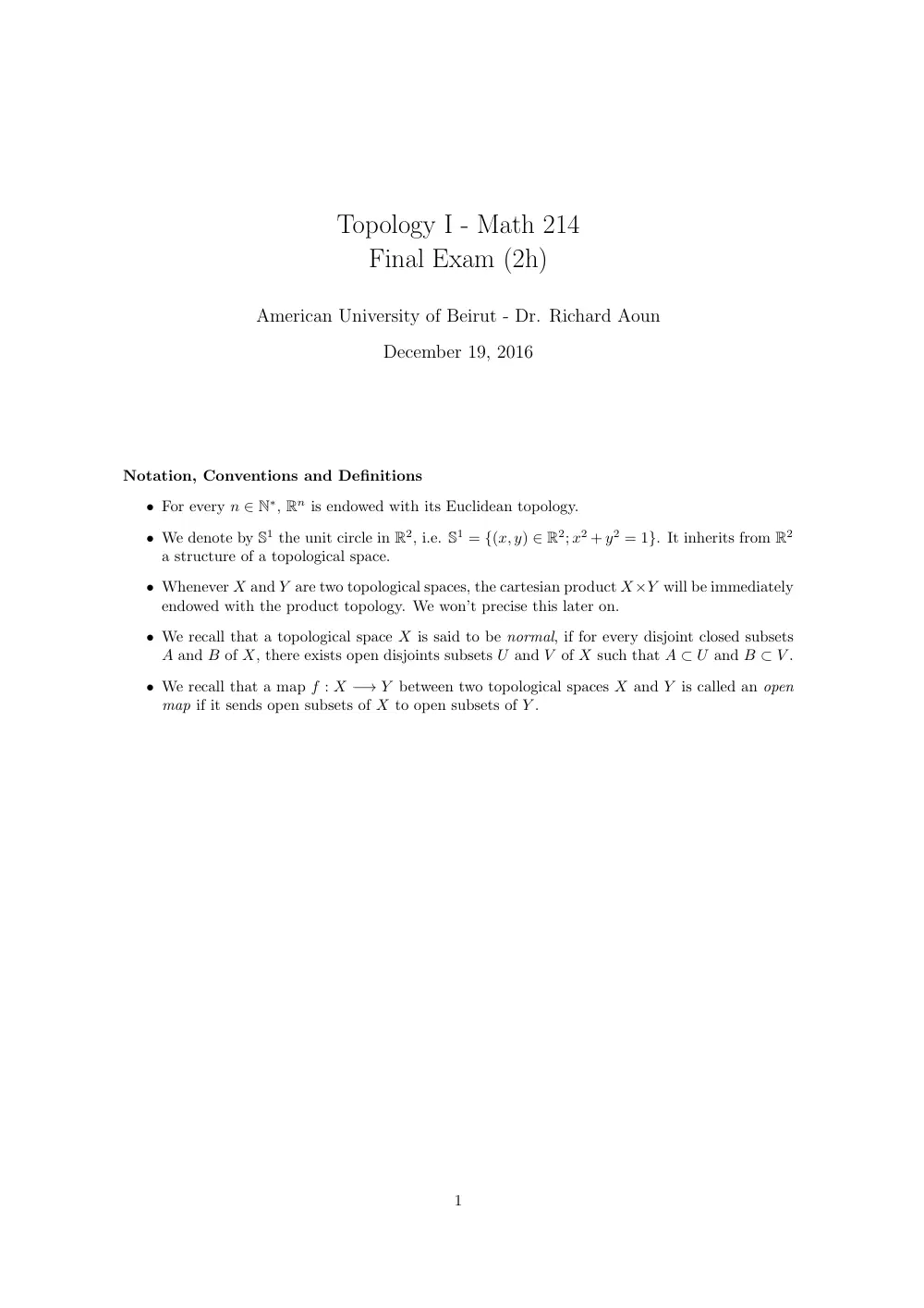
Topology I - Math 214
Final Exam (2h)
American University of Beirut - Dr. Richard Aoun
December 19, 2016
Notation, Conventions and Definitions
• For every n ∈ N∗, Rn is endowed with its Euclidean topology.
• We denote by S1 the unit circle in R2, i.e. S1 = {(x, y) ∈ R2; x2 + y2 = 1}. It inherits from R2
a structure of a topological space.
• Whenever X and Y are two topological spaces, the cartesian product X×Y will be immediately
endowed with the product topology. We won’t precise this later on.
• We recall that a topological space X is said to be normal, if for every disjoint closed subsets
A and B of X, there exists open disjoints subsets U and V of X such that A ⊂ U and B ⊂ V .
• We recall that a map f : X −→ Y between two topological spaces X and Y is called an open
map if it sends open subsets of X to open subsets of Y .
1
The rigor in the reasoning and the writing will have a great impact on the grading.
Exercise 1. (32 points)
1. (12 points) Show the following property proved in class: if f : X −→ Y is a continuous
surjective map between a compact topological space X and a topological space Y , then Y is
compact.
2. (10 points) Deduce that there is no continuous surjective function from S1 to the real line.
Prove rigorously all the properties you will claim that S1 and the real line have (or fail to have).
3. (5 points) What is the geometric intuition behind the previous result?
4. (5 points) Is it true that there is no continuous surjective map from the real line to S1? Justify
your answer.
Exercise 2. (22 points) Let X be a Hausdorff topological space, A and B two disjoint compact
subsets of X.
1. (18 points) Prove that there exists open disjoint subsets U and V of X such that A ⊂ U and
B ⊂ V .
Hint: treat first the case where B is reduced to a point.
2. (4 points) Deduce that a compact Hausdorff topological space is normal.
Exercise 3. (16 points) Let X and Y be two topological spaces and f : X −→ Y any map (not
necessarily continuous). Recall that the graph Gf of f is the following subset of X × Y :
Gf = {(x, f(x)) ; x ∈ X}.
Show that if f is an surjective open map such that Gf is closed in X × Y , then Y is Hausdorff.
Exercise 4. (Extension of uniformly continuous functions in complete spaces) (30 points)
Let (X, d) and (Y, d′) be two metric spaces. Let A ⊂ X and f : A −→ Y a uniformly continuous
map.
1. (10 points) Show that f maps Cauchy sequences in A to Cauchy sequences in Y .
From now on, (Y, d′) is assumed to be complete.
2. (16 points) Use the previous question in order to define a map g : A −→ Y such that:
• g is uniformly continuous
• the restriction of g to A is just f.
Grading: 5 points for defining the map, 4 points to show that it is well-defined, 4 points to
show that it is uniformly continuous and 3 points to show that it coincides with f on A.
3. (4 points) Explain why g is the unique map that satisfies the aforementioned properties.
2