
MATH 219 Final, Fall 2001
American University of Beirut · Linear Algebra I · 2 pages
More MATH 219 files
Show the text of this final exam
Voobesse Ke Chur. Mekeks°
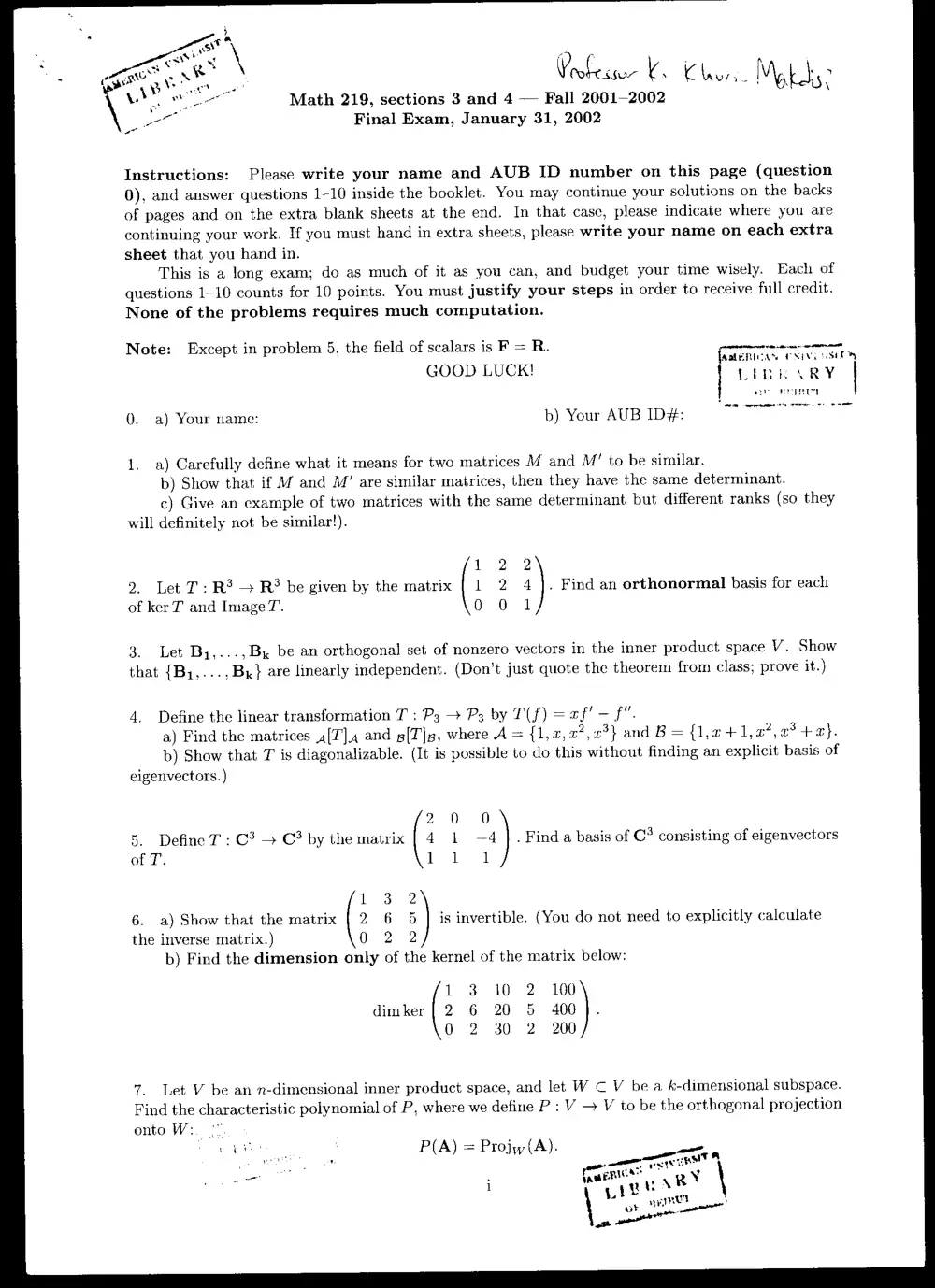
Math 219, sections 3 and 4 — Fall 2001-2002
Final Exam, January 31, 2002
Instructions: Please write your name and AUB ID number on this page (question
0), and answer questions 1-10 inside the booklet. You may continue your solutions on the backs
of pages and on the extra blank sheets at the end. In that case, please indicate where you are
continuing your work. If you must hand in extra sheets, please write your name on each extra
sheet that you hand in.
This is a long exam; do as much of it as you can, and budget your time wisely. Each of
questions 1-10 counts for 10 points. You must justify your steps in order to receive full credit.
None of the problems requires much computation.
Note: Except in problem 5, the field of scalars is F = R.
GOOD LUCK!
0. a) Your name: b) Your AUB ID#:
1. a) Carefully define what it means for two matrices M and M' to be similar.
b) Show that if M and M’ are similar matrices, then they have the same determinant.
c) Give an example of two matrices with the same determinant but different ranks (so they
will definitely not be similar!).
1
2. Let T: R? > R® be given by the matrix | 1 . Find an orthonormal basis for each
of ker T and Image 7’. 0
3. Let By,...,B, be an orthogonal set of nonzero vectors in the inner product space V. Show
that {B1,...,Bx} are linearly independent. (Don’t just quote the theorem from class; prove it.)
4. Define the linear transformation T : P3 + P3 by T(f) = xf’ — f”.
a) Find the matrices 4[T]4 and g[T]s, where A = {1, 2,22, 23} and B= {1,e+1,2°,2° +2}.
b) Show that T is diagonalizable. (It is possible to do this without finding an explicit basis of
eigenvectors.)
2 0 O
5. Define T: C3 = C3 by the matrix | 4 1 —4 |. Finda basis of C consisting of eigenvectors
of T. 11 1
1 3
6. a) Show that the matrix | 2 6
2
5 | is invertible. (You do not need to explicitly calculate
the inverse matrix.) 0 2 2
b) Find the dimension only of the kernel of the matrix below:
1 3 10 2 100
dimker [2 6 20 5 400
0 2 30 2 200
7. Let V be an n-dimensional inner product space, and let W C V be a k-dimensional subspace.
Find the characteristic polynomial of P, where we define P : V — V to be the orthogonal projection
onto W:. 7
P(A) = Projy (A). >
(A) jw (A) _— mere RT A
famenice> , Y
\ pies
yyIRet
or
sen
=. reer ad
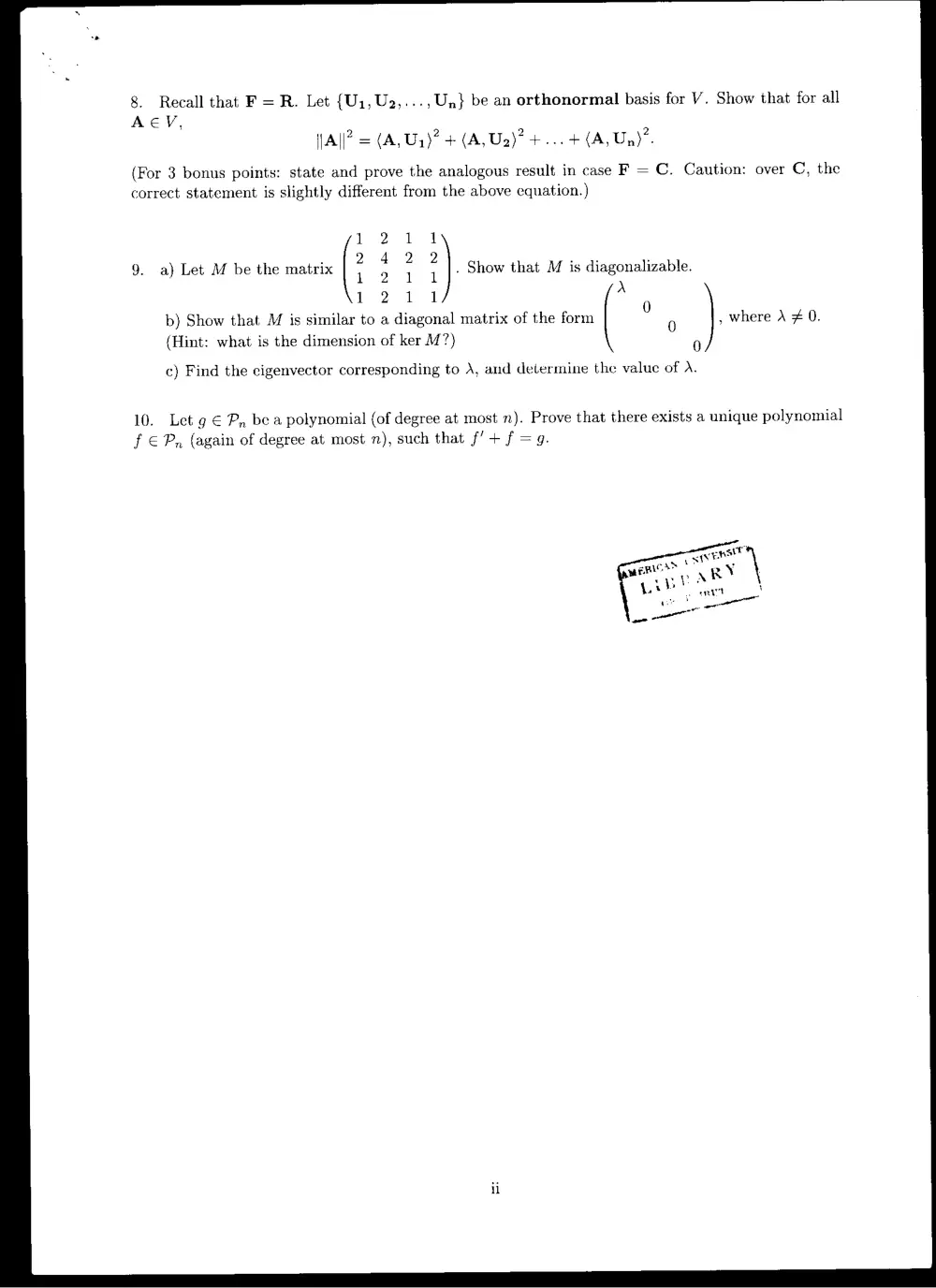
8. Recall that F =R. Let {U1,U2,...,Un} be an orthonormal basis for V. Show that for all
AcY,
JA? = (A, Uy)? + (A, Ua)? +... + (A, Un)’.
(For 3 bonus points: state and prove the analogous result in case F = C. Caution: over C, the
correct statement is slightly different from the above equation.)
11
2 2 wy :
rail: Show that M is diagonalizable.
A
1
9. a) Let M be the matrix :
1
2161
b) Show that M is similar to a diagonal matrix of the form 0 , where A # 0.
(Hint: what is the dimension of ker M?) 0
c) Find the eigenvector corresponding to , and determine the value of X.
10. Let g € Pn bea polynomial (of degree at most n). Prove that there exists a unique polynomial
f €P, (again of degree at most n), such that f’+ f=g.