
MATH 224 Final, Fall 2003
American University of Beirut · Fourier Series and Applications · 2 pages
More MATH 224 files
Show the text of this final exam
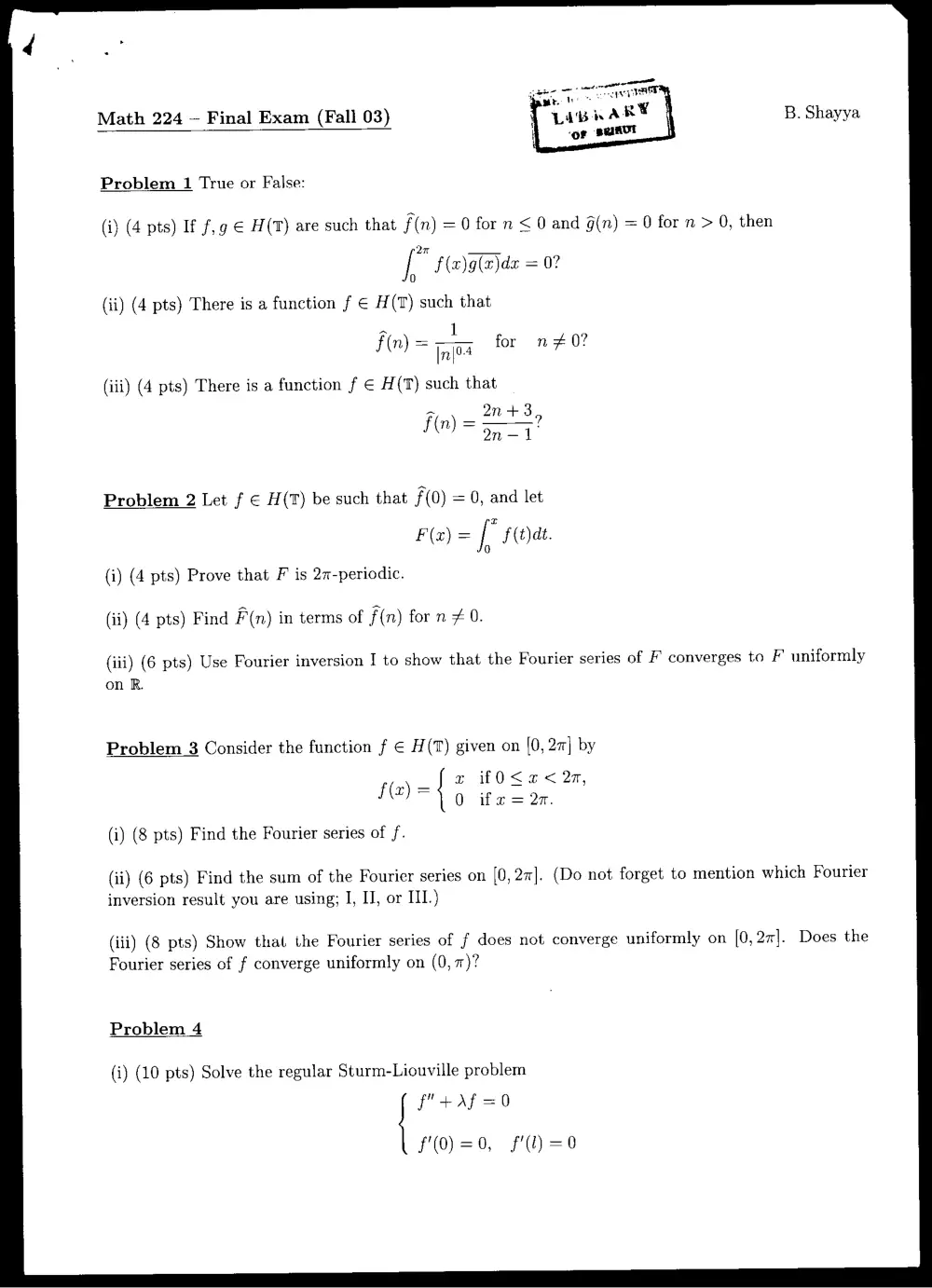
Math 224 — Final Exam (Fall 03)
Problem 1 True or False:
(i) (4 pts) If f, 9 € A(T) are such that f(n) = 0 for n < 0 and g(n) = 0 for n > 0, then
P f(a)gl@dz = 02
(ii) (4 pts) There is a function f € H(T) such that
> 1
f= ra for n#0?
(iii) (4 pts) There is a function f € H(T) such that
~ 2n+3
= ?
P(r) a2n-1
Problem 2 Let f € H(T) be such that f(0) = 0, and let
F(e) = [ f(tat.
@)= [Fe
(i) (4 pts) Prove that F is 27-periodic.
(ii) (4 pts) Find F(n) in terms of f(r) forn £0.
(iii) (6 pts) Use Fourier inversion I to show that the Fourier series of F converges to F uniformly
on R.
Problem 3 Consider the function f € H(T) given on [0, 27] by
fe) ={
(i) (8 pts) Find the Fourier series of f.
x if0<a<2r,
if = 2r.
(ii) (6 pts) Find the sum of the Fourier series on [0,27]. (Do not forget to mention which Fourier
inversion result you are using; I, II, or III.)
(iii) (8 pts) Show thal the Fourier series of f does not converge uniformly on [0,27]. Does the
Fourier series of f converge uniformly on (0,7)?
Problem 4
(i) (10 pts) Solve the regular Sturm-Liouville problem
| f"+Af =0
f(0)=0, f=
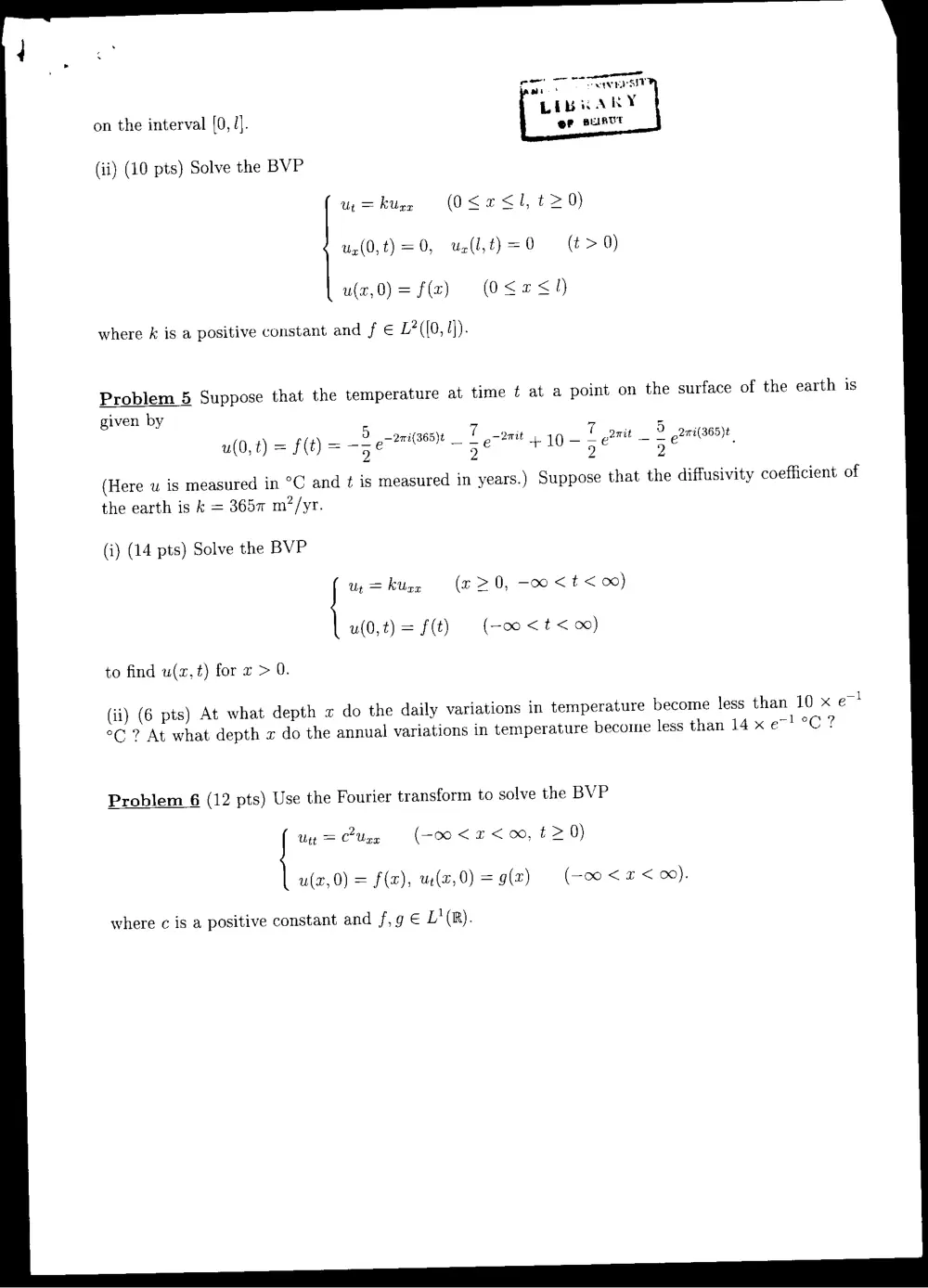
on the interval [0,/].
(ii) (10 pts) Solve the BVP
Ut = kUee (0<a2<l,t>0)
u,(0,t)=0, ur(l,é)=0 (¢> 0)
u(e,0)= fz) OS2<0
where k is a positive constant and f € L?((0, 1).
Problem 5 Suppose that the temperature at time ¢ at a point on the surface of the earth is
given by
u(0,t) = f(é) = #8 e727 i(365)t _ T omit +10—- T amit _ 5 2mi(365)t,
2 2 2 2
(Here u is measured in °C and ¢ is measured in years.) Suppose that the diffusivity coefficient of
the earth is k = 365% m?/yr.
(i) (14 pts) Solve the BVP
Up = KUge (x > 0, -—o0o <t < o)
u(0,t) = f(t) (-oo < t < 00)
to find u(z,t) for z > 0.
(ii) (6 pts) At what depth do the daily variations in temperature become less than 10 x e?
°C ? At what depth z do the annual variations in temperature become less than 14 x ew! °C ?
Problem 6 (12 pts) Use the Fourier transform to solve the BVP
{“ (-00 < 4 < 00, t> 0)
u(x, 0) = f(x), u(x, 0) = g(2) (—oo < x < 00).
where c is a positive constant and f,g € L}(R).