
MATH 224 Final, Fall 2004
American University of Beirut · Fourier Series and Applications · 2 pages

More MATH 224 files
Show the text of this final exam
AMERICAN UNIVERSITY OF BEIRUT
MATHEMATICS 224, FINAL EXAMINATION
FALL SEMESTER, 2004-05
Answer the following questions:
1. Let fa(z) = nz/(1+ nz) forO<2< om.
(a) Find f(z) = limyeo fn (2). (2 points)
(b) Does f, —+ f uniformly on (0,1)? Justify. (4 points)
(c) Does f, — f uniformly on [1, oof? Justify. (4 points)
2. Use separation of variables to derive the family of solutions
ux _(z,y,z) = sin(maz) cos(ny) exp(£Vm? + n? m2)
of the boundary-value problem
Vou = User + Uyy + Use = 9,
u(O.y,z) = u(l,y.z) = u,(x,0,z) = uy(z,1,z) = 0.
(14 points)
3. (a) Define a regular Sturm-Liouville problem on a closed interval
fa, d]. (3 points)
(b) Define an eigenvalue and eigenfunction of a regular Sturm-Liouville
problem. (3 points)
(c) Find the eigenvalues and the normalized eigenfunctions for the
following regular Sturm-Liouville problem on {1,6}, b > 1.
(a? fy +Af=0, fC) = f(b) =0.
Hint: The general solution of the Cauchy-Euler differential equation
az’y" + bry! + cy = 0, 2 > 0, is y = cz" + con"?. where 1,1 are the
roots of the characteristic equation ar?+(b-a)r+c=O.Ifry =r =7,
then the general solution is y = cx" + cox” Inz. (14 points)
4. (a) Define the Beta function and show that (5 points)
{2
Biz,y) = 2 | sin**-1 6 cos’? @ dé.
0
(b) Define the Gamma function and show that (5 points)
T(z) -| (in(i/t)""' dt, 2>0.
0
(c) State Stirling’s formula. . (3 points)
pune.
a atre
JARI “NEVERSI
y PAN ONPVERSIC
{J Library
{ OF PERO? }
Too aa retreat
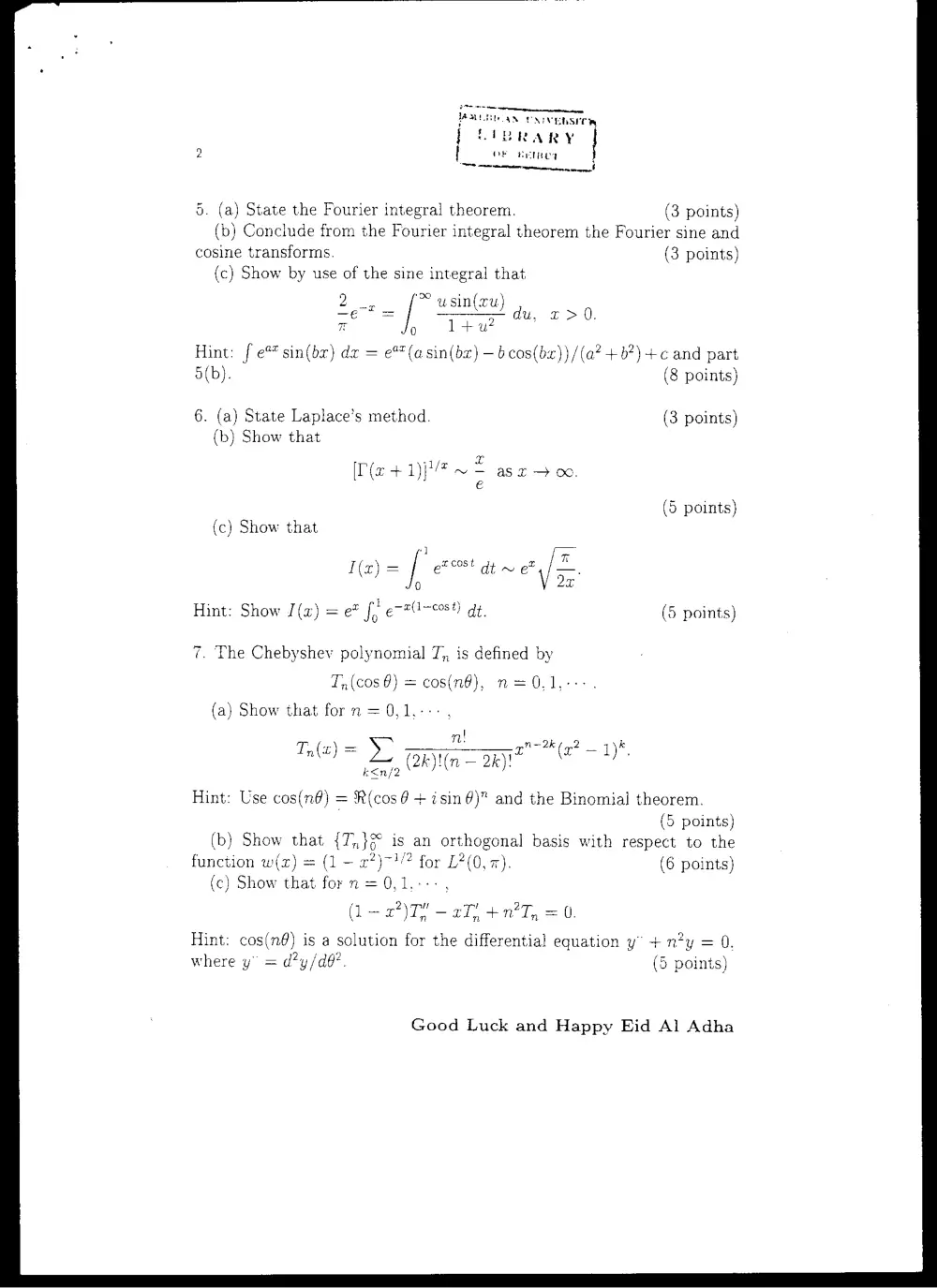
5. (a) State the Fourier integral theorem. (3 points)
(b) Conclude from the Fourier integral theorem the Fourier sine and
cosine transforms. (3 points)
(c) Show by use of the sine integral that
2er= | usin(eu) du, ©>0.
0
tr lt+u?
Hint: f e** sin(br) dz = e**(asin(bx) — bcos(br))/(a? +b?)+c and part
5(b). (8 points)
6. (a) State Laplace’s method. (3 points)
(b} Show that
x
[D(a + 1))/F ~ = as 2 00.
(5 points)
(c) Show that
4 =
(2) = f 6 8! dt me? / —.
0 22
Hint: Show J(z) = e* f eWtl=cost) de. (5 points)
7. The Chebyshev polynomial T,, is defined by
T,(cos @) = cos(n@), n=O,1,---.
(a) Show that form =0,1,---,
!
he n—2k ( 2 ke
T,(£) = S- Qki(n— 2K)” Fg —1) :
k<n/2
Hint: Use cos(n@) = R(cos @ + isin)" and the Binomial theorem.
, (5 points)
(b) Show that {7,,}§° is an orthogonal basis with respect to the
function w(x) = (1 — 2?)71/? for L?(0, 7). (6 points)
(c) Show that for n =0,1.---,
(l= 2°)T" — aT! +n°T, = 0.
Hint: cos(n@) is a solution for the differential equation y” + n?y = 0,
where y° = d’y/d6?. (5 points)
Good Luck and Happy Eid Al Adha