
MATH 224 Final, Fall 2005
American University of Beirut · Fourier Series and Applications · 2 pages
More MATH 224 files
Show the text of this final exam
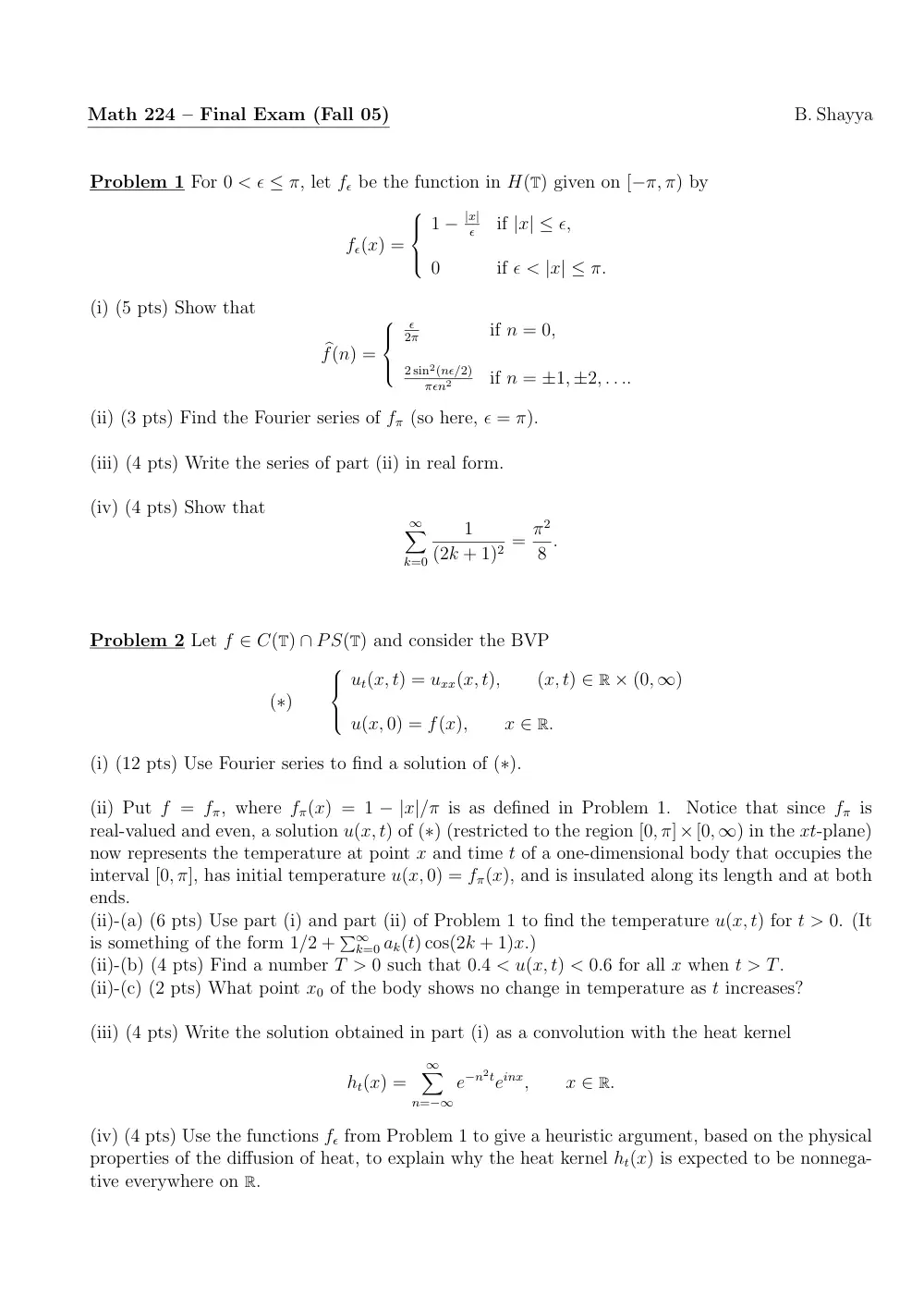
Math 224 – Final Exam (Fall 05)
B. Shayya
Problem 1 For 0 < ϵ ≤ π, let fϵ be the function in H(T) given on [−π, π) by
fϵ(x) =
1 − |x|
ϵ
if |x| ≤ ϵ,
0
if ϵ < |x| ≤ π.
(i) (5 pts) Show that
�f(n) =
ϵ
2π
if n = 0,
2 sin2(nϵ/2)
πϵn2
if n = ±1, ±2, . . ..
(ii) (3 pts) Find the Fourier series of fπ (so here, ϵ = π).
(iii) (4 pts) Write the series of part (ii) in real form.
(iv) (4 pts) Show that
∞
�
k=0
1
(2k + 1)2 = π2
8 .
Problem 2 Let f ∈ C(T) ∩ PS(T) and consider the BVP
(∗)
ut(x, t) = uxx(x, t),
(x, t) ∈ R × (0, ∞)
u(x, 0) = f(x),
x ∈ R.
(i) (12 pts) Use Fourier series to find a solution of (∗).
(ii) Put f = fπ, where fπ(x) = 1 − |x|/π is as defined in Problem 1.
Notice that since fπ is
real-valued and even, a solution u(x, t) of (∗) (restricted to the region [0, π]×[0, ∞) in the xt-plane)
now represents the temperature at point x and time t of a one-dimensional body that occupies the
interval [0, π], has initial temperature u(x, 0) = fπ(x), and is insulated along its length and at both
ends.
(ii)-(a) (6 pts) Use part (i) and part (ii) of Problem 1 to find the temperature u(x, t) for t > 0. (It
is something of the form 1/2 +
�∞
k=0 ak(t) cos(2k + 1)x.)
(ii)-(b) (4 pts) Find a number T > 0 such that 0.4 < u(x, t) < 0.6 for all x when t > T.
(ii)-(c) (2 pts) What point x0 of the body shows no change in temperature as t increases?
(iii) (4 pts) Write the solution obtained in part (i) as a convolution with the heat kernel
ht(x) =
∞
�
n=−∞
e−n2teinx,
x ∈ R.
(iv) (4 pts) Use the functions fϵ from Problem 1 to give a heuristic argument, based on the physical
properties of the diffusion of heat, to explain why the heat kernel ht(x) is expected to be nonnega-
tive everywhere on R.
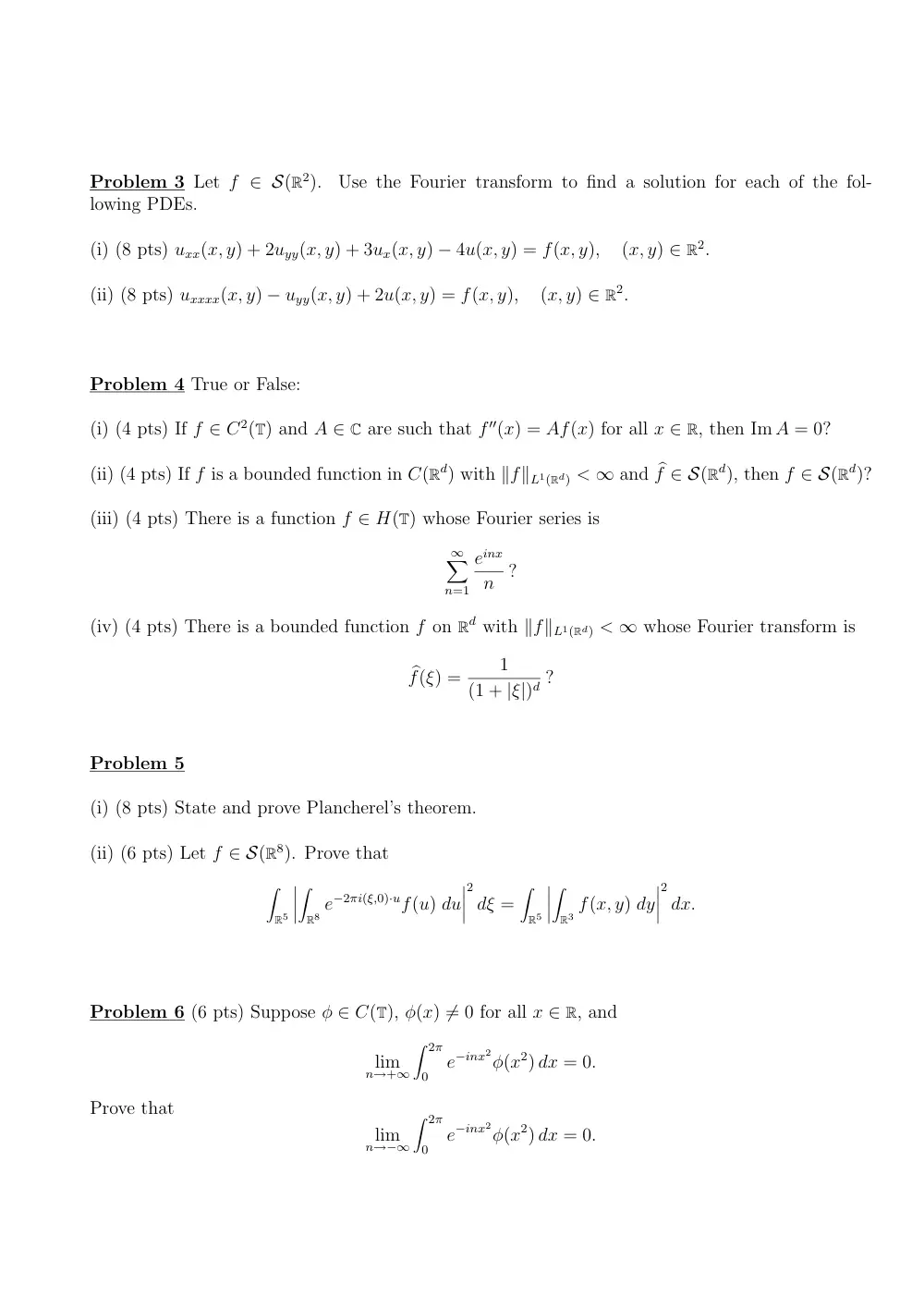
Problem 3 Let f ∈ S(R2).
Use the Fourier transform to find a solution for each of the fol-
lowing PDEs.
(i) (8 pts) uxx(x, y) + 2uyy(x, y) + 3ux(x, y) − 4u(x, y) = f(x, y),
(x, y) ∈ R2.
(ii) (8 pts) uxxxx(x, y) − uyy(x, y) + 2u(x, y) = f(x, y),
(x, y) ∈ R2.
Problem 4 True or False:
(i) (4 pts) If f ∈ C2(T) and A ∈ C are such that f ′′(x) = Af(x) for all x ∈ R, then Im A = 0?
(ii) (4 pts) If f is a bounded function in C(Rd) with ∥f∥L1(Rd) < ∞ and �f ∈ S(Rd), then f ∈ S(Rd)?
(iii) (4 pts) There is a function f ∈ H(T) whose Fourier series is
∞
�
n=1
einx
n ?
(iv) (4 pts) There is a bounded function f on Rd with ∥f∥L1(Rd) < ∞ whose Fourier transform is
�f(ξ) =
1
(1 + |ξ|)d ?
Problem 5
(i) (8 pts) State and prove Plancherel’s theorem.
(ii) (6 pts) Let f ∈ S(R8). Prove that
�
R5
����
�
R8 e−2πi(ξ,0)·uf(u) du
����
2
dξ =
�
R5
����
�
R3 f(x, y) dy
����
2
dx.
Problem 6 (6 pts) Suppose φ ∈ C(T), φ(x) ̸= 0 for all x ∈ R, and
lim
n→+∞
� 2π
0
e−inx2φ(x2) dx = 0.
Prove that
lim
n→−∞
� 2π
0
e−inx2φ(x2) dx = 0.