
MATH 261 Exam 1, Fall 2018
American University of Beirut · Number Theory · 2 pages · Dr. Nicolas Mascot
More MATH 261 files
Show the text of this exam
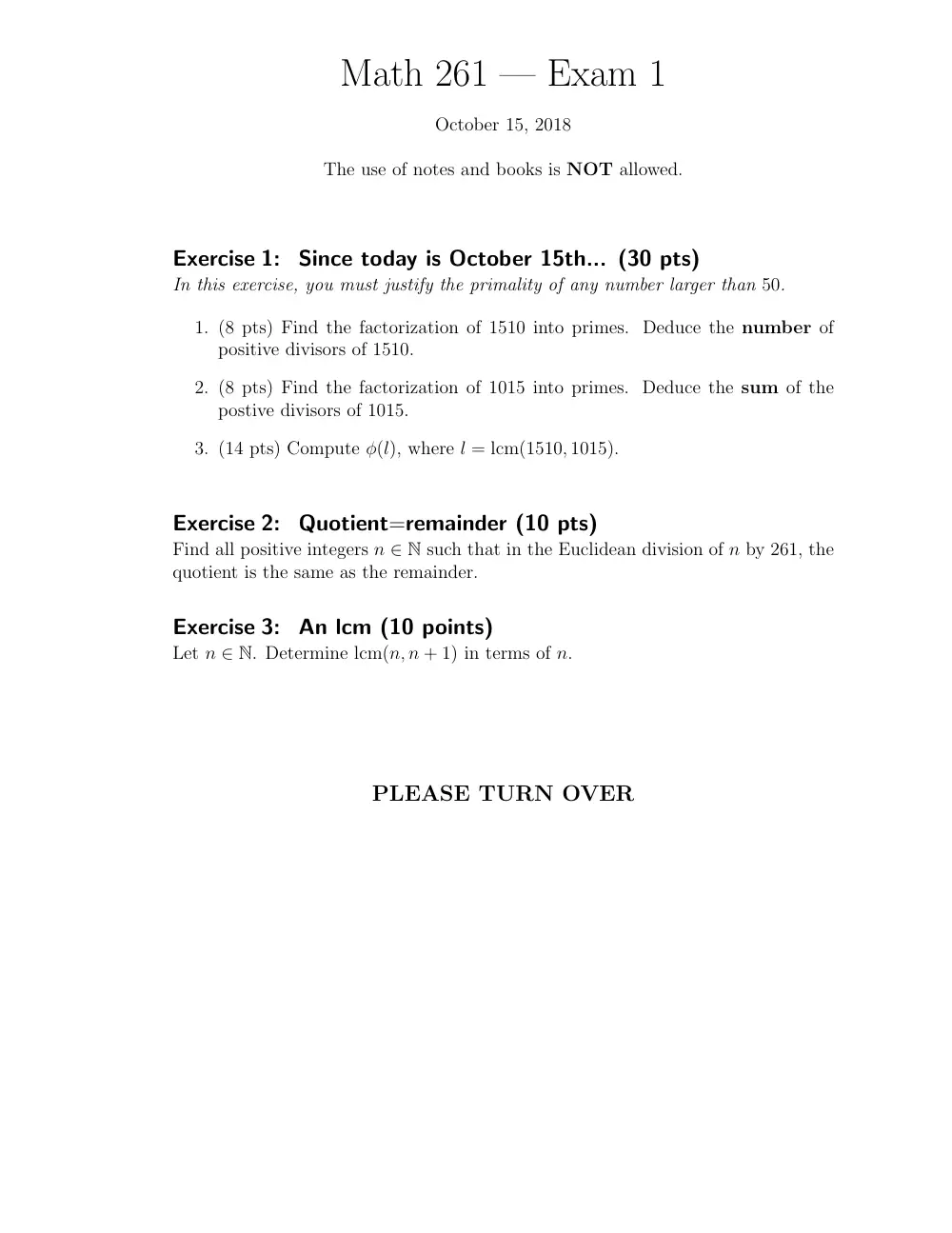
Math 261 — Exam 1
October 15, 2018
The use of notes and books is NOT allowed.
Exercise 1:
Since today is October 15th... (30 pts)
In this exercise, you must justify the primality of any number larger than 50.
1. (8 pts) Find the factorization of 1510 into primes. Deduce the number of
positive divisors of 1510.
2. (8 pts) Find the factorization of 1015 into primes. Deduce the sum of the
postive divisors of 1015.
3. (14 pts) Compute φ(l), where l = lcm(1510, 1015).
Exercise 2:
Quotient=remainder (10 pts)
Find all positive integers n ∈ N such that in the Euclidean division of n by 261, the
quotient is the same as the remainder.
Exercise 3:
An lcm (10 points)
Let n ∈ N. Determine lcm(n, n + 1) in terms of n.
PLEASE TURN OVER
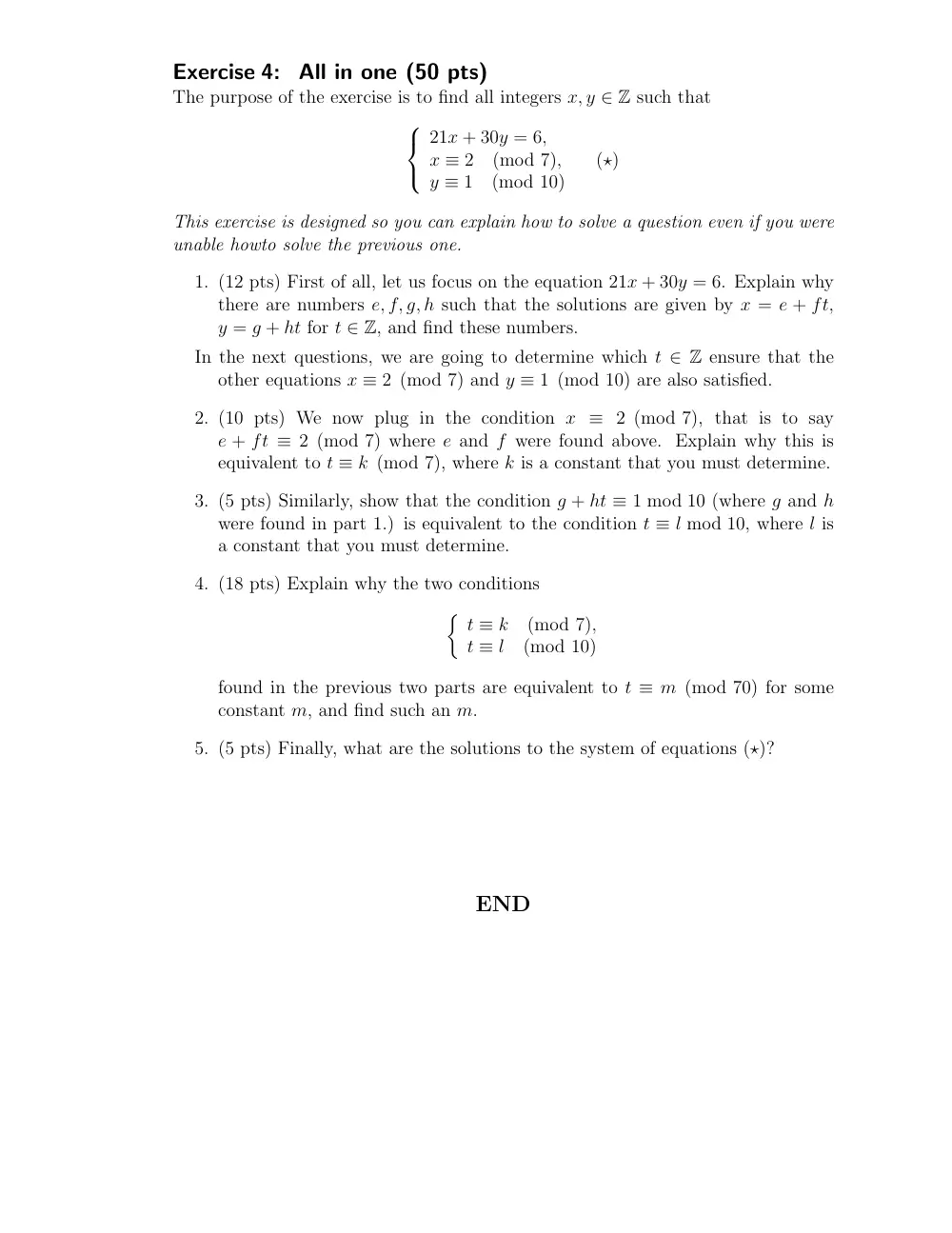
Exercise 4:
All in one (50 pts)
The purpose of the exercise is to find all integers x, y ∈ Z such that
21x + 30y = 6,
x ≡ 2
(mod 7),
y ≡ 1
(mod 10)
(⋆)
This exercise is designed so you can explain how to solve a question even if you were
unable howto solve the previous one.
1. (12 pts) First of all, let us focus on the equation 21x + 30y = 6. Explain why
there are numbers e, f, g, h such that the solutions are given by x = e + ft,
y = g + ht for t ∈ Z, and find these numbers.
In the next questions, we are going to determine which t ∈ Z ensure that the
other equations x ≡ 2 (mod 7) and y ≡ 1 (mod 10) are also satisfied.
2. (10 pts) We now plug in the condition x ≡ 2 (mod 7), that is to say
e + ft ≡ 2 (mod 7) where e and f were found above. Explain why this is
equivalent to t ≡ k (mod 7), where k is a constant that you must determine.
3. (5 pts) Similarly, show that the condition g + ht ≡ 1 mod 10 (where g and h
were found in part 1.) is equivalent to the condition t ≡ l mod 10, where l is
a constant that you must determine.
4. (18 pts) Explain why the two conditions
� t ≡ k
(mod 7),
t ≡ l
(mod 10)
found in the previous two parts are equivalent to t ≡ m (mod 70) for some
constant m, and find such an m.
5. (5 pts) Finally, what are the solutions to the system of equations (⋆)?
END