
MATH 261 Exam 2, Fall 2018
American University of Beirut · Number Theory · 2 pages
More MATH 261 files
Show the text of this exam
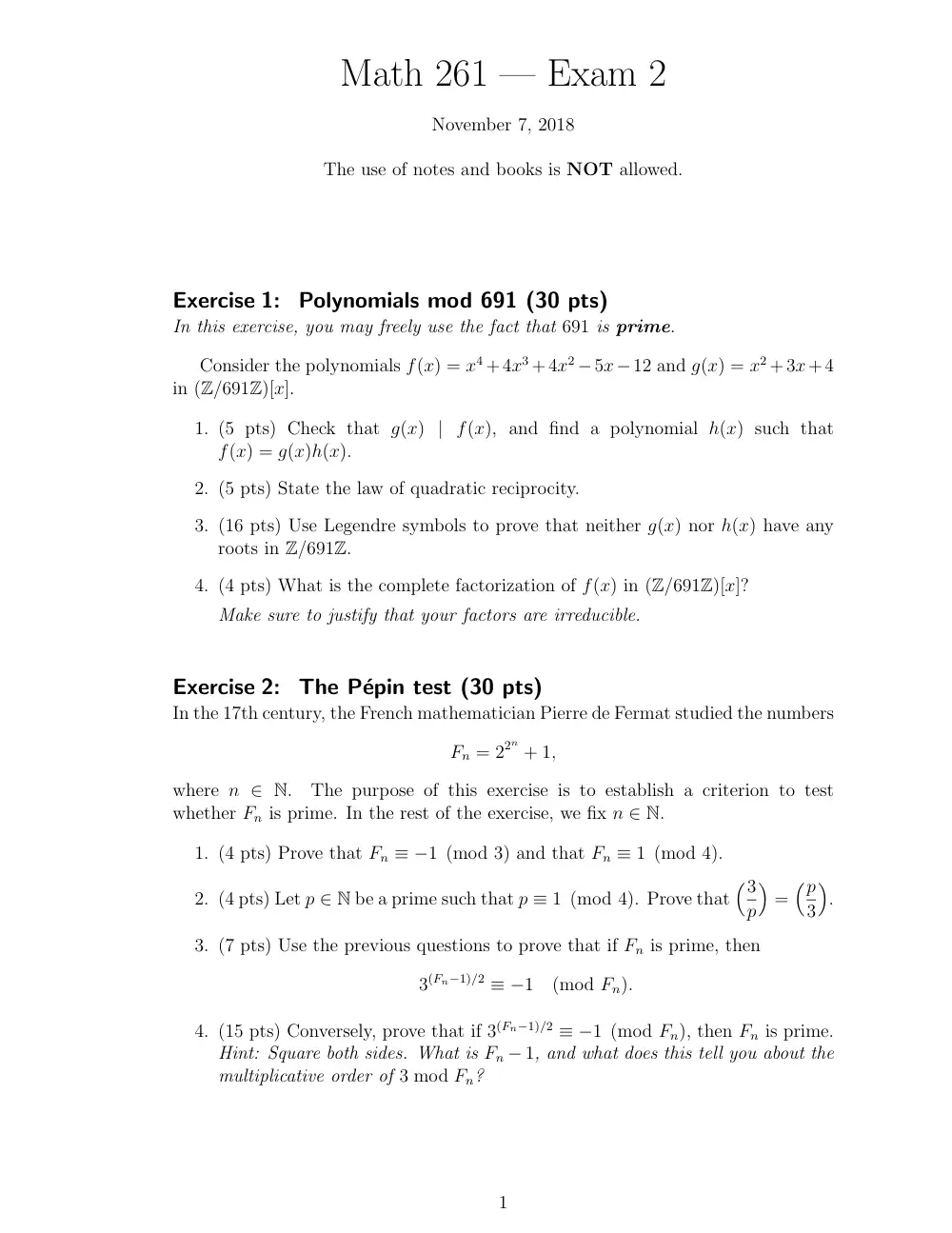
Math 261 — Exam 2
November 7, 2018
The use of notes and books is NOT allowed.
Exercise 1:
Polynomials mod 691 (30 pts)
In this exercise, you may freely use the fact that 691 is prime.
Consider the polynomials f(x) = x4 +4x3 +4x2 −5x−12 and g(x) = x2 +3x+4
in (Z/691Z)[x].
1. (5 pts) Check that g(x) | f(x), and find a polynomial h(x) such that
f(x) = g(x)h(x).
2. (5 pts) State the law of quadratic reciprocity.
3. (16 pts) Use Legendre symbols to prove that neither g(x) nor h(x) have any
roots in Z/691Z.
4. (4 pts) What is the complete factorization of f(x) in (Z/691Z)[x]?
Make sure to justify that your factors are irreducible.
Exercise 2:
The P´epin test (30 pts)
In the 17th century, the French mathematician Pierre de Fermat studied the numbers
Fn = 22n + 1,
where n ∈ N.
The purpose of this exercise is to establish a criterion to test
whether Fn is prime. In the rest of the exercise, we fix n ∈ N.
1. (4 pts) Prove that Fn ≡ −1 (mod 3) and that Fn ≡ 1 (mod 4).
2. (4 pts) Let p ∈ N be a prime such that p ≡ 1 (mod 4). Prove that
�3
p
�
=
�p
3
�
.
3. (7 pts) Use the previous questions to prove that if Fn is prime, then
3(Fn−1)/2 ≡ −1
(mod Fn).
4. (15 pts) Conversely, prove that if 3(Fn−1)/2 ≡ −1 (mod Fn), then Fn is prime.
Hint: Square both sides. What is Fn − 1, and what does this tell you about the
multiplicative order of 3 mod Fn?
1
Exercise 3:
The Solovay-Strassen test (40 pts)
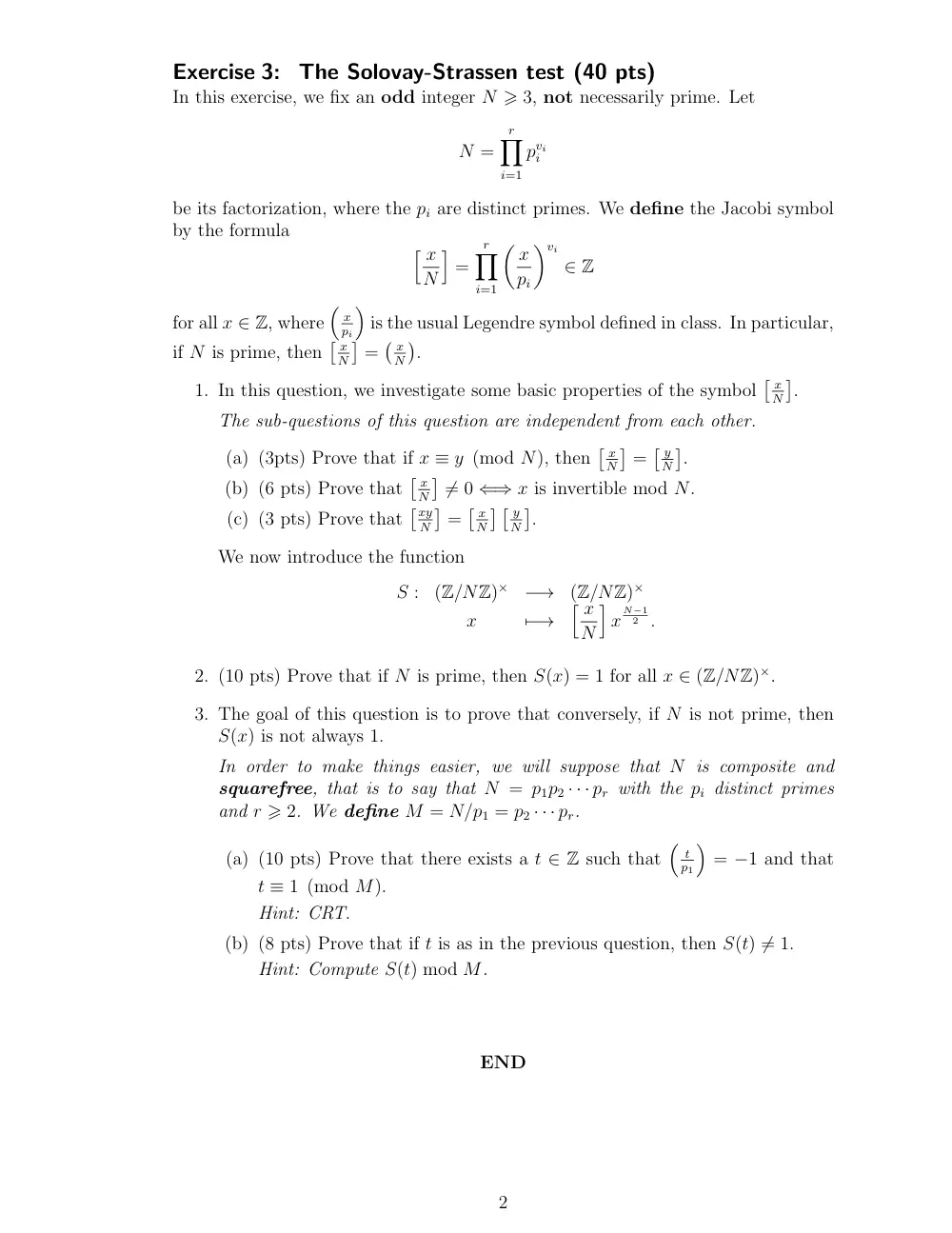
In this exercise, we fix an odd integer N ⩾ 3, not necessarily prime. Let
N =
r�
i=1
pvi
i
be its factorization, where the pi are distinct primes. We define the Jacobi symbol
by the formula
� x
N
�
=
r�
i=1
� x
pi
�vi
∈ Z
for all x ∈ Z, where
�
x
pi
�
is the usual Legendre symbol defined in class. In particular,
if N is prime, then
� x
N
�
=
� x
N
�
.
1. In this question, we investigate some basic properties of the symbol
� x
N
�
.
The sub-questions of this question are independent from each other.
(a) (3pts) Prove that if x ≡ y (mod N), then
� x
N
�
=
� y
N
�
.
(b) (6 pts) Prove that
� x
N
�
̸= 0 ⇐⇒ x is invertible mod N.
(c) (3 pts) Prove that
� xy
N
�
=
� x
N
� � y
N
�
.
We now introduce the function
S :
(Z/NZ)×
−→
(Z/NZ)×
x
�−→
� x
N
�
x
N−1
2 .
2. (10 pts) Prove that if N is prime, then S(x) = 1 for all x ∈ (Z/NZ)×.
3. The goal of this question is to prove that conversely, if N is not prime, then
S(x) is not always 1.
In order to make things easier, we will suppose that N is composite and
squarefree, that is to say that N = p1p2 · · · pr with the pi distinct primes
and r ⩾ 2. We define M = N/p1 = p2 · · · pr.
(a) (10 pts) Prove that there exists a t ∈ Z such that
�
t
p1
�
= −1 and that
t ≡ 1 (mod M).
Hint: CRT.
(b) (8 pts) Prove that if t is as in the previous question, then S(t) ̸= 1.
Hint: Compute S(t) mod M.
END
2