
MECH 310 Exam 1, Fall 2009
American University of Beirut · Thermodynamics I · 5 pages
More MECH 310 files
- Exam 2 Solution Leen Alawieh · Fall 2017Exam · with solutionView
- Exam 1 Leen Alawieh With Solutions · Fall 2017Exam · with solutionView
- Exam 1 · Fall 2016ExamView
- Exam 1 · Summer 2012ExamView
- Exam 2 · Summer 2011ExamView
- Exam 1 · Spring 2011ExamView
- Exam 1 · Summer 2011ExamView
- Exam 1 with Solution · Fall 2011Exam · with solutionView
Show the text of this exam
MECH 310 Thermodynamics I
November 25, 2009
American University of Beirut, Fall 2009
Handout # Quiz 1
Quiz 1
• This is an open book 90 minutes exam.
• It is recommended that you read the whole exam before you start solving.
• Make sure that the units are consistent.
• Write your name and section number on both the question and answer sheets.
• Clearly identify your control mass / control volume.
• State any assumptions you need and provide a convincing justification.
Problem 1 (40 points)
A rigid cylinder of volume 1 m3 contains 1 kg of a saturated liquid+vapor water mixture
at 100 C. The water undergoes a process with a final state of saturated vapor. The cylin-
der is fitted with a piston which is either free to move or held stationary, depending on
the process. For each of the processes (a), (b) and (c):
(1) Find the initial and final states, work produced by and heat transferred into water,
(2) Sketch the process on a p − v and T − v diagrams,
(3) Explain whether the piston is free to move or held stationary.
(a) An isobaric process.
(b) An isothermal process.
(c) An isometric process.
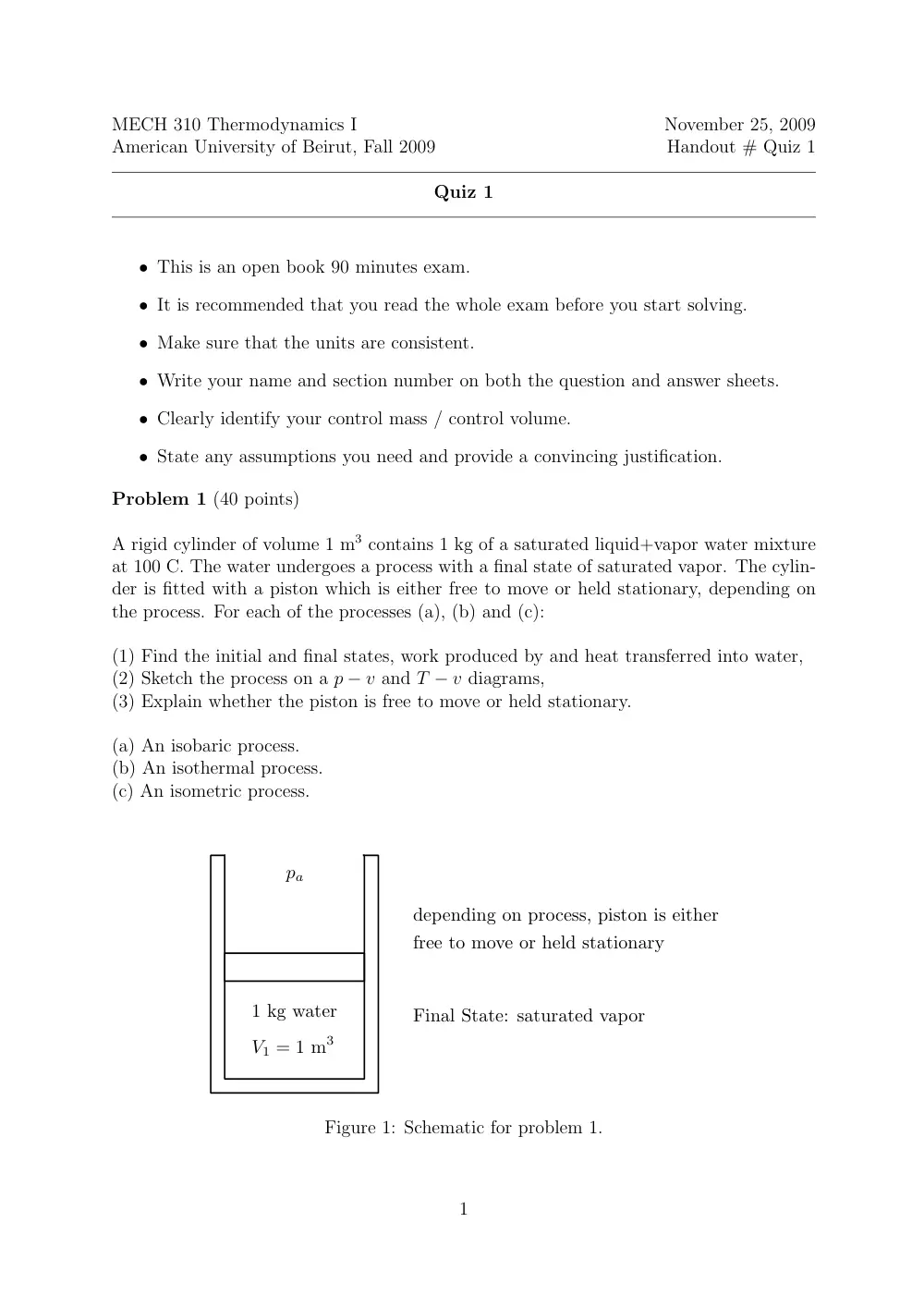
1 kg water
V1 = 1 m3
pa
depending on process, piston is either
free to move or held stationary
Final State: saturated vapor
Figure 1: Schematic for problem 1.
1
Problem 2 (30 points)
A well-insulated rigid tank contains 5 kg of saturated liquid+vapor mixture of water at
100 kPa at an initial unknown quality, x1. An electric resistor, placed in the tank, is
connected to a 110-V source and a current of 8 A flows through the resistor when the
switch is turned on. It took 10 minutes to completely vaporize the liquid. Determine the
following:
(a) The volume of the tank in m3.
(b) The initial quality x1
(c) Sketch the process on a p-v diagram
Note that when electric current I flows through a resistor, it dissipates heat at a rate of
I V (Watts), where V is the potential difference across the resistor.
Note: This problem may require an iterative solution. Do not carry out more than two
iterations.
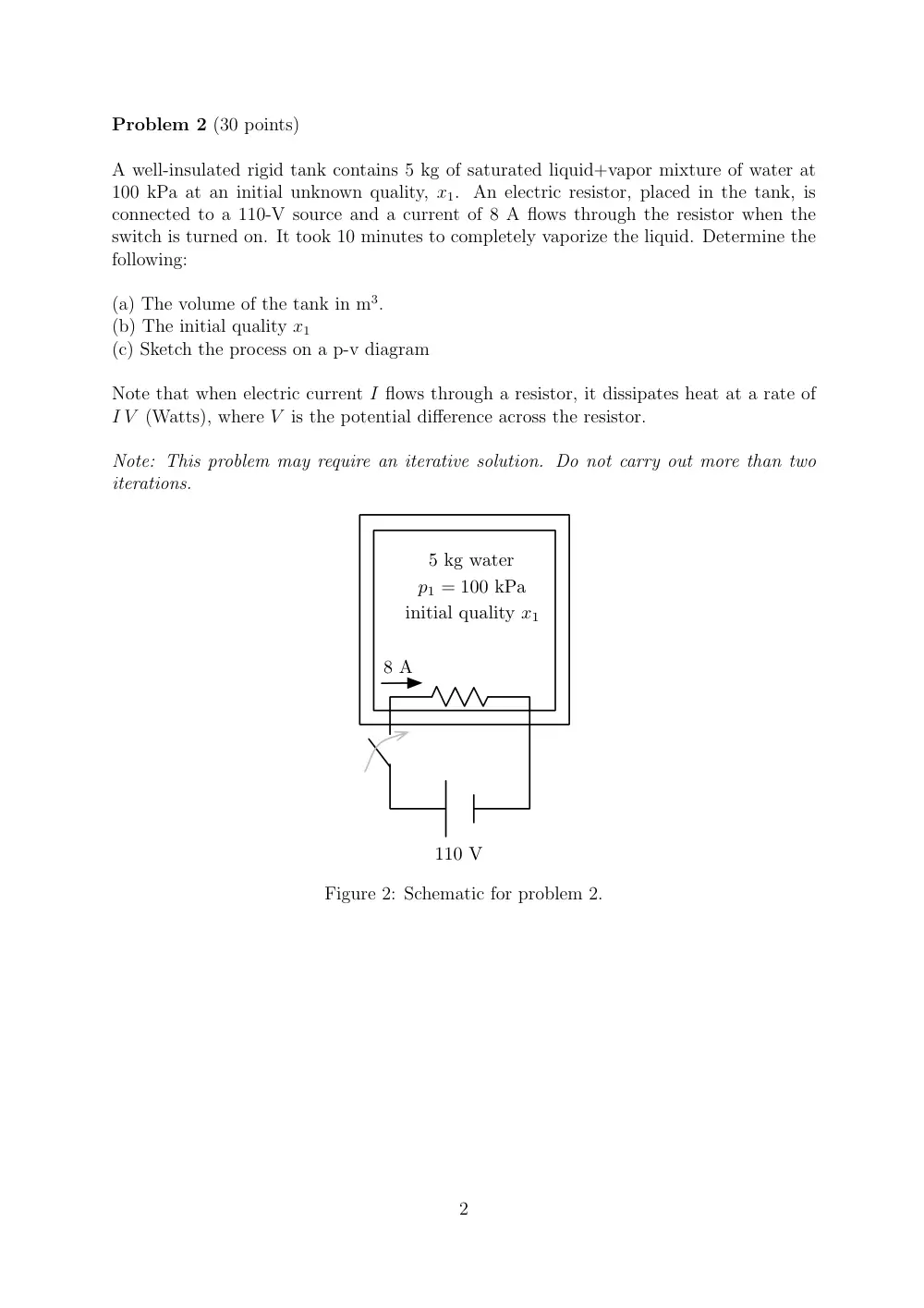
5 kg water
p1 = 100 kPa
initial quality x1
8 A
110 V
Figure 2: Schematic for problem 2.
2
Problem 3 (30 points)
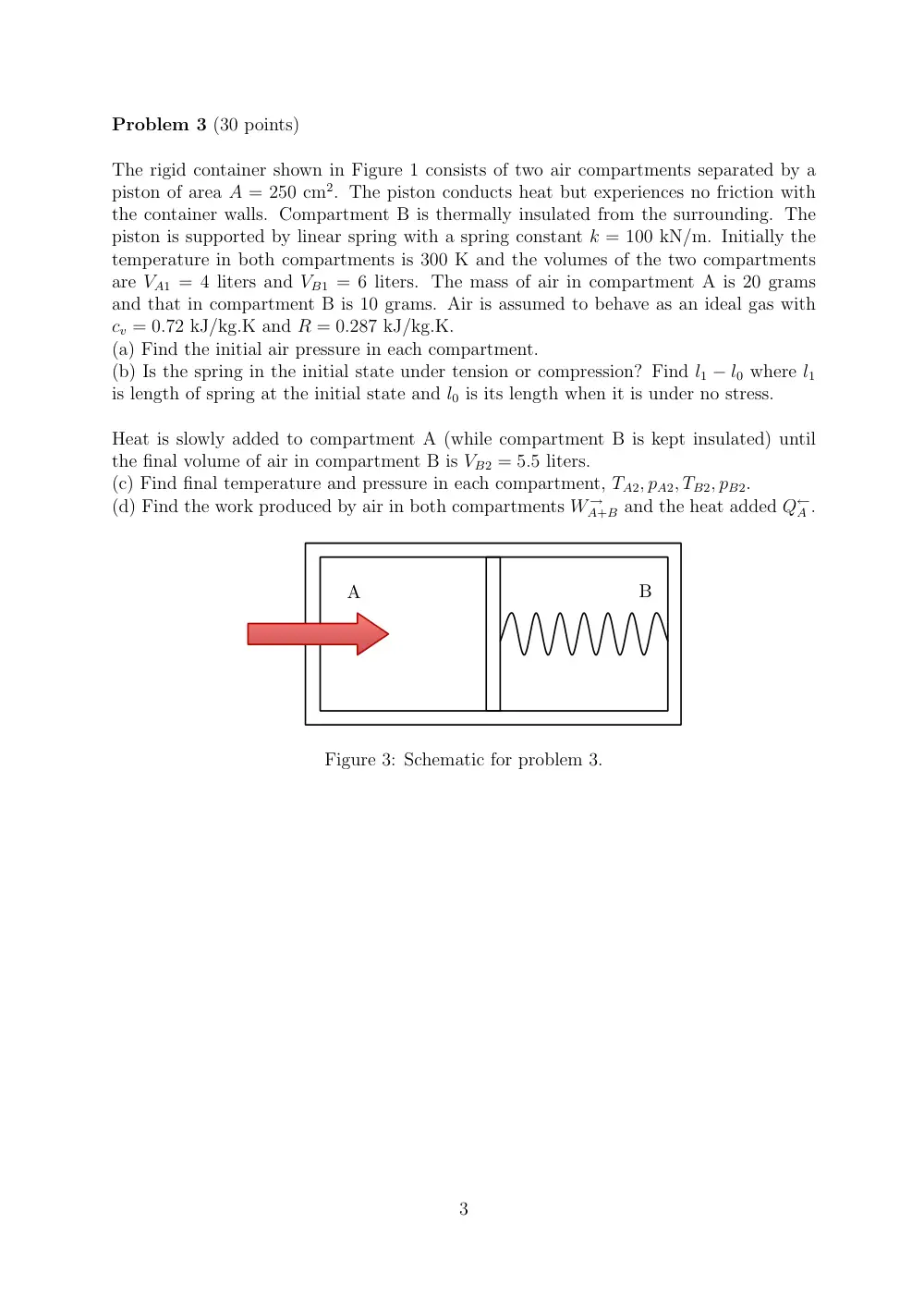
The rigid container shown in Figure 1 consists of two air compartments separated by a
piston of area A = 250 cm2. The piston conducts heat but experiences no friction with
the container walls. Compartment B is thermally insulated from the surrounding. The
piston is supported by linear spring with a spring constant k = 100 kN/m. Initially the
temperature in both compartments is 300 K and the volumes of the two compartments
are VA1 = 4 liters and VB1 = 6 liters. The mass of air in compartment A is 20 grams
and that in compartment B is 10 grams. Air is assumed to behave as an ideal gas with
cv = 0.72 kJ/kg.K and R = 0.287 kJ/kg.K.
(a) Find the initial air pressure in each compartment.
(b) Is the spring in the initial state under tension or compression? Find l1 − l0 where l1
is length of spring at the initial state and l0 is its length when it is under no stress.
Heat is slowly added to compartment A (while compartment B is kept insulated) until
the final volume of air in compartment B is VB2 = 5.5 liters.
(c) Find final temperature and pressure in each compartment, TA2, pA2, TB2, pB2.
(d) Find the work produced by air in both compartments W →
A+B and the heat added Q←
A .
A
B
Figure 3: Schematic for problem 3.
3
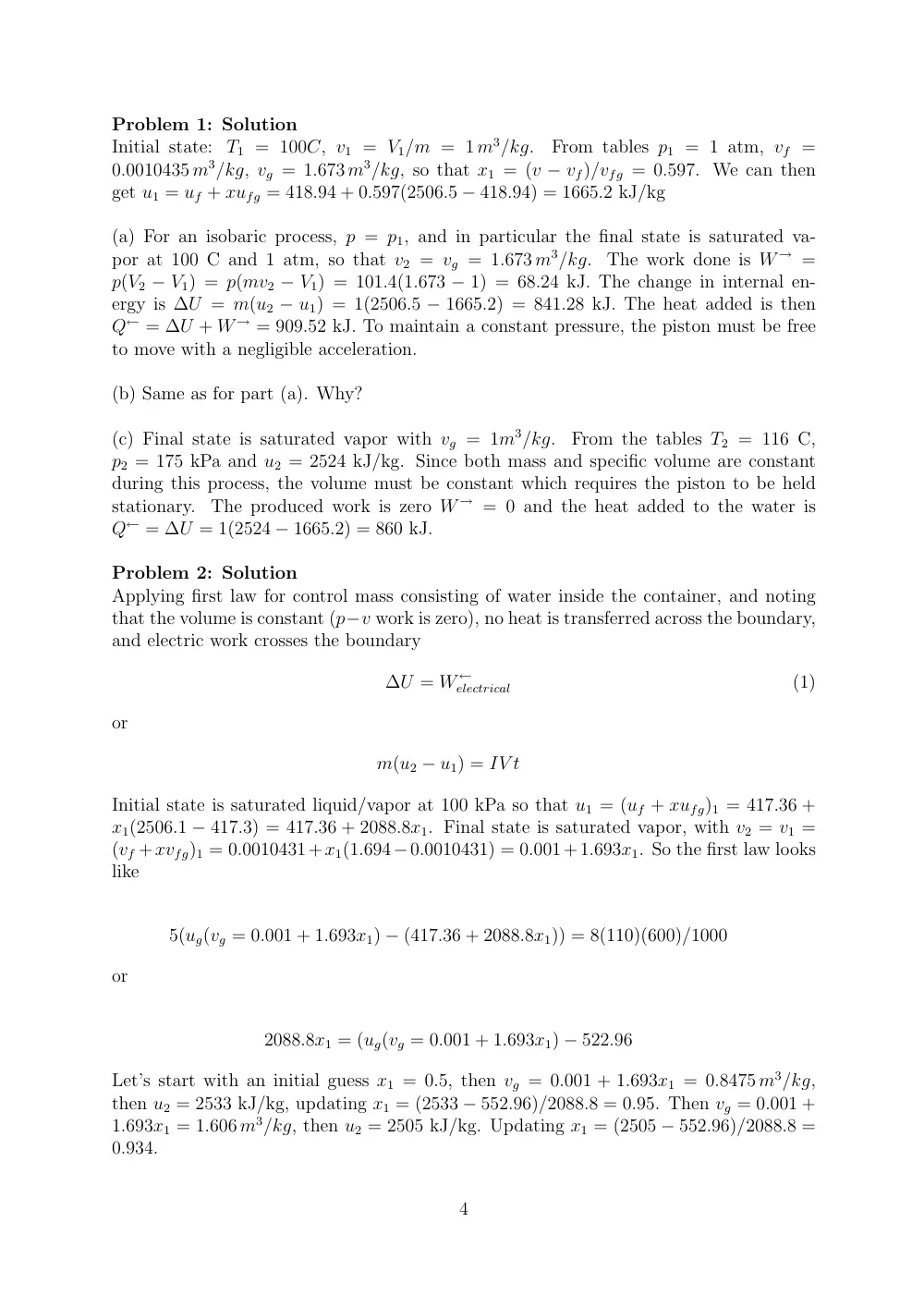
Problem 1: Solution
Initial state: T1 = 100C, v1 = V1/m = 1 m3/kg.
From tables p1 = 1 atm, vf =
0.0010435 m3/kg, vg = 1.673 m3/kg, so that x1 = (v − vf)/vfg = 0.597. We can then
get u1 = uf + xufg = 418.94 + 0.597(2506.5 − 418.94) = 1665.2 kJ/kg
(a) For an isobaric process, p = p1, and in particular the final state is saturated va-
por at 100 C and 1 atm, so that v2 = vg = 1.673 m3/kg. The work done is W → =
p(V2 − V1) = p(mv2 − V1) = 101.4(1.673 − 1) = 68.24 kJ. The change in internal en-
ergy is ∆U = m(u2 − u1) = 1(2506.5 − 1665.2) = 841.28 kJ. The heat added is then
Q← = ∆U + W → = 909.52 kJ. To maintain a constant pressure, the piston must be free
to move with a negligible acceleration.
(b) Same as for part (a). Why?
(c) Final state is saturated vapor with vg = 1m3/kg.
From the tables T2 = 116 C,
p2 = 175 kPa and u2 = 2524 kJ/kg. Since both mass and specific volume are constant
during this process, the volume must be constant which requires the piston to be held
stationary.
The produced work is zero W → = 0 and the heat added to the water is
Q← = ∆U = 1(2524 − 1665.2) = 860 kJ.
Problem 2: Solution
Applying first law for control mass consisting of water inside the container, and noting
that the volume is constant (p−v work is zero), no heat is transferred across the boundary,
and electric work crosses the boundary
∆U = W ←
electrical
(1)
or
m(u2 − u1) = IV t
Initial state is saturated liquid/vapor at 100 kPa so that u1 = (uf + xufg)1 = 417.36 +
x1(2506.1 − 417.3) = 417.36 + 2088.8x1. Final state is saturated vapor, with v2 = v1 =
(vf +xvfg)1 = 0.0010431+x1(1.694−0.0010431) = 0.001+1.693x1. So the first law looks
like
5(ug(vg = 0.001 + 1.693x1) − (417.36 + 2088.8x1)) = 8(110)(600)/1000
or
2088.8x1 = (ug(vg = 0.001 + 1.693x1) − 522.96
Let’s start with an initial guess x1 = 0.5, then vg = 0.001 + 1.693x1 = 0.8475 m3/kg,
then u2 = 2533 kJ/kg, updating x1 = (2533 − 552.96)/2088.8 = 0.95. Then vg = 0.001 +
1.693x1 = 1.606 m3/kg, then u2 = 2505 kJ/kg. Updating x1 = (2505 − 552.96)/2088.8 =
0.934.
4
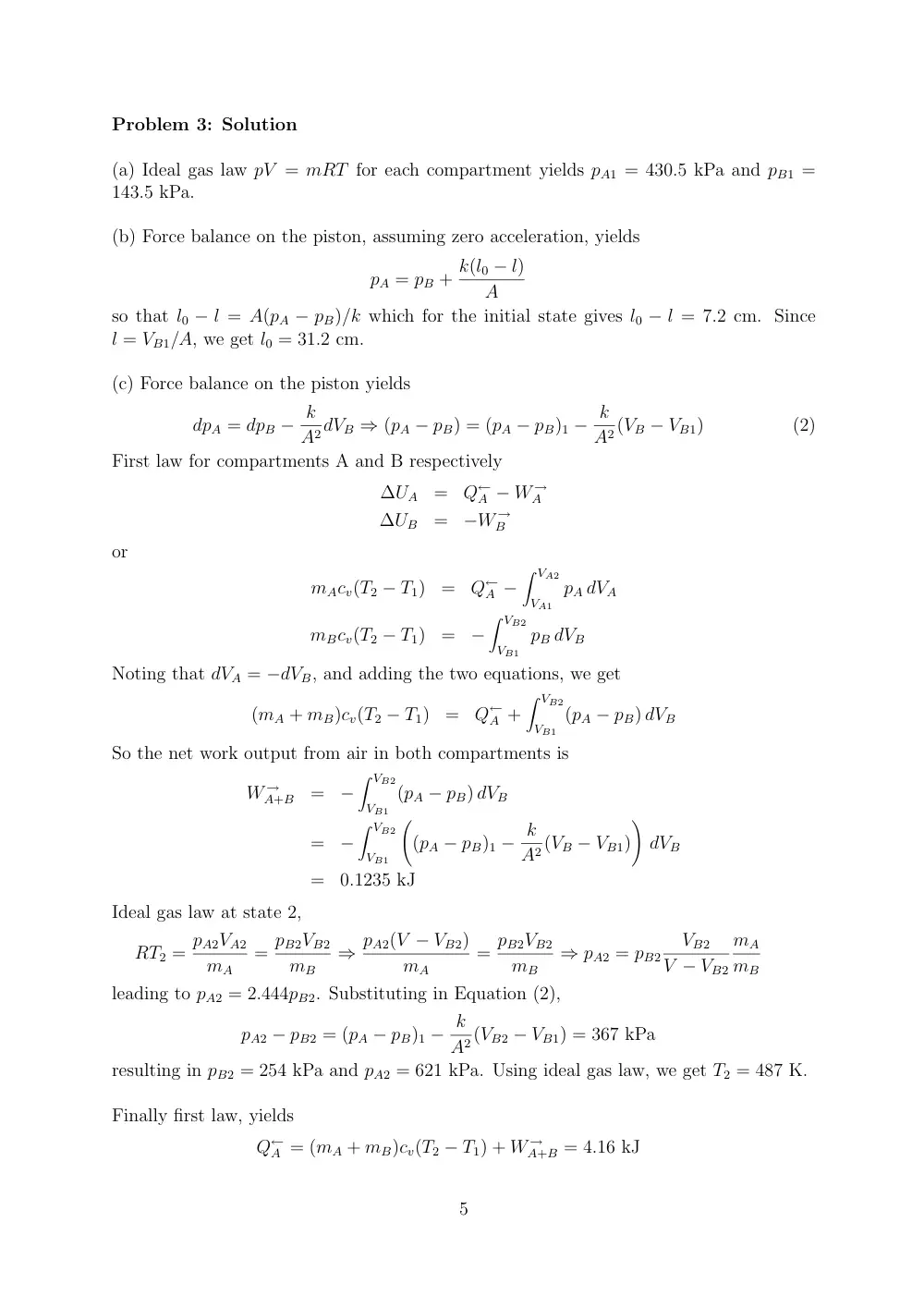
Problem 3: Solution
(a) Ideal gas law pV = mRT for each compartment yields pA1 = 430.5 kPa and pB1 =
143.5 kPa.
(b) Force balance on the piston, assuming zero acceleration, yields
pA = pB + k(l0 − l)
A
so that l0 − l = A(pA − pB)/k which for the initial state gives l0 − l = 7.2 cm. Since
l = VB1/A, we get l0 = 31.2 cm.
(c) Force balance on the piston yields
dpA = dpB − k
A2dVB ⇒ (pA − pB) = (pA − pB)1 − k
A2(VB − VB1)
(2)
First law for compartments A and B respectively
∆UA
=
Q←
A − W →
A
∆UB
=
−W →
B
or
mAcv(T2 − T1)
=
Q←
A −
� VA2
VA1
pA dVA
mBcv(T2 − T1)
=
−
� VB2
VB1
pB dVB
Noting that dVA = −dVB, and adding the two equations, we get
(mA + mB)cv(T2 − T1)
=
Q←
A +
� VB2
VB1
(pA − pB) dVB
So the net work output from air in both compartments is
W →
A+B
=
−
� VB2
VB1
(pA − pB) dVB
=
−
� VB2
VB1
�
(pA − pB)1 − k
A2(VB − VB1)
�
dVB
=
0.1235 kJ
Ideal gas law at state 2,
RT2 = pA2VA2
mA
= pB2VB2
mB
⇒ pA2(V − VB2)
mA
= pB2VB2
mB
⇒ pA2 = pB2
VB2
V − VB2
mA
mB
leading to pA2 = 2.444pB2. Substituting in Equation (2),
pA2 − pB2 = (pA − pB)1 − k
A2(VB2 − VB1) = 367 kPa
resulting in pB2 = 254 kPa and pA2 = 621 kPa. Using ideal gas law, we get T2 = 487 K.
Finally first law, yields
Q←
A = (mA + mB)cv(T2 − T1) + W →
A+B = 4.16 kJ
5