
MECH 310 Exam 1 with Solution, Fall 2011
American University of Beirut · Thermodynamics I · 5 pages · Prof. Mahmoud Al Hindi · with solution
More MECH 310 files
- Exam 2 Solution Leen Alawieh · Fall 2017Exam · with solutionView
- Exam 1 Leen Alawieh With Solutions · Fall 2017Exam · with solutionView
- Exam 1 · Fall 2016ExamView
- Exam 1 · Summer 2012ExamView
- Exam 2 · Summer 2011ExamView
- Exam 2 with Solution · Fall 2011Exam · with solutionView
- Exam 1 · Spring 2011ExamView
- Exam 1 · Summer 2011ExamView
Show the text of this exam
1
MECH 310 Thermodynamics I, Sections 1,2 ,3
November 12, 2011
American University of Beirut, Fall 2011
Professors: R. Slim, M. Al Hindi
Quiz 1
Problem 1
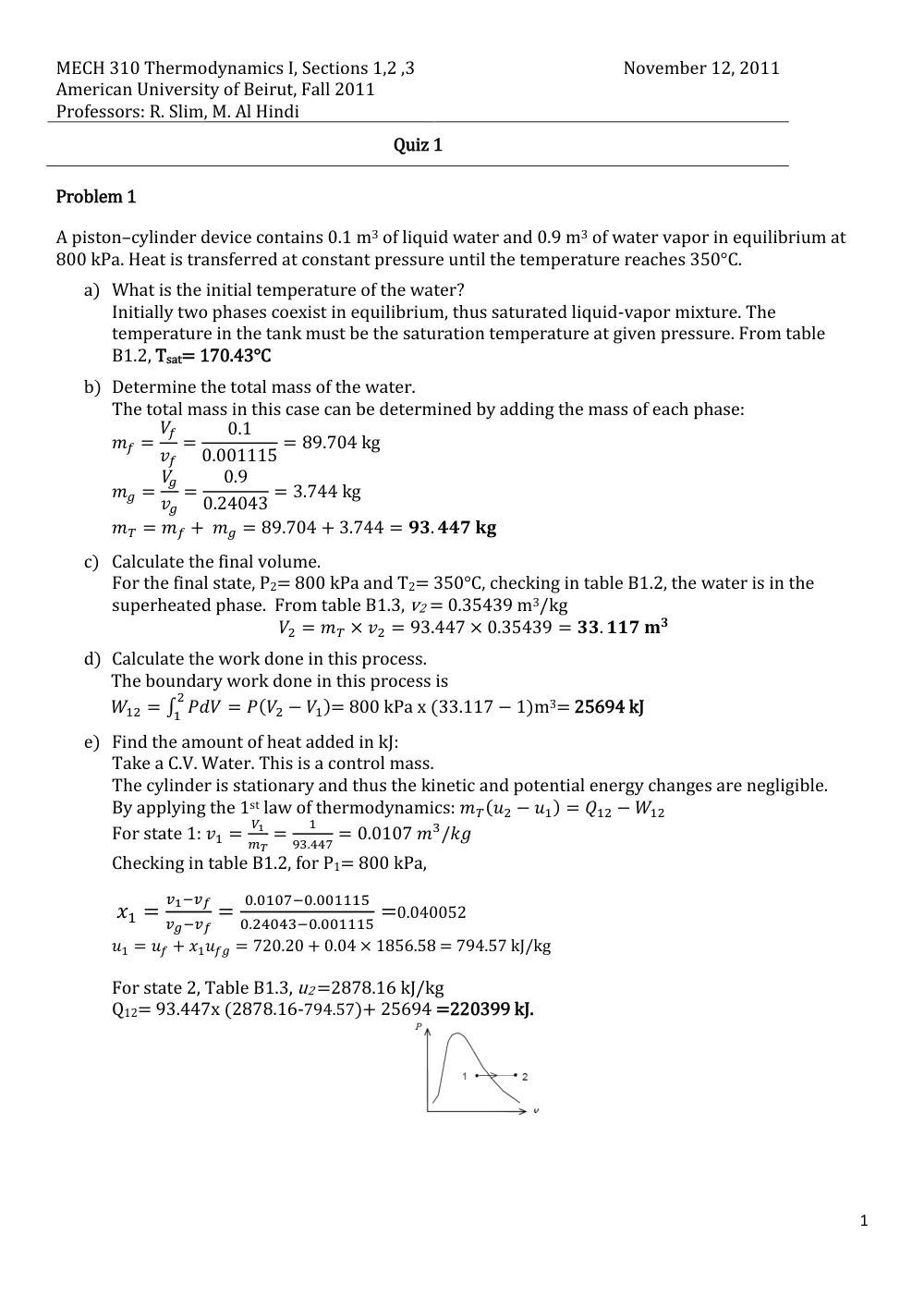
A piston–cylinder device contains 0.1 m3 of liquid water and 0.9 m3 of water vapor in equilibrium at
800 kPa. Heat is transferred at constant pressure until the temperature reaches 350°C.
a) What is the initial temperature of the water?
Initially two phases coexist in equilibrium, thus saturated liquid-vapor mixture. The
temperature in the tank must be the saturation temperature at given pressure. From table
B1.2, Tsat= 170.43°C
b) Determine the total mass of the water.
The total mass in this case can be determined by adding the mass of each phase:
c) Calculate the final volume.
For the final state, P2= 800 kPa and T2= 350°C, checking in table B1.2, the water is in the
superheated phase. From table B1.3, v2 = 0.35439 m3/kg
d) Calculate the work done in this process.
The boundary work done in this process is
= 800 kPa x ( )m3= 25694 kJ
e) Find the amount of heat added in kJ:
Take a C.V. Water. This is a control mass.
The cylinder is stationary and thus the kinetic and potential energy changes are negligible.
By applying the 1st law of thermodynamics:
For state 1:
Checking in table B1.2, for P1= 800 kPa,
0.040052
= 794.57 kJ/kg
For state 2, Table B1.3, u2 =2878.16 kJ/kg
Q12= 93.447x (2878.16-794.57)+ 25694 =220399 kJ.
2
Problem 2
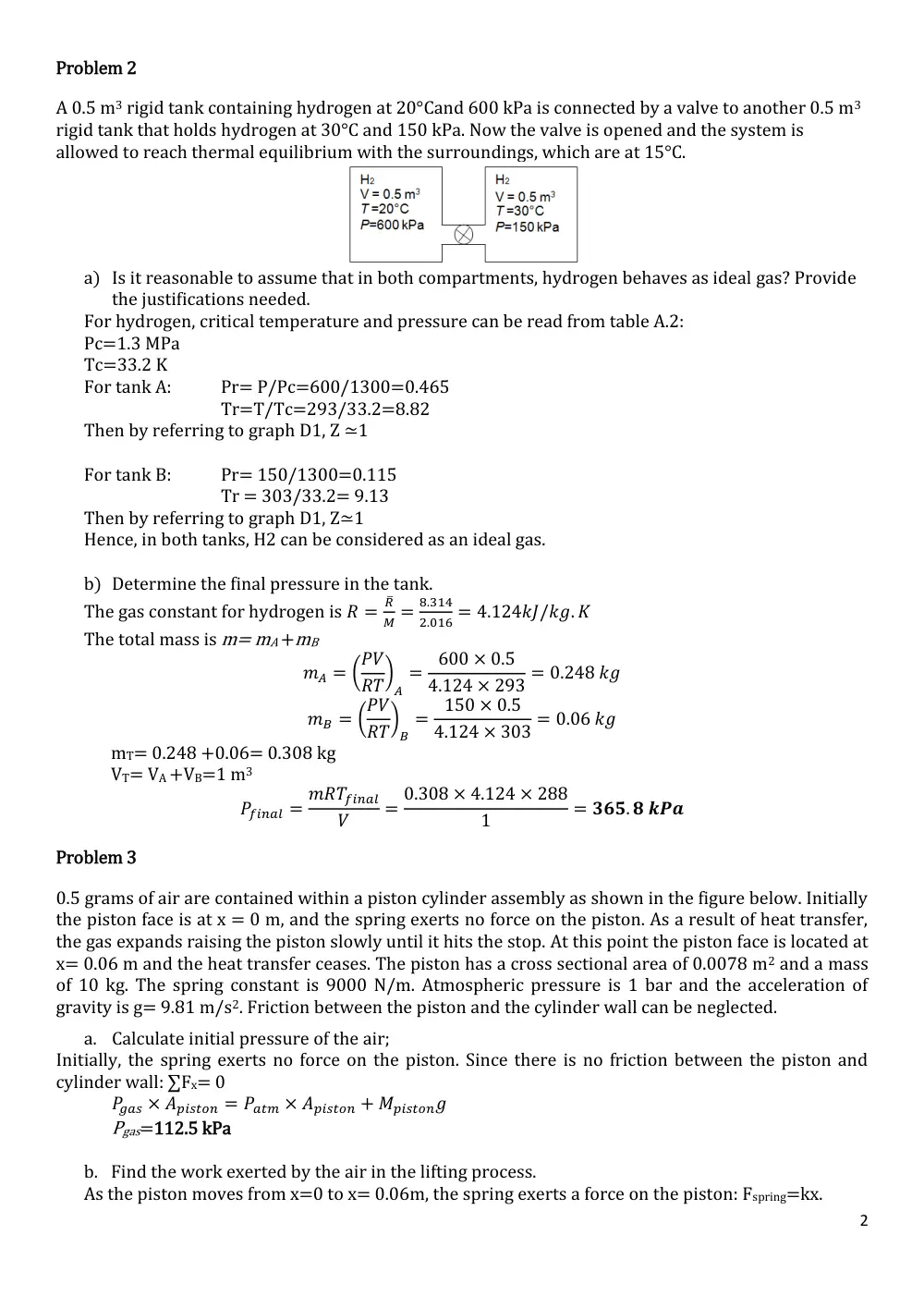
A 0.5 m3 rigid tank containing hydrogen at 20°Cand 600 kPa is connected by a valve to another 0.5 m3
rigid tank that holds hydrogen at 30°C and 150 kPa. Now the valve is opened and the system is
allowed to reach thermal equilibrium with the surroundings, which are at 15°C.
a) Is it reasonable to assume that in both compartments, hydrogen behaves as ideal gas? Provide
the justifications needed.
For hydrogen, critical temperature and pressure can be read from table A.2:
Pc=1.3 MPa
Tc=33.2 K
For tank A:
Pr= P/Pc=600/1300=0.465
Tr=T/Tc=293/33.2=8.82
Then by referring to graph D1, Z ≃1
For tank B:
Pr= 150/1300=0.115
Tr = 303/33.2= 9.13
Then by referring to graph D1, Z≃1
Hence, in both tanks, H2 can be considered as an ideal gas.
b) Determine the final pressure in the tank.
The gas constant for hydrogen is
The total mass is m= mA +mB
mT= 0.248 +0.06= 0.308 kg
VT= VA +VB=1 m3
Problem 3
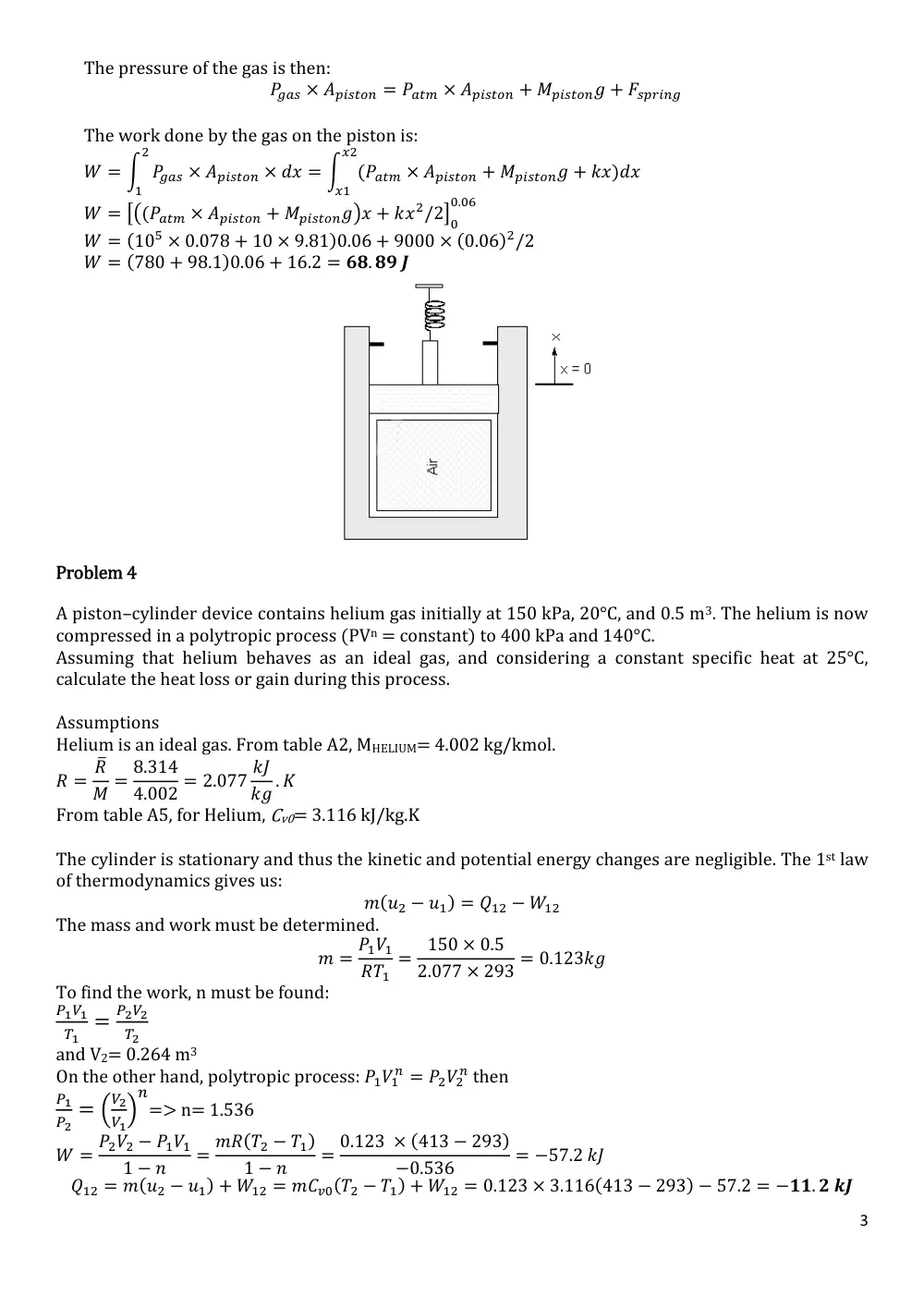
0.5 grams of air are contained within a piston cylinder assembly as shown in the figure below. Initially
the piston face is at x = 0 m, and the spring exerts no force on the piston. As a result of heat transfer,
the gas expands raising the piston slowly until it hits the stop. At this point the piston face is located at
x= 0.06 m and the heat transfer ceases. The piston has a cross sectional area of 0.0078 m2 and a mass
of 10 kg. The spring constant is 9000 N/m. Atmospheric pressure is 1 bar and the acceleration of
gravity is g= 9.81 m/s2. Friction between the piston and the cylinder wall can be neglected.
a. Calculate initial pressure of the air;
Initially, the spring exerts no force on the piston. Since there is no friction between the piston and
cylinder wall: ∑Fx= 0
Pgas=112.5 kPa
b. Find the work exerted by the air in the lifting process.
As the piston moves from x=0 to x= 0.06m, the spring exerts a force on the piston: Fspring=kx.
3
The pressure of the gas is then:
The work done by the gas on the piston is:
Problem 4
A piston–cylinder device contains helium gas initially at 150 kPa, 20°C, and 0.5 m3. The helium is now
compressed in a polytropic process (PVn = constant) to 400 kPa and 140°C.
Assuming that helium behaves as an ideal gas, and considering a constant specific heat at 25°C,
calculate the heat loss or gain during this process.
Assumptions
Helium is an ideal gas. From table A2, MHELIUM= 4.002 kg/kmol.
From table A5, for Helium, Cv0= 3.116 kJ/kg.K
The cylinder is stationary and thus the kinetic and potential energy changes are negligible. The 1st law
of thermodynamics gives us:
The mass and work must be determined.
To find the work, n must be found:
and V2= 0.264 m3
On the other hand, polytropic process:
then
=> n= 1.536
4
Problem 5
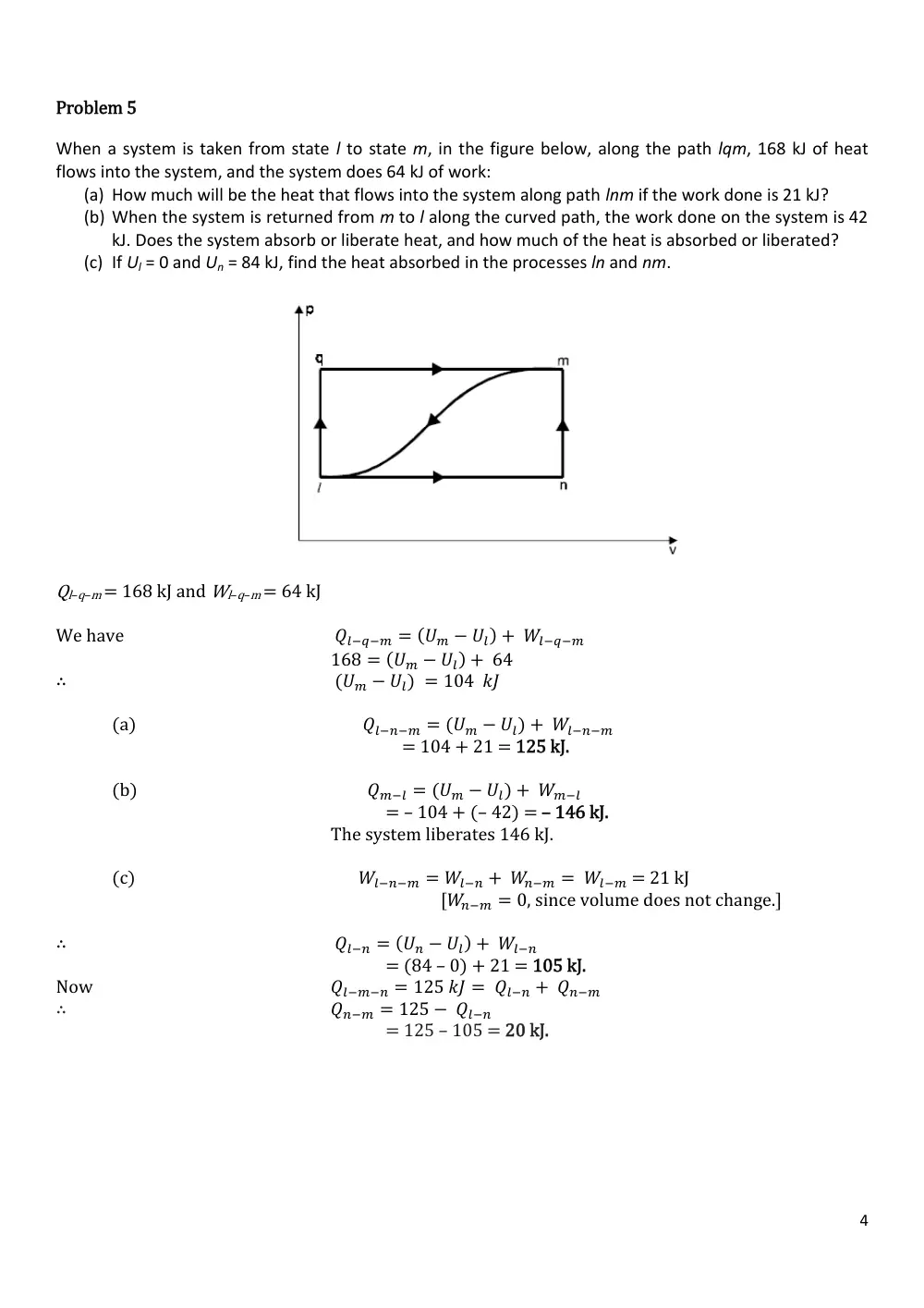
When a system is taken from state l to state m, in the figure below, along the path lqm, 168 kJ of heat
flows into the system, and the system does 64 kJ of work:
(a) How much will be the heat that flows into the system along path lnm if the work done is 21 kJ?
(b) When the system is returned from m to l along the curved path, the work done on the system is 42
kJ. Does the system absorb or liberate heat, and how much of the heat is absorbed or liberated?
(c) If Ul = 0 and Un = 84 kJ, find the heat absorbed in the processes ln and nm.
Ql–q–m = 168 kJ and Wl–q–m = 64 kJ
We have
∴
(a)
= 104 + 21 = 125 kJ.
(b)
= – 104 + (– 42) = – 146 kJ.
The system liberates 146 kJ.
(c)
= 21 kJ
[ , since volume does not change.]
∴
= (84 – 0) + 21 = 105 kJ.
Now
∴
= 125 – 105 = 20 kJ.
5
Bonus Problem
A student living in a 4-m X 6m X 6m dormitory room turns on his/her 150-W fan before he/she leaves the
room on a summer day, hoping that the room will be cooler when he/she comes back in the evening.
Assuming all the doors and windows are tightly closed and disregarding any heat transfer through the walls
and the windows, determine the temperature in the room when he/she comes back 10 hours later. Use
specific heat values at room temperature, and assume the room to be at 100 kPa and 15°C in the morning
when he/she leaves.
Assumptions:
Air is an ideal gas since it is at a high temperature and low pressure relative to its critical point values
The kinetic and potential energy changes are negligible,
Constant specific heats at room temperature can be used for air.
All the doors and windows are tightly closed, and heat transfer through the walls and the windows is
disregarded.
The following properties are needed from Table A-5:
The molecular mass of air = 28.97
The specific heat capacity for air at constant volume and room temperature cv = 0.717 kJ/kg.K
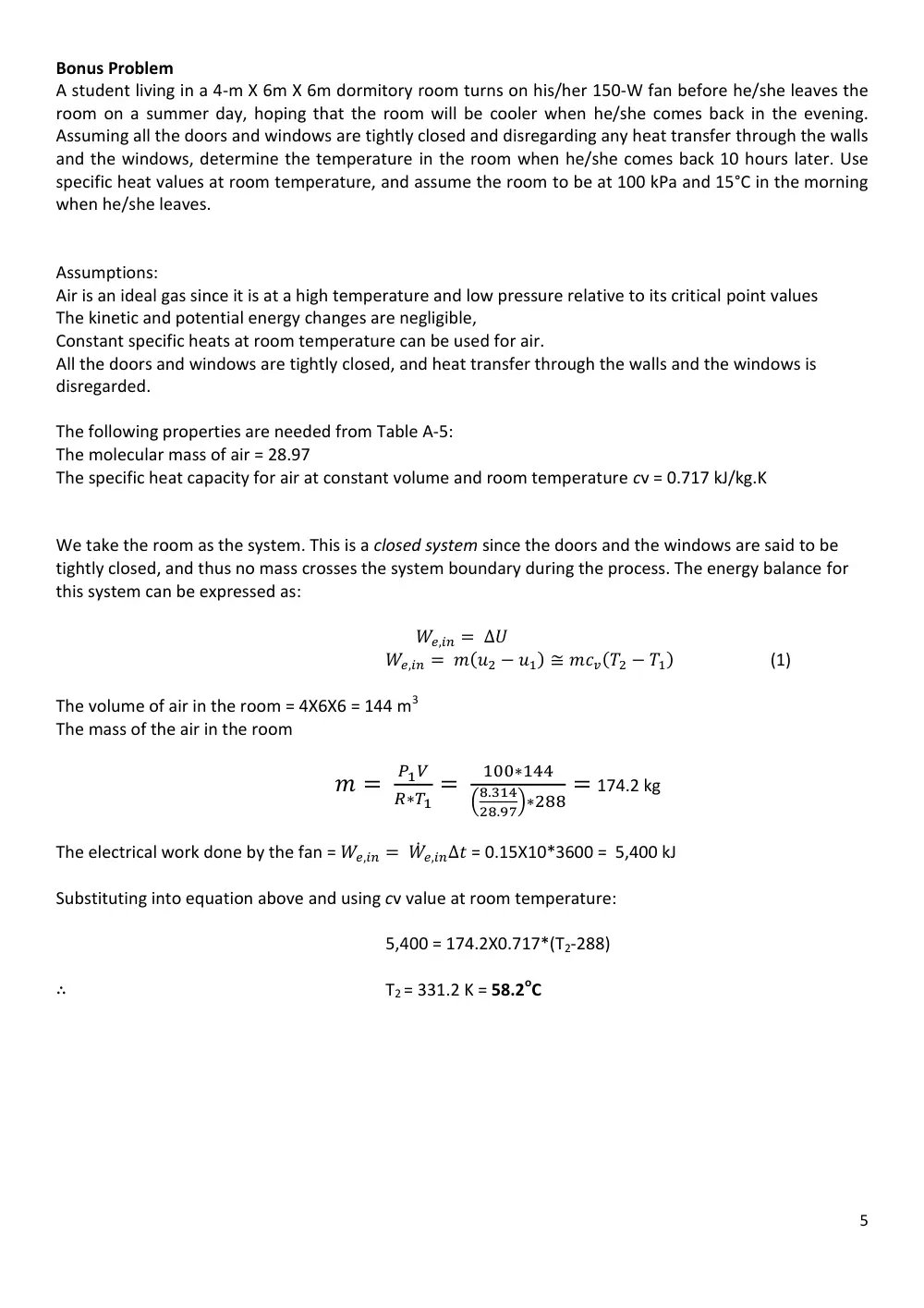
We take the room as the system. This is a closed system since the doors and the windows are said to be
tightly closed, and thus no mass crosses the system boundary during the process. The energy balance for
this system can be expressed as:
(1)
The volume of air in the room = 4X6X6 = 144 m3
The mass of the air in the room
174.2 kg
The electrical work done by the fan = = 0.15X10*3600 = 5,400 kJ
Substituting into equation above and using cv value at room temperature:
5,400 = 174.2X0.717*(T2-288)
∴
T2 = 331.2 K = 58.2oC