
MECH 310 Exam 1, Spring 2011
American University of Beirut · Thermodynamics I · 2 pages · Prof. Mahmoud Al Hindi

More MECH 310 files
- Exam 2 Solution Leen Alawieh · Fall 2017Exam · with solutionView
- Exam 1 Leen Alawieh With Solutions · Fall 2017Exam · with solutionView
- Exam 1 · Fall 2016ExamView
- Exam 1 · Summer 2012ExamView
- Exam 2 · Summer 2011ExamView
- Exam 2 with Solution · Fall 2011Exam · with solutionView
- Exam 1 · Summer 2011ExamView
- Exam 1 with Solution · Fall 2011Exam · with solutionView
Show the text of this exam
MECH 310 THERMODYNAMICS
Exam 1 (OPEN BOOK 90 MINUTES)
1st April 2011
(3 Problems for a total of 100 POINTS plus two bonus questions for 5 POINTS)
PROBLEM 1
Pressure and Force
(20 POINTS)
I)
What is the absolute pressure at a point where the gauge pressure is 70 cm of water? Give your
answer in bars and psi. (2 points)
II)
A tube contains an oil of specific gravity 0.9 to a depth of 120 cm. Find the gauge pressure at this
depth. Give your answer kPa and atm. (2 points)
III) Calculate the pressure in the 240-mm-diameter cylinder shown in Figure 1(a) below. The spring
is compressed by 60 cm. Assume that there is no friction. Give your answer in kPa. (8 points)
IV) A bell jar of 200 mm diameter (as shown in Figure 1(b) below) sits on a flat plate and is
evacuated until a vacuum of 720 mmHg exists. The local barometer reads 760 mmHg. Estimate
the force required to lift the jar off the plate. Neglect the weight of the jar. (8 points)
(a)
(b)
Figure 1 (a) Cylinder-spring system, (b) bell jar system
PROBLEM 2
Energy, Heat and Work
(30 POINTS)
I)
An object that weighs 4 N traveling at 60 m/s enters a viscous liquid and is essentially brought to
rest before it strikes the bottom. What is the increase in internal energy, taking the object and the
liquid as the system? Neglect the potential energy change. (10 points)
II)
A 1700-kg vehicle traveling at 82 km/h collides head-on with a 1400-kg vehicle traveling at 90
km/h. If they come to rest immediately after impact, determine the increase in the internal
energy, taking both vehicles as the system. (10 points)
III)
Gas from a cylinder of compressed helium is used to inflate an inelastic flexible balloon,
originally folded completely flat and attached to the top of the cylinder, to a volume 0.6 m3. If the
barometer reads 760 mm Hg, what is the amount of work done upon the atmosphere by the
balloon? Sketch the system before and after the process clearly identifying the boundaries at the
start and end of the process and state whether it is an open or a closed system. (10 points)
PTO
MECH 310 THERMODYNAMICS
Exam 1 (OPEN BOOK 90 MINUTES)
1st April 2011
PROBLEM 3:
Pure Substance
(50 POINTS)
I)
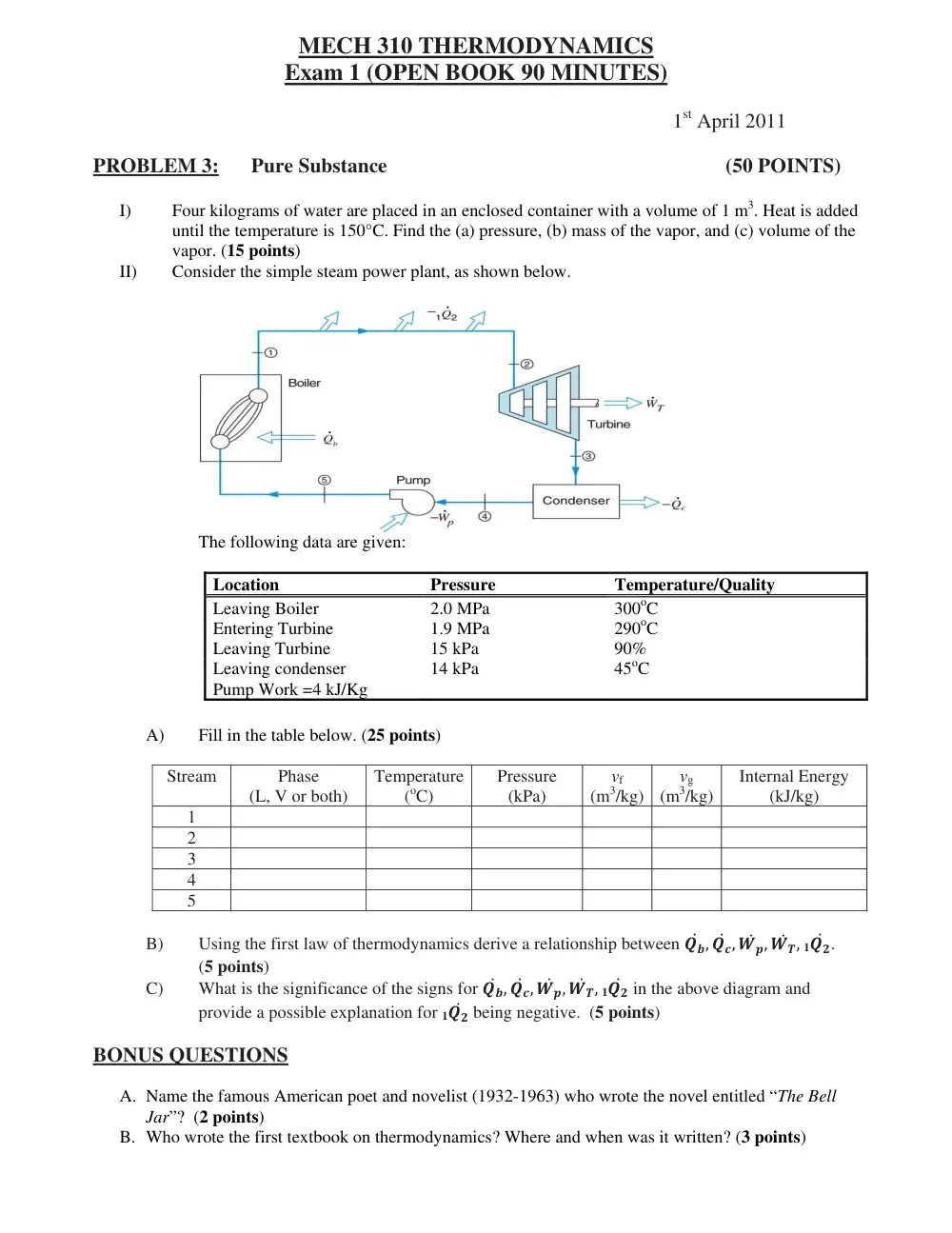
Four kilograms of water are placed in an enclosed container with a volume of 1 m3. Heat is added
until the temperature is 150°C. Find the (a) pressure, (b) mass of the vapor, and (c) volume of the
vapor. (15 points)
II)
Consider the simple steam power plant, as shown below.
The following data are given:
Location
Pressure
Temperature/Quality
Leaving Boiler
2.0 MPa
300oC
Entering Turbine
1.9 MPa
290oC
Leaving Turbine
15 kPa
90%
Leaving condenser
14 kPa
45oC
Pump Work =4 kJ/Kg
A)
Fill in the table below. (25 points)
Stream
Phase
(L, V or both)
Temperature
(oC)
Pressure
(kPa)
vf
(m3/kg)
vg
(m3/kg)
Internal Energy
(kJ/kg)
1
2
3
4
5
B)
Using the first law of thermodynamics derive a relationship between ��� , ��� , ��� , ��� , 1��� .
(5 points)
C)
What is the significance of the signs for ��� , ��� , ��� , ��� , 1��� in the above diagram and
provide a possible explanation for 1��� being negative. (5 points)
BONUS QUESTIONS
A. Name the famous American poet and novelist (1932-1963) who wrote the novel entitled “The Bell
Jar”? (2 points)
B. Who wrote the first textbook on thermodynamics? Where and when was it written? (3 points)