
MECH 310 Exam 2 with Solution, Fall 2011
American University of Beirut · Thermodynamics I · 12 pages · with solution
Showing the first 10 of 12 pages. Download the PDF to see all of it.
More MECH 310 files
- Exam 2 Solution Leen Alawieh · Fall 2017Exam · with solutionView
- Exam 1 Leen Alawieh With Solutions · Fall 2017Exam · with solutionView
- Exam 1 · Fall 2016ExamView
- Exam 1 · Summer 2012ExamView
- Exam 1 with Solution · Fall 2011Exam · with solutionView
- Exam 2 · Summer 2011ExamView
- Exam 1 · Spring 2011ExamView
- Exam 1 · Summer 2011ExamView
Show the text of this exam
1
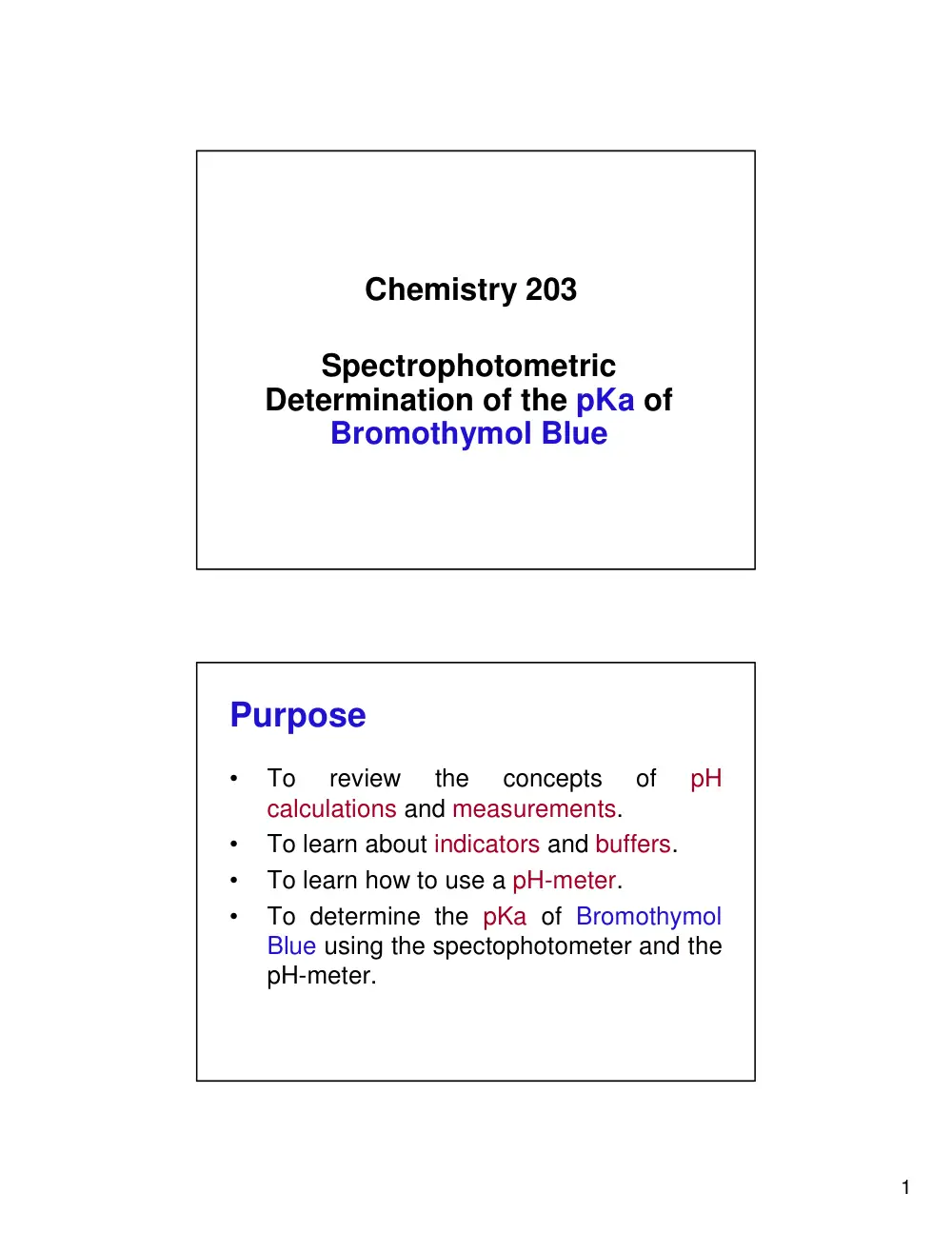
Chemistry 203
Spectrophotometric
Determination of the pKa of
Bromothymol Blue
Purpose
•
To
review
the
concepts
of
pH
calculations and measurements.
•
To learn about indicators and buffers.
•
To learn how to use a pH-meter.
•
To determine the pKa of Bromothymol
Blue using the spectophotometer and the
pH-meter.
2
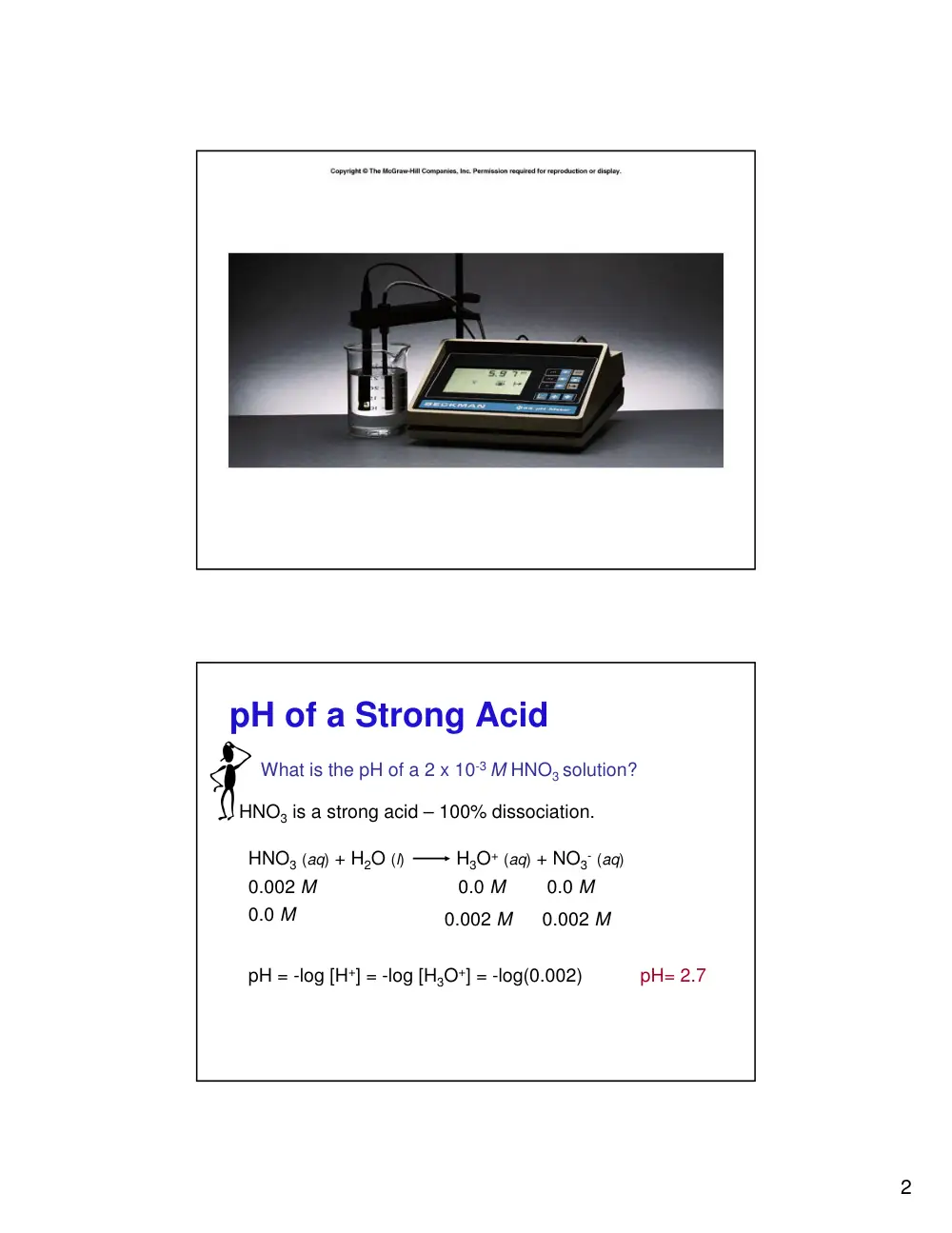
Fig. 15.2
pH of a Strong Acid
What is the pH of a 2 x 10⁻³ M HNO3 solution?
HNO3 is a strong acid – 100% dissociation.
HNO3 (aq) + H2O (l)
H3O+ (aq) + NO3
- (aq)
0.002 M
0.0 M
0.0 M
0.002 M
0.002 M
0.0 M
pH = -log [H+] = -log [H3O+] = -log(0.002)
pH= 2.7
3
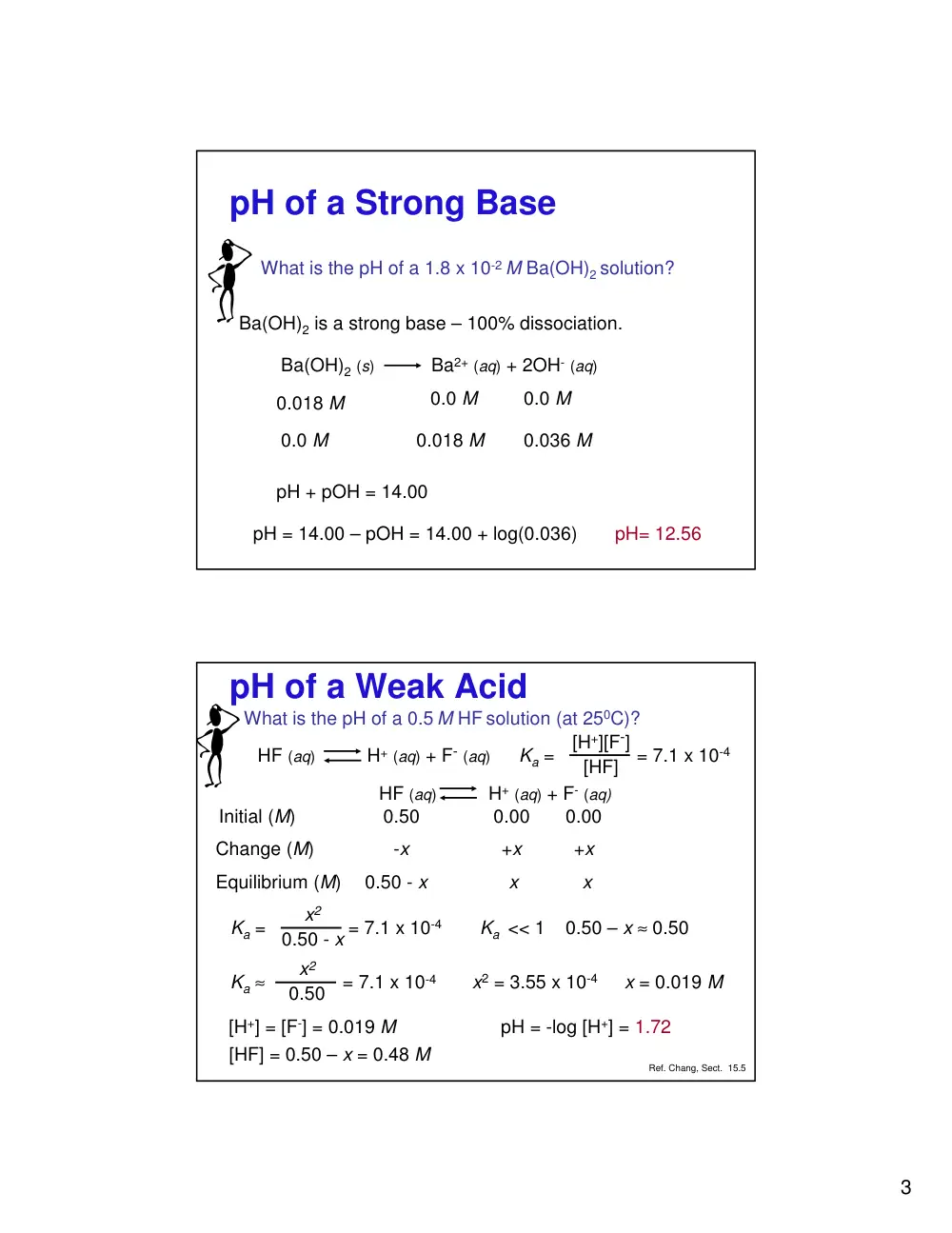
pH of a Strong Base
Ba(OH)2 is a strong base – 100% dissociation.
What is the pH of a 1.8 x 10⁻² M Ba(OH)2 solution?
Ba(OH)2 (s)
Ba2+ (aq) + 2OH- (aq)
0.018 M
0.0 M
0.0 M
0.0 M
0.018 M
0.036 M
pH = 14.00 – pOH = 14.00 + log(0.036)
pH= 12.56
pH + pOH = 14.00
What is the pH of a 0.5 M HF solution (at 250C)?
HF (aq)
H+ (aq) + F- (aq)
Ka =
[H+][F-]
[HF]
= 7.1 x 10⁻⁴
HF (aq)
H+ (aq) + F- (aq)
Initial (M)
Change (M)
Equilibrium (M)
0.50
0.00
-x
+x
0.50 - x
0.00
+x
x
x
Ka =
x2
0.50 - x = 7.1 x 10⁻⁴
Ka ≈
x2
0.50
= 7.1 x 10⁻⁴
0.50 – x ≈ 0.50
Ka << 1
x2 = 3.55 x 10⁻⁴
x = 0.019 M
[H+] = [F-] = 0.019 M
pH = -log [H+] = 1.72
[HF] = 0.50 – x = 0.48 M
Ref. Chang, Sect. 15.5
pH of a Weak Acid
4
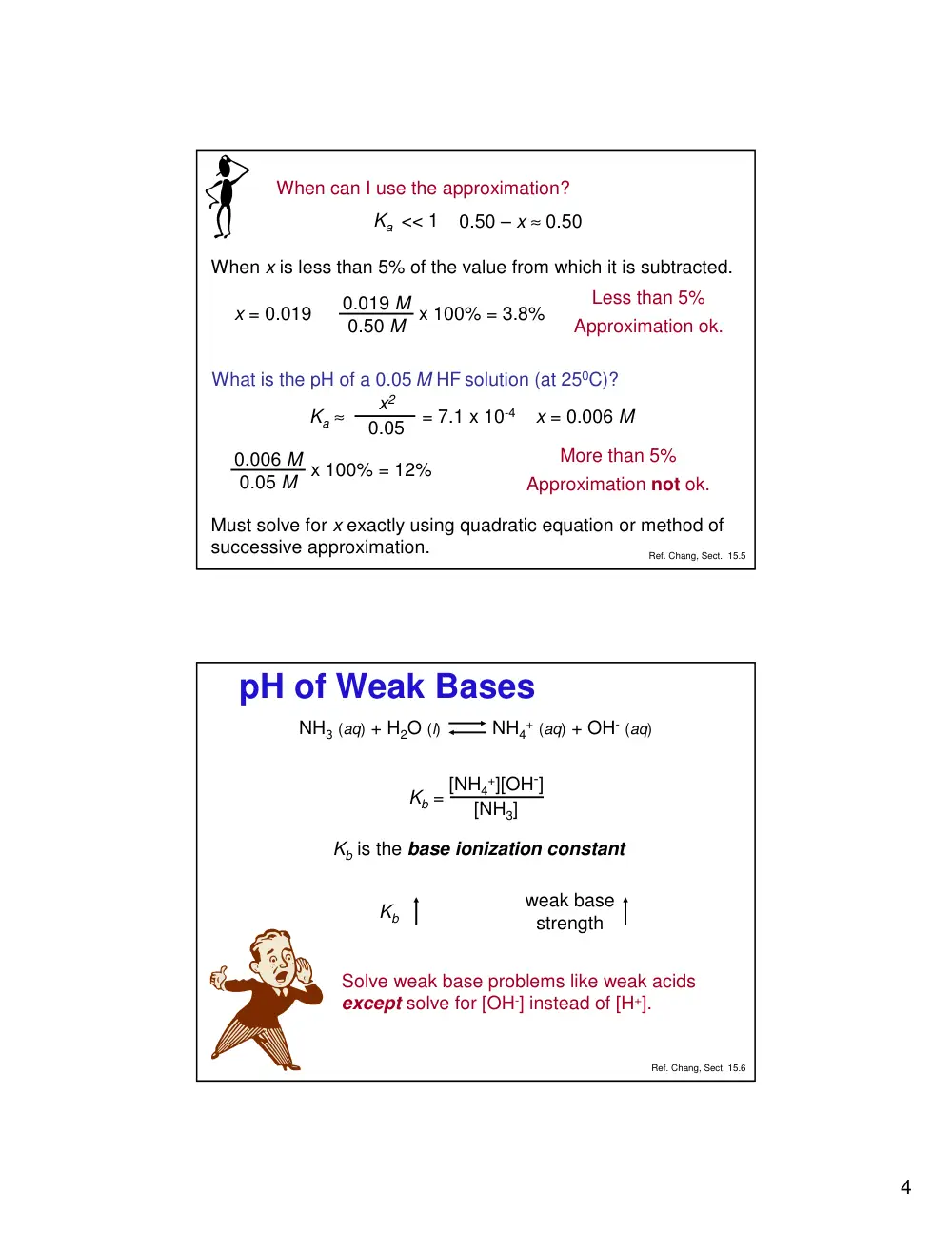
When can I use the approximation?
0.50 – x ≈ 0.50
Ka << 1
When x is less than 5% of the value from which it is subtracted.
x = 0.019
0.019 M
0.50 M x 100% = 3.8%
Less than 5%
Approximation ok.
What is the pH of a 0.05 M HF solution (at 250C)?
Ka ≈
x2
0.05
= 7.1 x 10⁻⁴
x = 0.006 M
0.006 M
0.05 M x 100% = 12%
More than 5%
Approximation not ok.
Must solve for x exactly using quadratic equation or method of
successive approximation.
Ref. Chang, Sect. 15.5
NH3 (aq) + H2O (l)
NH4
+ (aq) + OH- (aq)
pH of Weak Bases
Kb = [NH4
+][OH-]
[NH3]
Kb is the base ionization constant
Kb
weak base
strength
Ref. Chang, Sect. 15.6
Solve weak base problems like weak acids
except solve for [OH-] instead of [H+].
5
Ref. Chang, Sect. 15.7
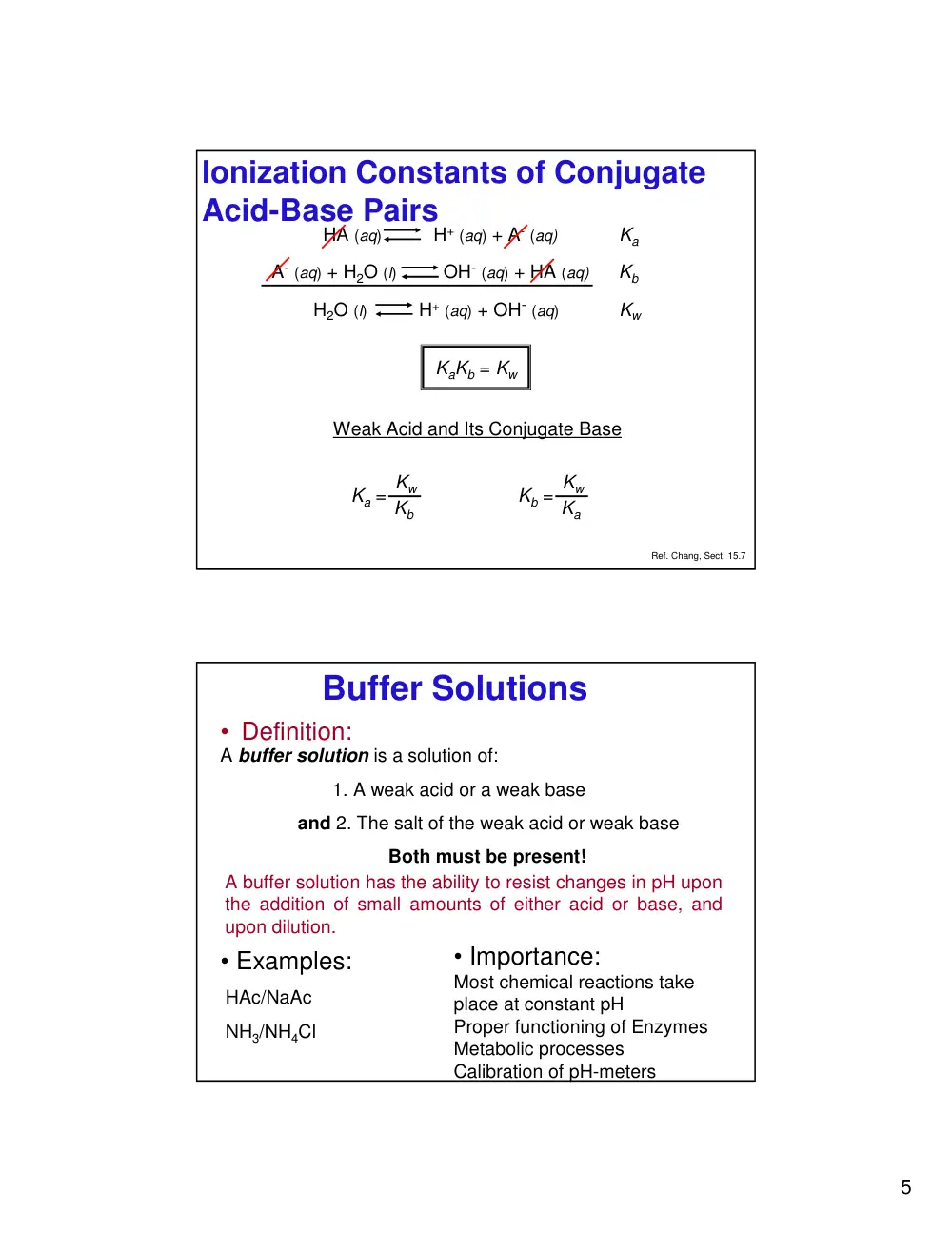
Ionization Constants of Conjugate
Acid-Base Pairs
HA (aq)
H+ (aq) + A- (aq)
A- (aq) + H2O (l)
OH- (aq) + HA (aq)
Ka
Kb
H2O (l)
H+ (aq) + OH- (aq)
Kw
KaKb = Kw
Weak Acid and Its Conjugate Base
Ka = Kw
Kb
Kb = Kw
Ka
Buffer Solutions
• Definition:
A buffer solution is a solution of:
1. A weak acid or a weak base
and 2. The salt of the weak acid or weak base
Both must be present!
A buffer solution has the ability to resist changes in pH upon
the addition of small amounts of either acid or base, and
upon dilution.
• Examples:
HAc/NaAc
NH3/NH4Cl
• Importance:
Most chemical reactions take
place at constant pH
Proper functioning of Enzymes
Metabolic processes
Calibration of pH-meters
6
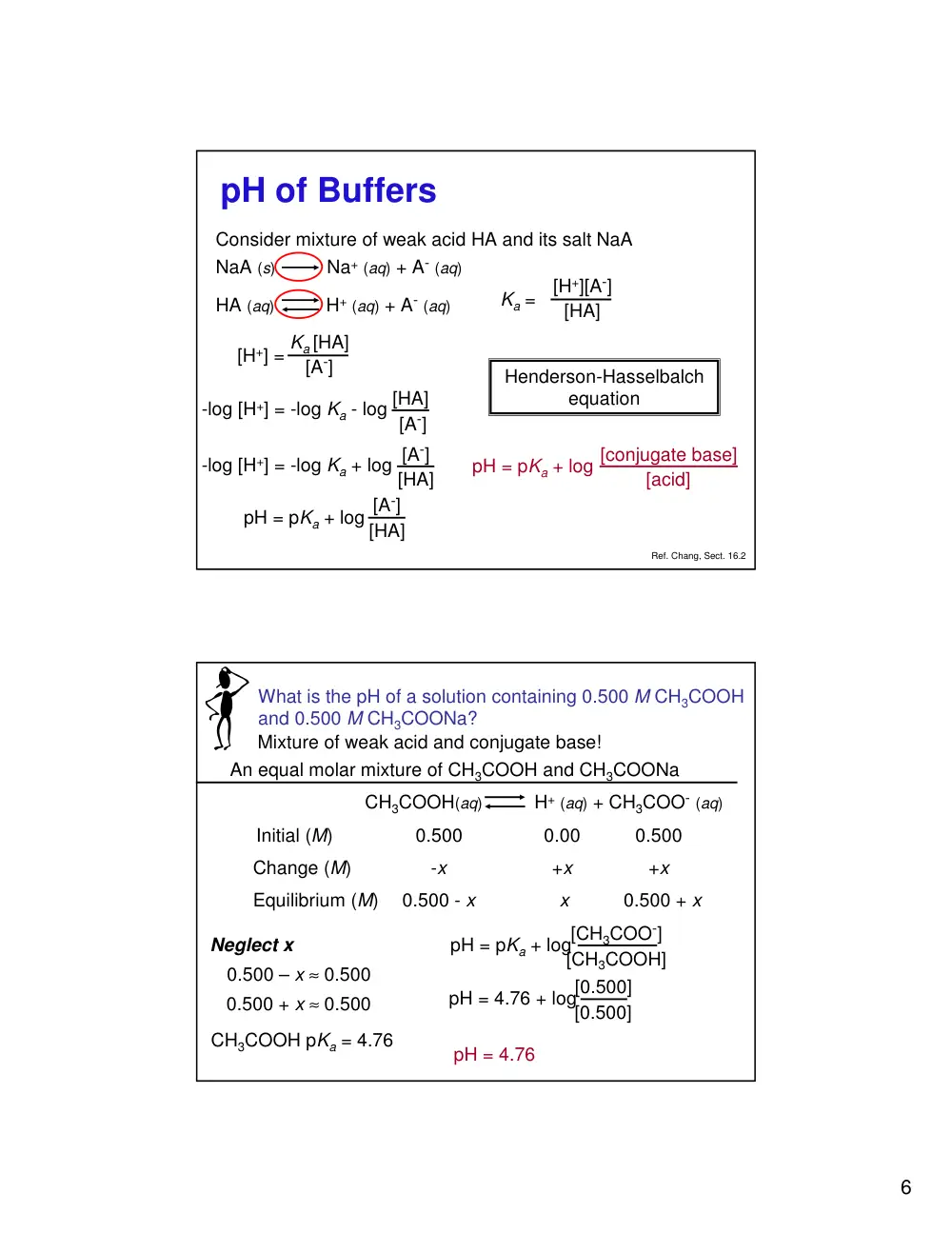
Consider mixture of weak acid HA and its salt NaA
HA (aq)
H+ (aq) + A- (aq)
NaA (s)
Na+ (aq) + A- (aq)
Ka =
[H+][A-]
[HA]
[H+] = Ka [HA]
[A-]
-log [H+] = -log Ka - log [HA]
[A-]
-log [H+] = -log Ka + log [A-]
[HA]
pH = pKa + log [A-]
[HA]
Henderson-Hasselbalch
equation
Ref. Chang, Sect. 16.2
pH = pKa + log [conjugate base]
[acid]
pH of Buffers
What is the pH of a solution containing 0.500 M CH3COOH
and 0.500 M CH3COONa?
CH3COOH(aq)
H+ (aq) + CH3COO- (aq)
Initial (M)
Change (M)
Equilibrium (M)
0.500
0.00
-x
+x
0.500 - x
0.500
+x
x
0.500 + x
Neglect x
0.500 – x ≈ 0.500
0.500 + x ≈ 0.500
pH = pKa + log[CH3COO-]
[CH3COOH]
CH3COOH pKa = 4.76
pH = 4.76 + log[0.500]
[0.500]
Mixture of weak acid and conjugate base!
pH = 4.76
An equal molar mixture of CH3COOH and CH3COONa
7
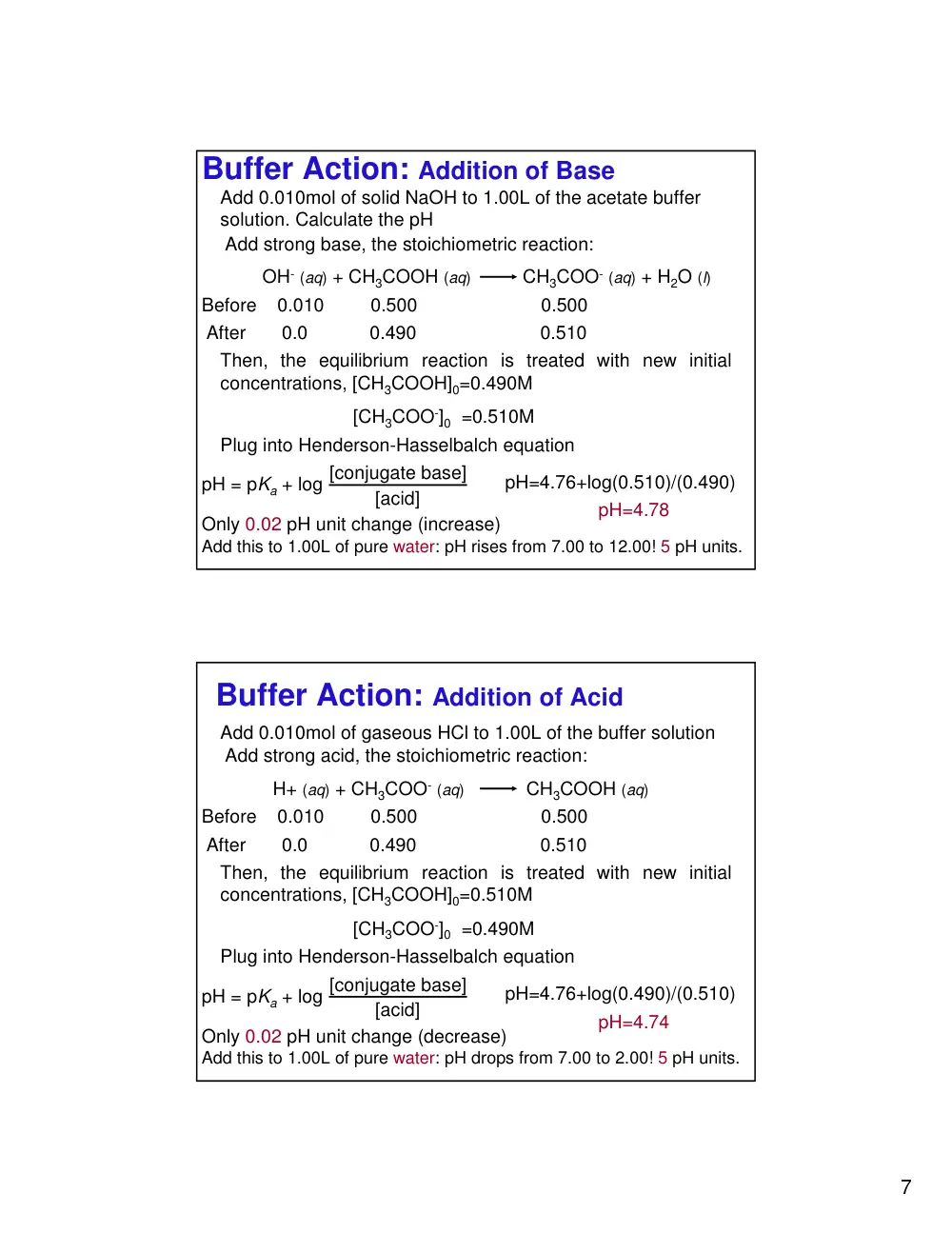
Buffer Action: Addition of Base
Add strong base, the stoichiometric reaction:
OH- (aq) + CH3COOH (aq)
CH3COO- (aq) + H2O (l)
Add 0.010mol of solid NaOH to 1.00L of the acetate buffer
solution. Calculate the pH
Before 0.010 0.500 0.500
After 0.0 0.490 0.510
Then, the equilibrium reaction is treated with new initial
concentrations, [CH3COOH]0=0.490M
[CH3COO-]0 =0.510M
Plug into Henderson-Hasselbalch equation
pH = pKa + log [conjugate base]
[acid]
pH=4.76+log(0.510)/(0.490)
pH=4.78
Only 0.02 pH unit change (increase)
Add this to 1.00L of pure water: pH rises from 7.00 to 12.00! 5 pH units.
Buffer Action: Addition of Acid
Add strong acid, the stoichiometric reaction:
H+ (aq) + CH3COO- (aq)
CH3COOH (aq)
Add 0.010mol of gaseous HCl to 1.00L of the buffer solution
Before 0.010 0.500 0.500
After 0.0 0.490 0.510
Then, the equilibrium reaction is treated with new initial
concentrations, [CH3COOH]0=0.510M
[CH3COO-]0 =0.490M
Plug into Henderson-Hasselbalch equation
pH = pKa + log [conjugate base]
[acid]
pH=4.76+log(0.490)/(0.510)
pH=4.74
Only 0.02 pH unit change (decrease)
Add this to 1.00L of pure water: pH drops from 7.00 to 2.00! 5 pH units.
8
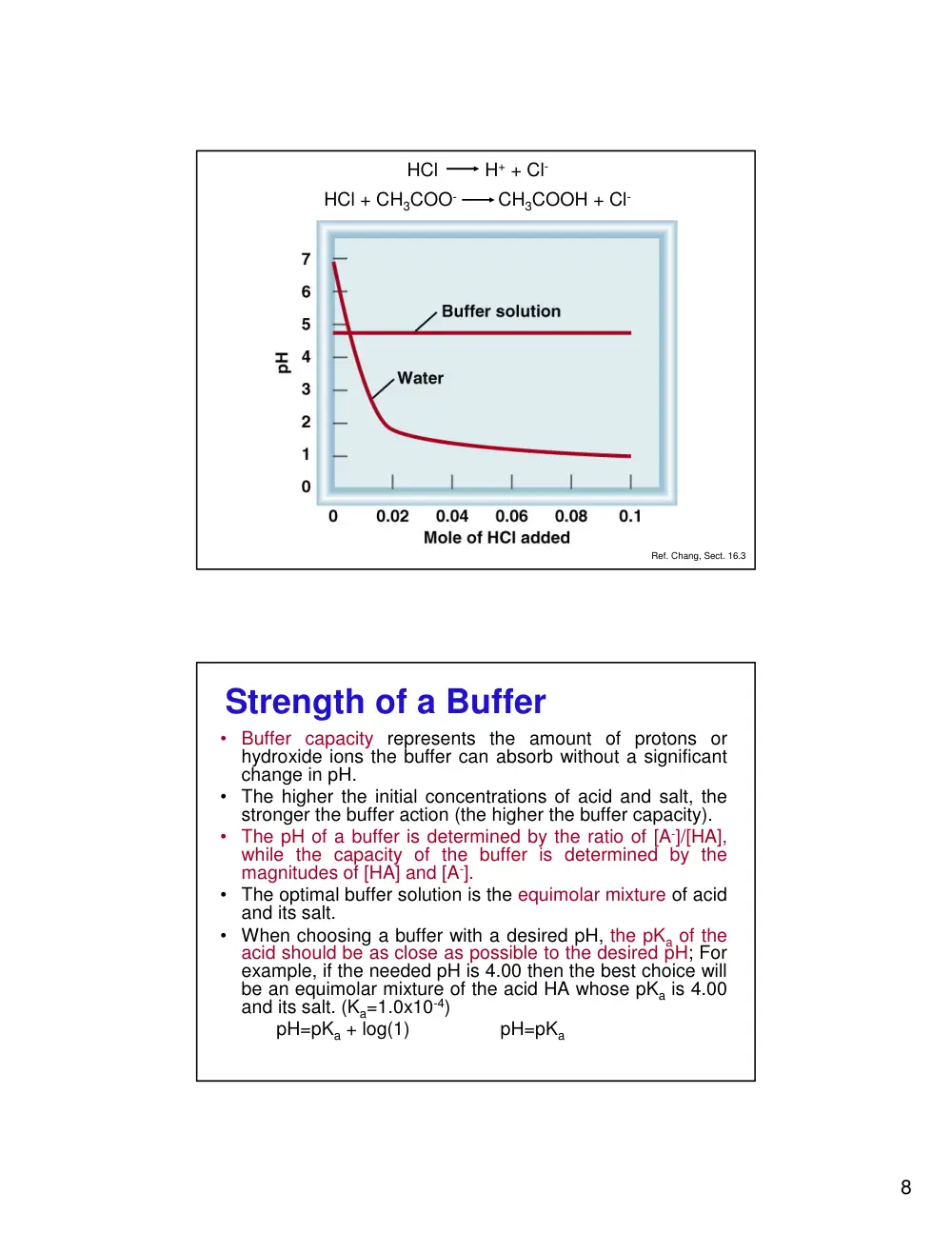
HCl
H+ + Cl-
HCl + CH3COO-
CH3COOH + Cl-
Ref. Chang, Sect. 16.3
Strength of a Buffer
• Buffer capacity represents the amount of protons or
hydroxide ions the buffer can absorb without a significant
change in pH.
• The higher the initial concentrations of acid and salt, the
stronger the buffer action (the higher the buffer capacity).
• The pH of a buffer is determined by the ratio of [A-]/[HA],
while the capacity of the buffer is determined by the
magnitudes of [HA] and [A-].
• The optimal buffer solution is the equimolar mixture of acid
and its salt.
• When choosing a buffer with a desired pH, the pKa of the
acid should be as close as possible to the desired pH; For
example, if the needed pH is 4.00 then the best choice will
be an equimolar mixture of the acid HA whose pKa is 4.00
and its salt. (Ka=1.0x10⁻⁴)
pH=pKa + log(1)
pH=pKa
9
= 9.20
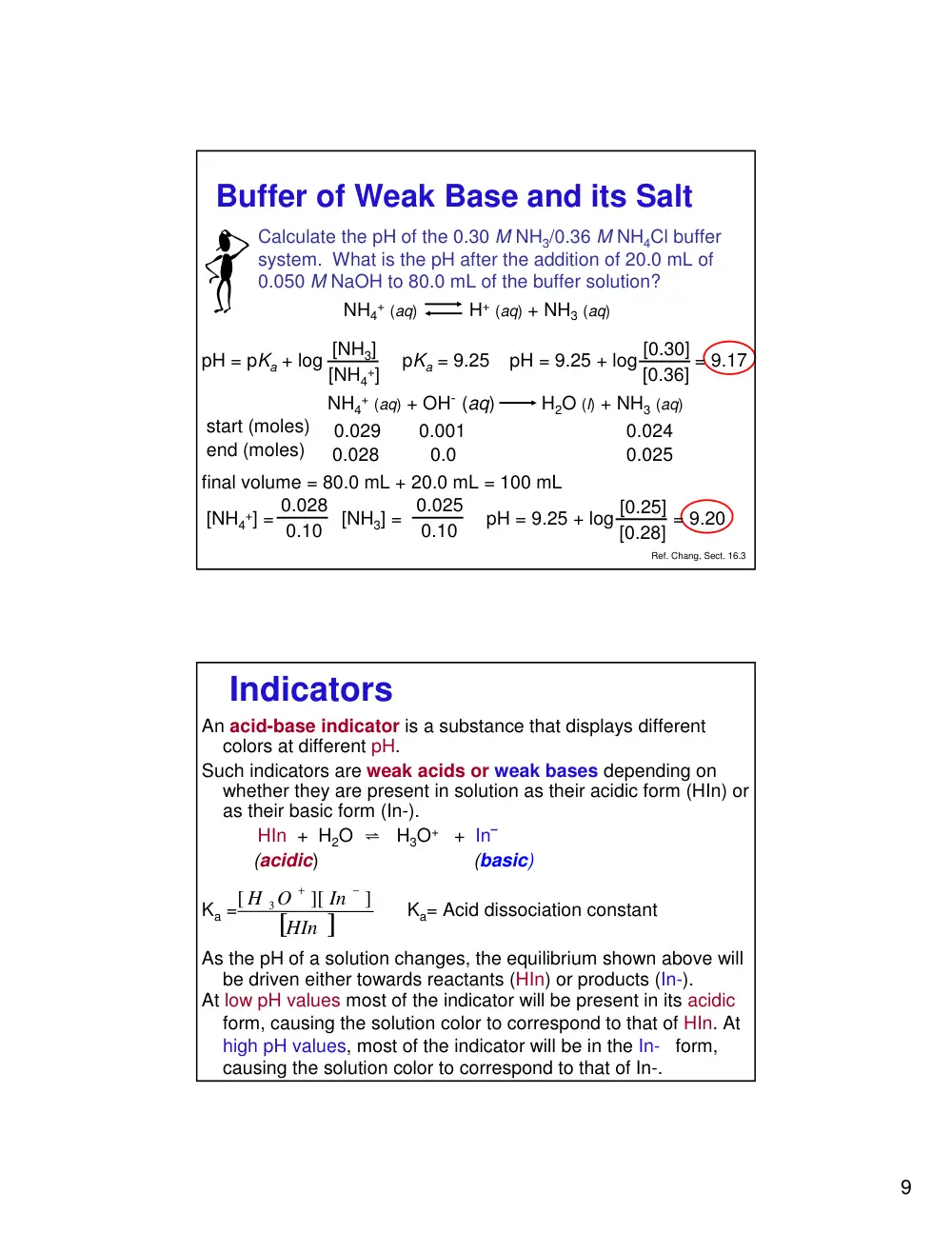
Calculate the pH of the 0.30 M NH3/0.36 M NH4Cl buffer
system. What is the pH after the addition of 20.0 mL of
0.050 M NaOH to 80.0 mL of the buffer solution?
NH4
+ (aq)
H+ (aq) + NH3 (aq)
pH = pKa + log [NH3]
[NH4
+]
pKa = 9.25
pH = 9.25 + log [0.30]
[0.36] = 9.17
NH4
+ (aq) + OH- (aq) H2O (l) + NH3 (aq)
start (moles)
end (moles)
0.029
0.001
0.024
0.028
0.0
0.025
pH = 9.25 + log [0.25]
[0.28]
[NH4
+] = 0.028
0.10
final volume = 80.0 mL + 20.0 mL = 100 mL
[NH3] = 0.025
0.10
Ref. Chang, Sect. 16.3
Buffer of Weak Base and its Salt
Indicators
An acid-base indicator is a substance that displays different
colors at different pH.
Such indicators are weak acids or weak bases depending on
whether they are present in solution as their acidic form (HIn) or
as their basic form (In-).
HIn + H2O �
H3O+
+ In�
(acidic) (basic)
Ka = Ka= Acid dissociation constant
As the pH of a solution changes, the equilibrium shown above will
be driven either towards reactants (HIn) or products (In-).
At low pH values most of the indicator will be present in its acidic
form, causing the solution color to correspond to that of HIn. At
high pH values, most of the indicator will be in the In-
form,
causing the solution color to correspond to that of In-.
[
HIn ]
In
H O
]
][
[
3
−
+
10
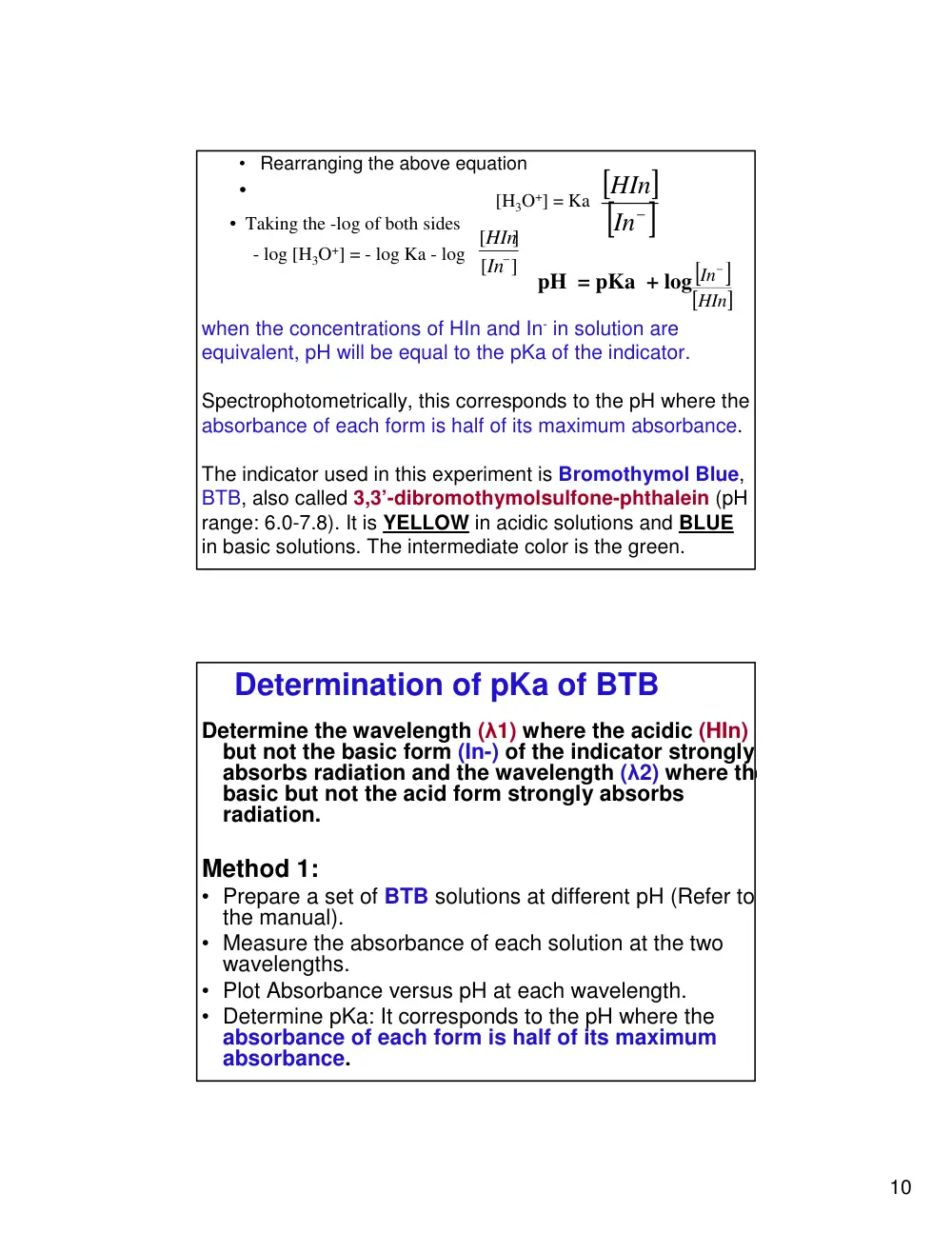
• Rearranging the above equation
•
]
[
]
[
In−
HIn
[H3O+] = Ka
• Taking the -log of both sides
- log [H3O+] = - log Ka - log
pH = pKa + log [
]
[
HIn]
In−
when the concentrations of HIn and In- in solution are
equivalent, pH will be equal to the pKa of the indicator.
Spectrophotometrically, this corresponds to the pH where the
absorbance of each form is half of its maximum absorbance.
The indicator used in this experiment is Bromothymol Blue,
BTB, also called 3,3’-dibromothymolsulfone-phthalein (pH
range: 6.0-7.8). It is YELLOW in acidic solutions and BLUE
in basic solutions. The intermediate color is the green.
[
]
[
In− ]
HIn
Determine the wavelength (�1) where the acidic (HIn)
but not the basic form (In-) of the indicator strongly
absorbs radiation and the wavelength (�2) where the
basic but not the acid form strongly absorbs
radiation.
Method 1:
• Prepare a set of BTB solutions at different pH (Refer to
the manual).
• Measure the absorbance of each solution at the two
wavelengths.
• Plot Absorbance versus pH at each wavelength.
• Determine pKa: It corresponds to the pH where the
absorbance of each form is half of its maximum
absorbance.
Determination of pKa of BTB
11
A plot of absorbance as a function of pH for an indicator.
Determination of pKa of BTB (continued)
Method 2:
The ratio [In-]/[HIn] can be obtained from
spectrophotometric measurements which are
made at two wavelengths (�1) and (�2).
If Beer's law is obeyed, the absorbance at �1 and
�2 are
A (λ1) = ε (HIn, λ1) b [HIn]
A (λ2) = ε (In-, λ2) b [In-]
where A is absorbance, � is molar absorptivity and b is cell
pathlength.
[In-]
[HIn]
pH = pKa
+
log
12
At any pH, the total concentration (CT) of both
forms of the indicator is constant and is the sum
of the individual concentrations of each species:
CT = [HIn] + [In-]
In highly acid solutions (lowest pH), CT = [HIn]
In highly basic solutions (highest pH) CT= [In-]
By substitution, taking ratios and rearrangements,
we can write
The plot of pH versus log [In-]/[HIn] yields a
straight line of an intercept equal to pKa
A plot of pH as a function of log([In-]/[HIn]).