
MECH 310 Exam 1 with Solution, Fall 2008
American University of Beirut · Thermodynamics I · 4 pages · with solution
More MECH 310 files
- Exam 2 Solution Leen Alawieh · Fall 2017Exam · with solutionView
- Exam 1 Leen Alawieh With Solutions · Fall 2017Exam · with solutionView
- Exam 1 · Fall 2016ExamView
- Exam 1 · Summer 2012ExamView
- Exam 2 · Summer 2011ExamView
- Exam 1 · Spring 2011ExamView
- Exam 1 · Summer 2011ExamView
- Exam 1 with Solution · Fall 2011Exam · with solutionView
Show the text of this exam
MECH 310 Thermodynamics I
November 20, 2008
American University of Beirut, Fall 2008
Handout # Quiz 1
Quiz 1
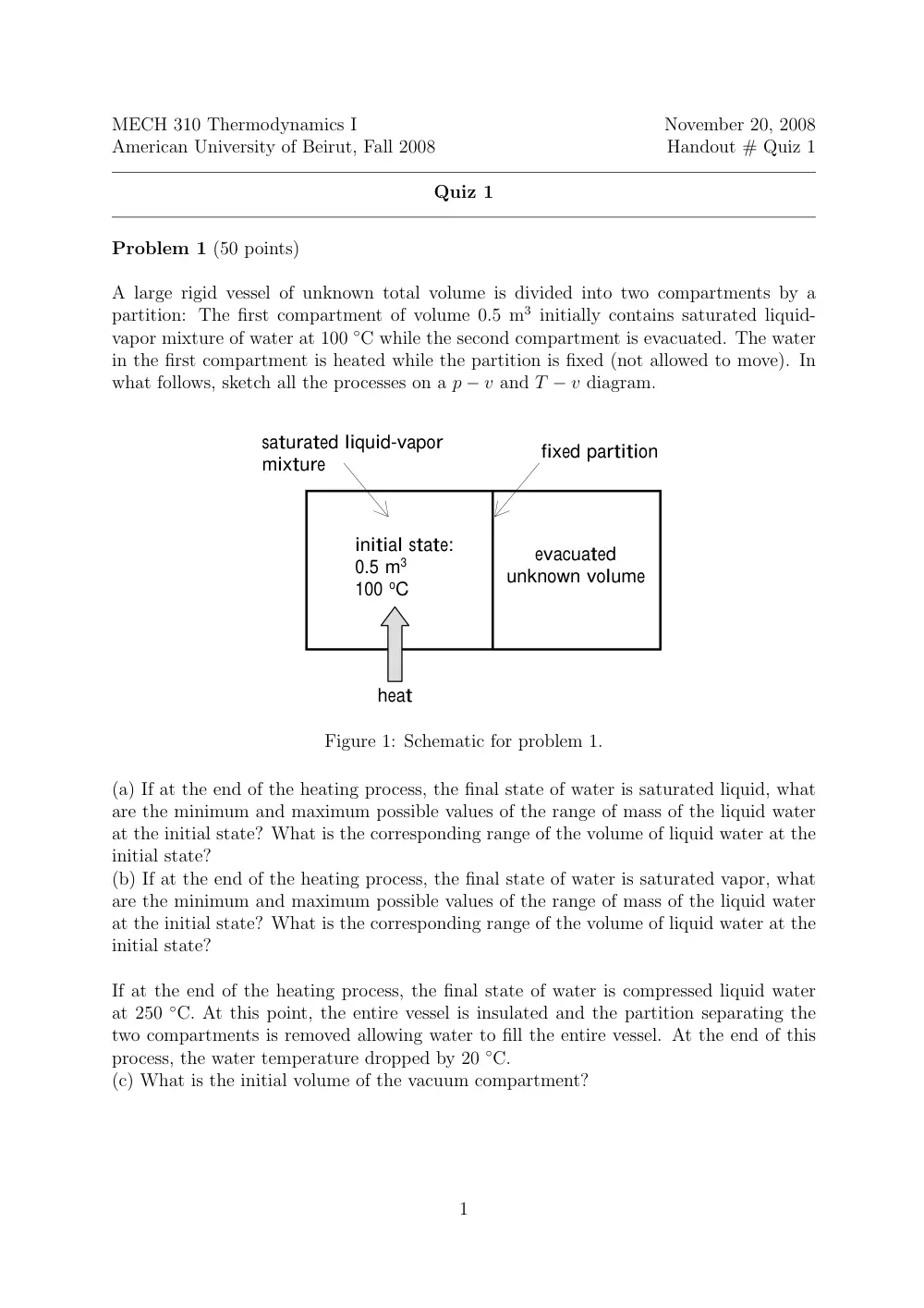
Problem 1 (50 points)
A large rigid vessel of unknown total volume is divided into two compartments by a
partition: The first compartment of volume 0.5 m3 initially contains saturated liquid-
vapor mixture of water at 100 ◦C while the second compartment is evacuated. The water
in the first compartment is heated while the partition is fixed (not allowed to move). In
what follows, sketch all the processes on a p − v and T − v diagram.
saturated liquid-vapor
mixture
initial state:
0.5 m3
100 oC
evacuated
unknown volume
heat
fixed partition
Figure 1: Schematic for problem 1.
(a) If at the end of the heating process, the final state of water is saturated liquid, what
are the minimum and maximum possible values of the range of mass of the liquid water
at the initial state? What is the corresponding range of the volume of liquid water at the
initial state?
(b) If at the end of the heating process, the final state of water is saturated vapor, what
are the minimum and maximum possible values of the range of mass of the liquid water
at the initial state? What is the corresponding range of the volume of liquid water at the
initial state?
If at the end of the heating process, the final state of water is compressed liquid water
at 250 ◦C. At this point, the entire vessel is insulated and the partition separating the
two compartments is removed allowing water to fill the entire vessel. At the end of this
process, the water temperature dropped by 20 ◦C.
(c) What is the initial volume of the vacuum compartment?
1
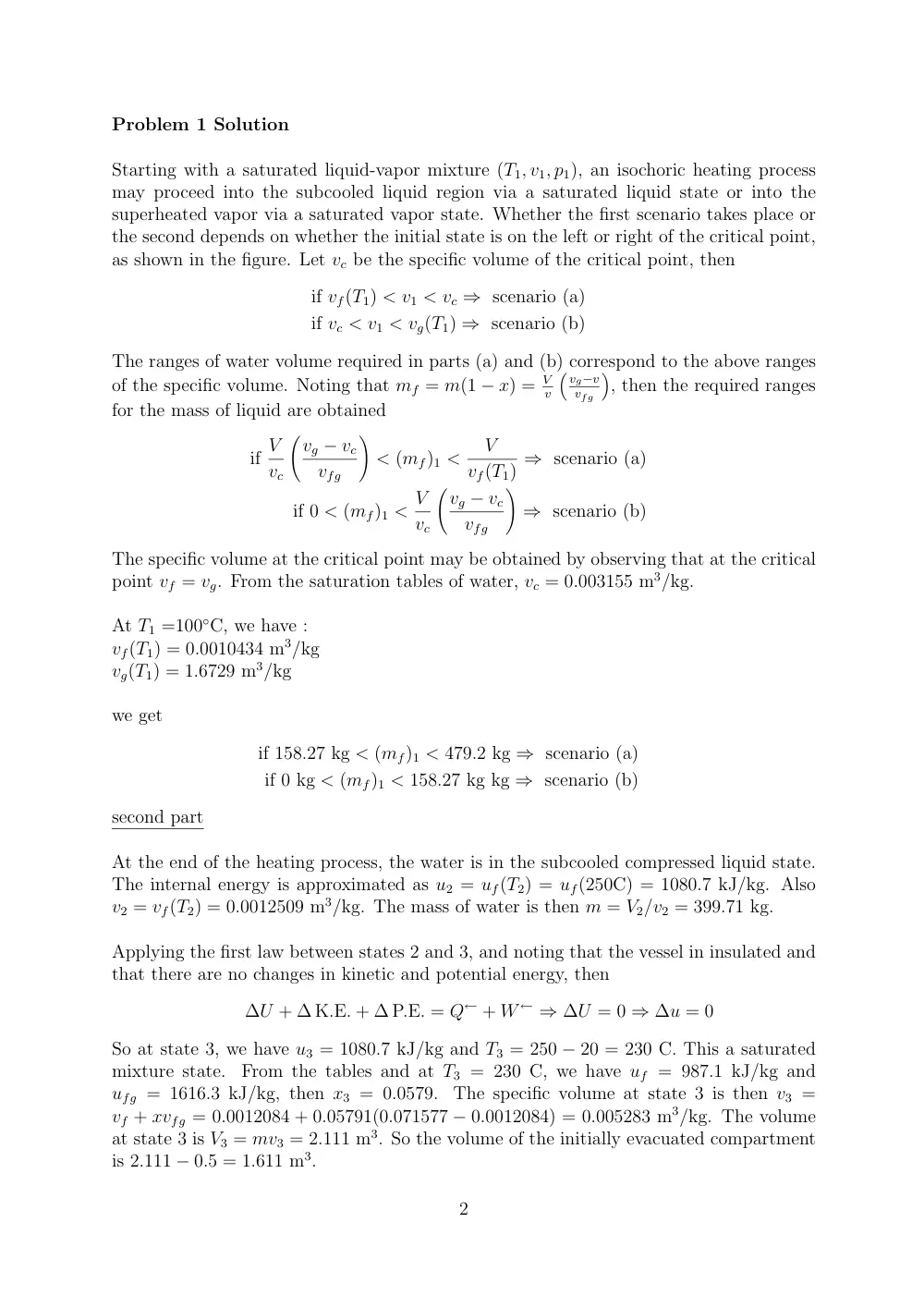
Problem 1 Solution
Starting with a saturated liquid-vapor mixture (T1, v1, p1), an isochoric heating process
may proceed into the subcooled liquid region via a saturated liquid state or into the
superheated vapor via a saturated vapor state. Whether the first scenario takes place or
the second depends on whether the initial state is on the left or right of the critical point,
as shown in the figure. Let vc be the specific volume of the critical point, then
if vf(T1) < v1 < vc ⇒ scenario (a)
if vc < v1 < vg(T1) ⇒ scenario (b)
The ranges of water volume required in parts (a) and (b) correspond to the above ranges
of the specific volume. Noting that mf = m(1 − x) = V
v
� vg−v
vfg
�
, then the required ranges
for the mass of liquid are obtained
if V
vc
�vg − vc
vfg
�
< (mf)1 <
V
vf(T1) ⇒ scenario (a)
if 0 < (mf)1 < V
vc
�vg − vc
vfg
�
⇒ scenario (b)
The specific volume at the critical point may be obtained by observing that at the critical
point vf = vg. From the saturation tables of water, vc = 0.003155 m3/kg.
At T1 =100◦C, we have :
vf(T1) = 0.0010434 m3/kg
vg(T1) = 1.6729 m3/kg
we get
if 158.27 kg < (mf)1 < 479.2 kg ⇒ scenario (a)
if 0 kg < (mf)1 < 158.27 kg kg ⇒ scenario (b)
second part
At the end of the heating process, the water is in the subcooled compressed liquid state.
The internal energy is approximated as u2 = uf(T2) = uf(250C) = 1080.7 kJ/kg. Also
v2 = vf(T2) = 0.0012509 m3/kg. The mass of water is then m = V2/v2 = 399.71 kg.
Applying the first law between states 2 and 3, and noting that the vessel in insulated and
that there are no changes in kinetic and potential energy, then
∆U + ∆ K.E. + ∆ P.E. = Q← + W ← ⇒ ∆U = 0 ⇒ ∆u = 0
So at state 3, we have u3 = 1080.7 kJ/kg and T3 = 250 − 20 = 230 C. This a saturated
mixture state.
From the tables and at T3 = 230 C, we have uf = 987.1 kJ/kg and
ufg = 1616.3 kJ/kg, then x3 = 0.0579.
The specific volume at state 3 is then v3 =
vf + xvfg = 0.0012084 + 0.05791(0.071577 − 0.0012084) = 0.005283 m3/kg. The volume
at state 3 is V3 = mv3 = 2.111 m3. So the volume of the initially evacuated compartment
is 2.111 − 0.5 = 1.611 m3.
2
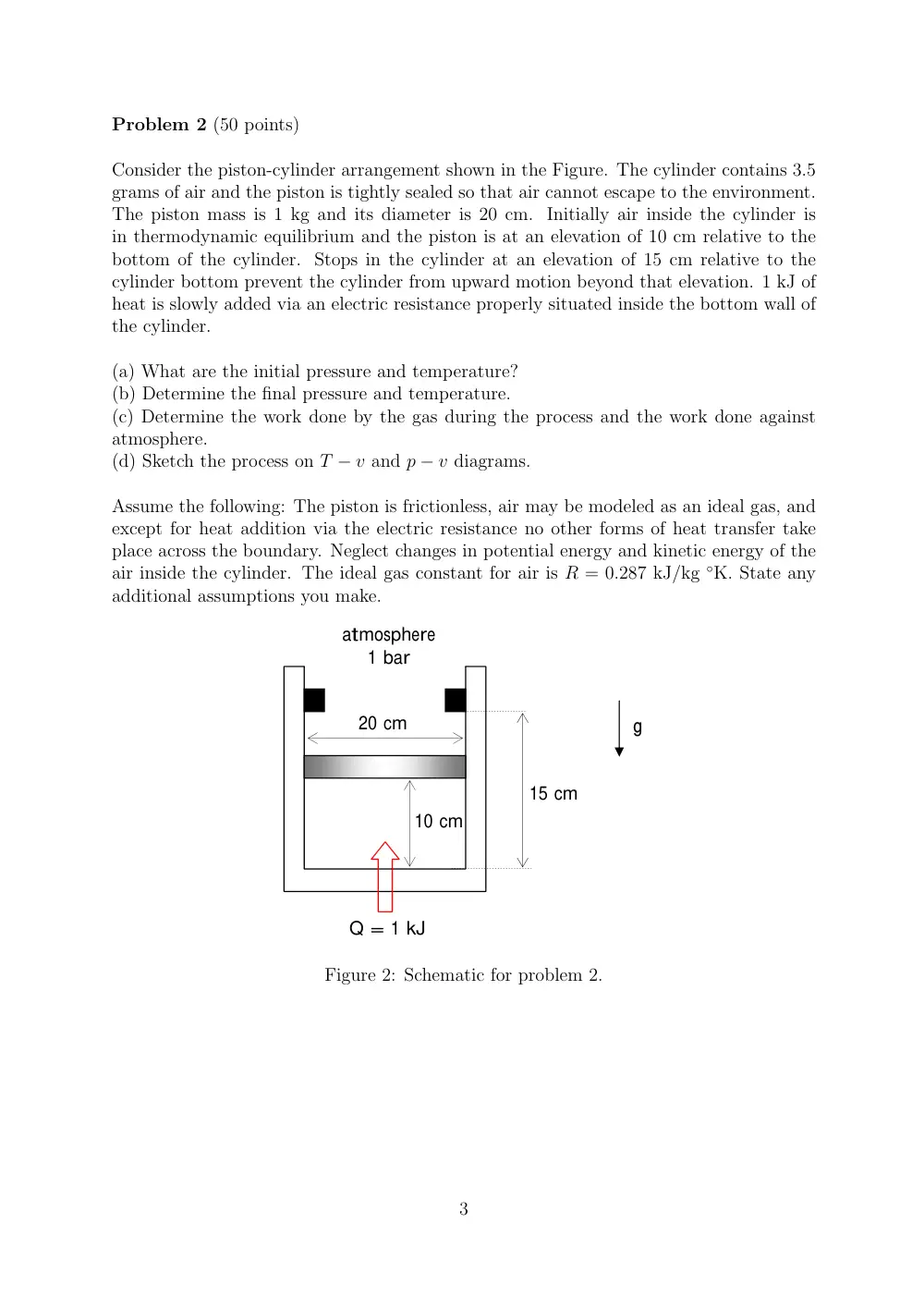
Problem 2 (50 points)
Consider the piston-cylinder arrangement shown in the Figure. The cylinder contains 3.5
grams of air and the piston is tightly sealed so that air cannot escape to the environment.
The piston mass is 1 kg and its diameter is 20 cm. Initially air inside the cylinder is
in thermodynamic equilibrium and the piston is at an elevation of 10 cm relative to the
bottom of the cylinder. Stops in the cylinder at an elevation of 15 cm relative to the
cylinder bottom prevent the cylinder from upward motion beyond that elevation. 1 kJ of
heat is slowly added via an electric resistance properly situated inside the bottom wall of
the cylinder.
(a) What are the initial pressure and temperature?
(b) Determine the final pressure and temperature.
(c) Determine the work done by the gas during the process and the work done against
atmosphere.
(d) Sketch the process on T − v and p − v diagrams.
Assume the following: The piston is frictionless, air may be modeled as an ideal gas, and
except for heat addition via the electric resistance no other forms of heat transfer take
place across the boundary. Neglect changes in potential energy and kinetic energy of the
air inside the cylinder. The ideal gas constant for air is R = 0.287 kJ/kg ◦K. State any
additional assumptions you make.
10 cm
15 cm
20 cm
Q = 1 kJ
g
atmosphere
1 bar
Figure 2: Schematic for problem 2.
3
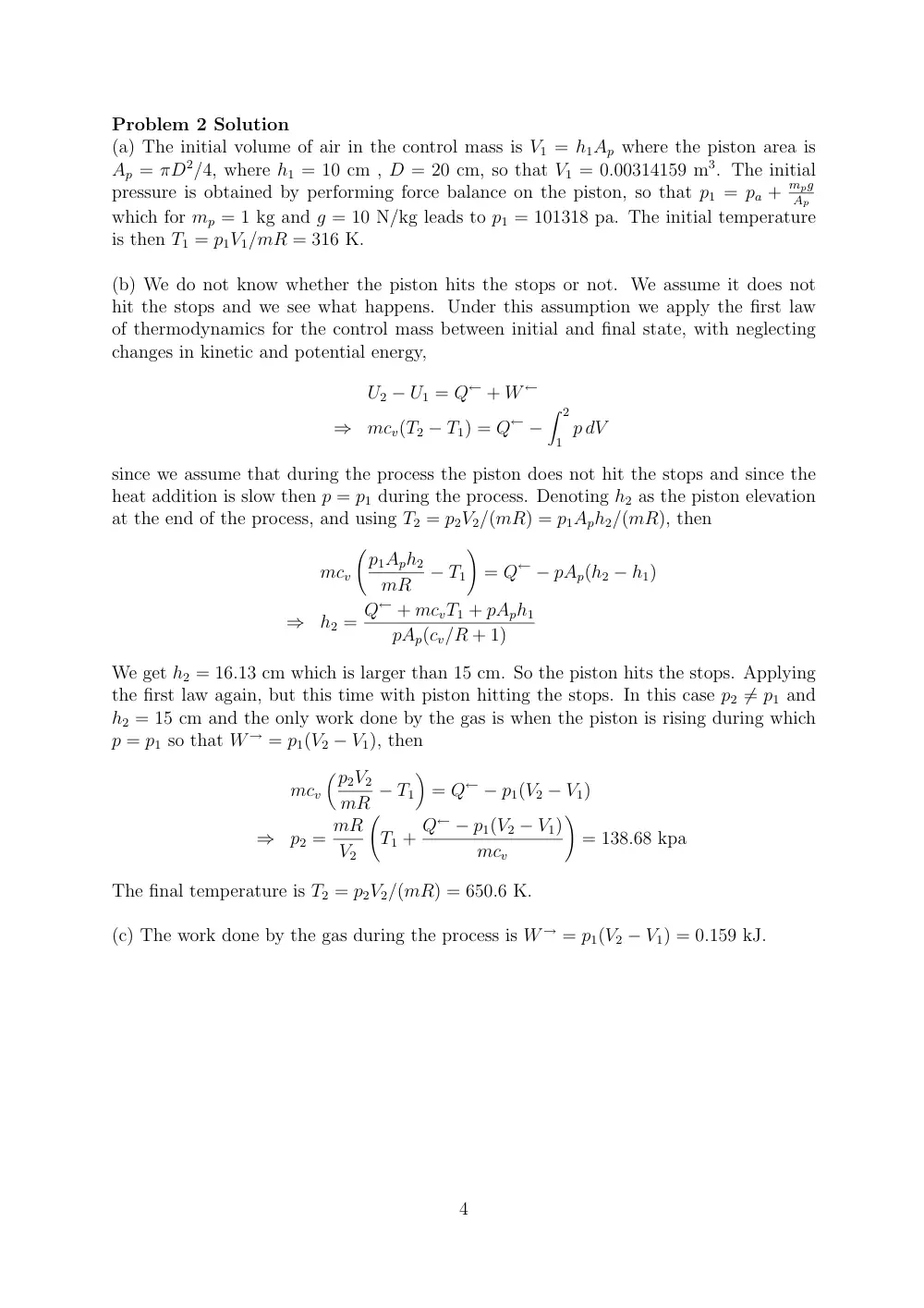
Problem 2 Solution
(a) The initial volume of air in the control mass is V1 = h1Ap where the piston area is
Ap = πD2/4, where h1 = 10 cm , D = 20 cm, so that V1 = 0.00314159 m3. The initial
pressure is obtained by performing force balance on the piston, so that p1 = pa + mpg
Ap
which for mp = 1 kg and g = 10 N/kg leads to p1 = 101318 pa. The initial temperature
is then T1 = p1V1/mR = 316 K.
(b) We do not know whether the piston hits the stops or not. We assume it does not
hit the stops and we see what happens. Under this assumption we apply the first law
of thermodynamics for the control mass between initial and final state, with neglecting
changes in kinetic and potential energy,
U2 − U1 = Q← + W ←
⇒
mcv(T2 − T1) = Q← −
� 2
1 p dV
since we assume that during the process the piston does not hit the stops and since the
heat addition is slow then p = p1 during the process. Denoting h2 as the piston elevation
at the end of the process, and using T2 = p2V2/(mR) = p1Aph2/(mR), then
mcv
�p1Aph2
mR
− T1
�
= Q← − pAp(h2 − h1)
⇒
h2 = Q← + mcvT1 + pAph1
pAp(cv/R + 1)
We get h2 = 16.13 cm which is larger than 15 cm. So the piston hits the stops. Applying
the first law again, but this time with piston hitting the stops. In this case p2 ̸= p1 and
h2 = 15 cm and the only work done by the gas is when the piston is rising during which
p = p1 so that W → = p1(V2 − V1), then
mcv
�p2V2
mR − T1
�
= Q← − p1(V2 − V1)
⇒
p2 = mR
V2
�
T1 + Q← − p1(V2 − V1)
mcv
�
= 138.68 kpa
The final temperature is T2 = p2V2/(mR) = 650.6 K.
(c) The work done by the gas during the process is W → = p1(V2 − V1) = 0.159 kJ.
4