
MECH 310 Exam 2, Fall 2007
American University of Beirut · Thermodynamics I · 4 pages
More MECH 310 files
- Exam 2 Solution Leen Alawieh · Fall 2017Exam · with solutionView
- Exam 1 Leen Alawieh With Solutions · Fall 2017Exam · with solutionView
- Exam 1 · Fall 2016ExamView
- Exam 1 · Summer 2012ExamView
- Exam 1 with Solution · Fall 2011Exam · with solutionView
- Exam 2 · Summer 2011ExamView
- Exam 1 · Spring 2011ExamView
- Exam 1 · Summer 2011ExamView
Show the text of this exam
MECH 310 Thermodynamics I
January 7, 2008
American University of Beirut, Fall 2008
Handout # Quiz 2
Quiz 2
• This is a closed book exam.
• You have 90 minutes.
• Write your name and section number on both the question and answer sheets.
• It is recommended that you read the whole exam before you start solving.
Problem 1 (40 points)
A rigid metal tank of volume V is connected to the atmosphere through a valve. At-
mospheric pressure and temperature are p0 and T0 respectively.
Initially the tank is
evacuated and the valve is closed. The valve is then opened and air flows into the tank.
During the first few seconds (from t = 0 to t = t1), air flows rapidly into the tank at a
decreasing mass flow rate until the pressure inside the tank increased, from zero to p0.
Following this fast process is another long process (from t = t1 to t = t2) during which
air flows into the tank at a very small flow rate while the pressure in the tank remains p0.
The second process ends when the air flow goes to zero. Air is modeled as an ideal gas
with specific heat ratio γ = cp/cv, with cp and cv are respectively the constant pressure
and constant volume specific heats.
(a) Argue why the first process may be modeled as adiabatic.
(b) What is the temperature at time t = t1? Express your answer in terms of given
quantities.
(c) What the amount of heat transfer between the tank and the atmosphere? Express
your answer in terms of given quantities.
Problem 2 (20 points)
A system undergoes a cyclic process while interacting exclusively with a thermal reservoir.
Explain whether any of these effects violates the second law.
(a) No external effect except the rise of a weight.
(b) No external effect except the fall of a weight.
1
Problem 3(40 points)
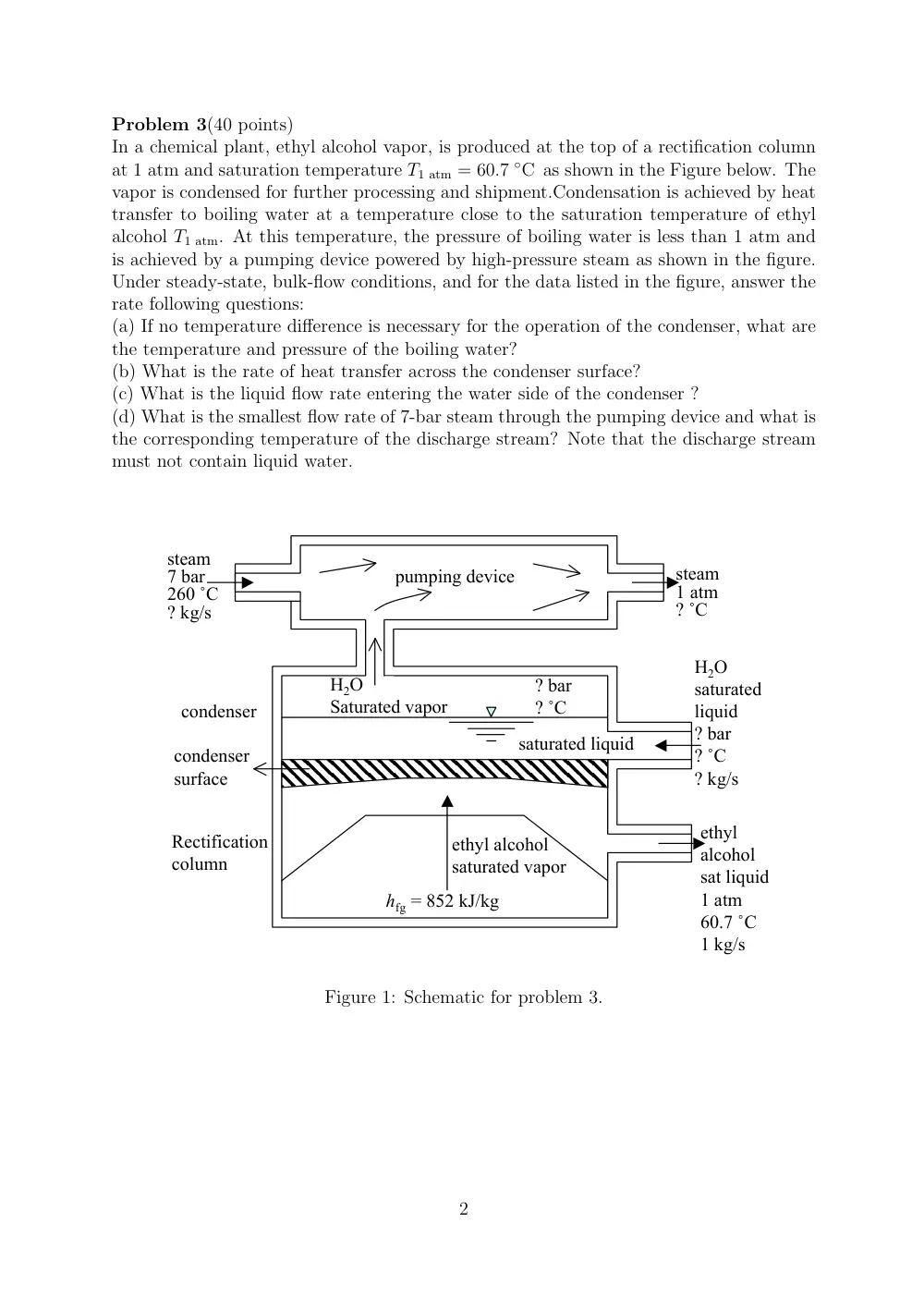
In a chemical plant, ethyl alcohol vapor, is produced at the top of a rectification column
at 1 atm and saturation temperature T1 atm = 60.7 ◦C as shown in the Figure below. The
vapor is condensed for further processing and shipment.Condensation is achieved by heat
transfer to boiling water at a temperature close to the saturation temperature of ethyl
alcohol T1 atm. At this temperature, the pressure of boiling water is less than 1 atm and
is achieved by a pumping device powered by high-pressure steam as shown in the figure.
Under steady-state, bulk-flow conditions, and for the data listed in the figure, answer the
rate following questions:
(a) If no temperature difference is necessary for the operation of the condenser, what are
the temperature and pressure of the boiling water?
(b) What is the rate of heat transfer across the condenser surface?
(c) What is the liquid flow rate entering the water side of the condenser ?
(d) What is the smallest flow rate of 7-bar steam through the pumping device and what is
the corresponding temperature of the discharge stream? Note that the discharge stream
must not contain liquid water.
pumping device
steam
7 bar
260 ˚C
? kg/s
steam
1 atm
? ˚C
H2O
Saturated vapor
? bar
? ˚C
H2O
saturated
liquid
? bar
? ˚C
? kg/s
ethyl
alcohol
sat liquid
1 atm
60.7 ˚C
1 kg/s
saturated liquid
condenser
surface
ethyl alcohol
saturated vapor
hfg = 852 kJ/kg
Rectification
column
condenser
Figure 1: Schematic for problem 3.
2
Problem 1 Solution
(b) Applying the first law of thermodynamics between t = 0 and t = t1 and neglecting
kinetic energy and potential energy changes, and noting that air flow into the tank is
characterized by h0 = cpT0, and that there is work (other than bulk) interactions. It is
further assumed that the first process is adiabatic since it occurs very quickly (there is no
time for heat transfer to take place), then
m1u1 − m0u0 = minhin
where conservation of mass yields min = m1 −m0 = m1 since m0 = 0 (the tank is initially
evacuated). Noting that u1 = cvT1 and hin = cpT0, then T1 = γT0, with γ = cp/cv.
(c) Applying the first law of thermodynamics between t = t1 to t2,
m2u2 − m1u1 = minhin + Q←
1−2
⇒
cv (m2T2 − m1T1) = (m2 − m1)cpT0 + Q←
1−2
where m2 = p2V2/(RT2) = p0V/(RT0) and m1 = p1V1/(RT1) = p0V/(γRT0). The heat
transfer is then
cvV
R (p2 − p1) = p0V
RT0
�
1 − 1
γ
�
cpT0 + Q←
1−2
Noting that p1 = p2 = p0, then
Q→
1−2 = p0V
RT0
�
1 − 1
γ
�
cpT0 = p0V
Problem 2 solution
(a) This violates the Kelvin Planck statement of the second law of thermodynamics.
(b) This does not violate the second law of thermodynamics because the device is receiv-
ing work (mgh) and transfers an equal amount of heat to the reservoir.
(c) This violates the Kelvin Planck statement of the second law of thermodynamics be-
cause increasing the voltage across the capacitor is equivalent to producing work (equal
to 1
2CV 2) while interacting with a single reservoir.
(d) This does not violate the second law of thermodynamics because the device is receiv-
ing work (equal to 1
2CV 2) and transfers an equal amount of heat to the reservoir.
Problem 3 solution
(a) The temperature of the boiling water is 60.7 ◦C. The pressure is the saturated pressure
of water at 60.7 ◦C, which is 19.940 kPa.
(b) The rate of heat transfer is obtained by applying 1st law for a control volume for the
liquid section of the ethyl alcohol, so that ˙Q→ = ˙methyl(hin − hout) = 852 kJ.
(c) Applying the first law to the liquid water section, we get ˙mliq water(hout − hin) = ˙Q← =
852 kJ. Noting that liquid water entering is in the saturated state at 60.7 ◦Cand exiting as
saturated vapor at the same temperature, we get hin = hfg(60.7) = 2357.5 kJ/kg leading
to ˙ml water,in = 0.361 kg/s.
(d) First law for the pumping section,
˙msat vap inhsat vap in + ˙msteam inhsteam in = ( ˙msat vap in + ˙msteam in) hsteam out
3
where ˙msat vap in = 0.361 kg/s, hsat vap in = hg(60.7) = 2609.6 kJ/kg, hsteam in = h(260◦C, 7 bar) =
2975 kJ/kg. Then, we must have
942 + ˙msteam in2975 = (0.361 + ˙msteam in) hsteam out(1 atm, Tout)
Assuming that the discharge stream is saturated vapor at 1 atm, then hsteam out = 2675.6
kJ/kg and correspondingly ˙msteam in = 0.08 kg/s.
4