
MECH 310 Exam 2, Fall 2008
American University of Beirut · Thermodynamics I · 5 pages


More MECH 310 files
- Exam 2 Solution Leen Alawieh · Fall 2017Exam · with solutionView
- Exam 1 Leen Alawieh With Solutions · Fall 2017Exam · with solutionView
- Exam 1 · Fall 2016ExamView
- Exam 1 · Summer 2012ExamView
- Exam 1 with Solution · Fall 2011Exam · with solutionView
- Exam 2 · Summer 2011ExamView
- Exam 1 · Spring 2011ExamView
- Exam 1 · Summer 2011ExamView
Show the text of this exam
MECH 310 Thermodynamics I
January 12, 2009
American University of Beirut, Fall 2008
Handout # Quiz 2
Quiz 2
• This is a closed book 90 minutes exam. You allowed to bring one A4 hand written
cheat sheet which will be collected at end of exam. It is recommended that you read
the whole exam before you start solving.
• Write your name and section number on both the question and answer sheets.
• Clearly identify your control mass / control volume.
Problem 11 (20 points)
Based on the idea of Maxwell’s deamon, Richard Feynman2 proposed a perpetual motion
machine. The PMM, depicted in Figure 1, consists of a ratchet (asymmetric gear) that
rotates freely in one direction but is prevented from rotating in the opposite direction by a
pawl. The ratchet is connected by a massless and frictionless rod to a paddle wheel that is
immersed in a bath of molecules at temperature T1. The molecules constitute a heat bath
in that they undergo random (Brownian) motion with a mean kinetic energy that is deter-
mined by the temperature. Each time a molecule collides with a paddle, it imparts an im-
pulse that exerts a torque on the ratchet (the mechanism is imagined to be small enough
that this tiny force could move it). Because the pawl only allows motion in one direction,
the net effect of many such random collisions should be for the ratchet to rotate con-
tinuously in that direction. The ratchet’s motion then can be used to do work on other
systems, for example lifting a weight against gravity. The energy necessary to do this
work apparently would come from the heat bath, without any heat gradient.
(a) Does the machine violate the first law of thermodynamics? Explain.
(b) Does the machine violate the second law of thermodynamics? If yes, which form of
the second law statement does Feynman’s machine violate?
(c) Prove that Feynman’s machine cannot work as proposed.
Figure 1: Schematic for problem 1.
1This problem is pretty much copied form wikipedia website with minor modifications.
2American Physicist and Nobel Prize winner.
1
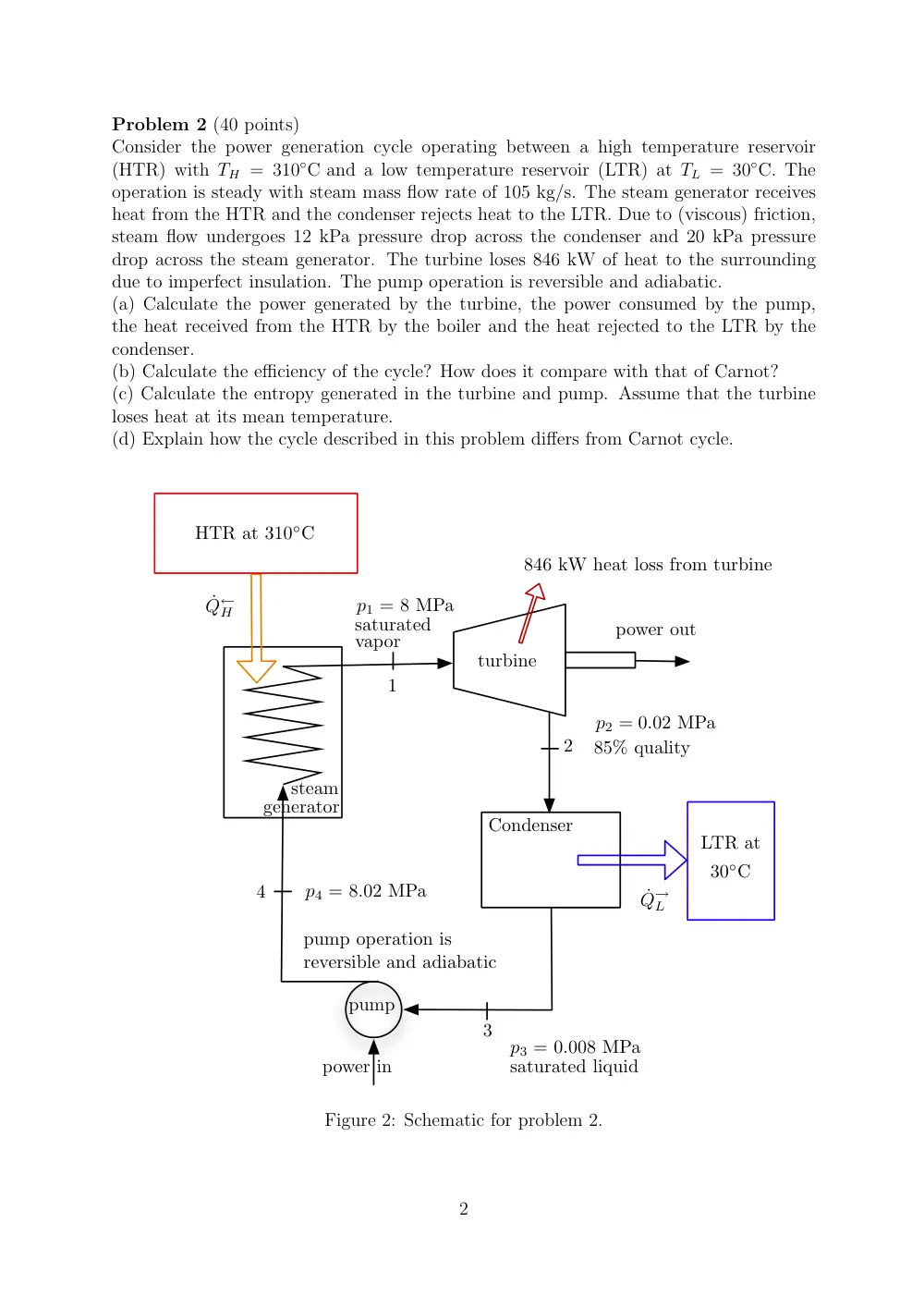
Problem 2 (40 points)
Consider the power generation cycle operating between a high temperature reservoir
(HTR) with TH = 310◦C and a low temperature reservoir (LTR) at TL = 30◦C. The
operation is steady with steam mass flow rate of 105 kg/s. The steam generator receives
heat from the HTR and the condenser rejects heat to the LTR. Due to (viscous) friction,
steam flow undergoes 12 kPa pressure drop across the condenser and 20 kPa pressure
drop across the steam generator. The turbine loses 846 kW of heat to the surrounding
due to imperfect insulation. The pump operation is reversible and adiabatic.
(a) Calculate the power generated by the turbine, the power consumed by the pump,
the heat received from the HTR by the boiler and the heat rejected to the LTR by the
condenser.
(b) Calculate the efficiency of the cycle? How does it compare with that of Carnot?
(c) Calculate the entropy generated in the turbine and pump. Assume that the turbine
loses heat at its mean temperature.
(d) Explain how the cycle described in this problem differs from Carnot cycle.
turbine
power out
1
2
Condenser
3
saturated liquid
pump
power in
steam
generator
4
saturated
vapor
p1 = 8 MPa
p3 = 0.008 MPa
p2 = 0.02 MPa
85% quality
reversible and adiabatic
pump operation is
HTR at 310◦C
˙Q→
L
LTR at
30◦C
˙Q←
H
846 kW heat loss from turbine
p4 = 8.02 MPa
Figure 2: Schematic for problem 2.
2
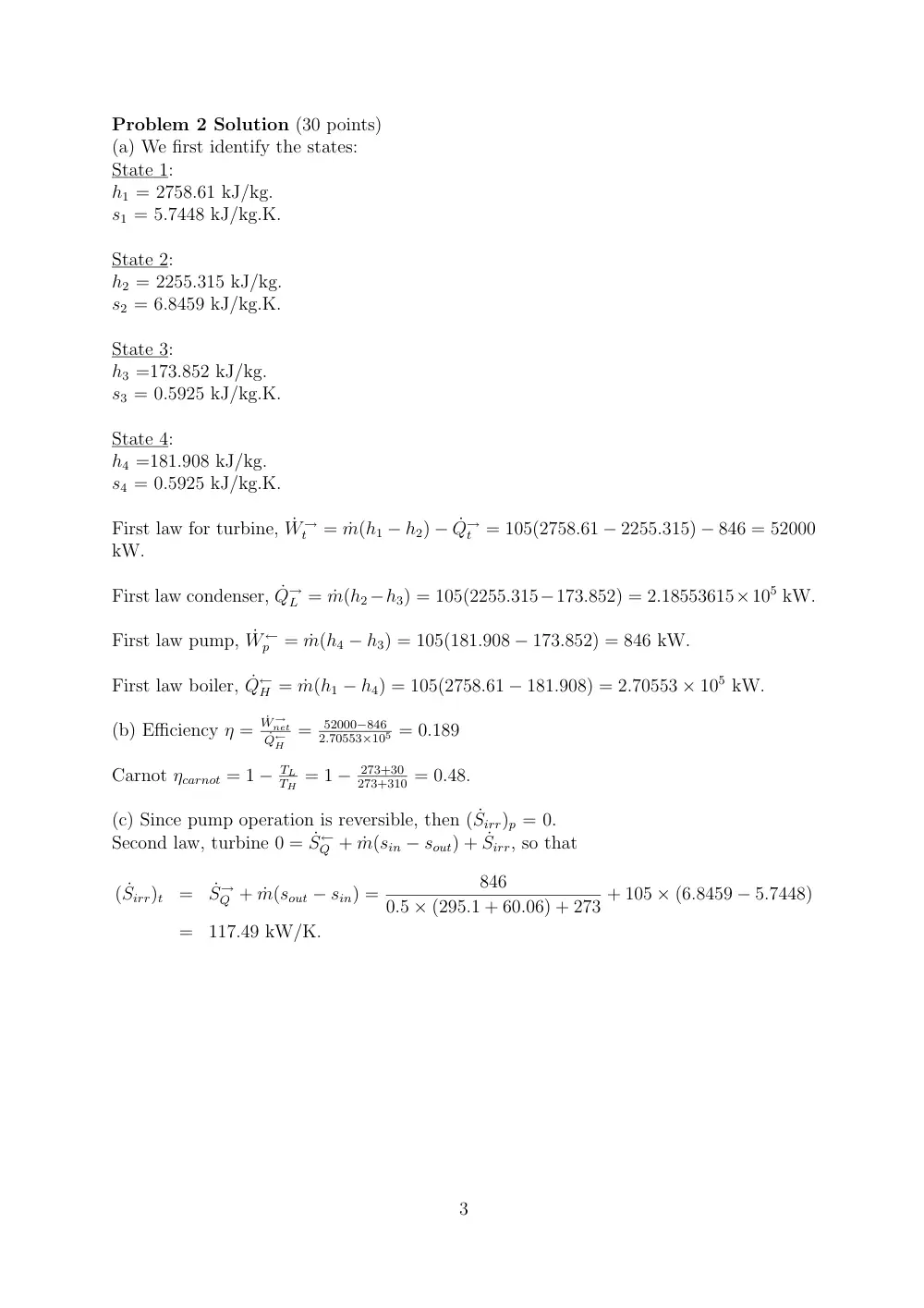
Problem 2 Solution (30 points)
(a) We first identify the states:
State 1:
h1 = 2758.61 kJ/kg.
s1 = 5.7448 kJ/kg.K.
State 2:
h2 = 2255.315 kJ/kg.
s2 = 6.8459 kJ/kg.K.
State 3:
h3 =173.852 kJ/kg.
s3 = 0.5925 kJ/kg.K.
State 4:
h4 =181.908 kJ/kg.
s4 = 0.5925 kJ/kg.K.
First law for turbine, ˙W →
t
= ˙m(h1 − h2) − ˙Q→
t = 105(2758.61 − 2255.315) − 846 = 52000
kW.
First law condenser, ˙Q→
L = ˙m(h2−h3) = 105(2255.315−173.852) = 2.18553615×10⁵ kW.
First law pump, ˙W ←
p
= ˙m(h4 − h3) = 105(181.908 − 173.852) = 846 kW.
First law boiler, ˙Q←
H = ˙m(h1 − h4) = 105(2758.61 − 181.908) = 2.70553 × 10⁵ kW.
(b) Efficiency η =
˙W →
net
˙Q←
H =
52000−846
2.70553×105 = 0.189
Carnot ηcarnot = 1 − TL
TH = 1 − 273+30
273+310 = 0.48.
(c) Since pump operation is reversible, then ( ˙Sirr)p = 0.
Second law, turbine 0 = ˙S←
Q + ˙m(sin − sout) + ˙Sirr, so that
( ˙Sirr)t
=
˙S→
Q + ˙m(sout − sin) =
846
0.5 × (295.1 + 60.06) + 273 + 105 × (6.8459 − 5.7448)
=
117.49 kW/K.
3
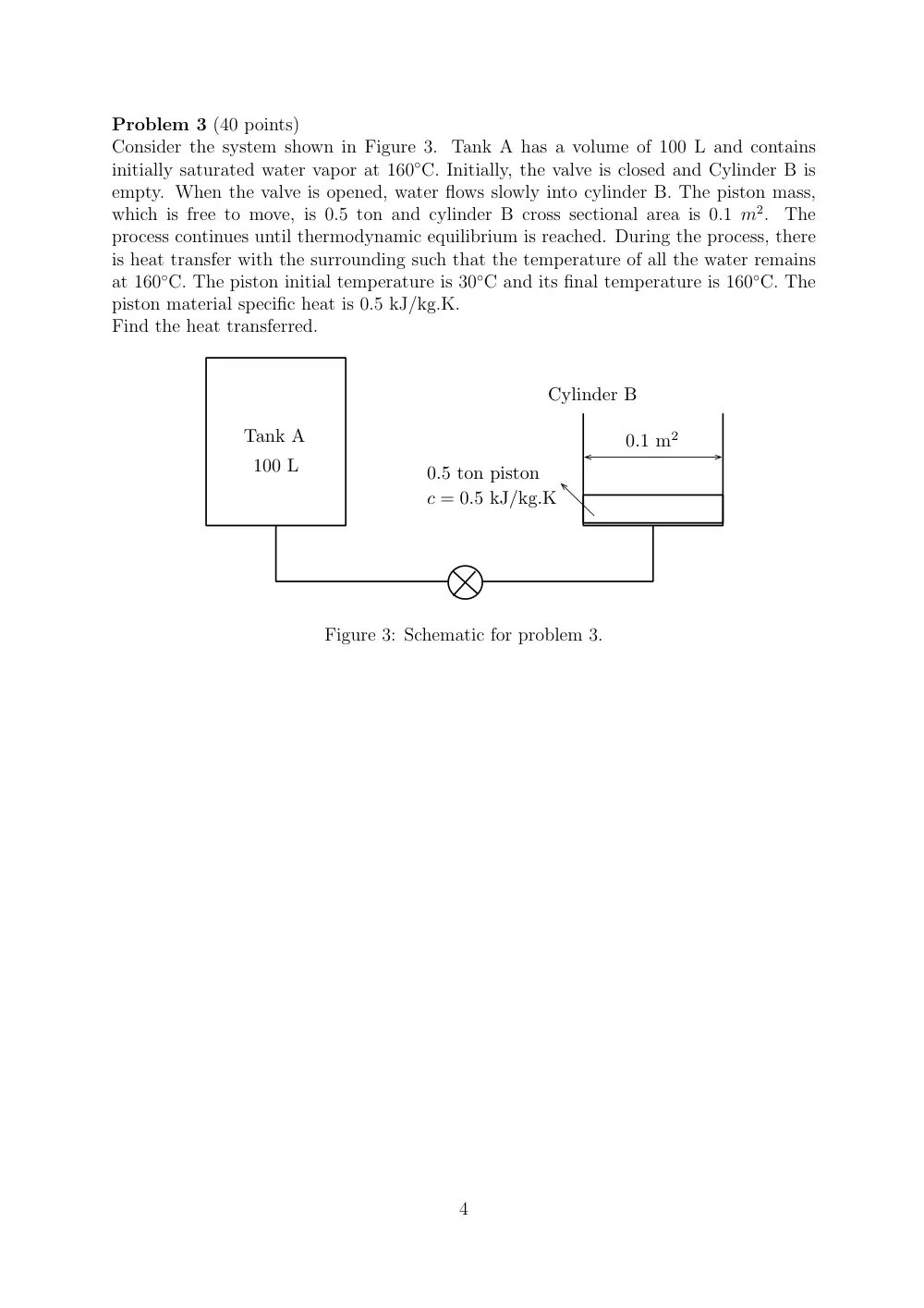
Problem 3 (40 points)
Consider the system shown in Figure 3. Tank A has a volume of 100 L and contains
initially saturated water vapor at 160◦C. Initially, the valve is closed and Cylinder B is
empty. When the valve is opened, water flows slowly into cylinder B. The piston mass,
which is free to move, is 0.5 ton and cylinder B cross sectional area is 0.1 m2.
The
process continues until thermodynamic equilibrium is reached. During the process, there
is heat transfer with the surrounding such that the temperature of all the water remains
at 160◦C. The piston initial temperature is 30◦C and its final temperature is 160◦C. The
piston material specific heat is 0.5 kJ/kg.K.
Find the heat transferred.
Tank A
Cylinder B
0.1 m2
0.5 ton piston
c = 0.5 kJ/kg.K
100 L
Figure 3: Schematic for problem 3.
4
Problem 3 Solution
State A1:
sat. vapor at 160◦C.
pA1 = 6.178 bar
uA1= 2568.4 kJ/kg
hA1 = 2758.1 kJ/kg
vA1 = 0.3071 m3/kg
mA1 = VA/vA1 = 0.1/0.3071 = 0.3256 kg.
State A2:
pA2 = 150 kPa
TA2 = 160◦C
superheated.
vA2 = 1.317 m3/kg
uA2 = 2595.2 kJ/kg
hA2 = 2792.8 kJ/kg
mA2 = VA/vA2 = 0.1/1.317 = 0.07593 kg.
State B2:
pB2 = 150 kPa
TB2 = 160◦C
superheated.
vB2 = 1.317 m3/kg
uB2 = 2595.2 kJ/kg
hB2 = 2792.8 kJ/kg
mB2 = mA1 − mA2 = 0.3256 - 0.07593 = 0.24967 kg.
VB2 = mB2vB2 = 0.24967 × 1.317 = 0.3288 m3.
First law, unsteady, for the control volume consisting of A+B+piston:
U2 − U1 = Q← + W ←
⇒
mA2uA2 + mB2uB2 − mA1uA1 + mpcp(T2 − T1)p + mpg(z2 − z1)p = Q← − pB(V2 − V1)B
⇒
mA2uA2 + mB2uB2 − mA1uA1 + mpcp(T2 − T1)p + mpgV2B
A
= Q← − pB(V2 − V1)B
⇒
(0.3256)(2595.2) − (0.3256)(2568.4) + (500)(0.5)(160 − 30) + (500)(10)
1000
0.3288
0.1
= Q← − (150)(0.3288)
Leading to Q← =32574.48608 kJ.
5