
MECH 310 Exam 2, Fall 2009
American University of Beirut · Thermodynamics I · 3 pages
More MECH 310 files
- Exam 2 Solution Leen Alawieh · Fall 2017Exam · with solutionView
- Exam 1 Leen Alawieh With Solutions · Fall 2017Exam · with solutionView
- Exam 1 · Fall 2016ExamView
- Exam 1 · Summer 2012ExamView
- Exam 1 with Solution · Fall 2011Exam · with solutionView
- Exam 2 · Summer 2011ExamView
- Exam 1 · Spring 2011ExamView
- Exam 1 · Summer 2011ExamView
Show the text of this exam
This
is
an
open
book
90
minutes
exam.
•
It
is
recommended
that
you
read
the
whole
exam
before
you
start
solving.
•
Make
sure
that
the
units
are
consistent.
•
Write
your
name
and
section
number
on
both
the
question
and
answer
sheets.
•
Clearly
identify
your
control
mass
/
control
volume.
• State
any
assumptions
you
need
and
provide
a
convincing
justiFication.
Problem
1
(35%)
A
spherical
balloon
initially
contains
25
m3
of
helium
gas
at
25
°C
and
150
kPa.
A
valve
is
now
opened,
and
the
helium
is
allowed
to
escape
slowly.
The
valve
is
closed
when
the
pressure
inside
the
balloon
drops
to
atmospheric
pressure
of
100
kPa.
The
elasticity
of
the
balloon
material
is
such
that
the
pressure
inside
the
balloon
during
the
process
varies
with
the
volume
according
to
the
relation:
p
=
a
+
b
V
where
a
=
‐
100
kPa
and
b
is
constant
Disregarding
any
heat
transfer
and
assuming
constant
speciFic
heats,
determine:
(a)
(25
%)
The
Final
temperature
inside
the
balloon.
(b) (10
%)The
mass
of
the
helium
that
has
escaped
Problem
1
Solution
Given:
V1,
T1,
p1,
p2
and
the
p‐V
relationship.
Q=0.
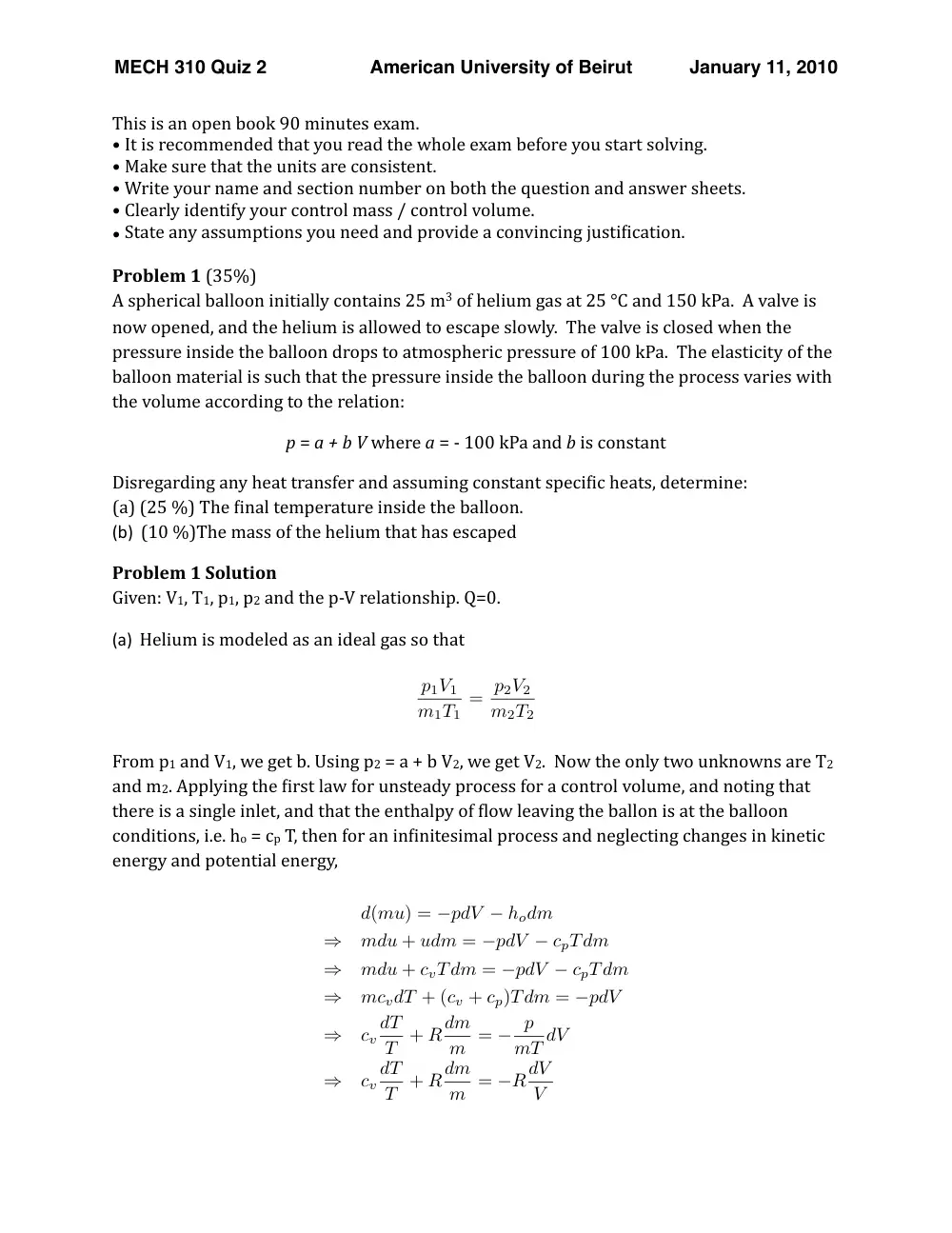
(a) Helium
is
modeled
as
an
ideal
gas
so
that
From
p1
and
V1,
we
get
b.
Using
p2
=
a
+
b
V2,
we
get
V2.
Now
the
only
two
unknowns
are
T2
and
m2.
Applying
the
First
law
for
unsteady
process
for
a
control
volume,
and
noting
that
there
is
a
single
inlet,
and
that
the
enthalpy
of
Flow
leaving
the
ballon
is
at
the
balloon
conditions,
i.e.
ho
=
cp
T,
then
for
an
inFinitesimal
process
and
neglecting
changes
in
kinetic
energy
and
potential
energy,
MECH 310 Quiz 2 American University of Beirut January 11, 2010
d(mu) = −pdV − hodm
⇒
mdu + udm = −pdV − cpTdm
⇒
mdu + cvTdm = −pdV − cpTdm
⇒
mcvdT + (cv + cp)Tdm = −pdV
⇒
cv
dT
T + Rdm
m = − p
mT dV
⇒
cv
dT
T + Rdm
m = −RdV
V
p1V1
m1T1
= p2V2
m2T2
Integrating
between
initial
and
Final
states,
we
get
Now,
we
have
two
equations
with
two
unknowns,
one
of
which
is
nonlinear.
So
use
iterative
technique
or
a
plotting
technique
to
get
T2
and
m2.
Problem
2
(30%)
You
are
asked
to
assess
energy
production
of
100
kg/s
of
(geothermal)
saturated
steam
at
1
atm.
(a) (10%)
What
is
the
maximum
efFiciency
of
a
power
generation
cyclic
engine
operating
between
the
steam
as
a
high
temperature
reservoir
and
atmosphere
(at
27
°C)
as
a
low
temperature
reservoir.
(b) (10%)
What
is
the
maximum
work
produced
per
unit
time
assuming
that
steam
enters
a
heat
exchanger
and
leaves
it
as
saturated
liquid
at
the
same
pressure.
(c) (10%)
What
are
the
conditions
for
satisfying
Carnot
cycle
requirements.
Problem
1
Solution
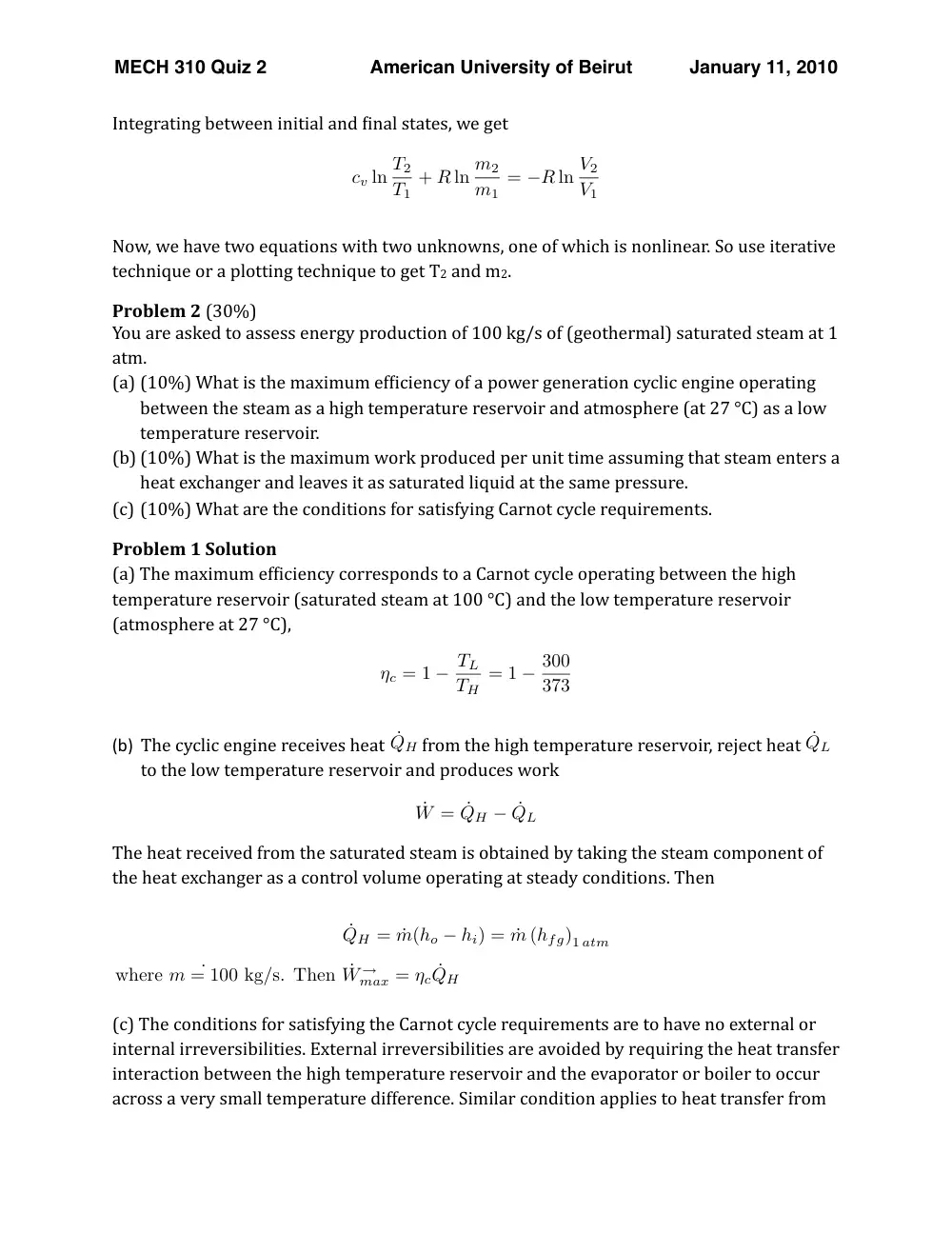
(a)
The
maximum
efFiciency
corresponds
to
a
Carnot
cycle
operating
between
the
high
temperature
reservoir
(saturated
steam
at
100
°C)
and
the
low
temperature
reservoir
(atmosphere
at
27
°C),
(b) The
cyclic
engine
receives
heat
from
the
high
temperature
reservoir,
reject
heat
to
the
low
temperature
reservoir
and
produces
work
The
heat
received
from
the
saturated
steam
is
obtained
by
taking
the
steam
component
of
the
heat
exchanger
as
a
control
volume
operating
at
steady
conditions.
Then
(c)
The
conditions
for
satisfying
the
Carnot
cycle
requirements
are
to
have
no
external
or
internal
irreversibilities.
External
irreversibilities
are
avoided
by
requiring
the
heat
transfer
interaction
between
the
high
temperature
reservoir
and
the
evaporator
or
boiler
to
occur
across
a
very
small
temperature
difference.
Similar
condition
applies
to
heat
transfer
from
MECH 310 Quiz 2 American University of Beirut January 11, 2010
cv ln T2
T1
+ R ln m2
m1
= −R ln V2
V1
ηc = 1 − TL
TH
= 1 − 300
373
˙QH = ˙m(ho − hi) = ˙m (hfg)1 atm
˙QH
˙QL
˙W = ˙QH − ˙QL
where
˙
m = 100 kg/s. Then ˙W →
max = ηc ˙QH
the
condenser
to
the
low
temperature
reservoir.
This
means
that
if
these
reservoirs
are
at
Fixed
temperature
then
the
only
way
to
exchange
heat
with
them
without
violating
the
very
small
temperature
difference
requirement
is
the
have
isothermal
phase
change
in
both
evaporator
and
condenser.
Also
expansion
in
the
turbine
must
be
reversible
and
adiabatic
(isentropic).
Similar
condition
applies
to
compression
in
the
compressor.
Insulation
of
all
the
components
including
the
pipes
must
be
perfect
to
avoid
undesired
heat
losses.
Finally
Flow
in
the
pipes
my
be
frictionless.
Problem
3
(35%)
Refrigerant
R‐134a
enters
a
compressor
at
200
kPa,
0
°C
and
exits
at
1200
kPa
and
50
°C.
The
diameters
of
the
inlet
and
exit
pipes
are
4
and
2
cm.
The
volumetric
Flow
rate
of
the
refrigerant
at
the
entrance
is
0.38
m3/min
and
the
compressor
experiences
a
heat
loss
to
cooling
water
circulating
through
a
water
jacket
enclosing
the
compressor.
The
cooling
water
Flow
rate
is
0.25
kg/s
and
its
temperature
rise
from
inlet
to
exit
is
2
°C.
Determine
the
following:
(a)
(15%)
The
power
input
to
the
compressor
(b) (15%)
The
compressor
is
powered
by
an
adiabatic
steam
turbine
that
is
directly
coupled
to
the
refrigerant
compressor.
If
the
steam
enters
the
turbine
at
3
MPa
and
400
°C
and
expands
to
6
kPa
with
quality
(x
=
0.9),
determine
the
Flow
rate
of
steam
required
to
drive
the
compressor.
Problem
3
Solution
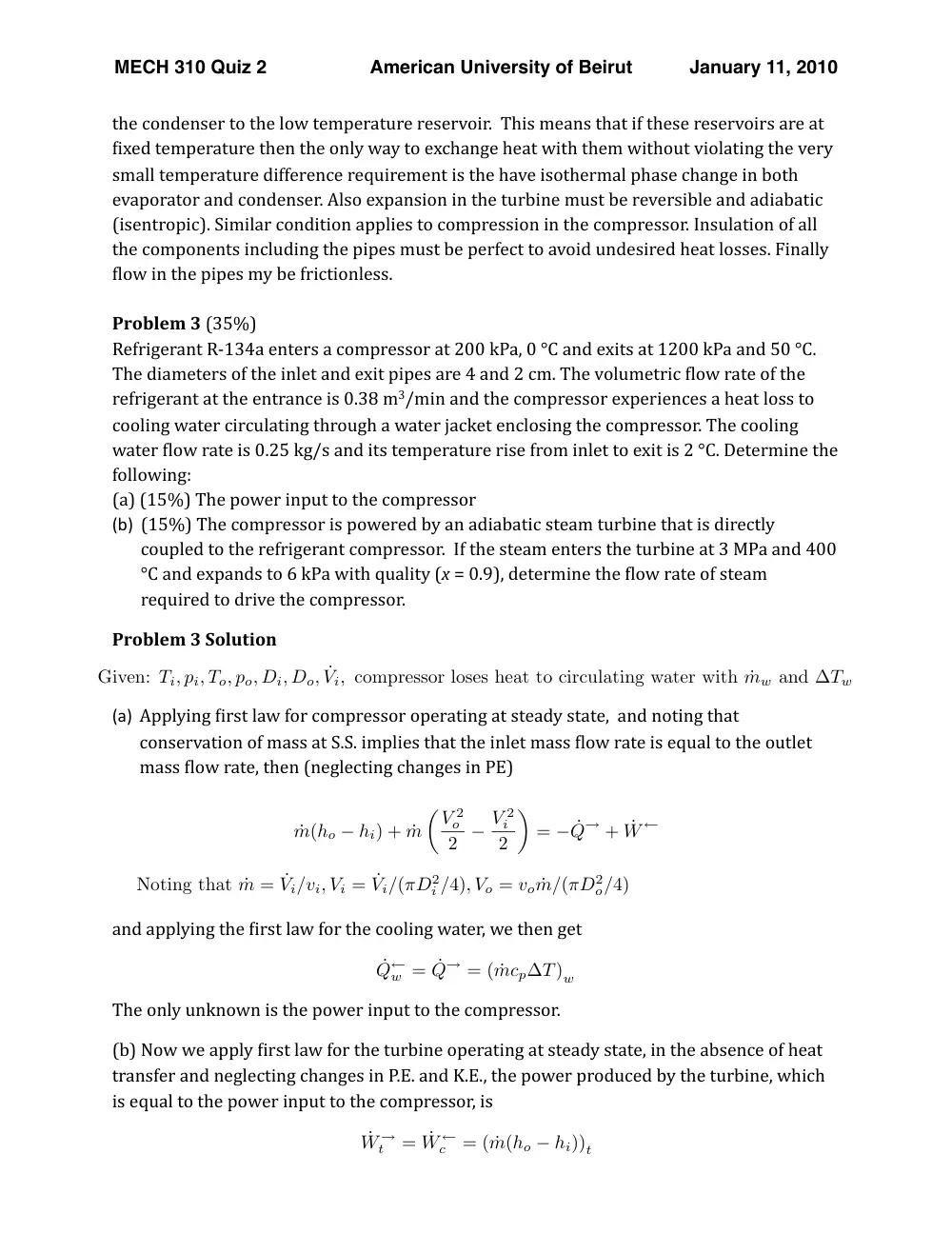
(a) Applying
First
law
for
compressor
operating
at
steady
state,
and
noting
that
conservation
of
mass
at
S.S.
implies
that
the
inlet
mass
Flow
rate
is
equal
to
the
outlet
mass
Flow
rate,
then
(neglecting
changes
in
PE)
and
applying
the
First
law
for
the
cooling
water,
we
then
get
The
only
unknown
is
the
power
input
to
the
compressor.
(b)
Now
we
apply
First
law
for
the
turbine
operating
at
steady
state,
in
the
absence
of
heat
transfer
and
neglecting
changes
in
P.E.
and
K.E.,
the
power
produced
by
the
turbine,
which
is
equal
to
the
power
input
to
the
compressor,
is
MECH 310 Quiz 2 American University of Beirut January 11, 2010
Given: Ti, pi, To, po, Di, Do, ˙Vi, compressor loses heat to circulating water with ˙mw and ∆Tw
˙m(ho − hi) + ˙m
�V 2
o
2 − V 2
i
2
�
= − ˙Q→ + ˙W ←
Noting that ˙m = ˙Vi/vi, Vi = ˙Vi/(πD2
i /4), Vo = vo ˙m/(πD2
o/4)
˙Q←
w = ˙Q→ = ( ˙mcp∆T)w
˙W →
t
= ˙W ←
c
= ( ˙m(ho − hi))t