
MECH 310 Exam 2, Fall 2009
American University of Beirut · Thermodynamics I · 10 pages


More MECH 310 files
- Exam 2 Solution Leen Alawieh · Fall 2017Exam · with solutionView
- Exam 1 Leen Alawieh With Solutions · Fall 2017Exam · with solutionView
- Exam 1 · Fall 2016ExamView
- Exam 1 · Summer 2012ExamView
- Exam 1 with Solution · Fall 2011Exam · with solutionView
- Exam 2 · Summer 2011ExamView
- Exam 1 · Spring 2011ExamView
- Exam 1 · Summer 2011ExamView
Show the text of this exam
MECH 310 Thermodynamics I
January 11, 2007
American University of Beirut, Fall 2007
Handout # Quiz 2
Quiz 2
• This is a 120 minutes exam.
• You allowed to bring in 3 cheat sheets in addition to the thermodynamic tables.
• You are advised to read the whole exam before you start.
• Make sure you state all the assumptions you make and that you clearly identify any
control mass or control volume you utilize in your analysis.
• Good luck!
Problem 1[30 points] - Hydroelectric Power
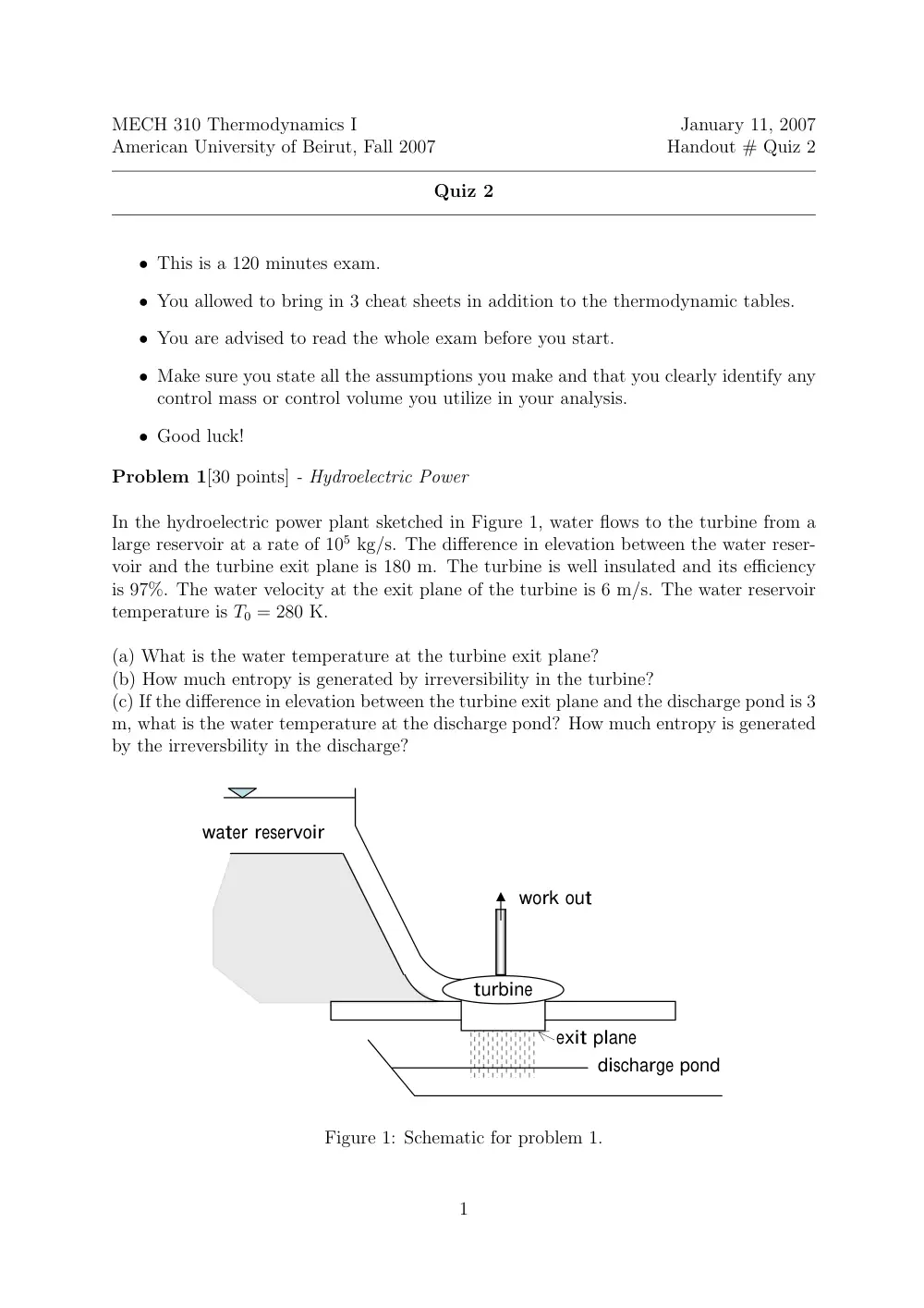
In the hydroelectric power plant sketched in Figure 1, water flows to the turbine from a
large reservoir at a rate of 105 kg/s. The difference in elevation between the water reser-
voir and the turbine exit plane is 180 m. The turbine is well insulated and its efficiency
is 97%. The water velocity at the exit plane of the turbine is 6 m/s. The water reservoir
temperature is T0 = 280 K.
(a) What is the water temperature at the turbine exit plane?
(b) How much entropy is generated by irreversibility in the turbine?
(c) If the difference in elevation between the turbine exit plane and the discharge pond is 3
m, what is the water temperature at the discharge pond? How much entropy is generated
by the irreversbility in the discharge?
turbine
discharge pond
exit plane
work out
water reservoir
Figure 1: Schematic for problem 1.
1
Solution
(a) Applying the first law for a control volume consisting of the water reservoir and the
falling water until the inlet to the turbine (CV1 in Figure 2) and noting that the flow is
steady, no heat or work interactions are taking place, the velocity of water in the reservoir
is negligible, and that the flow is isothermal, we get
(V 2
in)turbine
2
= gH ⇒ (V 2
in)turbine =
�
2gH = 60 m/s
where g is gravity.
turbine
discharge pond
exit plane
work out
water reservoir
CV1
CV2
CV3
Figure 2: Control volumes for problem 1.
Next we apply the first law for a control volume consisting of the turbine (CV2 in Figure
2). Noting that the turbine is thermally insulated, the flow is steady, and changes in
potential energy across the turbine are negligible, we get
0 = −(W →)turbine + ˙m (hin − hout) + ˙m
2
�
(V 2
in)turbine − (V 2
out)turbine
�
The efficiency of the turbine is the ratio of the actual work produced to the maximum
work that can be produced. The maximum work corresponds to the isentropic process in
the turbine and to zero outlet velocity,
η =
W →
(W →)max
= 2 ˙m (hin − hout) + ˙m ((V 2
in)turbine − (V 2
out)turbine)
2 ˙m (hin − hout,s) + ˙m ((V 2
in)turbine)
Now using the relation dh = T ds + v dp and noting that the turbine inlet and outlet
pressure are atmospheric, then for an isentropic process hin = hout,s.
Also note that
hin − hout = cp(Tin − Tout), then
η =
W →
(W →)max
= 2cp (Tin − Tout) + (V 2
in − V 2
out)
V 2
in
2
Which leads to
Tout = Tin + 1
2cp
�
(1 − η)V 2
in − V 2
out
�
= 288.6 K
(b) Applying 2nd law for the turbine control volume and noting that the turbine is
thermally insulated, then for an isobaric process of an incompressible liquid
˙Sirr = ˙m(sout − sin) = ˙mcp ln Tout
Tin
= 12663 kJ/s K
(c) Assuming that the discharge process (CV3 in Figure 2) is adiabatic (this claim is not
entirely true since some heat is transferred from the water to the surrounding), the first
lay yields for a steady process ,
0 = ˙m(hin − hout) + ˙m
2
�
V 2
in − V 2
out
�
+ ˙mg(zin − zout)
with Vout = 0 and hin − hout = cp(Tin − Tout), we get
0 = cp(Tin − Tout) + V 2
in
2 + g(zin − zout)
⇒
Tout = Tin + V 2
in
2cp
+ g
cp
(zin − zout) = 288.6 + 11.46 = 300 K
The second law applied for the control volume consisting of the turbine discharge and the
discharge pond assuming adiabatic process leads to
˙Sirr = ˙m(sout − sin) = ˙mcp ln Tout
Tin
= 16310 kJ/s K
3
Problem 2 [20 points] - Homer Simpson: “Lisa... In this house, we obey the laws of
thermodynamics”
US Patent No.: US 6,962,052 B2 (2005) by “inventor” Haim Goldenblum.
Q←
.
W
. →
Figure 3: Schematic for problem 2.
(a) Does the proposed device obey the first law of thermodynamics? If heat ˙Q enters the
heat exchanger, how much work per unit time does the device produce?
(b) Does the device obey the second law of thermodynamics? Why?
4
Solution
(a) Applying first law for the cyclic device, we get
W → = Q←
So the device obeys the first law of thermodynamics.
(b) The device violated the Kelvin-Planck statement of the second law since it consists
of a cyclic device producing work while exchanging heat with a single thermodynamic
reservoir.
5
Problem 3 [25 points]
Air is contained in the insulated cylinder shown in the figure below. At this point the air
is at 140 kPa, 25 ◦C and the cylinder volume is 15 L. The piston cross-sectional area is
0.045 m2, and the spring is linear with spring constant 35 kN/m. The valve is opened,
and air from the line at 700 kPa, 25 ◦C flows into the cylinder until the pressure reaches
700 kPa, and the valve is closed. Find the final temperature.
1- Air is contained in the insulated cylinder shown in the figure below. At this point
the air is at 140 kPa, 25 ºC and the cylinder volume is 15 L. The piston cross-
sectional area is 0.045 m2, and the spring is linear with spring constant 35 kN/m.
The valve is opened, and air from the line at 700 kPa, 25 ºC flows into the
cylinder until the pressure reaches 700 kPa, and the valve is closed. Find the final
temperature
2- A thermal storage is made of a rock bed having a volume of 2 m3, density 2750
kg/m3 and specific heat of 0.89 kJ/kg K. The bed is heated by solar energy until
its temperature reaches 400 K. If a reversible heat engine is connected between
the rock bed and the environment thermal reservoir at temperature To.
a) Find the amount of work produced as the temperature of the rock bed
decreases to To.
b) If the environmental thermal reservoir is replaced by a rigid vessel
containing 10 kg of air that is initially at To, what would be the amount of
work produced?
Figure 4: Schematic for problem 3.
6
Solution
Applying the first law for the control volume consisting of the air inside the cylinder and
noting that the process is unsteady and the cylinder is insulated, then
m2u2 − m1u1 = −W → + minhin
(1)
where kinetic and potential energy effects are neglected. Now conservation of mass re-
quires
min = m2 − m1
Assuming the process to be quasi-static, the work done by the system must balance the
work done on the environment plus the work done in compressing the spring
W →
=
� V2
V1
p dV =
� V2
V1
�
p1 − kspring(∆z)
Apiston
�
dV
Noting that ∆z = z − z1 =
V1−V
Apiston, where z1 and V1 correspond height of piston and
volume at initial state
W → = p1(V2 − V1) + 1
2
kspring
A2
piston
(V2 − V1)2
Equation (1) becomes
m2u2 − m1u1 = p1(V2 − V1) + kspring
2A2
piston
(V2 − V1)2 + (m2 − m1)hin
Using the ideal gas law pV = mRT and noting u = cvT, h = cpT,
cv
R(p2V2 − p1V1) = p1(V2 − V1) + kspring
2A2
piston
(V2 − V1)2 + cp
R
�p2V2
T2
− p1V1
T1
�
Tin
(2)
The unknowns in the above equation are the volume and temperature at the final state.
The additional equation needed is naturally the second law of thermodynamics applied for
the control volume between initial and final states. Noting that the cylinder is insulated
and assuming that the process is irreversible, we get
m2s2 − m1s1 = minsin = (m2 − m1)sin
⇒
m2(s2 − sin) = m1(s1 − sin)
⇒
m2
�
cp ln T2
Tin
− R ln p2
pin
�
= m1
�
cp ln T1
Tin
− R ln p1
pin
�
⇒
p2V2
RT2
�
cp ln T2
Tin
− R ln p2
pin
�
= p1V1
RT1
�
cp ln T1
Tin
− R ln p1
pin
�
(3)
So basically we solve for T2 by substituting expression for V2 obtained from equation (3)
in equation (2) to get an equation in which the only unknown is T2.
7
Problem 4 [25 points]
A thermal storage is made of a rock bed having a volume of 2 m3, density 2750 kg/m3
and specific heat of 0.89 kJ/kg K. The bed is heated by solar energy until its temperature
reaches 400 K. If a reversible heat engine is connected between the rock bed and the
environment thermal reservoir at temperature To.
a) Find the amount of work produced as the temperature of the rock bed decreases to To.
b) If the environmental thermal reservoir is replaced by a rigid vessel containing 10 kg of
air that is initially at To, what would be the amount of work produced?
2- A thermal storage is made of a rock bed having a volume of 2 m3, density 2750
kg/m3 and specific heat of 0.89 kJ/kg K. The bed is heated by solar energy until
its temperature reaches 400 K. If a reversible heat engine is connected between
the rock bed and the environment thermal reservoir at temperature To.
a) Find the amount of work produced as the temperature of the rock bed
decreases to To.
b) If the environmental thermal reservoir is replaced by a rigid vessel
containing 10 kg of air that is initially at To, what would be the amount of
work produced?
Figure 5: Schematic for problem 4.
8
Solution
(a) First law for the cyclic engine gives
∆E = 0 = Q←
H − Q→
L − W →
Second law for the reversible cyclic engine gives
∆S = 0 = S←
H − S→
L =
� δQ←
H
T
− Q→
L
To
where the temperature of the rock bed T decreases from TH =400 K to To.
Now applying the first law for the rock bed over an infinitesimal process from T to T −dT,
we get
δQ←
H = −mrbcrb dT = −(ρVc)rb dT
(4)
Substituting in the entropy balance equation, we get
� To
TH
−(ρVc)rb dT
T
− Q→
L
To
= 0
⇒
Q→
L = (ρVc)rb To ln TH
To
Also from equation (4),
Q←
H = (ρVc)rb(TH − To)
Finally the work output is
W → = Q←
H − Q→
L = (ρVc)rb
�
(TH − To) − To ln TH
To
�
(b) In this case, not only the temperature of the rock bed is decreasing as it is giving heat
to the cyclic engine, but also the temperature of the water reservoir is increasing as it is
receiving heat from the cyclic engine. The process will start from the initial state and
continue until both reservoirs reach the same final temperature Tf.
First law for the rock bed, we have
δQ←
H = −mrbcrb dT
⇒
Q←
H = mrbcrb(TH − Tf)
First law for the water reservoir
δQ→
L = mwcw dT
⇒
Q→
L = mwcw(Tf − To)
9
Entropy balance for an infinitesimal reversible process of the cyclic engine yields,
� Tf
TH
δQ←
H
T
−
� Tf
To
δQ→
L
T
= 0
⇒
(mc)rb ln TH
Tf
= (mc)w ln Tf
To
⇒
Tf =
�
T Cw
o
T Crb
H
�
1
Cw+Crb
where Cw = mwcw and Crb = mrbcrb.
Substituting Tf in Q←
H and Q→
L , we get
W → = Q←
H − Q→
L = Crb
�
TH −
�
T Cw
o
T Crb
H
�
1
Cw+Crb
�
− Cw
��
T Cw
o
T Crb
H
�
1
Cw+Crb − To
�
10