
MECH 310 Exam 2, Fall 2010
American University of Beirut · Thermodynamics I · 2 pages
More MECH 310 files
- Exam 1 Leen Alawieh With Solutions · Fall 2017Exam · with solutionView
- Exam 2 Solution Leen Alawieh · Fall 2017Exam · with solutionView
- Exam 1 · Fall 2016ExamView
- Exam 1 · Summer 2012ExamView
- Exam 1 with Solution · Fall 2011Exam · with solutionView
- Exam 2 · Summer 2011ExamView
- Exam 1 · Spring 2011ExamView
- Exam 1 · Summer 2011ExamView
Show the text of this exam
MECH 310 Thermodynamics I
American University of Beirut, Fall 2010
January 15, 2011
Handout # Qviz 2
Quiz 2
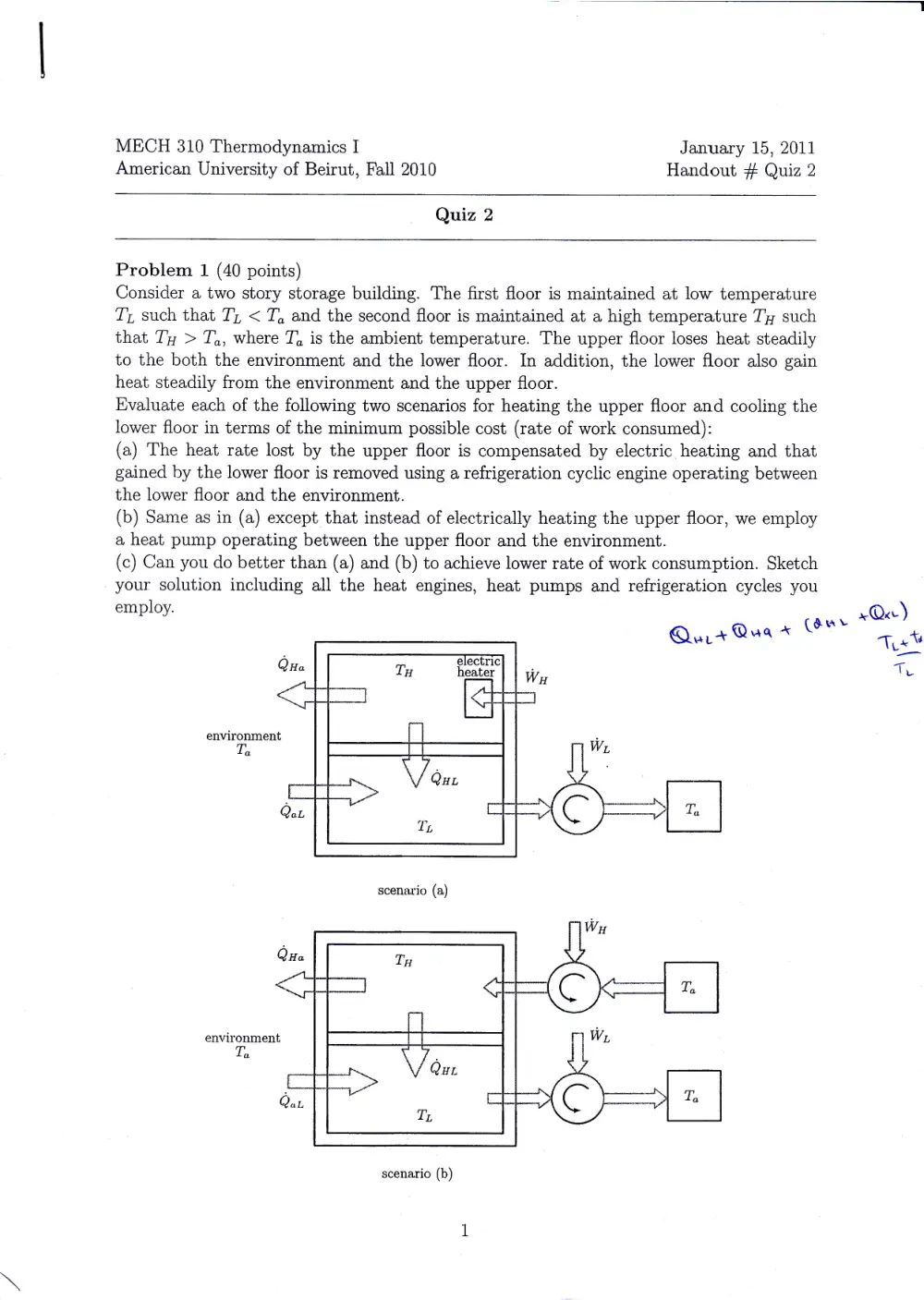
Problem 1 (40 points)
Consicler a two story storage buiiding. The first fl.oor is maintained at iow temperature
72, such lhat T1< 4 and the second floor is maintained at a high temperature 7s such
that Ta ) To, where Q is the ambient temperature. The upper floor loses heat steadily
to the both the environment and the lower floor. In addition, the lower fl.oor also gain
heat steadily from the environment and the upper floor.
Evaluate each of the following two scenarios for heating the upper floor and cooling the
lower floor in terms of the minimum possible cost (rate of work consumed):
(a) The heat rate lost by the upper floor is compensateci by electric heating and that
gained by the iower floor is removed using a refrigeration cyclic engine operating between
the lower floor and the environment.
(b) Same as in (a) except that instead of electrically heating the upper floor, we employ
a heat pump operating between the upper floor and the environment.
(c) Can you do better than (a) and (b) to achieve lower rate of work consumption. Sketch
your solution including all the heat engines, heat pumps and refrigeration cycles you
employ.
Q,*r-*Q*q t fsrru
Qnu.
W7
scenalio (a)
*Q*")
TrJ
tL
scenario (b)
a
b-,'**
-'lw;n
e"
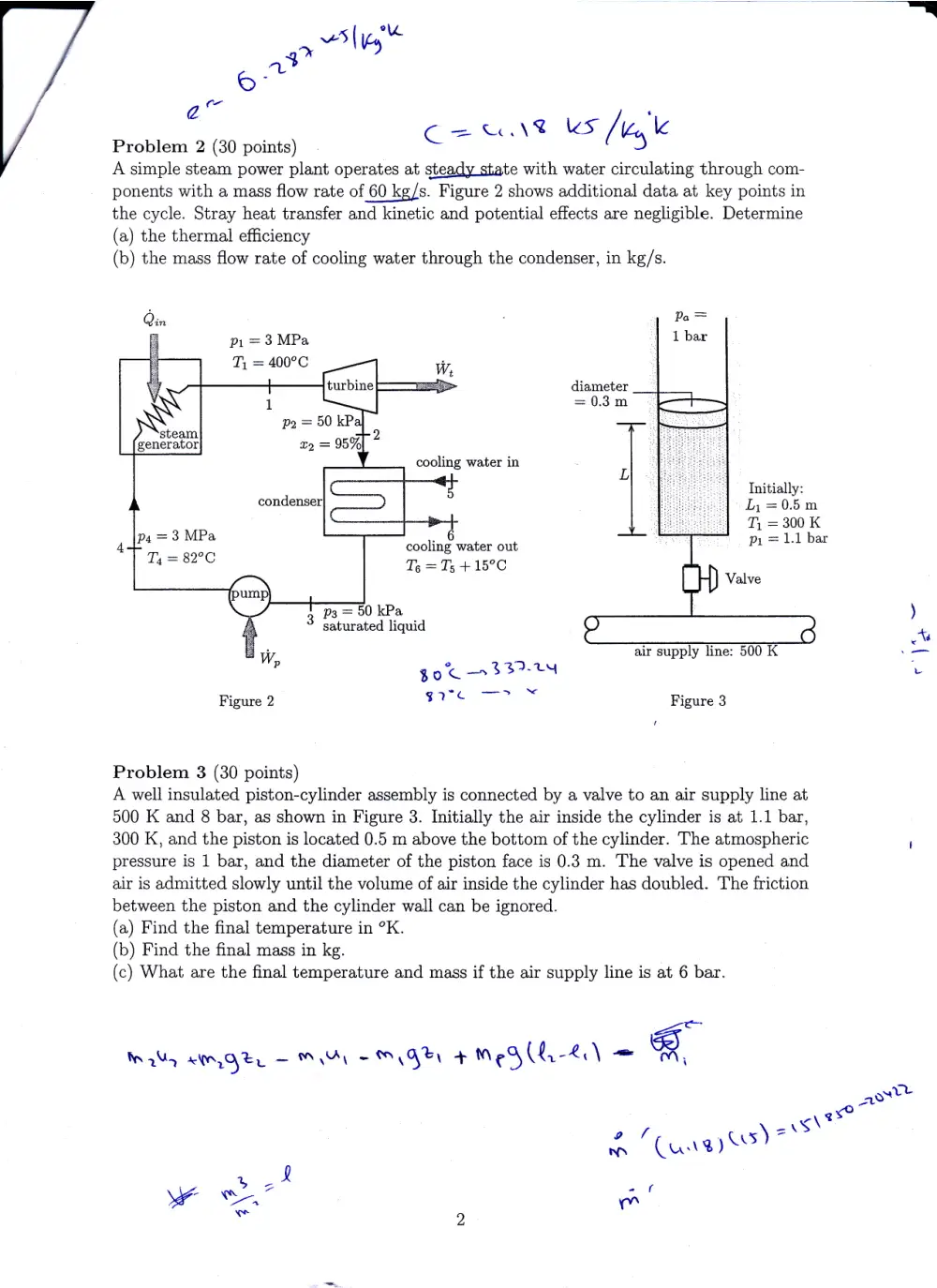
Problem 2 (30 points)
A simple steam power plant operates at sjsdystate with water circulating through com-
ponents with a mass flow rate of 60 kgfs. Figure 2 shows additional data at key points in
the cycle. Stray heat transfer and kinetic and potential effects are negiigible. Determine
(a) the thermal efficiency
(b) the mass flow rate of cooling water through the condenser, in kg/s.
Pr :3 MPa
Tr:400oC
cooling water in
cooling water out
Ta:Ts+15"C
Figure 3
Problem 3 (30 points)
A well insulated piston-cylinder assembly is connected by a valve to an air suppiy line at
500 K and 8 bar, as shown in Figure 3. Initially the air inside the cylinder is at 1.1 bar,
300 K, and the piston is located 0.5 m above the bottom of the cylinder. The atmospheric
pressure is 1 bar, and the diameter of the piston face is 0.3 m. The valve is opened and
air is admitted slowly until the volume of air inside the cylinder has doubled. The friction
between the piston and the cylinder wall can be ignored.
(a) Find the finai temperature in oK.
(b) Find the final mass in kg.
(c) What are the final temperature and mass if the air supply line is at 6 bar.
we
C-- L,.\e us f4'V
)f
v
Figure 2
r^rVr +\nrJt,- - s1$r -s,11, + nnf3({r-t,\ *q:
-,o -o*tt
'(r^'1g I tt:) = rs\ s'
) --!.
D--^
-
$F
0
r$
Y.A
Initially:
.Lt :0.5 m
Tr=300K
Pr : 1.1 bar
Ta:82"C
Pa:50 kPa