
MECH 310 Final, Spring 2011
American University of Beirut · Thermodynamics I · 6 pages



More MECH 310 files
- Final · Spring 2011Final examView
- Final · Summer 2011Final examView
- Final · Spring 2010Final examView
- Final · Fall 2009Final examView
- Final · Fall 2008Final examView
- Essay Chapter 3 · Fall 2017ChapterView
- Exam 2 Solution Leen Alawieh · Fall 2017Exam · with solutionView
- Exam 1 Leen Alawieh With Solutions · Fall 2017Exam · with solutionView
Show the text of this final exam
MECH 310 THERMODYNAMICS I
FINAL (OPEN BOOK 180 MINUTES)
2nd June 2010
1
MULTIPLE CHOICE SECTION
(1 Point per question, 20 POINTS TOTAL)
1. Select an acceptable paraphrase of the Kelvin-Planck statement of the second law.
(A) No process can produce more work than the heat that it accepts.
(B) No engine can produce more work than the heat that it intakes.
(C) An engine cannot produce work without accepting heat.
(D) An engine has to reject heat.
2. Which of the following can be assumed to be reversible?
(A) A paddle wheel
(B) A burst membrane
(C) A resistance heater
(D) A piston compressing gas in a car engine
3. Which of the following is not a control volume?
(A) Insulated tank
(B) Car radiator
(C) Compressor
(D) Turbine
4. Select the Kelvin-Planck statement of the second law.
(A) An engine cannot produce more heat than the heat it receives.
(B) A refrigerator cannot transfer heat from a low-temperature reservoir
to a high-temperature reservoir without work.
(C) An engine cannot produce work without discharging heat.
(D) An engine discharges heat if the work is less than the heat it receives
5. An isentropic process is
(A) Adiabatic and reversible.
(B) Reversible but may not be adiabatic.
(C) Adiabatic but may not be reversible.
(D) Always reversible.
6. Which of the following second law statements is incorrect?
(A) Heat must be rejected from a heat engine.
(B) The entropy of an isolated process must remain constant or rise.
(C) The entropy of a hot block decreases as it cools.
(D) Work must be input if energy is transferred from a cold body to a hot body.
7. An inventor claims a thermal engine operates between ocean layers at 27 and 10oC. It produces 10 kW
and discharges 9900 kJ/min. Such an engine is
(A) Impossible
(B) Reversible
(C) Slightly irreversible
(D) Very irreversible
MECH 310 THERMODYNAMICS I
FINAL (OPEN BOOK 180 MINUTES)
2nd June 2010
2
8. For any reversible process, the change in entropy of the system and surroundings is
(A) zero
(B) unity
(C) negative
(D) positive
(E) infinite.
9. The processes of a Carnot cycle are
(A) two adiabatic and two constant volume
(B) one constant volume and one constant pressure and two isentropic
(C) one adiabatic, one constant volume and two isothermal
(D) two isothermal and two isentropic.
10. In a Carnot engine, when the working substance gives heat to the sink
(A) the temperature of the sink increases
(B) the temperature of the sink remains the same
(C) the temperature of the source decreases
(D) the temperatures of both the sink and the source decrease
11. If the temperature of the source is increased, the efficiency of the Carnot engine
(A) decreases
(B) increases
(C) does not change
(D) will be equal to the efficiency of a practical engine
12. The efficiency of an ideal Carnot engine depends on
(A) working substance
(B) on the temperature of the source only
(C) on the temperature of the sink only
(D) on the temperatures of both the source and the sink
13. In a reversible cycle, the entropy of the system
(A) increases
(B) decreases
(C) does not change
(D) first increases and then decreases
14. A frictionless heat engine can be 100% efficient only if its exhaust temperature is
(A) equal to its input temperature
(B) less than its input temperature
(C) 0°C
(D) 0°K
15. Kelvin-Planck’s law deals with
(A) conservation of energy
(B) conservation of mass
(C) conversion of work into heat
(D) conversion of heat into work
MECH 310 THERMODYNAMICS I
FINAL (OPEN BOOK 180 MINUTES)
2nd June 2010
3
16. Which of the following statements is correct according to Clausius statement of second law of
thermodynamics?
(A) It is impossible to transfer heat from a body at a lower temperature to a body at a higher temperature.
(B) It is impossible to transfer heat from a body at a lower temperature to a body at a higher temperature,
without the aid of an external source.
(C) It is possible to transfer heat from a body at a lower temperature to a body at a higher temperature by
using refrigeration cycle
(D) None of the above.
17. The change of entropy, when heat is absorbed by the gas is
(A) positive
(B) negative
(C) positive or negative.
18. Which of the following statements is correct?
(A) The increase in entropy is obtained from a given quantity of heat at a low temperature
(B) The change in entropy may be regarded as a measure of the rate of the availability of heat for
transformation into work
(C) The entropy represents the maximum amount of work obtainable per degree drop in temperature
(D) All of the above.
19. The condition for the reversibility of a cycle is
(A) all the processes taking place in the cycle of operation, must be extremely slow
(B) the working parts of the engine must be friction free
(C) there should be no loss of energy during the cycle of operation
(D) all of the above.
20. Which of the following is the correct statement?
(A) All the reversible engines have the same efficiency
(B) All the reversible and irreversible engines have the same efficiency
(C) Irreversible engines have maximum efficiency
(D) All engines are designed as reversible in order to obtain maximum efficiency.
MECH 310 THERMODYNAMICS I
FINAL (OPEN BOOK 180 MINUTES)
2nd June 2010
4
PROBLEMS SECTION
(5 Problems for a total of 80 POINTS plus a bonus question for 15 POINTS)
PROBLEM 1
(20 POINTS)
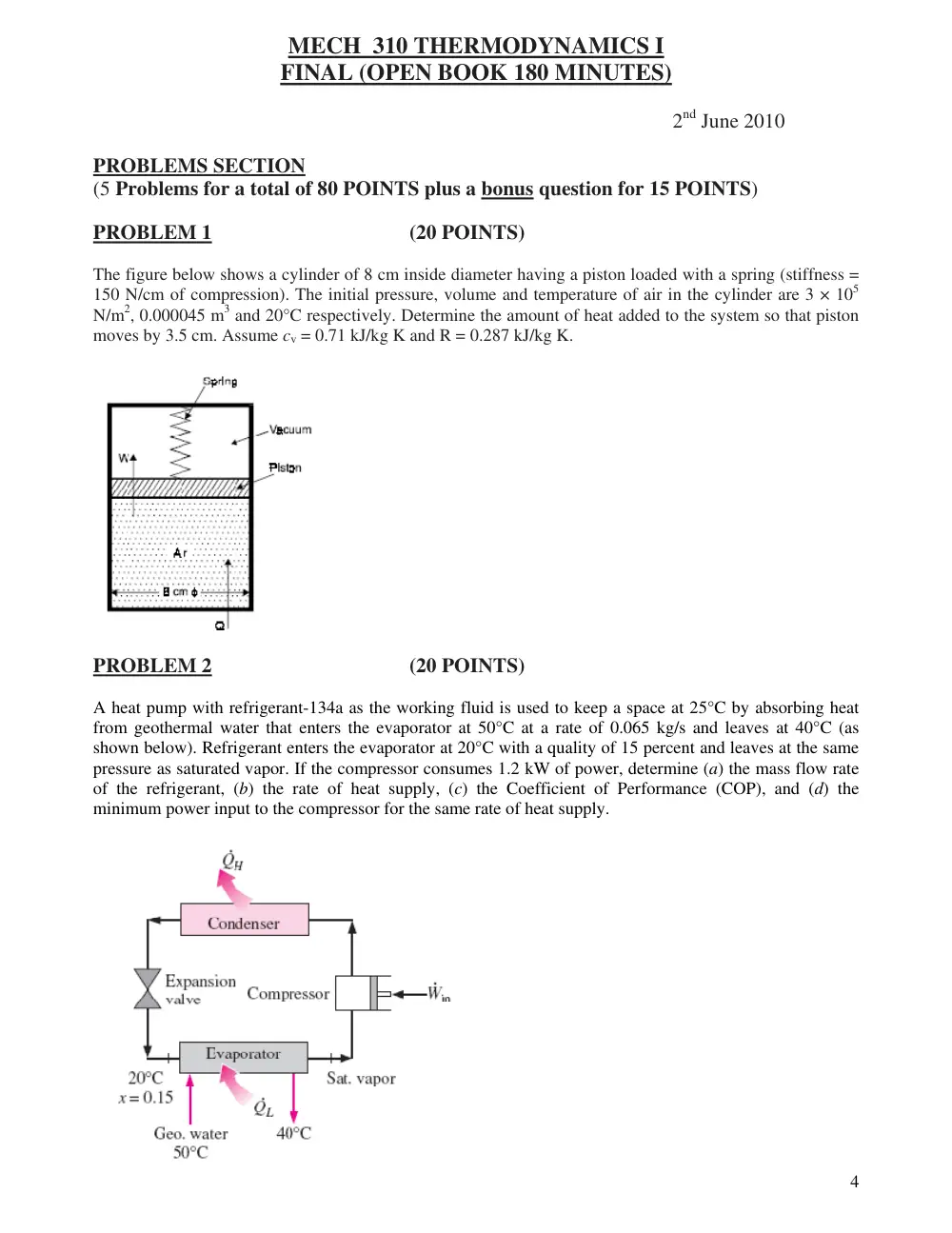
The figure below shows a cylinder of 8 cm inside diameter having a piston loaded with a spring (stiffness =
150 N/cm of compression). The initial pressure, volume and temperature of air in the cylinder are 3 × 10⁵
N/m2, 0.000045 m3 and 20°C respectively. Determine the amount of heat added to the system so that piston
moves by 3.5 cm. Assume cv = 0.71 kJ/kg K and R = 0.287 kJ/kg K.
PROBLEM 2
(20 POINTS)
A heat pump with refrigerant-134a as the working fluid is used to keep a space at 25°C by absorbing heat
from geothermal water that enters the evaporator at 50°C at a rate of 0.065 kg/s and leaves at 40°C (as
shown below). Refrigerant enters the evaporator at 20°C with a quality of 15 percent and leaves at the same
pressure as saturated vapor. If the compressor consumes 1.2 kW of power, determine (a) the mass flow rate
of the refrigerant, (b) the rate of heat supply, (c) the Coefficient of Performance (COP), and (d) the
minimum power input to the compressor for the same rate of heat supply.
MECH 310 THERMODYNAMICS I
FINAL (OPEN BOOK 180 MINUTES)
2nd June 2010
5
PROBLEM 3
(10 POINTS)
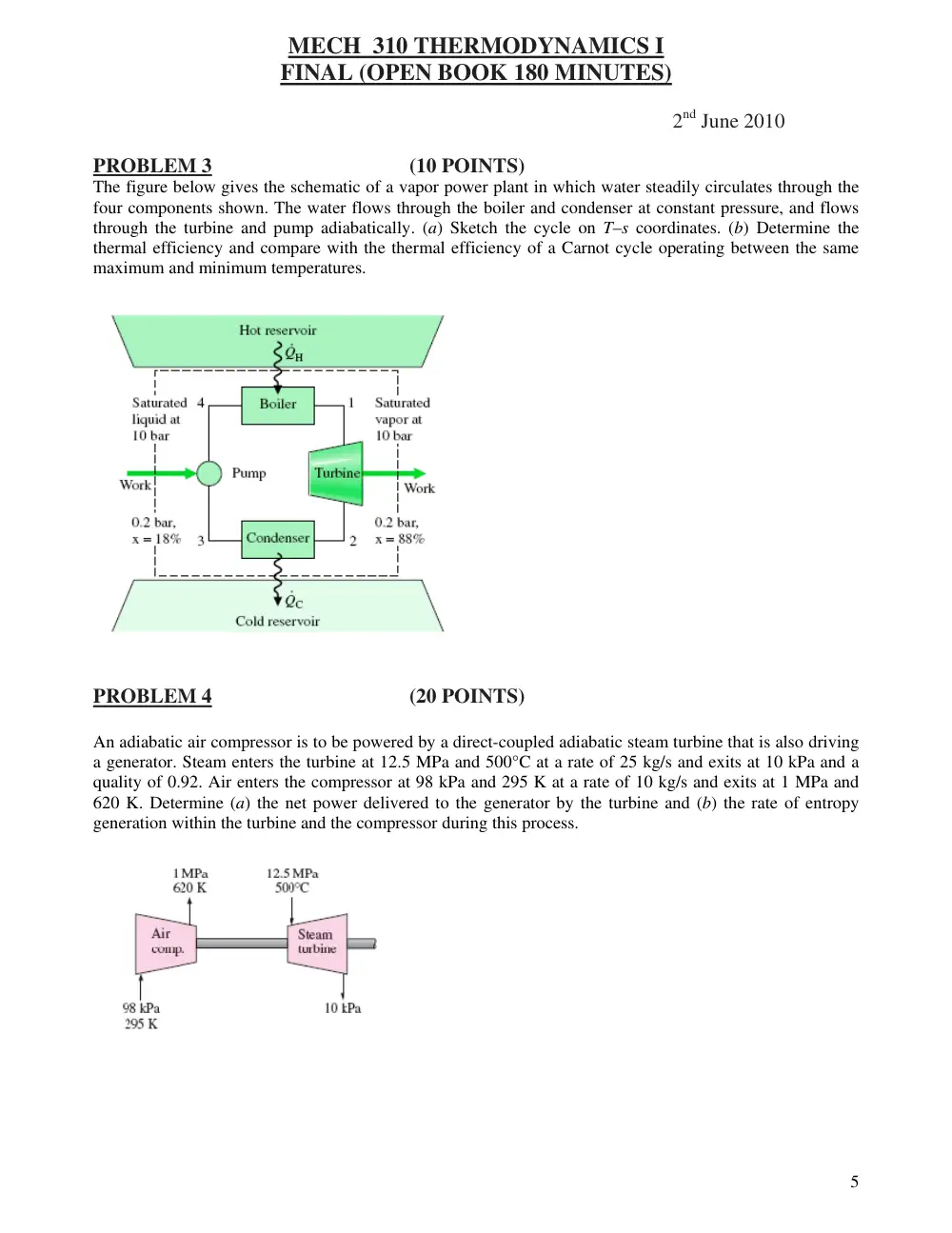
The figure below gives the schematic of a vapor power plant in which water steadily circulates through the
four components shown. The water flows through the boiler and condenser at constant pressure, and flows
through the turbine and pump adiabatically. (a) Sketch the cycle on T–s coordinates. (b) Determine the
thermal efficiency and compare with the thermal efficiency of a Carnot cycle operating between the same
maximum and minimum temperatures.
PROBLEM 4
(20 POINTS)
An adiabatic air compressor is to be powered by a direct-coupled adiabatic steam turbine that is also driving
a generator. Steam enters the turbine at 12.5 MPa and 500°C at a rate of 25 kg/s and exits at 10 kPa and a
quality of 0.92. Air enters the compressor at 98 kPa and 295 K at a rate of 10 kg/s and exits at 1 MPa and
620 K. Determine (a) the net power delivered to the generator by the turbine and (b) the rate of entropy
generation within the turbine and the compressor during this process.
MECH 310 THERMODYNAMICS I
FINAL (OPEN BOOK 180 MINUTES)
2nd June 2010
6
PROBLEM 5
(10 POINTS)
A closed system contains air at a pressure 1 bar, temperature 300 K and volume 0.018 m3. This system
undergoes a thermodynamic cycle consisting of the following three processes in series: (i) constant volume
heat addition till pressure becomes 5 bar, (ii) constant pressure cooling, and (iii) isothermal heating to initial
state. Represent the cycle on T-S and p-V plots and evaluate the change in entropy for each process. What is
the net change of entropy? Take cp = 0.718 kJ/kg K and R = 0.287 kJ/kg K.
BONUS PROBLEMS
(15 POINTS)
There are two bonus questions below (BP1 and BP2). Please choose either BP1 or BP2. It is suggested that
you attempt only one problem and not both. Bonus points will be given for one problem only.
BONUS PROBLEM 1 (PB1)
1 kg of ice at – 5°C is exposed to the atmosphere which is at 25°C. The ice melts and comes into thermal
equilibrium. (a) Determine the entropy increase of the universe. (b) What is the minimum amount of work
necessary to convert the water back into ice at – 5°C? Assume cp of ice = 2.093 kJ/kg°C and the Latent heat
of fusion of ice = 333.33 kJ/kg.
BONUS PROBLEM 2 (PB2)
It is often stated that the refrigerator door should be opened as few times as possible for the shortest duration
of time to save energy. Consider a household refrigerator whose interior volume is 0.9 m3 and average
internal temperature is 4°C. At any given time, one-third of the refrigerated space is occupied by food items,
and the remaining 0.6 m3 is filled with air. The average temperature and pressure in the kitchen are 20°C and
95 kPa, respectively. Also, the moisture contents of the air in the kitchen and the refrigerator are 0.010 and
0.004 kg per kg of air, respectively, and thus 0.006 kg of water vapor is condensed and removed for each kg
of air that enters. The refrigerator door is opened an average of 8 times a day, and each time half of the air
volume in the refrigerator is replaced by the warmer kitchen air. If the refrigerator has a coefficient of
performance of 1.4 and the cost of electricity is 7.5 cents per kWh, determine the cost of the energy wasted
per year as a result of opening the refrigerator door. What would your answer be if the kitchen air were very
dry and thus a negligible amount of water vapor condensed in the refrigerator?