
MECH 314 Notes 7, Spring 2014
American University of Beirut · Introduction to Fluids Engineering · 2 pages
More MECH 314 files
Show the text of this notes
MECH 314 Introduction to Fluid Mechanics
April 26, 2009
American University of Beirut, Spring 2009
Handout # 5
Incompressible Flow Criterion
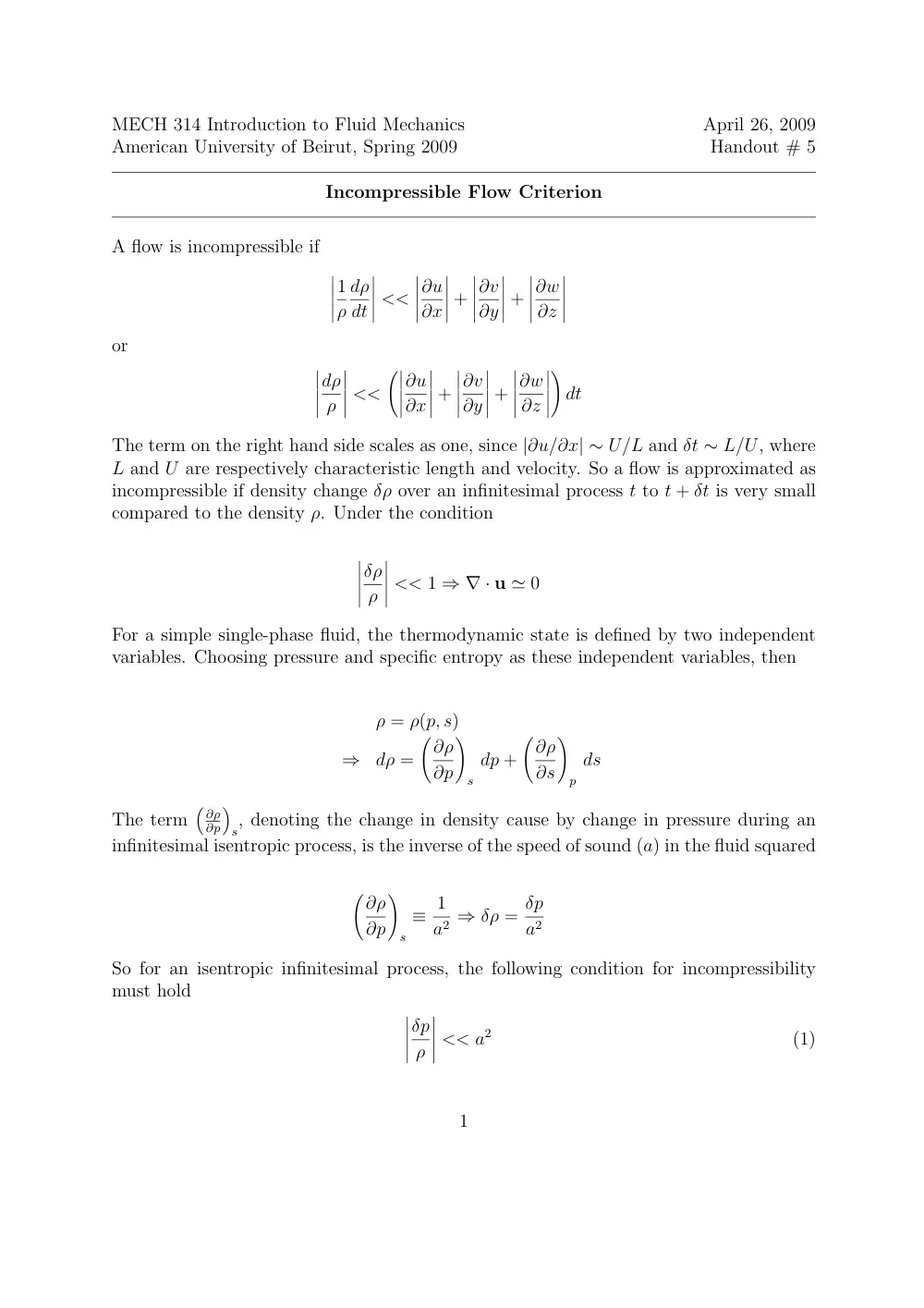
A flow is incompressible if
�����
1
ρ
dρ
dt
����� <<
�����
∂u
∂x
����� +
�����
∂v
∂y
����� +
�����
∂w
∂z
�����
or
�����
dρ
ρ
����� <<
������
∂u
∂x
����� +
�����
∂v
∂y
����� +
�����
∂w
∂z
�����
�
dt
The term on the right hand side scales as one, since |∂u/∂x| ∼ U/L and δt ∼ L/U, where
L and U are respectively characteristic length and velocity. So a flow is approximated as
incompressible if density change δρ over an infinitesimal process t to t + δt is very small
compared to the density ρ. Under the condition
�����
δρ
ρ
����� << 1 ⇒ ∇ · u ≃ 0
For a simple single-phase fluid, the thermodynamic state is defined by two independent
variables. Choosing pressure and specific entropy as these independent variables, then
ρ = ρ(p, s)
⇒
dρ =
�∂ρ
∂p
�
s
dp +
�∂ρ
∂s
�
p
ds
The term
�
∂ρ
∂p
�
s, denoting the change in density cause by change in pressure during an
infinitesimal isentropic process, is the inverse of the speed of sound (a) in the fluid squared
�∂ρ
∂p
�
s
≡ 1
a2 ⇒ δρ = δp
a2
So for an isentropic infinitesimal process, the following condition for incompressibility
must hold
�����
δp
ρ
����� << a2
(1)
1
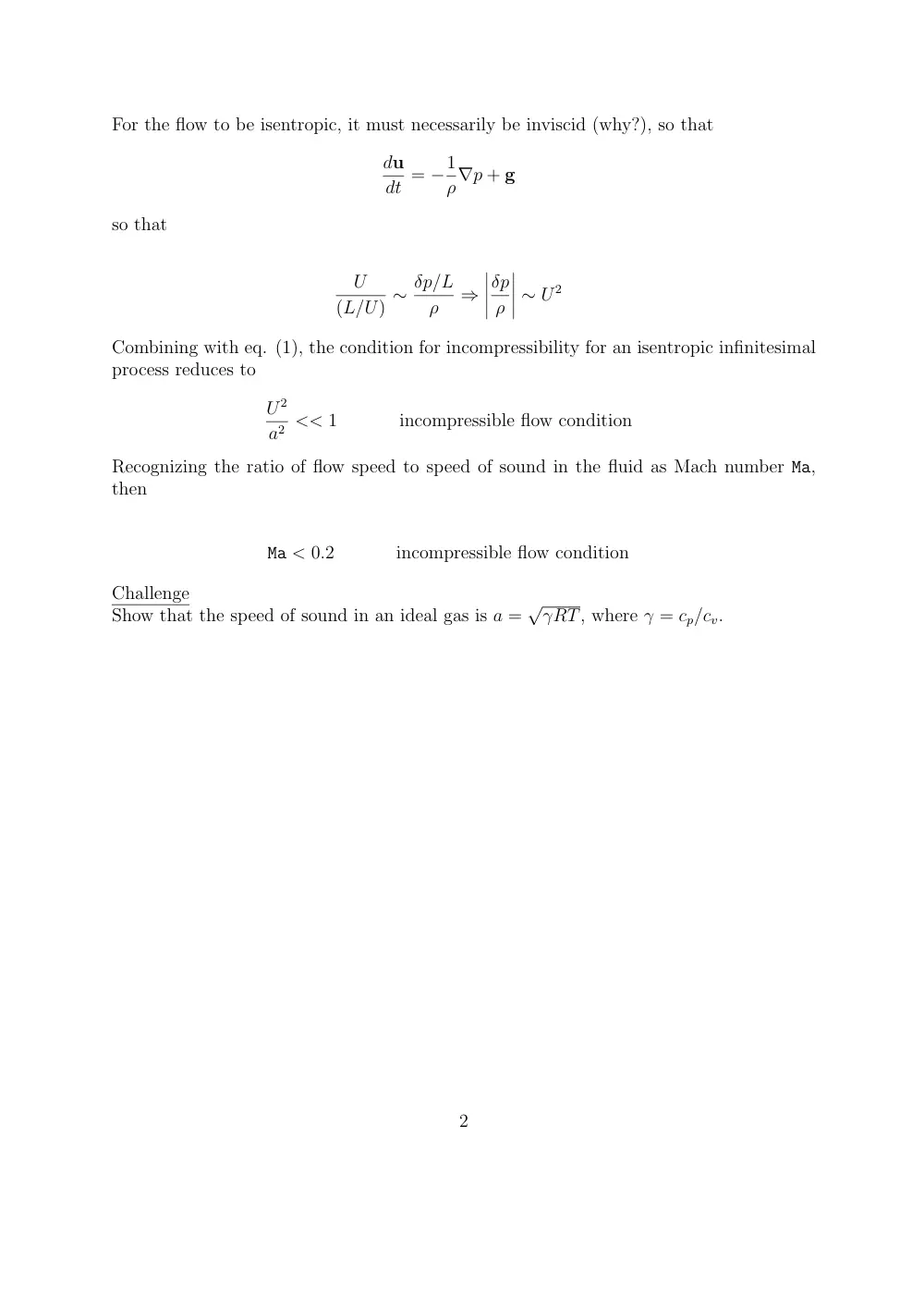
For the flow to be isentropic, it must necessarily be inviscid (why?), so that
du
dt = −1
ρ∇p + g
so that
U
(L/U) ∼ δp/L
ρ
⇒
�����
δp
ρ
����� ∼ U 2
Combining with eq. (1), the condition for incompressibility for an isentropic infinitesimal
process reduces to
U 2
a2 << 1
incompressible flow condition
Recognizing the ratio of flow speed to speed of sound in the fluid as Mach number Ma,
then
Ma < 0.2
incompressible flow condition
Challenge
Show that the speed of sound in an ideal gas is a = √γRT, where γ = cp/cv.
2