
PHIL 210 Notes Midterm, Fall 2015
American University of Beirut · Ethics · 8 pages · Dr. Paul Sphor




More PHIL 210 files
Show the text of this notes
Terms:
1-
Normative ethical theory
2-
Divine command theory
3-
Natural law theory
4-
Elenchus
5-
Euthyphro question
6-
Descriptive/normative claims
7-
Rationalism
8-
Utilitarianism
9-
Consequentialism
10- Hedonism
11- Aggregationism
12- Egalitarianism
13- Ideal observer
14- Experience machine
15- Act/rule utilitarianism
16- Common sense/revisionism
17- Principle of preventing bad occurrences
18- Negative responsibility
1-
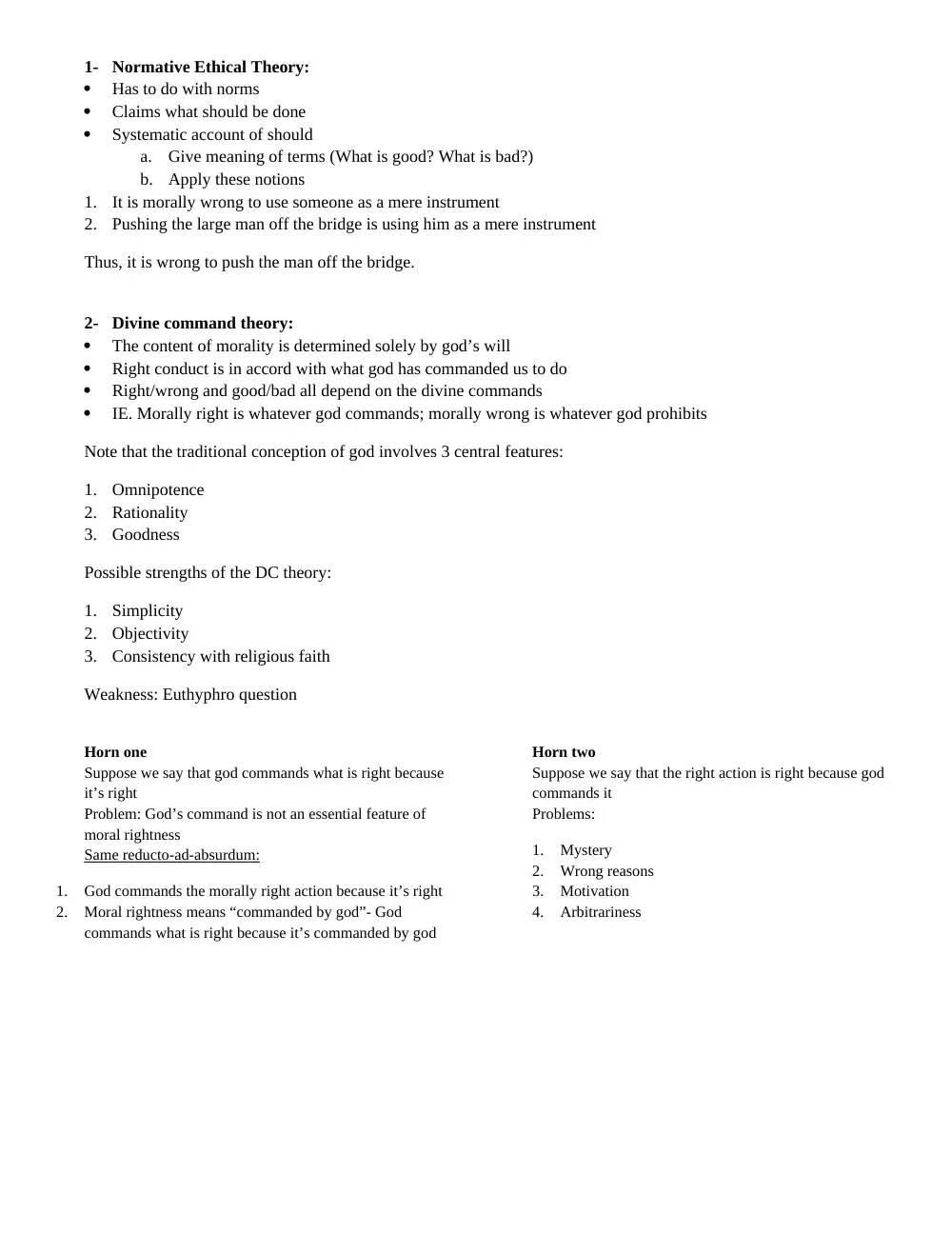
Normative Ethical Theory:
Has to do with norms
Claims what should be done
Systematic account of should
a.
Give meaning of terms (What is good? What is bad?)
b.
Apply these notions
1.
It is morally wrong to use someone as a mere instrument
2.
Pushing the large man off the bridge is using him as a mere instrument
Thus, it is wrong to push the man off the bridge.
2-
Divine command theory:
The content of morality is determined solely by god’s will
Right conduct is in accord with what god has commanded us to do
Right/wrong and good/bad all depend on the divine commands
IE. Morally right is whatever god commands; morally wrong is whatever god prohibits
Note that the traditional conception of god involves 3 central features:
1.
Omnipotence
2.
Rationality
3.
Goodness
Possible strengths of the DC theory:
1.
Simplicity
2.
Objectivity
3.
Consistency with religious faith
Weakness: Euthyphro question
Horn one
Suppose we say that god commands what is right because
it’s right
Problem: God’s command is not an essential feature of
moral rightness
Same reducto-ad-absurdum:
1.
God commands the morally right action because it’s right
2.
Moral rightness means “commanded by god”- God
commands what is right because it’s commanded by god
Horn two
Suppose we say that the right action is right because god
commands it
Problems:
1.
Mystery
2.
Wrong reasons
3.
Motivation
4.
Arbitrariness
3-
Natural Law Theory
The content of morality is solely a matter of god’s purposes for us and human reason can understand these
What is consistent with god’s purposes is right and vice versa
Basic principle: morally right actions are what accord with or divinely determined purposes; morally
wrong is what goes against the purposes.
How do we figure out our purposes?
They are clear inside social roles and social roles do seem to connect well to moral duties. But what is the purpose
of humans in general? Aquinas says it can be determined through natural inclinations.
Aquinas’ argument:
1.
To act rightly is to act as to promote God-given purposes
2.
We have natural inclinations towards those actions that help promote these purposes
3.
Therefore, to act rightly is to act with accordance to natural inclinations
What are those inclinations?
1.
Self preservation
2.
Sexual reproduction, care for offspring
3.
The good according to human reason
Assessing Aquinas’ argument:
Concern: Is the link between inclination and function plausible?
“Are we inclined to do good because its good or is it good because we’re inclined to do it?”
Rachel attacks Aquinas by saying that we have inclinations that are not necessarily good.
Aquinas says that only “natural” inclinations are good and they are good with accordance with our purpose. But how do
we identify the natural ones?
Homosexuality: in what way are homosexuals unnatural
Unnatural could mean:
1.
Abnormal (statistical infrequency)
2.
Not found in animal world
3.
Not genetically coded
4.
Contravenes with the purpose of sexual organs (Aquinas)
How to combine DC and NL theories? Conclude god’s purposes by scrutinizing holy books.
4-
Elenchus: Refutation
Begin with your beliefs
Socrates questions beliefs
One reaches aporia: a state of perplexity
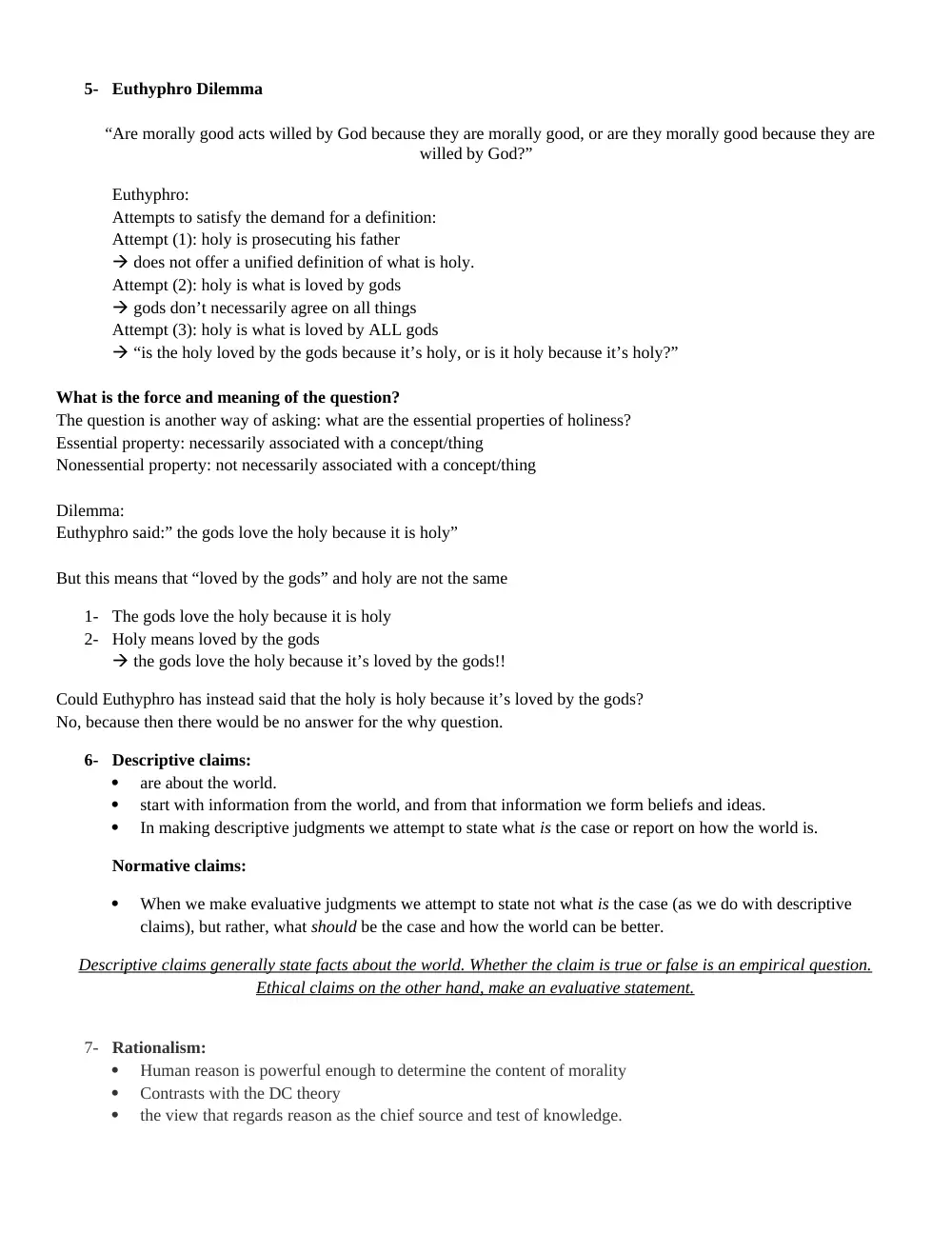
5-
Euthyphro Dilemma
“Are morally good acts willed by God because they are morally good, or are they morally good because they are
willed by God?”
Euthyphro:
Attempts to satisfy the demand for a definition:
Attempt (1): holy is prosecuting his father
does not offer a unified definition of what is holy.
Attempt (2): holy is what is loved by gods
gods don’t necessarily agree on all things
Attempt (3): holy is what is loved by ALL gods
“is the holy loved by the gods because it’s holy, or is it holy because it’s holy?”
What is the force and meaning of the question?
The question is another way of asking: what are the essential properties of holiness?
Essential property: necessarily associated with a concept/thing
Nonessential property: not necessarily associated with a concept/thing
Dilemma:
Euthyphro said:” the gods love the holy because it is holy”
But this means that “loved by the gods” and holy are not the same
1-
The gods love the holy because it is holy
2-
Holy means loved by the gods
the gods love the holy because it’s loved by the gods!!
Could Euthyphro has instead said that the holy is holy because it’s loved by the gods?
No, because then there would be no answer for the why question.
6-
Descriptive claims:
are about the world.
start with information from the world, and from that information we form beliefs and ideas.
In making descriptive judgments we attempt to state what is the case or report on how the world is.
Normative claims:
When we make evaluative judgments we attempt to state not what is the case (as we do with descriptive
claims), but rather, what should be the case and how the world can be better.
Descriptive claims generally state facts about the world. Whether the claim is true or false is an empirical question.
Ethical claims on the other hand, make an evaluative statement.
7-
Rationalism:
Human reason is powerful enough to determine the content of morality
Contrasts with the DC theory
the view that regards reason as the chief source and test of knowledge.
Holding that reality itself has an inherently logical structure, the rationalist asserts that a class of truths exists
that the intellect can grasp directly.
There are, according to the rationalists, certain rational principles—especially in logic and mathematics, and
even in ethics and metaphysics—that are so fundamental that to deny them is to fall into contradiction. The
rationalists’ confidence in reason and proof tends, therefore, to detract from their respect for other ways of
knowing.
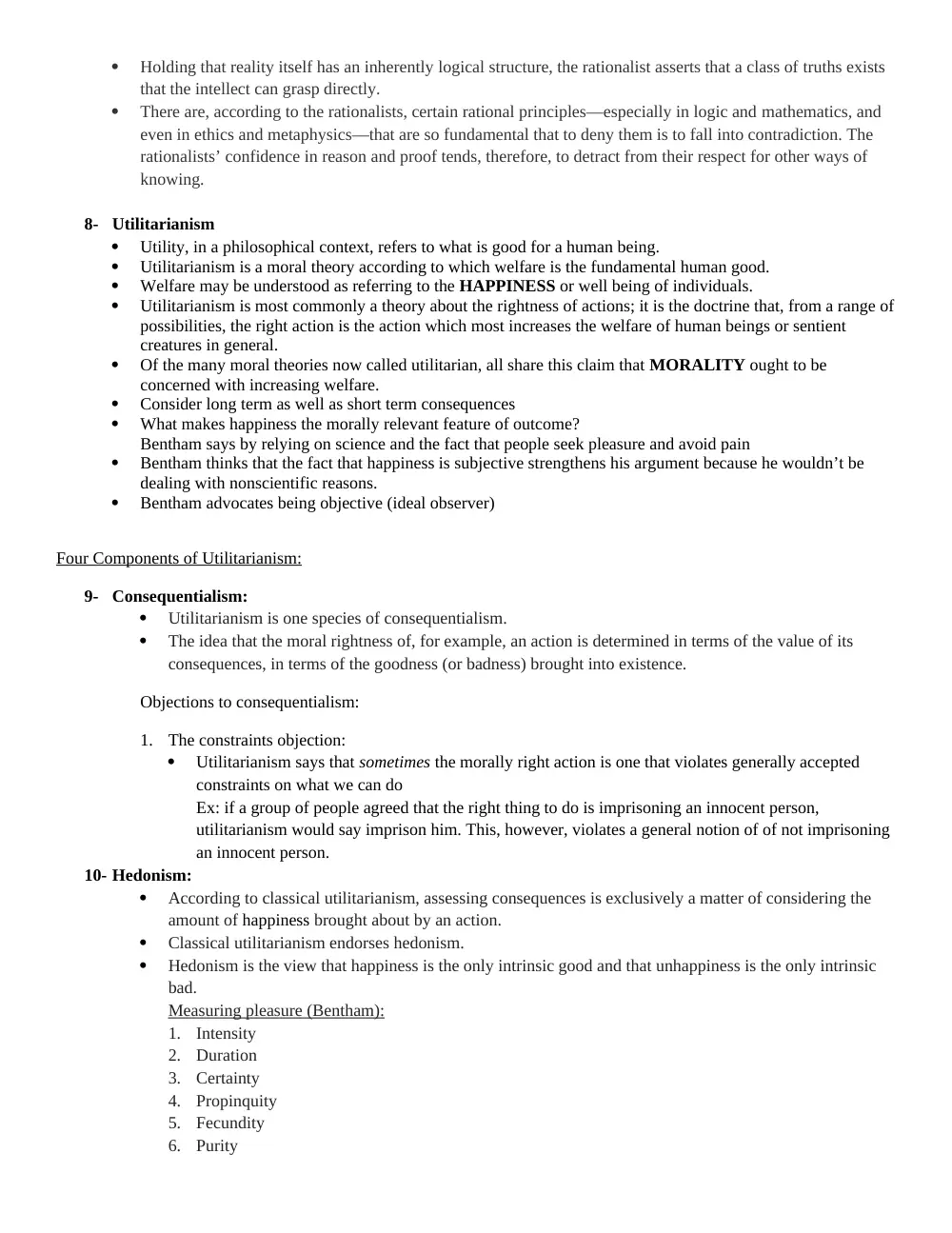
8-
Utilitarianism
Utility, in a philosophical context, refers to what is good for a human being.
Utilitarianism is a moral theory according to which welfare is the fundamental human good.
Welfare may be understood as referring to the HAPPINESS or well being of individuals.
Utilitarianism is most commonly a theory about the rightness of actions; it is the doctrine that, from a range of
possibilities, the right action is the action which most increases the welfare of human beings or sentient
creatures in general.
Of the many moral theories now called utilitarian, all share this claim that MORALITY ought to be
concerned with increasing welfare.
Consider long term as well as short term consequences
What makes happiness the morally relevant feature of outcome?
Bentham says by relying on science and the fact that people seek pleasure and avoid pain
Bentham thinks that the fact that happiness is subjective strengthens his argument because he wouldn’t be
dealing with nonscientific reasons.
Bentham advocates being objective (ideal observer)
Four Components of Utilitarianism:
9-
Consequentialism:
Utilitarianism is one species of consequentialism.
The idea that the moral rightness of, for example, an action is determined in terms of the value of its
consequences, in terms of the goodness (or badness) brought into existence.
Objections to consequentialism:
1.
The constraints objection:
Utilitarianism says that sometimes the morally right action is one that violates generally accepted
constraints on what we can do
Ex: if a group of people agreed that the right thing to do is imprisoning an innocent person,
utilitarianism would say imprison him. This, however, violates a general notion of of not imprisoning
an innocent person.
10- Hedonism:
According to classical utilitarianism, assessing consequences is exclusively a matter of considering the
amount of happiness brought about by an action.
Classical utilitarianism endorses hedonism.
Hedonism is the view that happiness is the only intrinsic good and that unhappiness is the only intrinsic
bad.
Measuring pleasure (Bentham):
1.
Intensity
2.
Duration
3.
Certainty
4.
Propinquity
5.
Fecundity
6.
Purity
Problems:
1.
Quantitative but not qualitative.
John Mill: quality of pleasure matters as much as quantity.
2.
Is intrinsic state all that matters?
Thought experiment: Experience Machine
11- Aggregationism:
Aggregationism implies that we should ignore the distribution of the welfare that we are bringing about, and
simply maximize its total sum in aggregate.
That is, if one outcome will produce more welfare, but distributes it very unequally, and another will produce
less, but distribute it more equally, it is, according to Aggregationism, the first outcome that we ought to
choose.
12- Egalitarianism:
Equal distribution of happiness
13- The ideal observer:
One common tactic among consequentialists, particularly those committed to an altruistic (selfless) account of
consequentialism, is to employ an ideal, neutral observer from which moral judgments can be made.
Utilitarianism, in common with other forms of consequentialism, relies on the perspective of such an ideal
observer.
The particular characteristics of this ideal observer can vary from an omniscient observer, who would grasp all the
consequences of any action, to an ideally informed observer, who knows as much as could reasonably be
expected, but not necessarily all the circumstances or all the possible consequences.
Consequentialist theories that adopt this paradigm hold that right action is the action that will bring about the best
consequences from this ideal observer's perspective.
14- Experience Machine (Criticisms of hedonism)
The thought experiment of "The Experience Machine" runs as follows:
"Suppose there were an experience machine that would give you any experience you desired. Super-
duper neuro-psychologists could stimulate your brain so that you would think and feel you were writing a
great novel, or making a friend, or reading an interesting book. All the time you would be floating in a
tank, with electrodes attached to your brain. Would you plug in? What else can matter to us, other than
how our lives feel from the inside?"
The experience machine is meant to be an argument against hedonism. If hedonism were correct, then
people would want to plug into the "Experience Machine." This is because the experience machine can
guarantee more pleasure than one would have in real life. Nozick thinks that people do not really want to
plug into the "Experience Machine."
Therefore, hedonism is not correct. If hedonism were correct, then, by the definition of hedonism, the
only thing people value, ultimately, is happiness or pleasure.
The conclusion of Nozick’s argument then says that people do, as a matter of fact, value things besides
our own happiness; the fact that people are reluctant to plug in means that at the very least, humanity
values the truthfulness of its experiences.
1.
Nozick would say that not only internal state matters but actually doing things
2.
Although we feel that we accomplished something, we do not really achieve it.
3.
One only develops characters by doing things and not by dreaming or plugging into the machine.
Lesson: if we really would choose not to plug in, then either:
happiness doesn’t have the value utilitarianism assigns to it (happiness is not as important as utilitarianism thinks it is)
or happiness is misconceived by utilitarianism; it isn’t pleasure i.e. Simply a positive internal state (utilitarianism
misunderstands the nature of happiness)
15- Act v. rule utilitarianism
Act utilitarianism:
Rightness and wrongness of an action is to be assessed by the consequences of the action itself.
Rule utilitarianism:
Rightness and wrongness of an action is to be assessed by the consequences of rule requiring that
everyone should perform this kind of action in like circumstances.
If everyone follows the rule, would it yield the greatest happiness?
With the constraints objection.
Not a stable position
Yes or no question
Have exceptions to rules
•
The distinction has to do with what the principle of utility is applied to.
◦
According to the act utilitarian, the principle is applied directly to the selection of particular actions
under particular circumstances. (For this reason AU has also been called "direct utilitarianism.")
◦
According to the rule utilitarian, the principle is applied to the selection of a set of rules, which are in
turn used to determine what to do in particular situations. (And thus RU is sometimes called "indirect
utilitarianism.")
Difference:
Both act utilitarians and rule utilitarians agree that our overall aim in evaluating actions should be to create the
best results possible, but they differ about how to do that.
Act utilitarians believe that whenever we are deciding what to do, we should perform the action that will create
the greatest net utility. In their view, the principle of utility—do whatever will produce the best overall results—
should be applied on a case by case basis. The right action in any situation is the one that yields more utility (i.e.
creates more well-being) than other available actions.
Rule utilitarians adopt a two part view that stresses the importance of moral rules. According to rule utilitarians,
a) a specific action is morally justified if it conforms to a justified moral rule; and b) a moral rule is justified if its
inclusion into our moral code would create more utility than other possible rules (or no rule at all). According to
this perspective, we should judge the morality of individual actions by reference to general moral rules, and we
should judge particular moral rules by seeing whether their acceptance into our moral code would produce more
well-being than other possible rules.
The key difference between act and rule utilitarianism is that act utilitarians apply the utilitarian principle directly to the
evaluation of individual actions while rule utilitarians apply the utilitarian principle directly to the evaluation of rules and
then evaluate individual actions by seeing if they obey or disobey those rules whose acceptance will produce the most
utility.
16- Revisionism:
Revisionist theories rely on beliefs and analysis rather than mere intuition
“my intuitions are not something I should always rely on.”
May violate constraints if it helps yield greater happiness
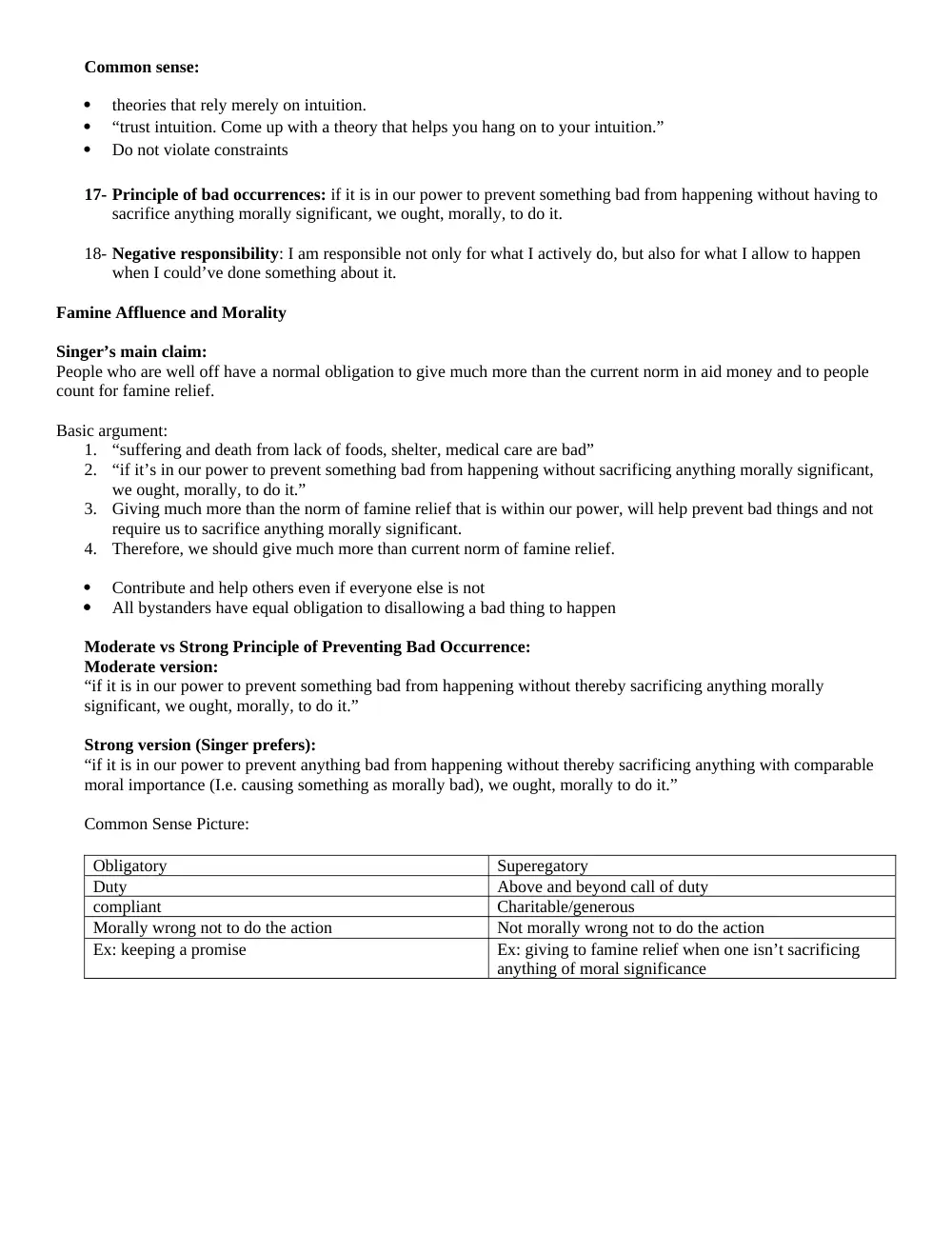
Common sense:
theories that rely merely on intuition.
“trust intuition. Come up with a theory that helps you hang on to your intuition.”
Do not violate constraints
17- Principle of bad occurrences: if it is in our power to prevent something bad from happening without having to
sacrifice anything morally significant, we ought, morally, to do it.
18- Negative responsibility: I am responsible not only for what I actively do, but also for what I allow to happen
when I could’ve done something about it.
Famine Affluence and Morality
Singer’s main claim:
People who are well off have a normal obligation to give much more than the current norm in aid money and to people
count for famine relief.
Basic argument:
1.
“suffering and death from lack of foods, shelter, medical care are bad”
2.
“if it’s in our power to prevent something bad from happening without sacrificing anything morally significant,
we ought, morally, to do it.”
3.
Giving much more than the norm of famine relief that is within our power, will help prevent bad things and not
require us to sacrifice anything morally significant.
4.
Therefore, we should give much more than current norm of famine relief.
Contribute and help others even if everyone else is not
All bystanders have equal obligation to disallowing a bad thing to happen
Moderate vs Strong Principle of Preventing Bad Occurrence:
Moderate version:
“if it is in our power to prevent something bad from happening without thereby sacrificing anything morally
significant, we ought, morally, to do it.”
Strong version (Singer prefers):
“if it is in our power to prevent anything bad from happening without thereby sacrificing anything with comparable
moral importance (I.e. causing something as morally bad), we ought, morally to do it.”
Common Sense Picture:
Obligatory
Superegatory
Duty
Above and beyond call of duty
compliant
Charitable/generous
Morally wrong not to do the action
Not morally wrong not to do the action
Ex: keeping a promise
Ex: giving to famine relief when one isn’t sacrificing
anything of moral significance