
PHIL 210 Notes, Summer 2011
American University of Beirut · Ethics · 3 pages

More PHIL 210 files
Show the text of this notes
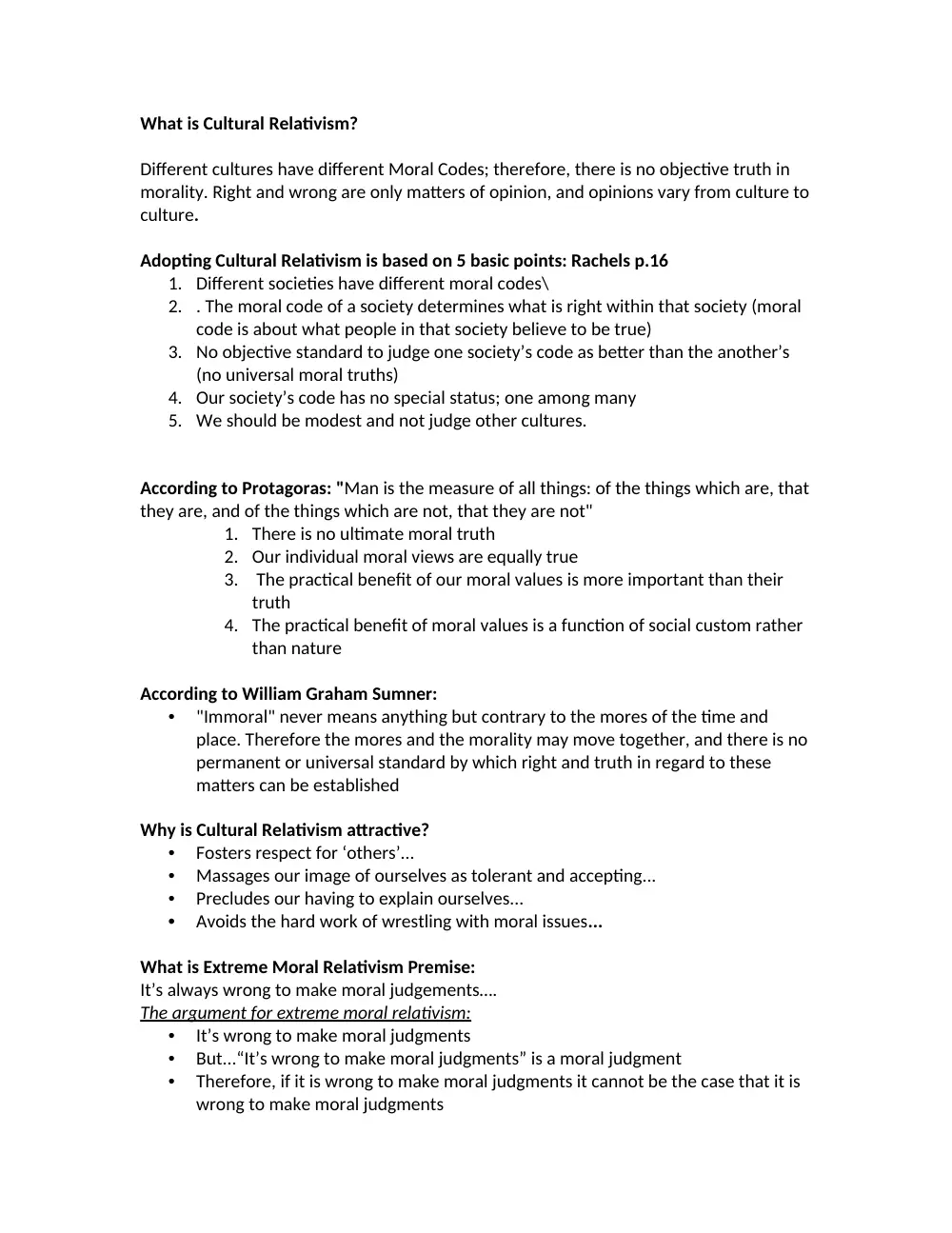
What is Cultural Relativism?
Different cultures have different Moral Codes; therefore, there is no objective truth in
morality. Right and wrong are only matters of opinion, and opinions vary from culture to
culture.
Adopting Cultural Relativism is based on 5 basic points: Rachels p.16
1. Different societies have different moral codes\
2. . The moral code of a society determines what is right within that society (moral
code is about what people in that society believe to be true)
3. No objective standard to judge one society’s code as better than the another’s
(no universal moral truths)
4. Our society’s code has no special status; one among many
5. We should be modest and not judge other cultures.
According to Protagoras: "Man is the measure of all things: of the things which are, that
they are, and of the things which are not, that they are not"
1. There is no ultimate moral truth
2. Our individual moral views are equally true
3. The practical benefit of our moral values is more important than their
truth
4. The practical benefit of moral values is a function of social custom rather
than nature
According to William Graham Sumner:
•
"Immoral" never means anything but contrary to the mores of the time and
place. Therefore the mores and the morality may move together, and there is no
permanent or universal standard by which right and truth in regard to these
matters can be established
Why is Cultural Relativism attractive?
•
Fosters respect for ‘others’...
•
Massages our image of ourselves as tolerant and accepting...
•
Precludes our having to explain ourselves...
•
Avoids the hard work of wrestling with moral issues...
What is Extreme Moral Relativism Premise:
It’s always wrong to make moral judgements….
The argument for extreme moral relativism:
•
It’s wrong to make moral judgments
•
But...“It’s wrong to make moral judgments” is a moral judgment
•
Therefore, if it is wrong to make moral judgments it cannot be the case that it is
wrong to make moral judgments
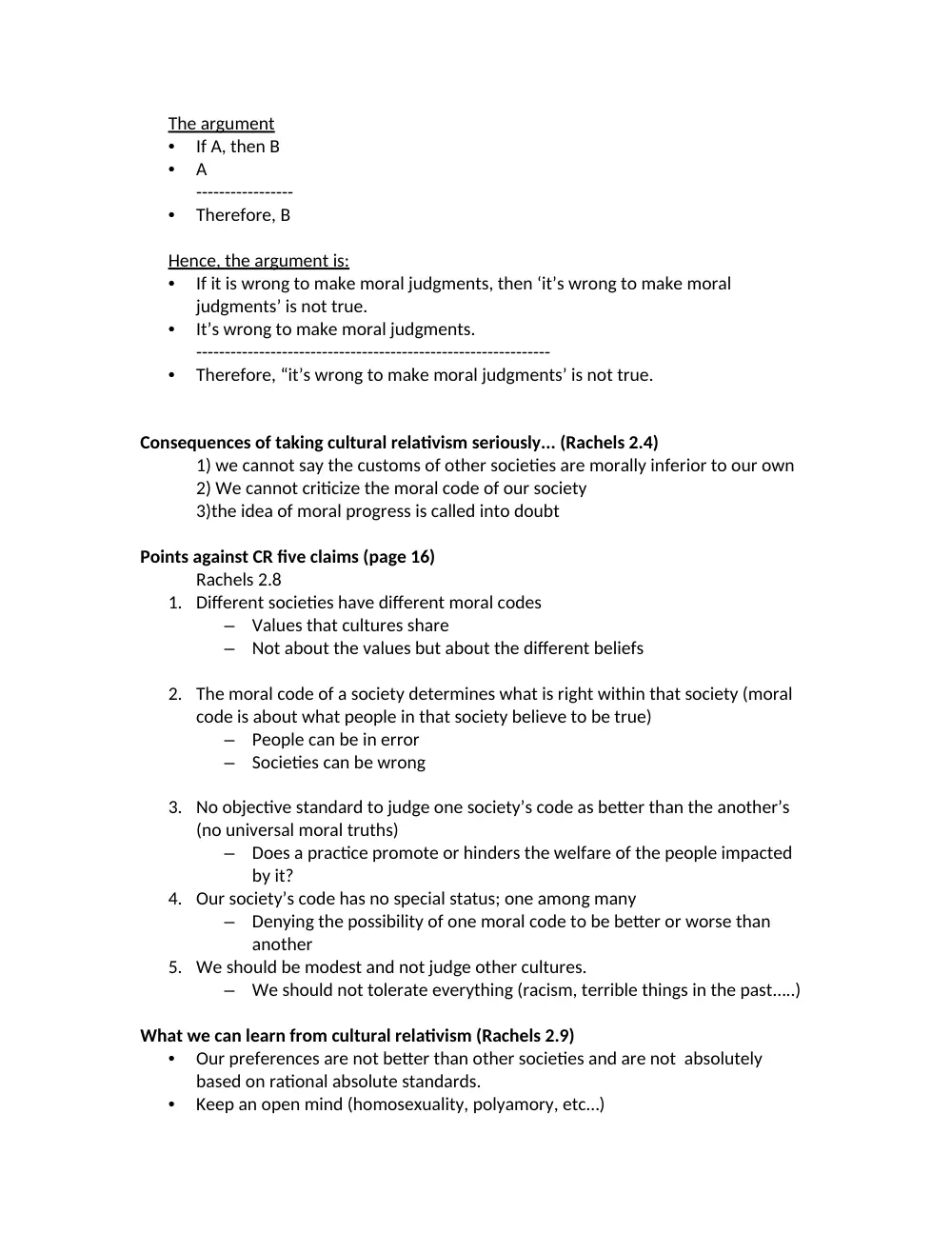
The argument
•
If A, then B
•
A
-----------------
•
Therefore, B
Hence, the argument is:
•
If it is wrong to make moral judgments, then ‘it’s wrong to make moral
judgments’ is not true.
•
It’s wrong to make moral judgments.
--------------------------------------------------------------
•
Therefore, “it’s wrong to make moral judgments’ is not true.
Consequences of taking cultural relativism seriously... (Rachels 2.4)
1) we cannot say the customs of other societies are morally inferior to our own
2) We cannot criticize the moral code of our society
3)the idea of moral progress is called into doubt
Points against CR five claims (page 16)
Rachels 2.8
1. Different societies have different moral codes
–
Values that cultures share
–
Not about the values but about the different beliefs
2. The moral code of a society determines what is right within that society (moral
code is about what people in that society believe to be true)
–
People can be in error
–
Societies can be wrong
3. No objective standard to judge one society’s code as better than the another’s
(no universal moral truths)
–
Does a practice promote or hinders the welfare of the people impacted
by it?
4. Our society’s code has no special status; one among many
–
Denying the possibility of one moral code to be better or worse than
another
5. We should be modest and not judge other cultures.
–
We should not tolerate everything (racism, terrible things in the past…..)
What we can learn from cultural relativism (Rachels 2.9)
•
Our preferences are not better than other societies and are not absolutely
based on rational absolute standards.
•
Keep an open mind (homosexuality, polyamory, etc…)