
PHIL 210 Notes, Summer 2011
American University of Beirut · Ethics · 5 pages


More PHIL 210 files
Show the text of this notes
Utilitarianism and Morality
Utilitarianism was considered unique and revolutionary as it presumed that morality is
neither about pleasing God nor about following abstract rules. To the Utilitarian
Morality is about making the world as happy as possible
A utilitarian believes that we should always do whatever will produce the greatest
possible happiness over unhappiness for everyone who will be affected by our action.
The principle of utility
The thought behind the theory is based on the principle of utility which is based on
three basic principles:
1. To know what to do, we should be guided by the consequences of our actions
2. To determine what is best, we should do whatever causes the most happiness and
least unhappiness
3. Each individual’s happiness is equally as important as everyone else's.
Utilitarianism as a theory is based on three basic premises:
•Actions are judged right or wrong solely on the basis of their consequences
•The only thing that counts is the amount of happiness or unhappiness produced by an
action (all else is irrelevant)
•Each person’s happiness counts the same
Philosophers who started utilitarian thought
1. Jeremy Bentham: The leader of a group of philosophers/reformers whose goal was to
reform the law and institutions of England along utilitarian lines
To Bentham:
morality is about making the world as happy as possible
Advocated “the greatest happiness of the greatest number”
“Nature has placed mankind under the governance of two sovereign masters:
pain and pleasure
2. John Stuart Mills
He believed that, •“Actions are right in proportion as they tend to promote happiness;
wrong as they tend to produce the reverse of happiness.”
J. S. Mill:
•“...happiness is desirable, and the only thing desirable, as an end: all other things being
desirable as a means to an end.”
What is Happiness?
1. The classical answer....
•Happiness is pleasure (mental states that feel good)
•Hedonism: pleasure is the one ultimate good; pain the one ultimate evil
2. Bentham believed that we should try to increase the overall amount of pleasure in
the world. But what is pleasure?
Definition: The enjoyable feeling we experience when a state of deprivation is replaced
by fulfillment.
•Advantages
–Easy to quantify
–Short duration
–Bodily
Criticisms
–Came to be known as “the pig’s philosophy”
–Ignores higher values
–Could justify living on a pleasure machine
3. Mills added the quality of pleasures to the quantity and advocated civilized
pleasures.
•Advantages
–A higher standard, more specific to humans
–About realization of goals
•Disadvantages
–More difficult to measure
–Competing conceptions of happiness
The question is: Why do we value certain things?
For their intrinsic value and although it makes us happy to have them yet it is not the
only reason why we value them………
Many things have instrumental value, that is, they have value as means to an end.
•However, there must be some things which are not merely instrumental, but have
value in themselves. This is what we call intrinsic value.
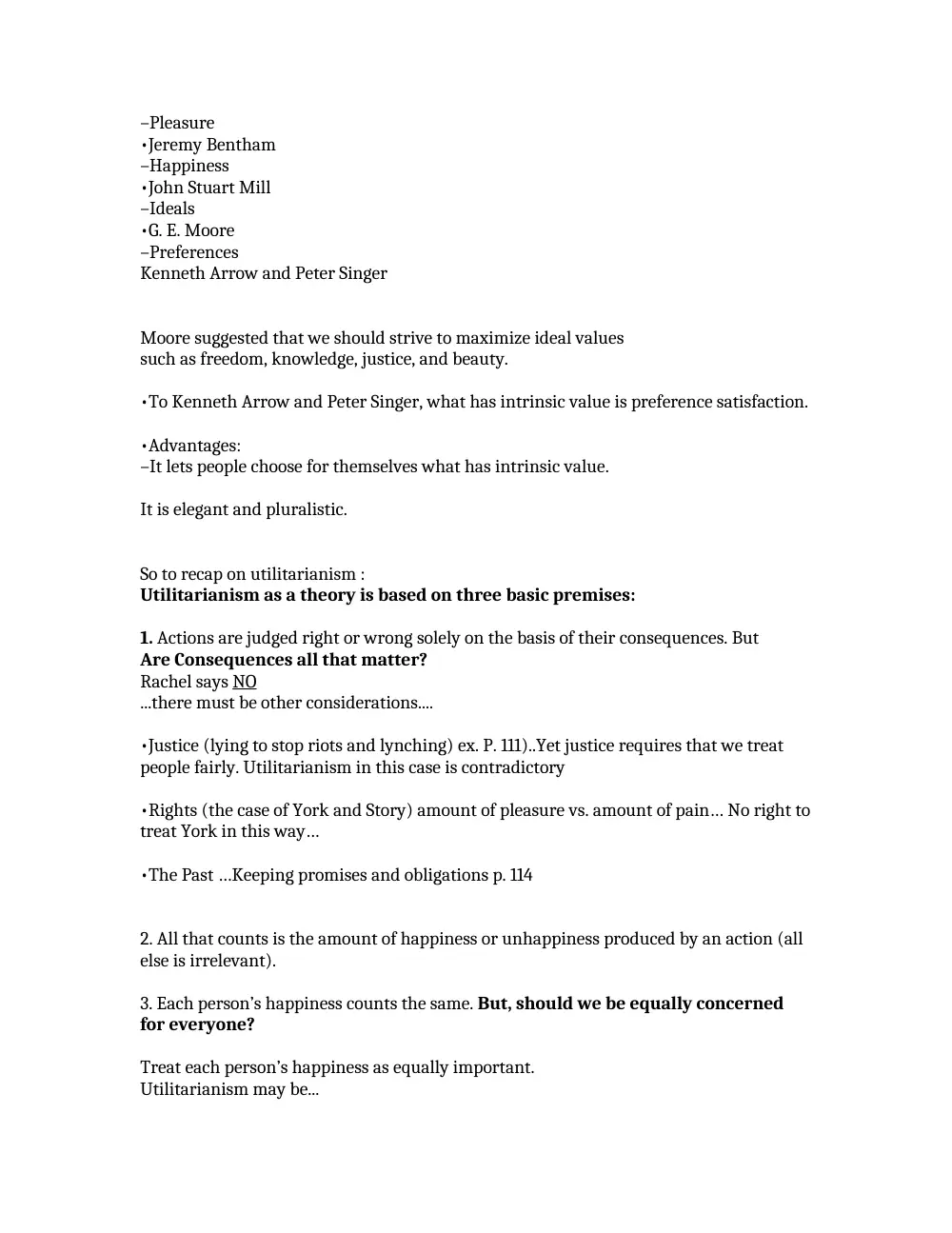
•What has intrinsic value? Four principal candidates:
–Pleasure
•Jeremy Bentham
–Happiness
•John Stuart Mill
–Ideals
•G. E. Moore
–Preferences
Kenneth Arrow and Peter Singer
Moore suggested that we should strive to maximize ideal values
such as freedom, knowledge, justice, and beauty.
•To Kenneth Arrow and Peter Singer, what has intrinsic value is preference satisfaction.
•Advantages:
–It lets people choose for themselves what has intrinsic value.
It is elegant and pluralistic.
So to recap on utilitarianism :
Utilitarianism as a theory is based on three basic premises:
1. Actions are judged right or wrong solely on the basis of their consequences. But
Are Consequences all that matter?
Rachel says NO
...there must be other considerations....
•Justice (lying to stop riots and lynching) ex. P. 111)..Yet justice requires that we treat
people fairly. Utilitarianism in this case is contradictory
•Rights (the case of York and Story) amount of pleasure vs. amount of pain… No right to
treat York in this way…
•The Past …Keeping promises and obligations p. 114
2. All that counts is the amount of happiness or unhappiness produced by an action (all
else is irrelevant).
3. Each person’s happiness counts the same. But, should we be equally concerned
for everyone?
Treat each person’s happiness as equally important.
Utilitarianism may be...
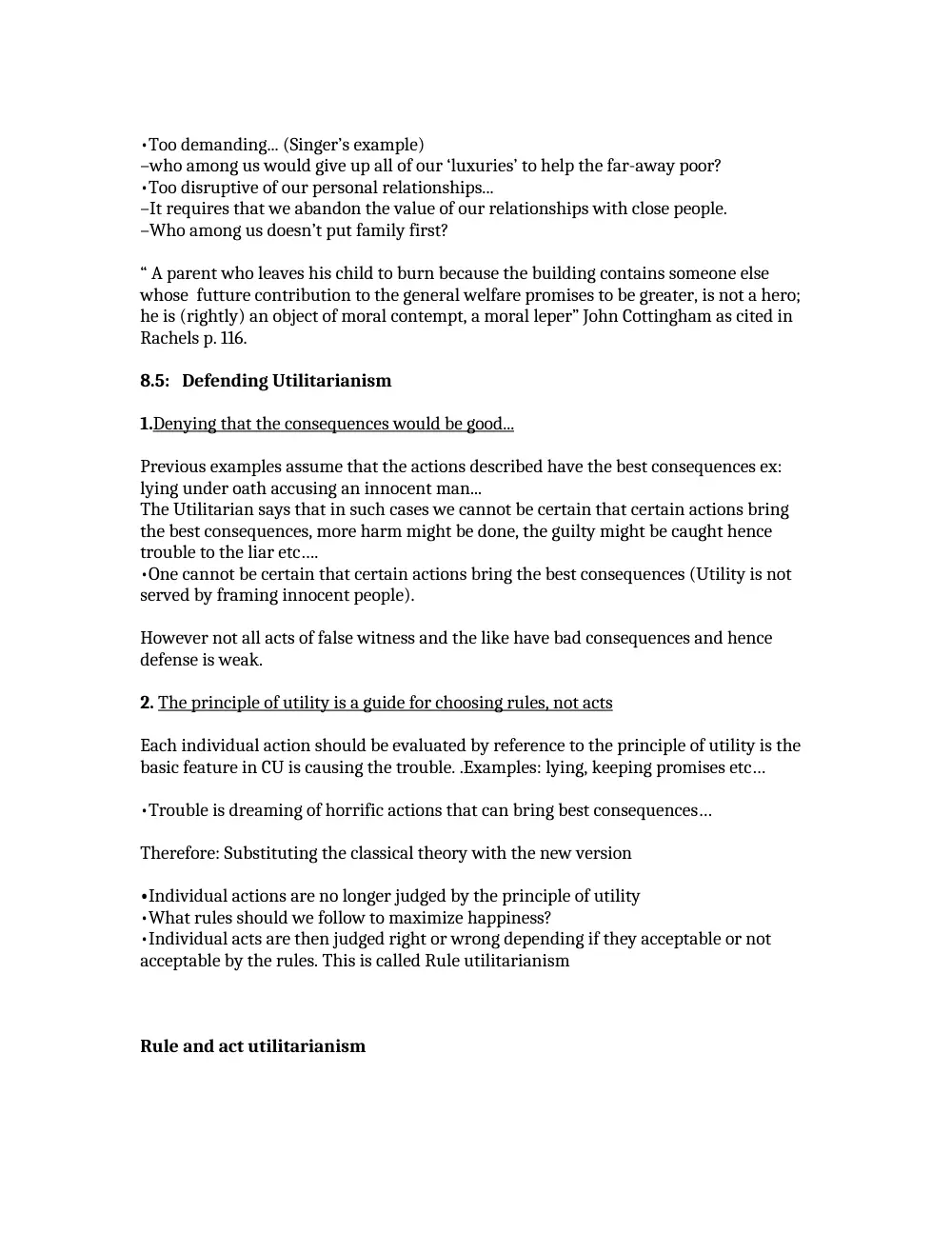
•Too demanding... (Singer’s example)
–who among us would give up all of our ‘luxuries’ to help the far-away poor?
•Too disruptive of our personal relationships...
–It requires that we abandon the value of our relationships with close people.
–Who among us doesn’t put family first?
“ A parent who leaves his child to burn because the building contains someone else
whose futture contribution to the general welfare promises to be greater, is not a hero;
he is (rightly) an object of moral contempt, a moral leper” John Cottingham as cited in
Rachels p. 116.
8.5: Defending Utilitarianism
1.Denying that the consequences would be good
...
Previous examples assume that the actions described have the best consequences ex:
lying under oath accusing an innocent man...
The Utilitarian says that in such cases we cannot be certain that certain actions bring
the best consequences, more harm might be done, the guilty might be caught hence
trouble to the liar etc….
•One cannot be certain that certain actions bring the best consequences (Utility is not
served by framing innocent people).
However not all acts of false witness and the like have bad consequences and hence
defense is weak.
2. The principle of utility is a guide for choosing rules, not acts
Each individual action should be evaluated by reference to the principle of utility is the
basic feature in CU is causing the trouble. .Examples: lying, keeping promises etc…
•Trouble is dreaming of horrific actions that can bring best consequences…
Therefore: Substituting the classical theory with the new version
•Individual actions are no longer judged by the principle of utility
•What rules should we follow to maximize happiness?
•Individual acts are then judged right or wrong depending if they acceptable or not
acceptable by the rules. This is called Rule utilitarianism
Rule and act utilitarianism
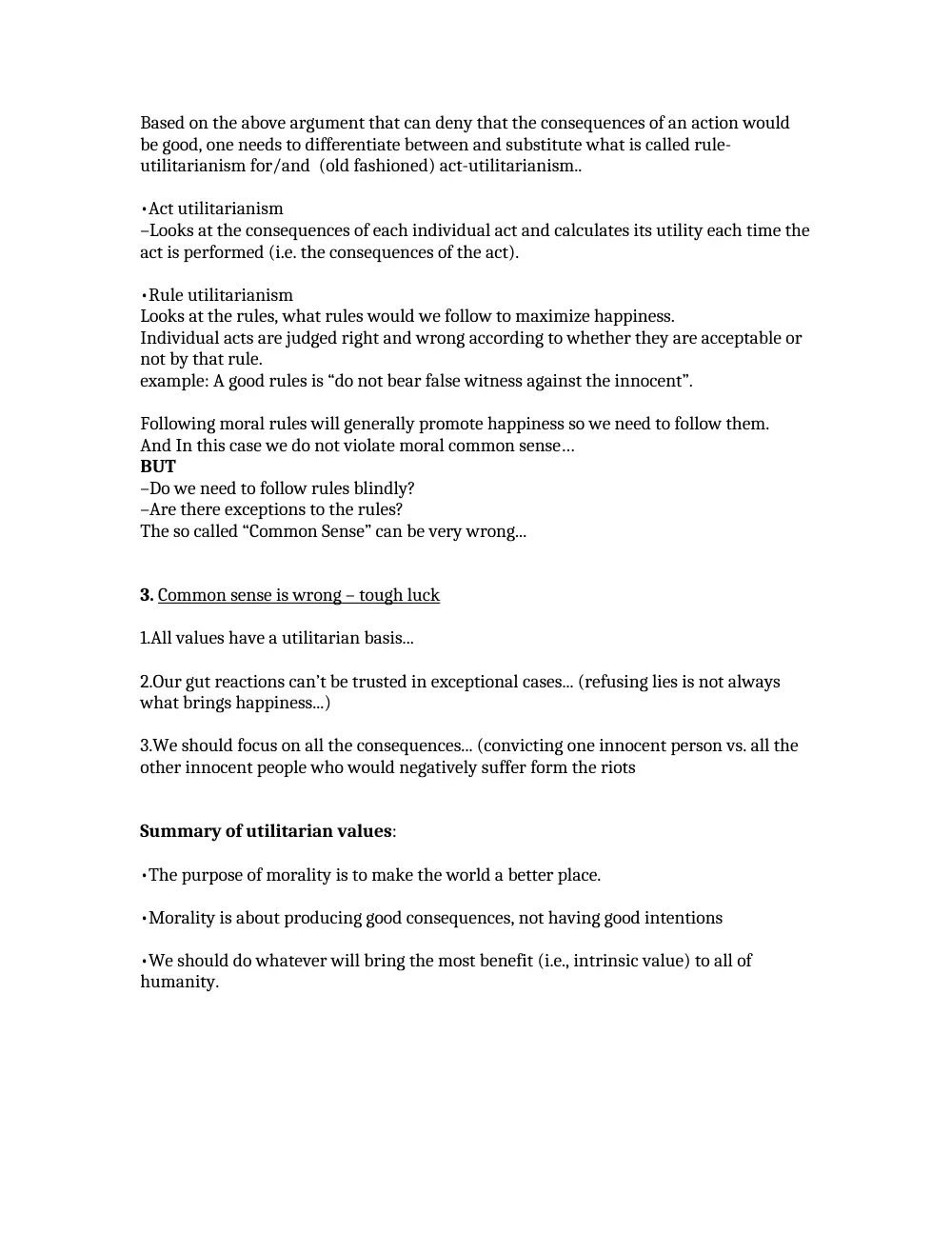
Based on the above argument that can deny that the consequences of an action would
be good, one needs to differentiate between and substitute what is called rule-
utilitarianism for/and (old fashioned) act-utilitarianism..
•Act utilitarianism
–Looks at the consequences of each individual act and calculates its utility each time the
act is performed (i.e. the consequences of the act).
•Rule utilitarianism
Looks at the rules, what rules would we follow to maximize happiness.
Individual acts are judged right and wrong according to whether they are acceptable or
not by that rule.
example: A good rules is “do not bear false witness against the innocent”.
Following moral rules will generally promote happiness so we need to follow them.
And In this case we do not violate moral common sense…
BUT
–Do we need to follow rules blindly?
–Are there exceptions to the rules?
The so called “Common Sense” can be very wrong...
3. Common sense is wrong – tough luck
1.All values have a utilitarian basis...
2.Our gut reactions can’t be trusted in exceptional cases... (refusing lies is not always
what brings happiness...)
3.We should focus on all the consequences... (convicting one innocent person vs. all the
other innocent people who would negatively suffer form the riots
Summary of utilitarian values:
•The purpose of morality is to make the world a better place.
•Morality is about producing good consequences, not having good intentions
•We should do whatever will bring the most benefit (i.e., intrinsic value) to all of
humanity.