
PHYS 204 Final, Fall 1995
American University of Beirut · Classical Physics for Life Sciences · 7 pages
More PHYS 204 files
Show the text of this final exam
section 1. 10TT & 3F
section 2. 9MWFE
section 3. 10MWE
section 4. 1IMWF
section 5. 12 MWF
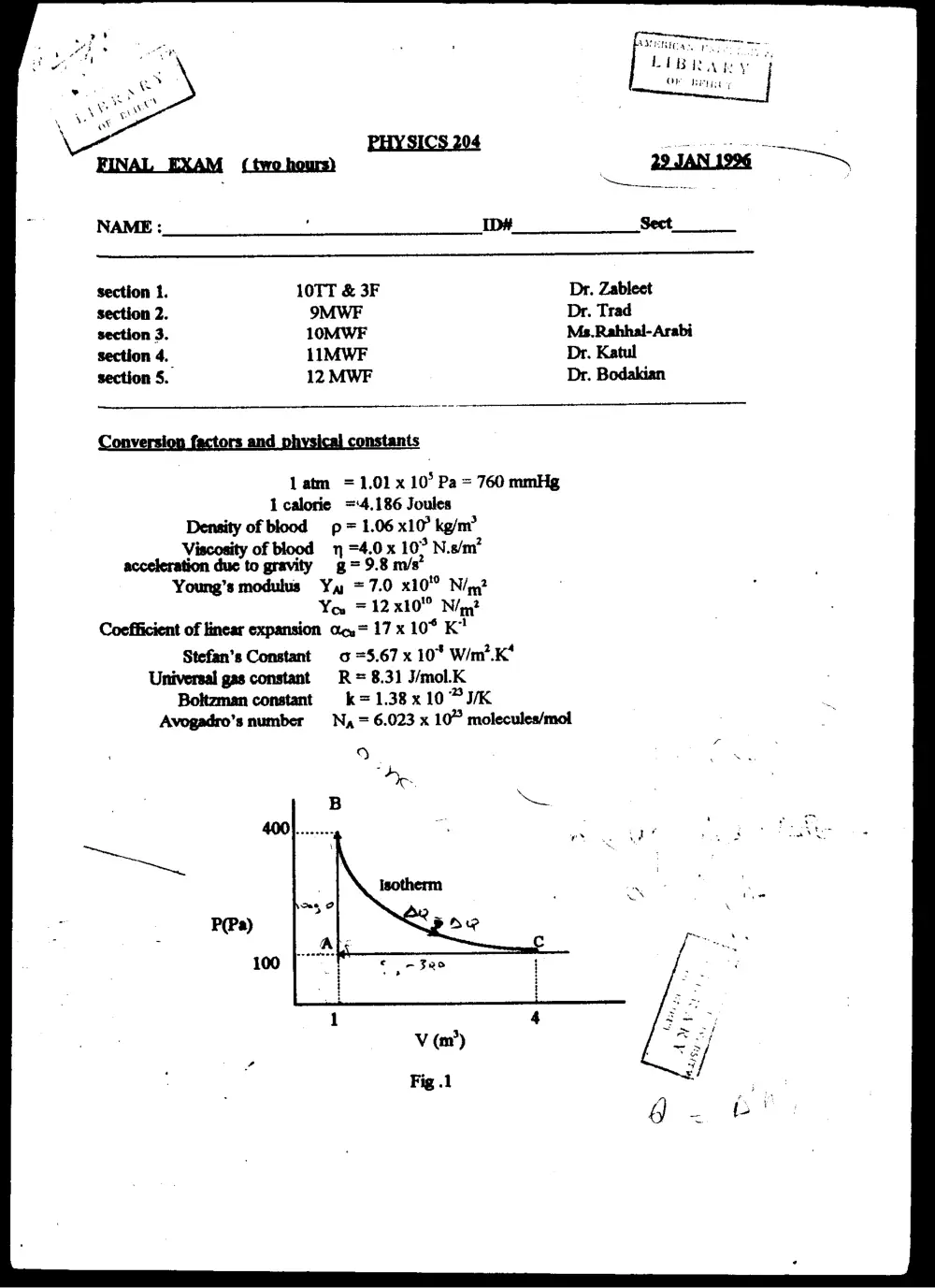
Conversion factors and physical constants
latm = 1.01 x 10° Pa = 760 mmHg
I calorie = 4,186 Joules
Density of blood pp = 1.06 x10" kg/m”
Viscosity of blood 1 =4.0 x 10° N.s/m?
acceleration duc to gravity he98 m/s
Young’s modulus Yq = 7.0 x10"° N/py?
You = 12 x10" N/m?
Coefficient of linear expansion o.¢,= 17 x 10° K"
Stefan’s Constant 0 =5.67 x 10° W/m’.K*
Universal gas constant = R = 8.31 J/mol.K
Boltzman constant k= 1.38x 10 7 J/K
Avogadro's number Ng = 6.023 x 10” molecules/mol
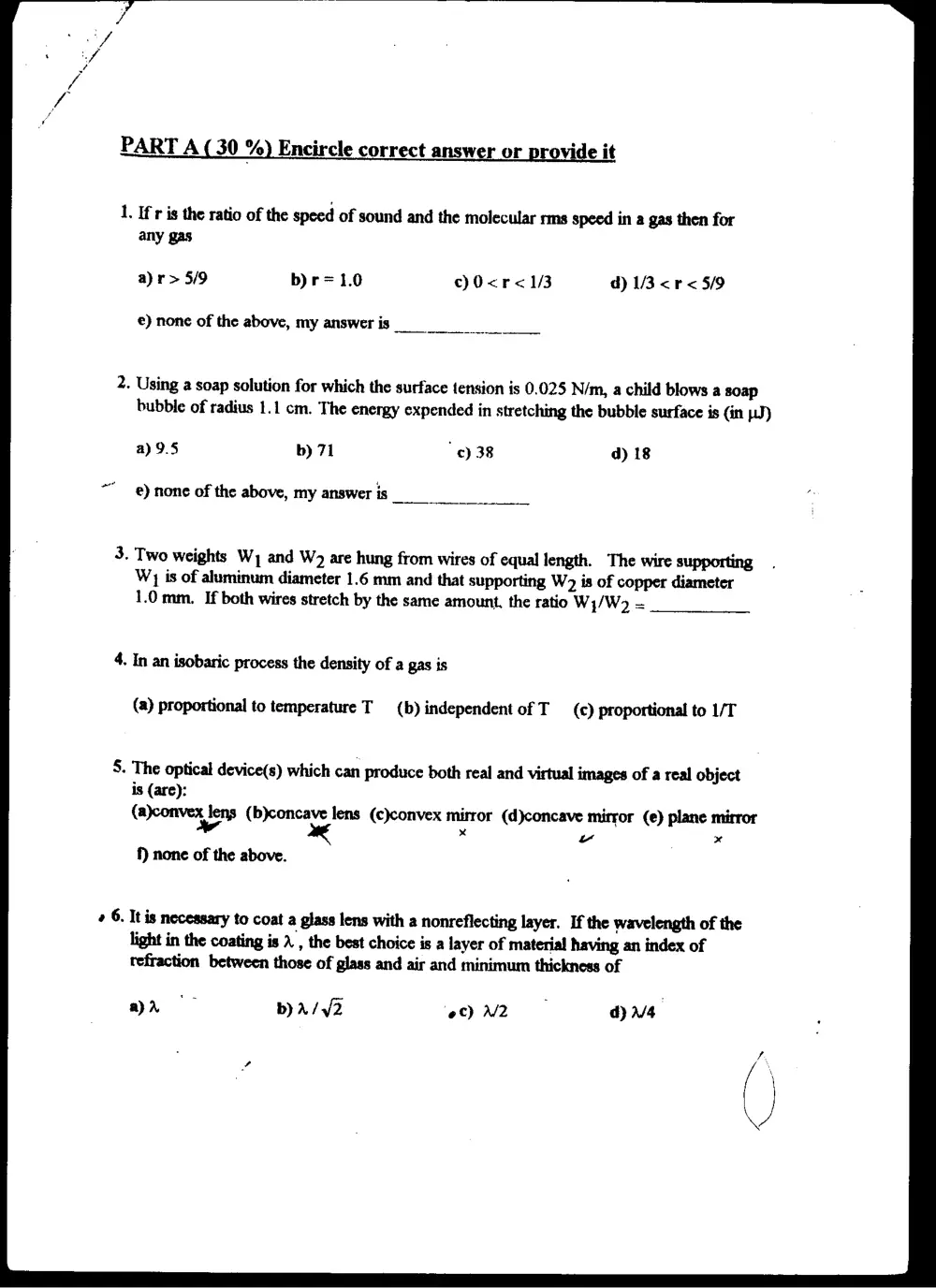
PART A (30 %) Encircle correct answer or provide it
1. Ifr is the ratio of the speed of sound and the molecular rms speed in a gas then for
any gas
a)r> 5/9 b)r=1.0 oO0<r< 1/3 d) 13 <r< 5/9
e) none of the above, my answer is
- Using a soap solution for which the surface tension is 0.025 Nim, a child blows a soap
bubble of radius 1.1 cm. The energy expended in stretching the bubbie surface is (in J)
a) 9.5 b) 71
e) none of the above, my answer is
- Two weights Wy and W2 are hung from wires of equal length. The wire supporting
Wy] is of aluminum diameter 1.6 mm and that supporting W? is of copper diameter
1.0 mm. If both wires stretch by the same amount, the ratio Wj/W? =
. In an isobaric process the density of a gas is
(a) proportional to temperature T (b) independent of T _(c) proportional to 1/T
. The optical device(s) which can produce both real and virtual images of a real object
is (are):
(a)convex, Jens (b)concave lens (c)convex mirror (d)concave mirror (e) plane mirror
x Lo x
f) none of the above.
. It is necessary to coat a glass lens with a nonreflecting layer, If the wavelength of the
light in the coating is A, the best choice is a layer of material having an index of
refraction between those of glass and air and minimum thickness of
ara b) A/ V2 ec) 2 dy 4
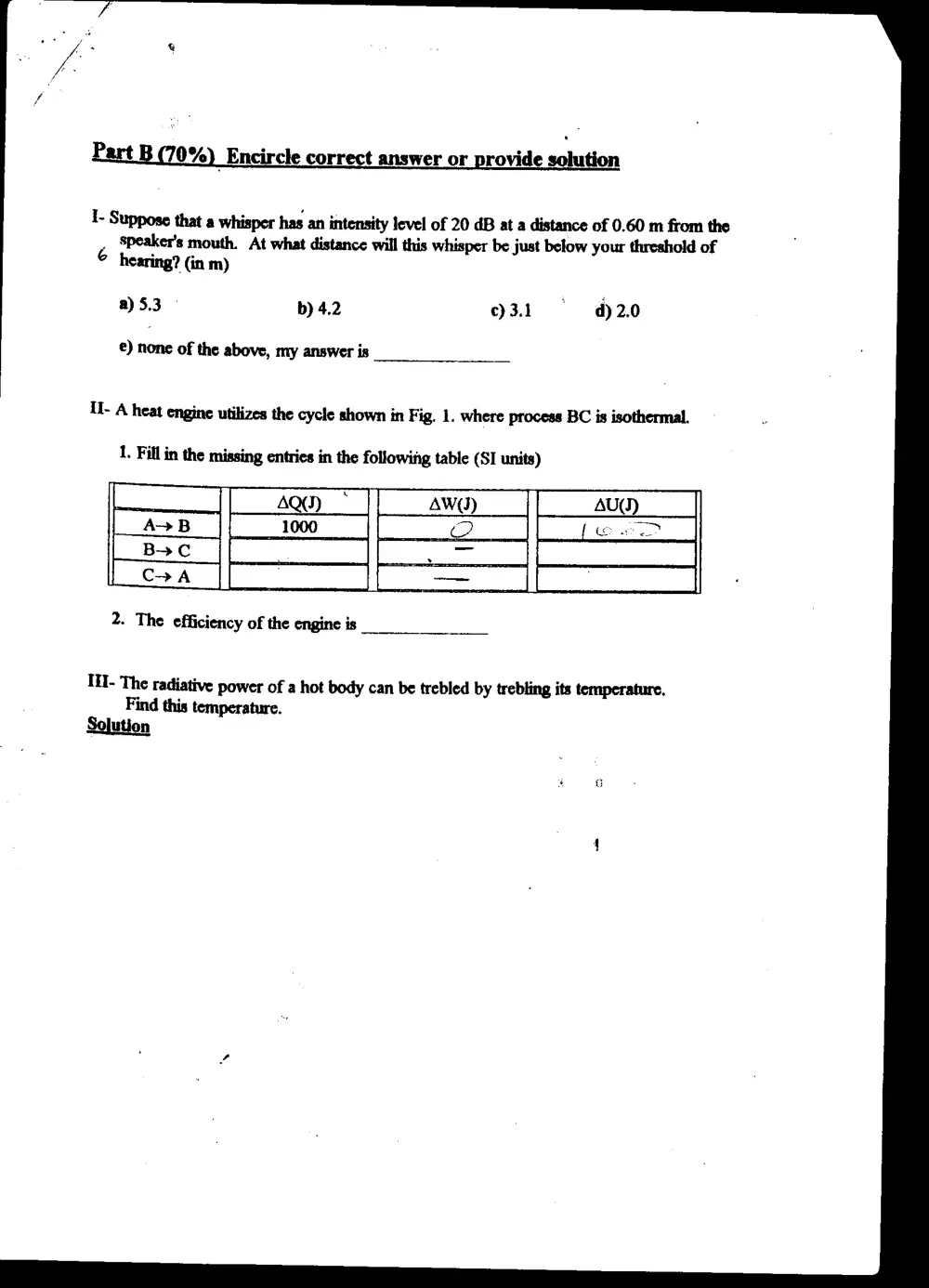
Part B (70%) _ Encircle correct answer or provide solution
1- Suppose that a whisper has an intensity level of 20 dB at a distance of 0.60 m from the
, Speaker's mouth. At what distance will this whisper be just below your threshold of
© hearing? (in m)
a) 5.3 ° b) 4.2 31° d)2.0
e) none of the above, my answer is
II- A heat engine utilizes the cycle shown in Fig. 1. where process BC is isothermal.
1. Fill in the missing entries in the following table (SI units)
2. The efficiency of the engine is
IIl- The radiative power of a hot body can be trebled by trebling its temperature,
Find this temperature.
Solution
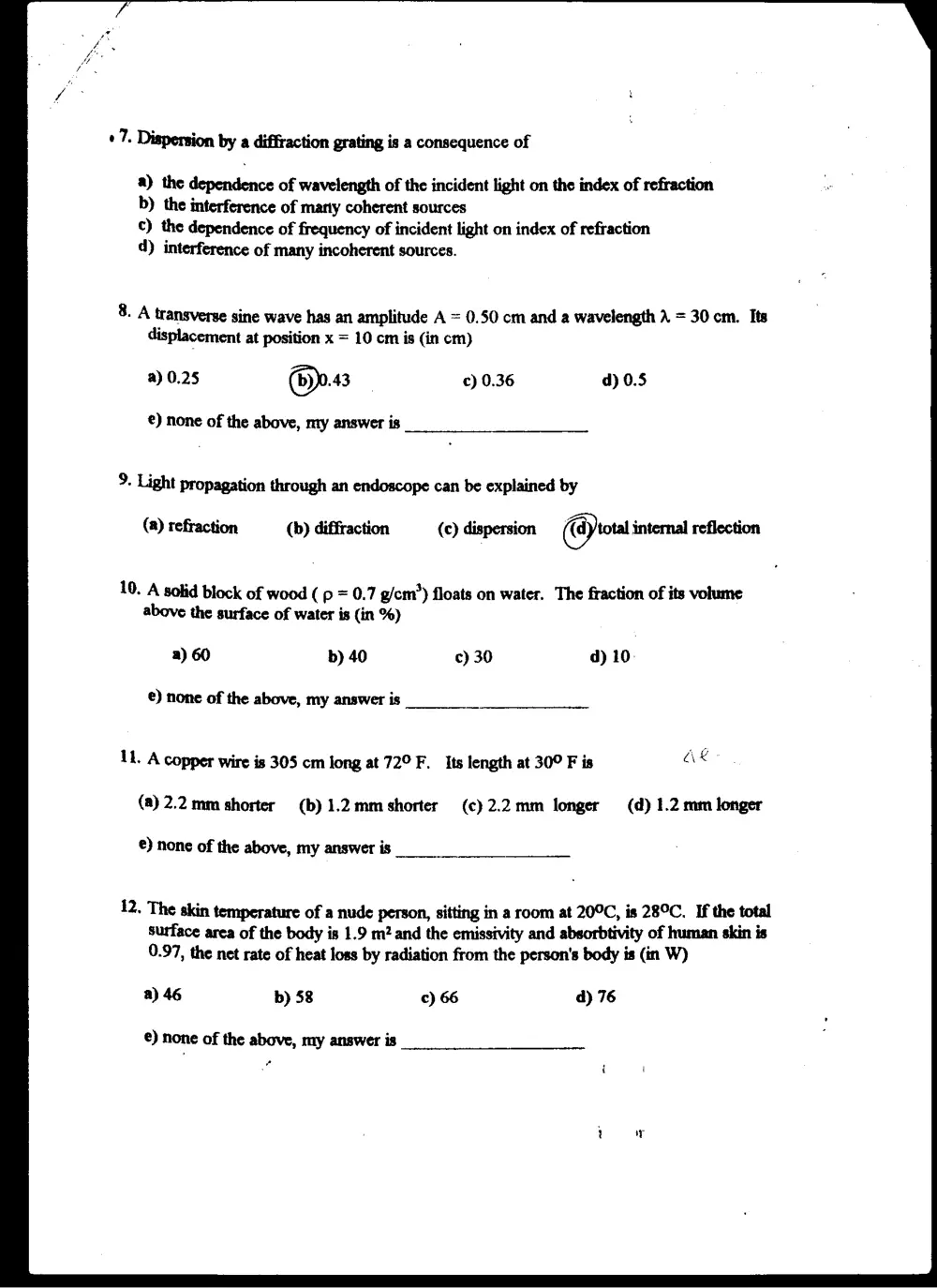
«7. Dispersion by a diffraction grating is a consequence of
a) the dependence of wavelength of the incident light on the index of refraction
b) the interference of many coherent sources
©) the dependence of frequency of incident light on index of refraction
d) interference of many incoherent sources.
B.A transverse sine wave has an amplitude A = 0.50 cm and a wavelength 4. = 30 cm. Its
displacement at position x = 10 cm is (in cm)
a) 0.25 (0.43 c) 0.36 d) 0.5
e) none of the above, mr answer is
9. Light propagation through an endoscope can be explained by
(a) refraction (b) diffraction ——_(c) dispersion @roat internal reflection
10. A solid block of wood (p = 0.7 g/cm’) floats on water. The fraction of its volume
above the surface of water is (in %)
a) 60 b) 40 c) 30 d) 10
€) none of the above, my answer is
11. A copper wire is 305 cm long at 72° F. Its length at 30° F is an
(a) 2.2 mm shorter (b) 1.2mm shorter (c) 2.2 mm longer —_(d) 1.2 mm longer
€) none of the above, my answer is
12. The skin temperature of a nude person, sitting in a room at 20°C, is 28°C. If the total
surface area of the body is 1.9 m? and the emissivity and absorbtivity of human skin is
0.97, the net rate of heat loss by radiation from the person's body is (in W)
a) 46 b) 58 c) 66 d) 76
e) none of the above, my answer is
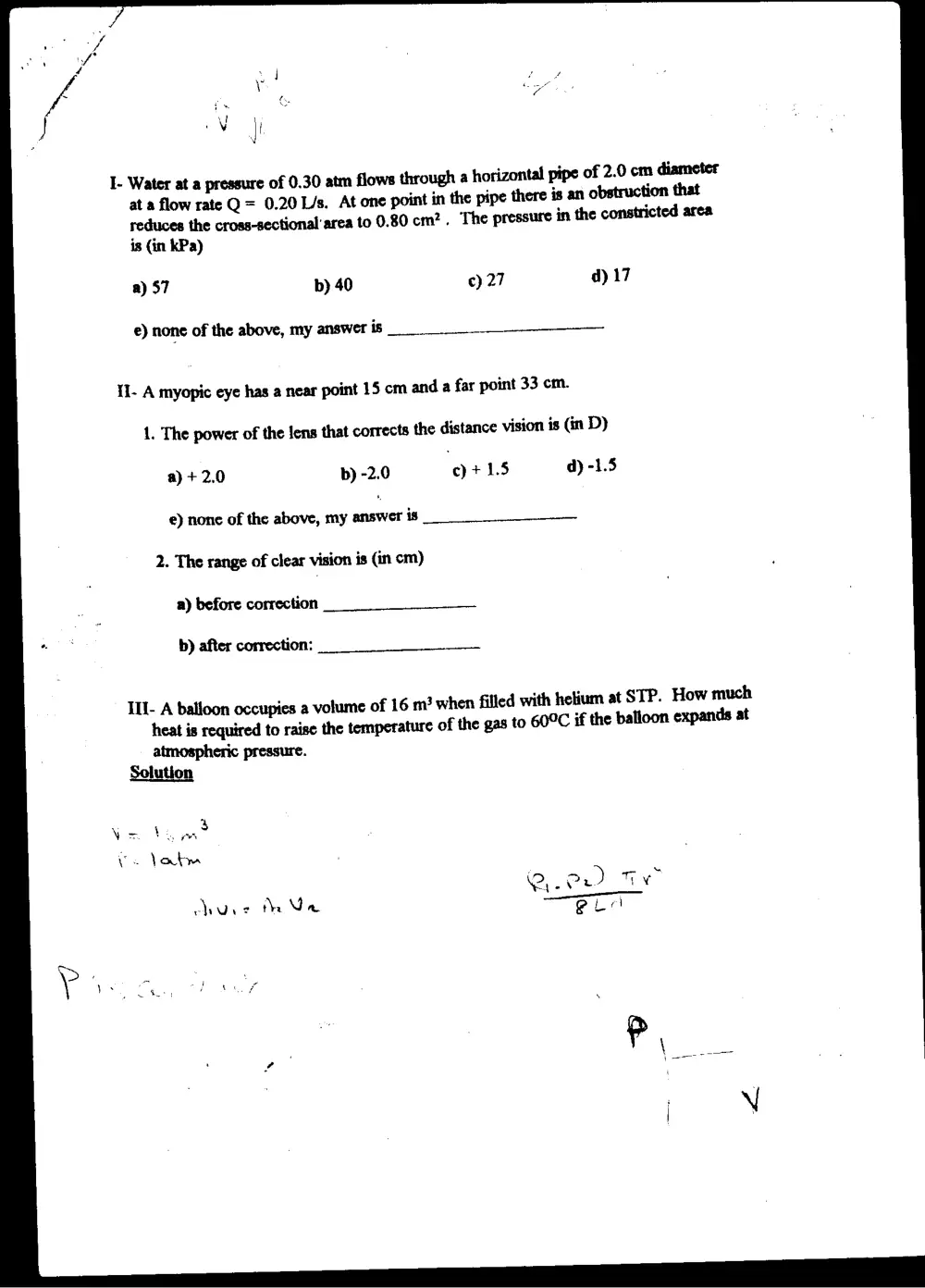
ugh a horizontal pipe of 2.0 cm diameter
the pipe there is an obstruction that
The pressure in the constricted area
I. Water at a pressure of 0.30 atm flows thro
at a flow rate Q = 0.20 L’s. At one point in
reduces the cross-sectional’ area to 0.80 cm? .
is (in kPa)
a) 57 b) 40 c) 27 d)17
e) none of the above, my answer is
Il- A myopic eye has a near point 15 cm and a far point 33 cm.
1. The power of the lens that corrects the distance vision is (in D)
a) + 2.0 b) -2.0 +s d)-1.5
e) none of the above, my answer is
2. The range of clear vision is (in cm)
a) before correction
b) after correction:
atmospheric pressure.
Solution
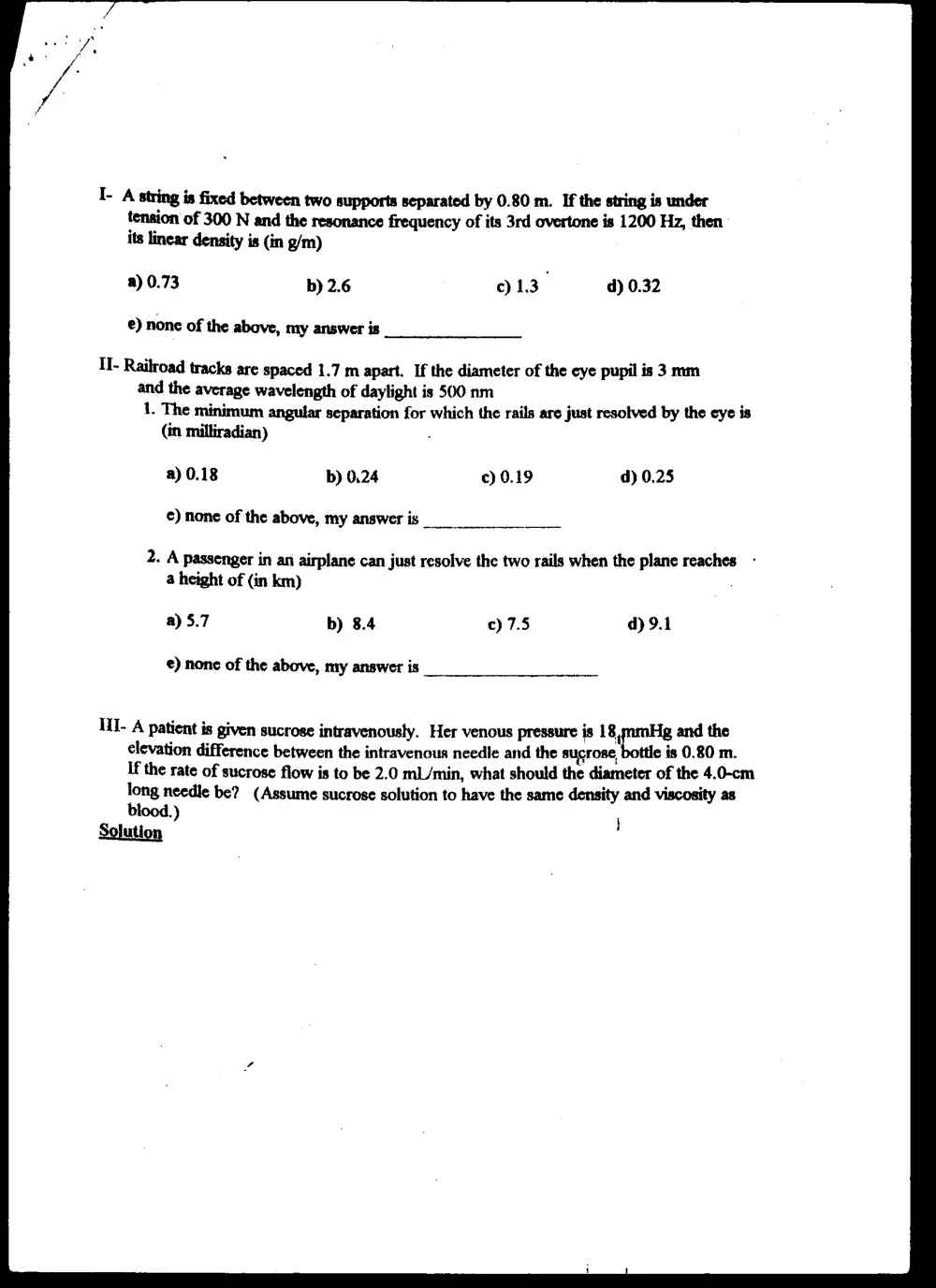
IL A string is fixed between two supports separated by 0.80 m. If the string is under
tension of 300 N and the resonance frequency of its 3rd overtone is 1200 Hz, then
its linear density is (in g/m)
a) 0.73 b) 2.6 13 — d) 0.32
e) none of the above, my answer is
T- Railroad tracks are spaced 1.7 m apart. If the diameter of the cye pupil is 3 mm
and the average wavelength of daylight is 500 nm
1. The minimum angular separation for which the rails are just resolved by the eye is
(in milliradian)
a) 0.18 b) 0.24 c) 0.19 d) 0.25
¢) none of the above, my answer is
2, A passenger in an airplane can just resolve the two rails when the plane reaches -
a height of (in km)
a) 5.7 b) 8.4 ©) 7.5 d) 9.1
e) none of the above, my answer is
lil- A patient is given sucrose intravenously. Her venous pressure is 18, and the
elevation difference between the intravenous needle and the sucrose, ttle is 0.80 m.
If the rate of sucrose flow is to be 2.0 mL/min, what should the diameter of the 4.0-cm
Arne needle be? (Assume sucrose solution to have the same density and viscosity as
)
Solution
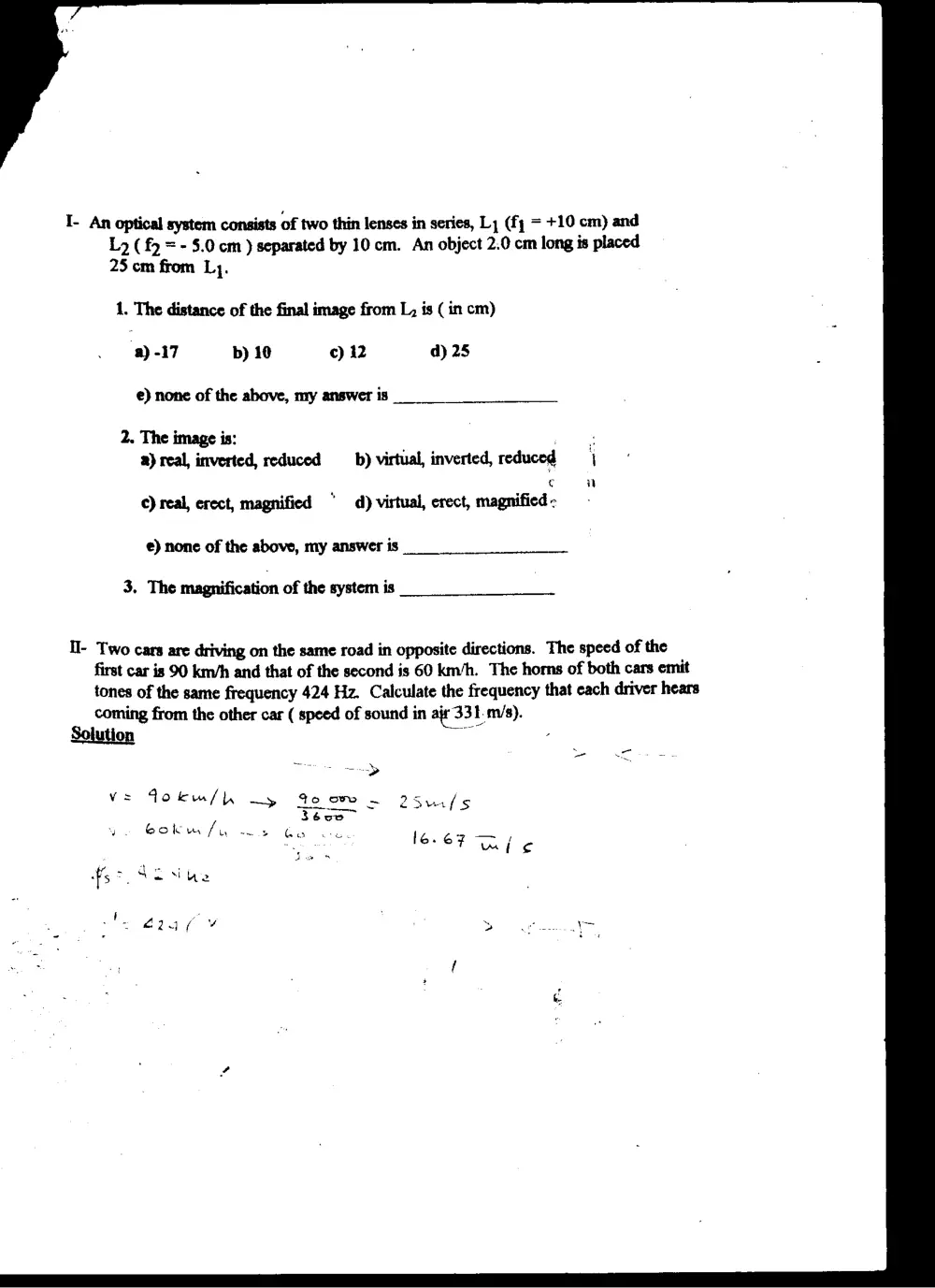
25 cm from Ly.
1. The distance of the final image from L, is ( in cm)
» -17 b) 10 o) 12 d) 25
e) none of the above, my answer is
2. The image is: 28
a) real, inverted, reduced —_b) virtual, inverted, reduced =|
ih
©) real, erect, magnified * d) virtual, erect, magnified -
e) none of the above, my answer is
3. The magnification of the system is
I- An optical system consists of two thin lenses in series, Lj (fj = +10 cm) and
Lz ( f2 = - 5.0 cm ) separated by 10 cm. An object 2.0 cm long is placed
I- Two cars are driving on the same road in opposite directions. The speed of the
first car is 90 km/h and that of the second is 60 km/h. The homs of both cars emit
tones of the same frequency 424 Hz. Calculate the frequency that each driver hears
coming from the other car ( speed of sound in ajr 33 Ins).
Solution ~
f
if
¥= Jokw/pK _» Fo om ~ 25/5
16.67