
PHYS 204 Final, Summer 1997
American University of Beirut · Classical Physics for Life Sciences · 7 pages


More PHYS 204 files
Show the text of this final exam
AMUCRICAN UNINERSIT
LIBRARY |
er Brn
ee earn
AUB Physics 204 August 27, 1997
Physics Department Final Exam Time: 2:00 n
Name:
LD. #:
Presguce. in GPs
1. 10 marks
The figure displays the phase diagram
of carbon, showing the ranges of
temperature and pressure in which
carbon will crystallize either as diamond
or graphite. What is the minimum depth
at which diamonds can form if the
temperature at that depth is 1000°C and
the subsurface rocks have density 3.1 g/om? ?
Assuming that, as a fluid, the pressure is due to
the weight of material lying above.
2. 15S marks
A block of wood has a mass of 3.67 kg and a density of 600 kg/m’. It is to be loaded
with lead so that it will float in water with 0.90 of its volume immersed. What mass of
lead (of density 1.13 x 10‘ kg/m’ ) is needed a) if the lead is on top of the wood and
b) if the lead is attached below the wood?
2
3. 1S. marks
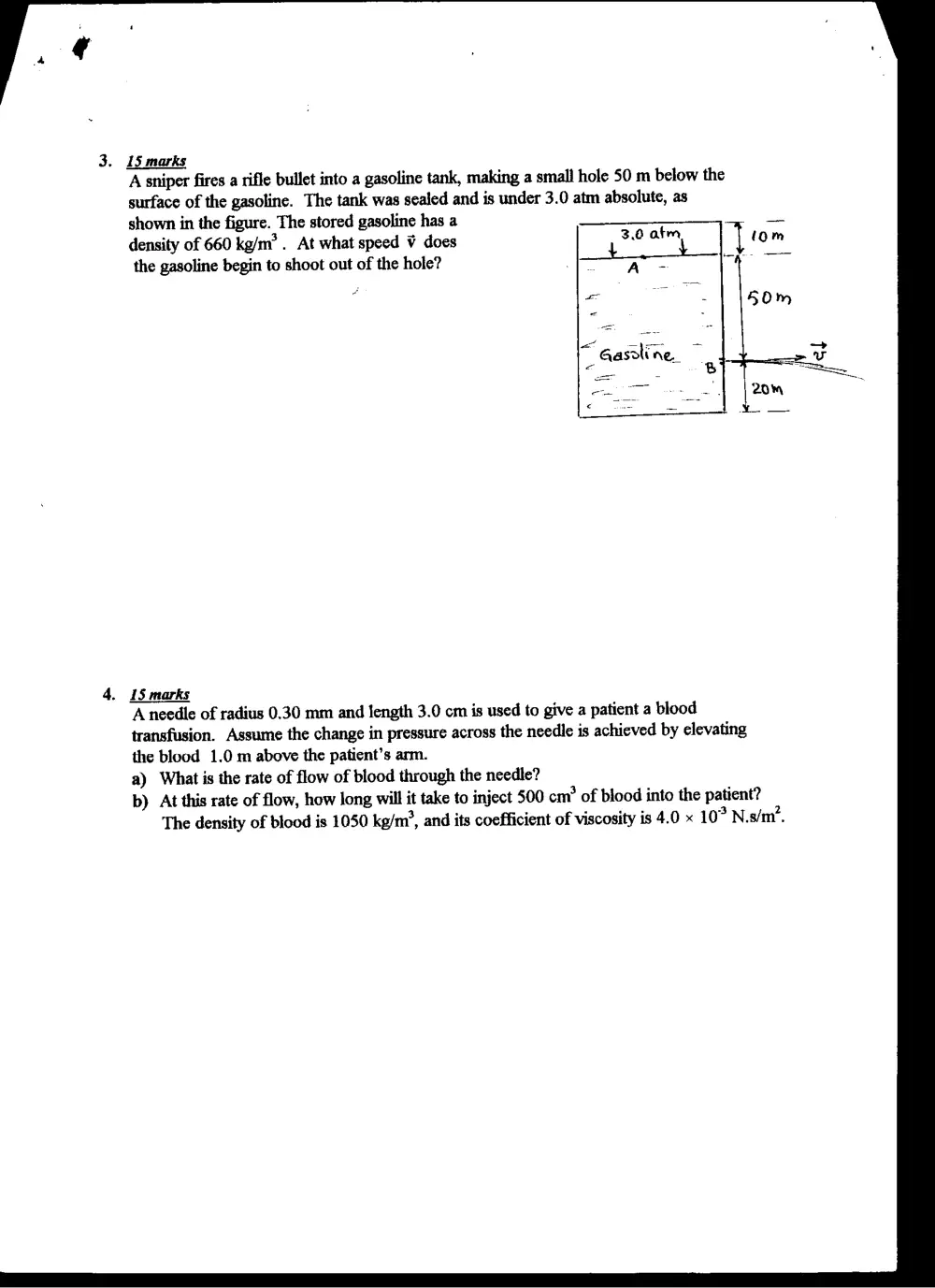
A sniper fires a rifle bullet into a gasoline tank, making a small hole 50 m below the
surface of the gasoline. The tank was sealed and is under 3.0 atm absolute, as
shown in the figure. The stored gasoline has a
density of 660 kg/m’. At what speed ¥ does 1 3.0 atm ai tom
the gasoline begin to shoot out of the hole? wT A - ho
~ aassline. ~
oe we
«
4. 15 marks
‘A needle of radius 0.30 mm and length 3.0 cm is used to give a patient a blood
transfusion. Assume the change in pressure across the needle is achieved by elevating
the blood 1.0 m above the patient’s arm.
a) What is the rate of flow of blood through the needle?
b) At this rate of flow, how long will it take to inject 500 cm? of biood into the patient?
The density of blood is 1050 kp/m’, and its coefficient of viscosity is 4.0 x 10? N.s/m’,
5. 10 marks
Sucrose is allowed to diffuse along a 10 cm length of tubing filled with water. The tube
is 6.0 cm? in cross-sectional area. The diffusion coefficient is 5.0 x 10⁷° m’/s and
8.0 x 10” kg is transported along the tube in 15 s. What is the difference in the
concentration levels of sucrose at the two ends of the tube?
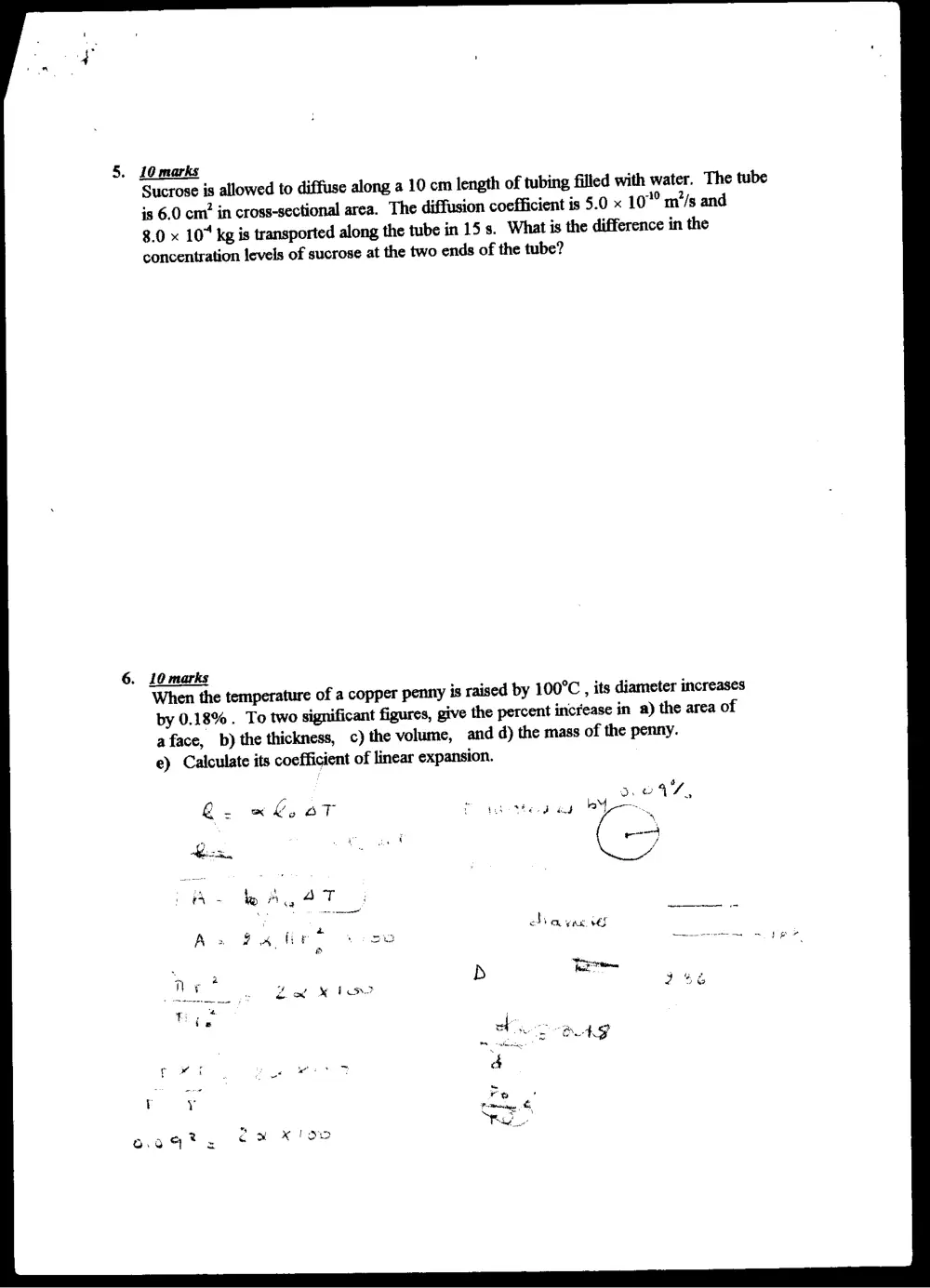
6. 10 marks
When the temperature of a copper penny is raised by 100°C , its diameter increases
by 0.18% . To two significant figures, give the percent increase in a) the area of
aface, b) the thickness, c) the volume, and d) the mass of the penny.
e) Calculate its coefficient of linear expansion.
2 x Kyat
7. 1S marks ; ‘
‘What mass of steam at 100°C must be mixed with 150 g of ice at its melting point,
in a thermally insulated container to produce liquid water at 50° C ?
(Latent heat of melting is L,, = 79.7 cal/g_, latent heat of vaporization is Ly ="539 cal/g.)
8. 20 marks
When a system is taken from state i to state f along path iaf , Q = 50 cal and W = 20 cal.
Along path ibf , Q = 36 cal. a) What is W along path ibf? b) if W = -13 cal for the curved
return path fi, what is Q for this path? P P
©) Take Ey. = 10 cal, What is Eat, +? a
d) If Ext,» = 22 cal, what are the values
of Q for path ib and path bf? i b
9. 15S marks
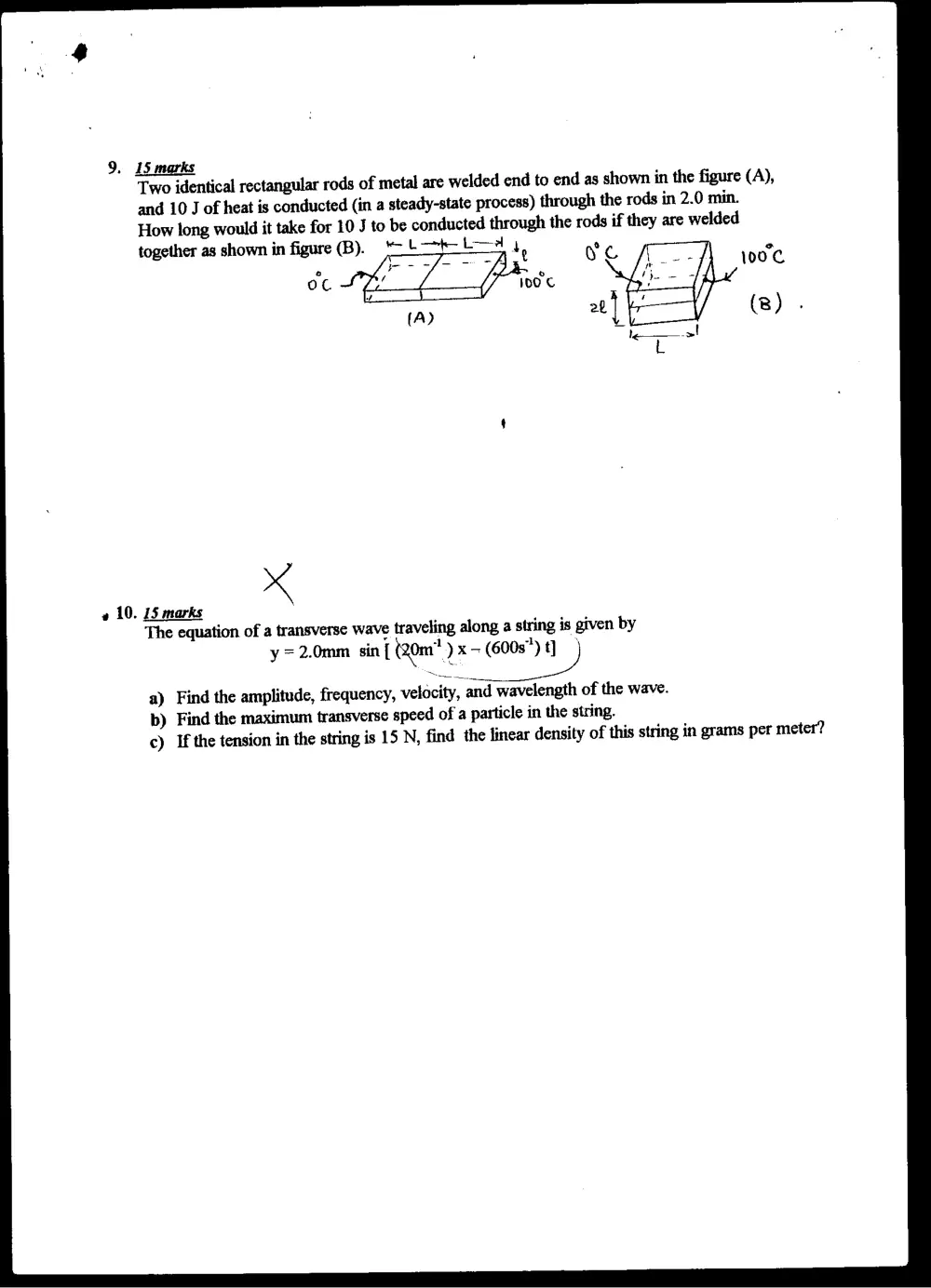
Two identical rectangular rods of metal are welded end to end as shown in the figure (A),
and 10 J of heat is conducted (in a steady-state process) through the rods in 2.0 min.
How long would it take for 10 J to be conducted through the rods if they are welded
together as shown in figure (B). “~ bt L—a 4
ve °
[AD eh (@) .
L
le —__->
a 10. 15 marks x
The equation of a transverse wave traveling along a string is given by
y = 2.0mm sn [Eom px O08) A)
a) Find the amplitude, frequency, velocity, and wavelength of the wave.
b) Find the maximum transverse speed of a particle in the string.
c) If the tension in the string is 15 N, find the linear density of this string in grams per meter?
11. 15 marks
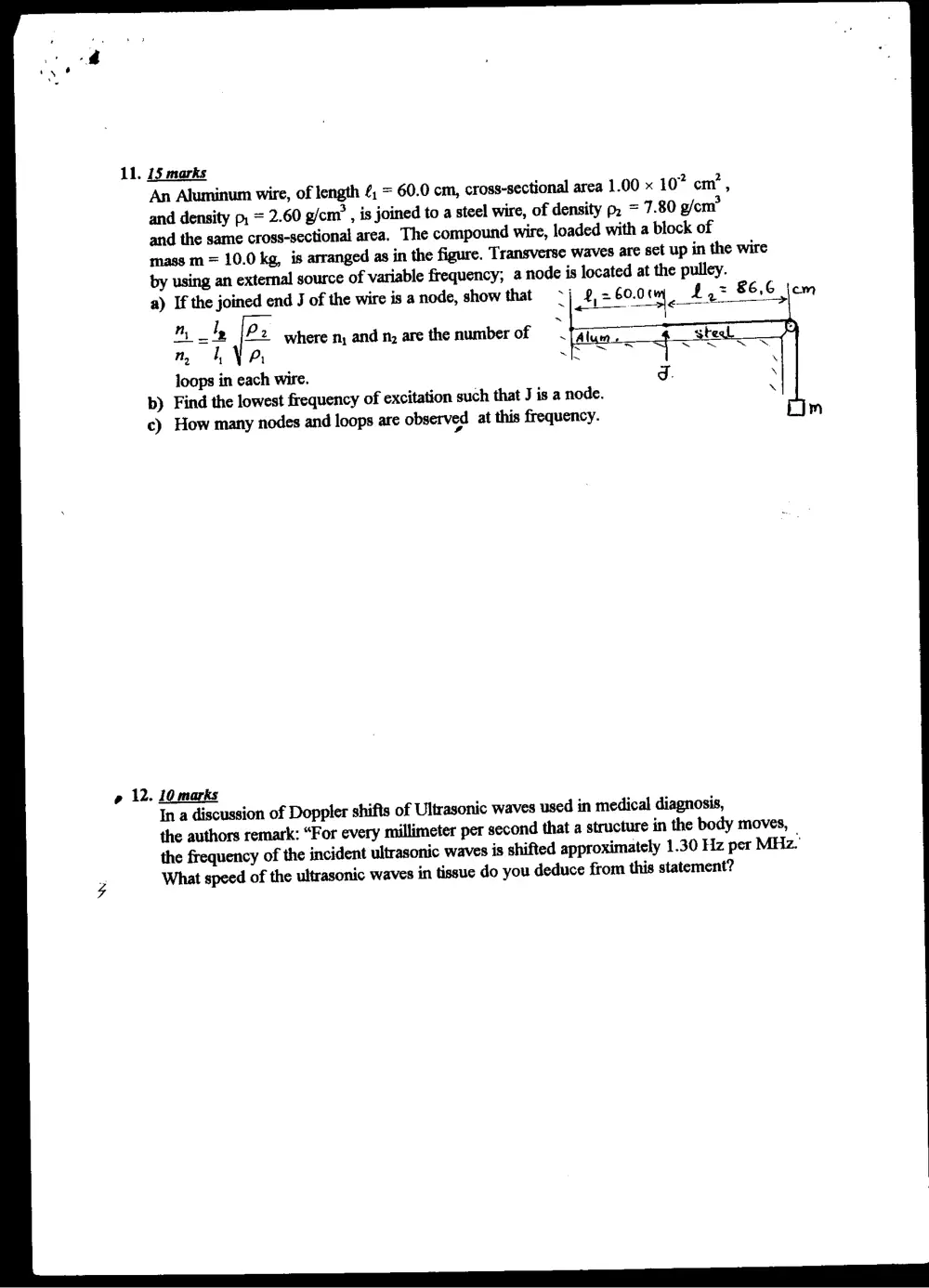
‘An Aluminum wire, of length ¢, = 60.0 cm, cross-sectional area 1.00 x 10? cm’,
and density p, = 2.60 g/cm” , is joined to a steel wire, of density p, = 7.80 g/cm?
and the same cross-sectional area. The compound wire, loaded with a block of
mass m = 10.0 kg, is arranged as in the figure. Transverse waves are set up in the wire
by using an external source of variable frequency; a node is located at the pulley.
a) If the joined end J of the wire is a node, show that >; 2, = 60.0« 4 a 86,6 \cm
. er
m oh Po where n, and n, are the number of
m LYVP,
loops in each wire.
b) Find the lowest frequency of excitation such that J is a node.
c) How many nodes and loops are observed at this frequency. m
a 12. 10 marks
In a discussion of Doppler shifts of Ultrasonic waves used in medical diagnosis,
the authors remark: “For every millimeter per second that a structure in the body moves, —
the frequency of the incident ultrasonic waves is shifted approximately 1.30 Hz per MHz.
What speed of the ultrasonic waves in tissue do you deduce from this statement?
13. 10 marks
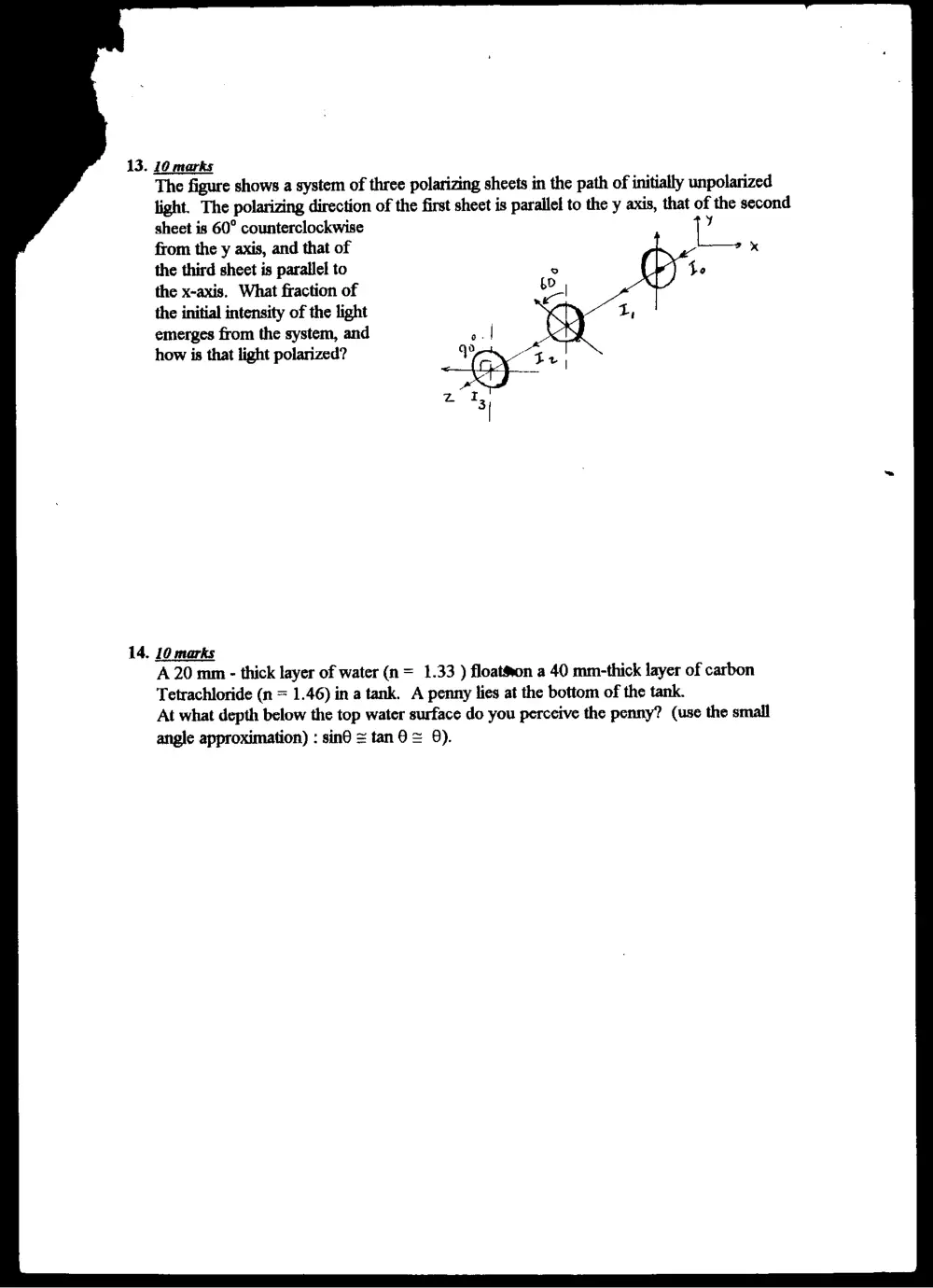
The figure shows a system of three polarizing sheets in the path of initially unpolarized
light. The polarizing direction of the first sheet is parallel to the y axis, that of the second
sheet is 60° counterclockwise
from the y axis, and that of x
the third sheet is parallel to to
the x-axis. What fraction of 60 |
the initial intensity of the light v L,
emerges from the system, and |
how is that light polarized? “© a
Zz *3|
|. LO marks
A 20 mm - thick layer of water (n = 1.33 ) float®on a 40 mm-thick layer of carbon
Tetrachloride (n = 1.46) in a tank. A penny lies at the bottom of the tank.
At what depth below the top water surface do you perceive the penny? (use the small
angle approximation) : sin0 = tan 6 = 6).