
PHYS 210L Exam 1 Sample, Fall 2010
American University of Beirut · Introductory Physics Laboratory II · 2 pages
More PHYS 210L files
- Lab Report · Fall 2017LabView
- Notes Data Analysis Formula Paper · Spring 2017NotesView
- Final · Fall 2015Final examView
- Notes Lab Summary for Final Revision (Fall 2015) · Fall 2015Final examView
- Useful File Summary · Spring 2014FileView
- Lab Spectrometer · Fall 2014LabView
- Lab Sound Waves Report Solution · Fall 2012Lab · with solutionView
- Lab Solved Report Standing Waves String · Fall 2012Lab · with solutionView
Show the text of this exam
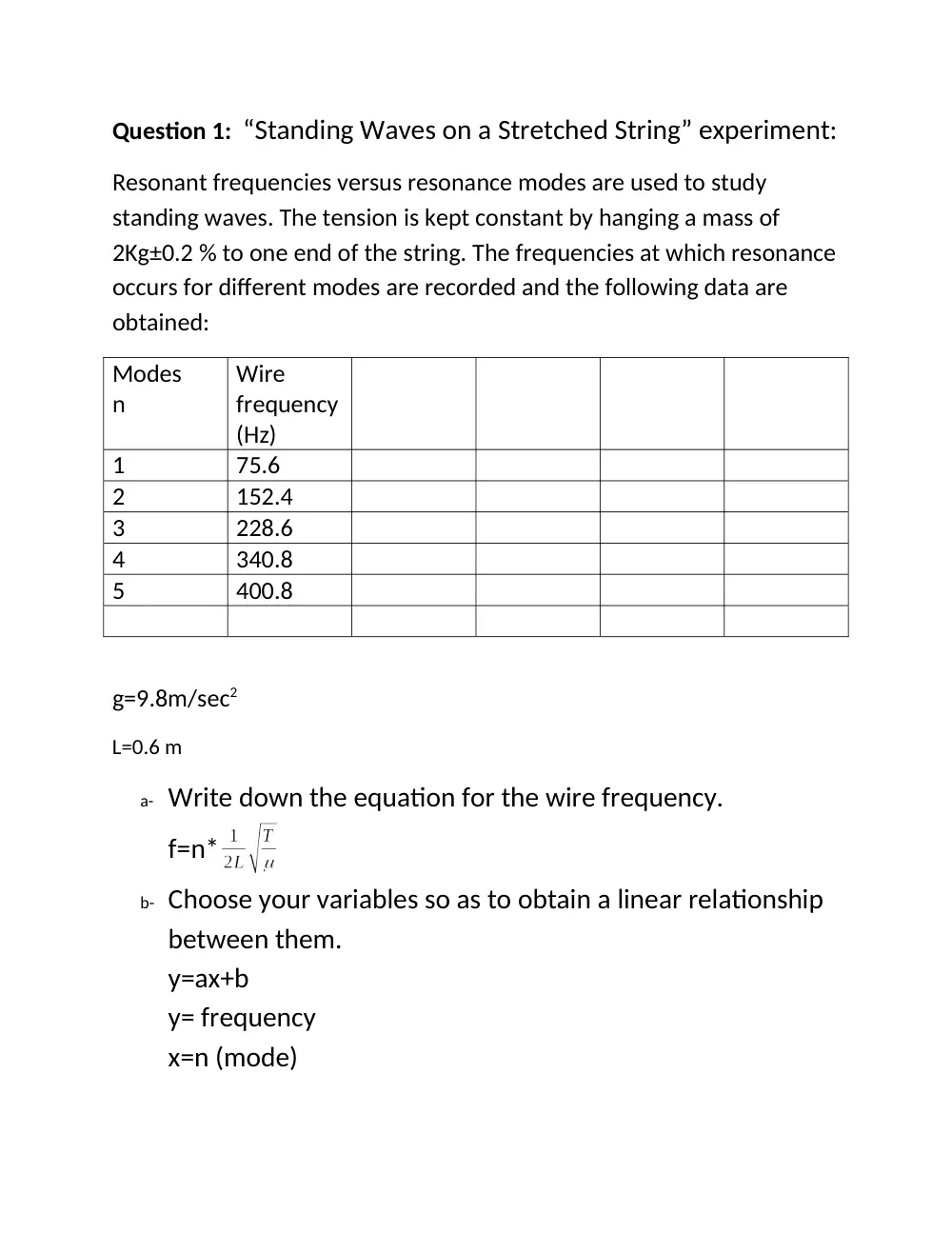
Question 1: “Standing Waves on a Stretched String” experiment:
Resonant frequencies versus resonance modes are used to study
standing waves. The tension is kept constant by hanging a mass of
2Kg±0.2 % to one end of the string. The frequencies at which resonance
occurs for different modes are recorded and the following data are
obtained:
Modes
n
Wire
frequency
(Hz)
1
75.6
2
152.4
3
228.6
4
340.8
5
400.8
g=9.8m/sec2
L=0.6 m
a- Write down the equation for the wire frequency.
f=n*
b- Choose your variables so as to obtain a linear relationship
between them.
y=ax+b
y= frequency
x=n (mode)
a=
(slope)
b=0
c- Use linear regression to find the slope along with its error.
d- Deduce the linear density of the string along with its error.
a=
a2 = (1/4L2) *(T/µ) µ= T/4L2*a2
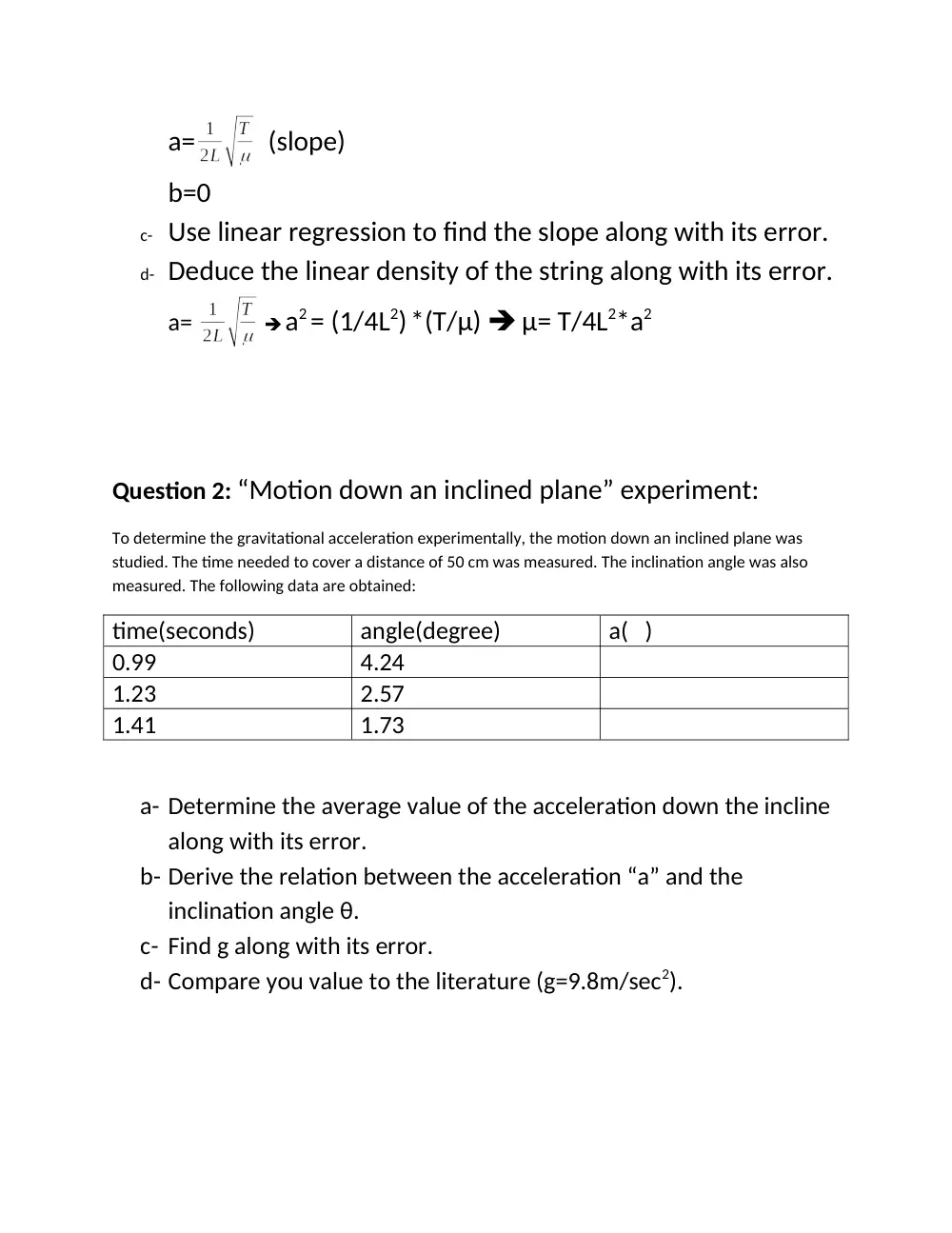
Question 2: “Motion down an inclined plane” experiment:
To determine the gravitational acceleration experimentally, the motion down an inclined plane was
studied. The time needed to cover a distance of 50 cm was measured. The inclination angle was also
measured. The following data are obtained:
time(seconds)
angle(degree)
a( )
0.99
4.24
1.23
2.57
1.41
1.73
a- Determine the average value of the acceleration down the incline
along with its error.
b- Derive the relation between the acceleration “a” and the
inclination angle θ.
c- Find g along with its error.
d- Compare you value to the literature (g=9.8m/sec2).