
PHYS 210L Lab Sound Waves Report Solution, Fall 2012
American University of Beirut · Introductory Physics Laboratory II · 9 pages · with solution


More PHYS 210L files
- Lab Report · Fall 2017LabView
- Lab Spectrometer · Fall 2014LabView
- Lab Solved Report Standing Waves String · Fall 2012Lab · with solutionView
- Lab Solved Report · Fall 2012Lab · with solutionView
- Lab Meq Heat Solved Report · Fall 2012Lab · with solutionView
- Lab Solved Report Interference and Diffraction · Fall 2010Lab · with solutionView
- Lab Solved Report Michelson · Fall 2010Lab · with solutionView
- Lab Solved Report Spectrometer · Fall 2010Lab · with solutionView
Show the text of this lab
Physics 210L
Standing Sound Waves in Air Columns
a- Tube length and resonant modes
:
i. Determination of piston positions that produce standing waves:
Freq.= 1.0 kHz
Freq.= 1.5 kHz
Freq.= 2.0 kHz
Freq.= 2.5 kHz
Piston Positions
(cm)
Piston Positions
(cm)
Piston Positions
(cm)
Piston Positions
(cm)
71.7
70.0
71.7
75.3
54.4
57.7
62.9
70.0
37.1
46.3
54.0
62.7
19.8
35.1
45.1
56.5
2.5
23.8
36.1
50.3
12.4
27.1
43.9
1.10
18.3
37.6
9.20
31.4
0.400
25.0
18.7
12.4
6.1
ii. Determination of the speed of sound in air:
For 1.0 kHz:
1
For 1.5 kHz:
2
For 2.0 kHz:
3
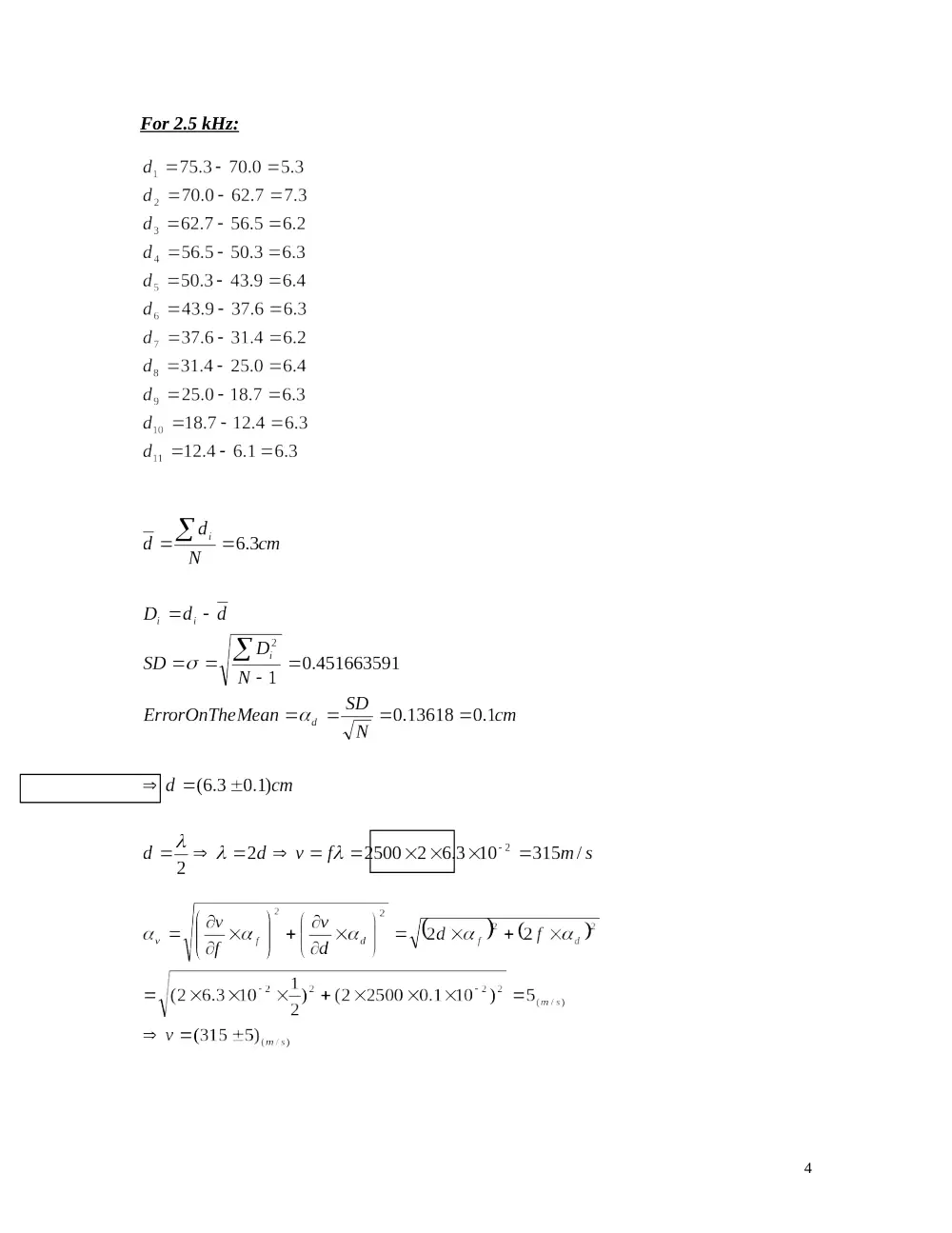
For 2.5 kHz:
4
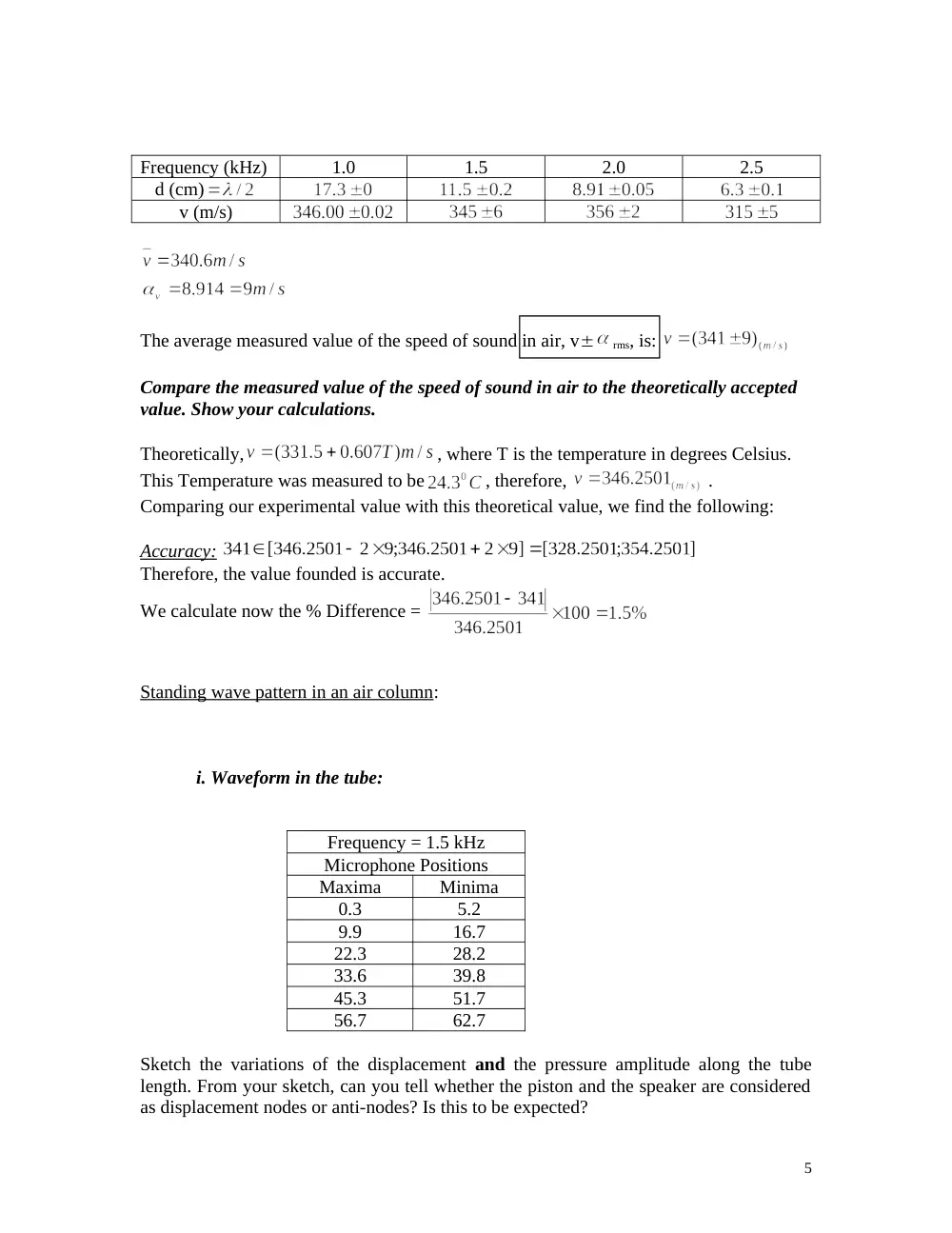
Frequency (kHz)
1.0
1.5
2.0
2.5
d (cm)
v (m/s)
The average measured value of the speed of sound in air, v
rms, is:
Compare the measured value of the speed of sound in air to the theoretically accepted
value. Show your calculations.
Theoretically,
, where T is the temperature in degrees Celsius.
This Temperature was measured to be
, therefore,
.
Comparing our experimental value with this theoretical value, we find the following:
Accuracy:
Therefore, the value founded is accurate.
We calculate now the % Difference =
Standing wave pattern in an air column:
i. Waveform in the tube:
Frequency = 1.5 kHz
Microphone Positions
Maxima
Minima
0.3
5.2
9.9
16.7
22.3
28.2
33.6
39.8
45.3
51.7
56.7
62.7
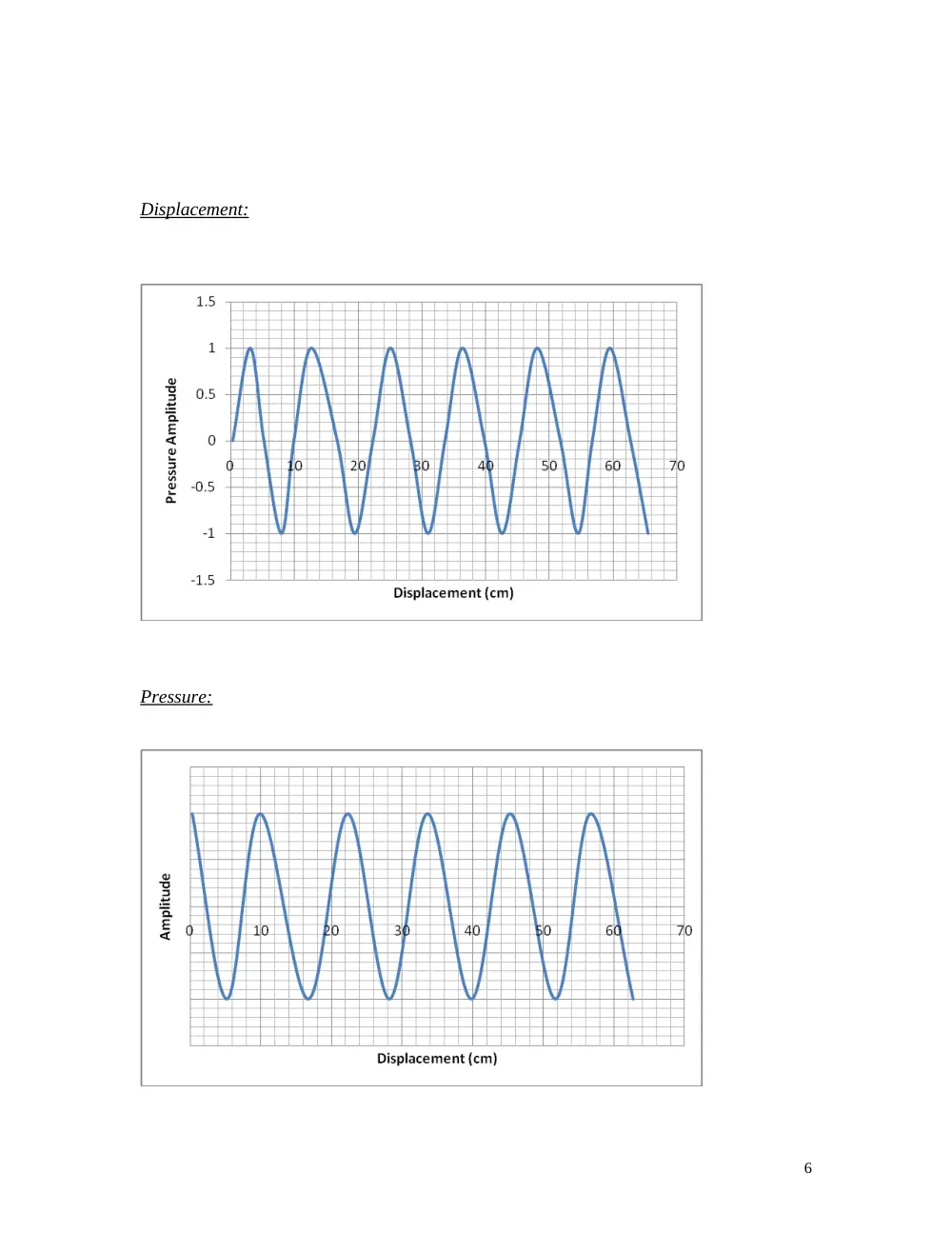
Sketch the variations of the displacement and the pressure amplitude along the tube
length. From your sketch, can you tell whether the piston and the speaker are considered
as displacement nodes or anti-nodes? Is this to be expected?
5
Displacement:
Pressure:
6
We can see that the speaker is pressure anti-node (displacement node) when there is
MAXIMUM amplitude in pressure and a pressure node (displacement anti-node) when
we have a MINIMUM amplitude in pressure. Theoretically speaking, the speaker is
referred to as anti-node since in our case it serves as the open end of the air column.
Since the tube has a fixed end, this fixed end does not allow displacement meaning that
the piston is a displacement node and a pressure anti-node.
ii. Determination of the speed of sound in air:
Record the number of pressure nodes, N, for each value of the tube length.
Frequency = 1.5 kHz
Length (cm)
N
71.5
7
60.0
6
48.5
5
36.6
4
25.0
3
13.5
2
3.00
1
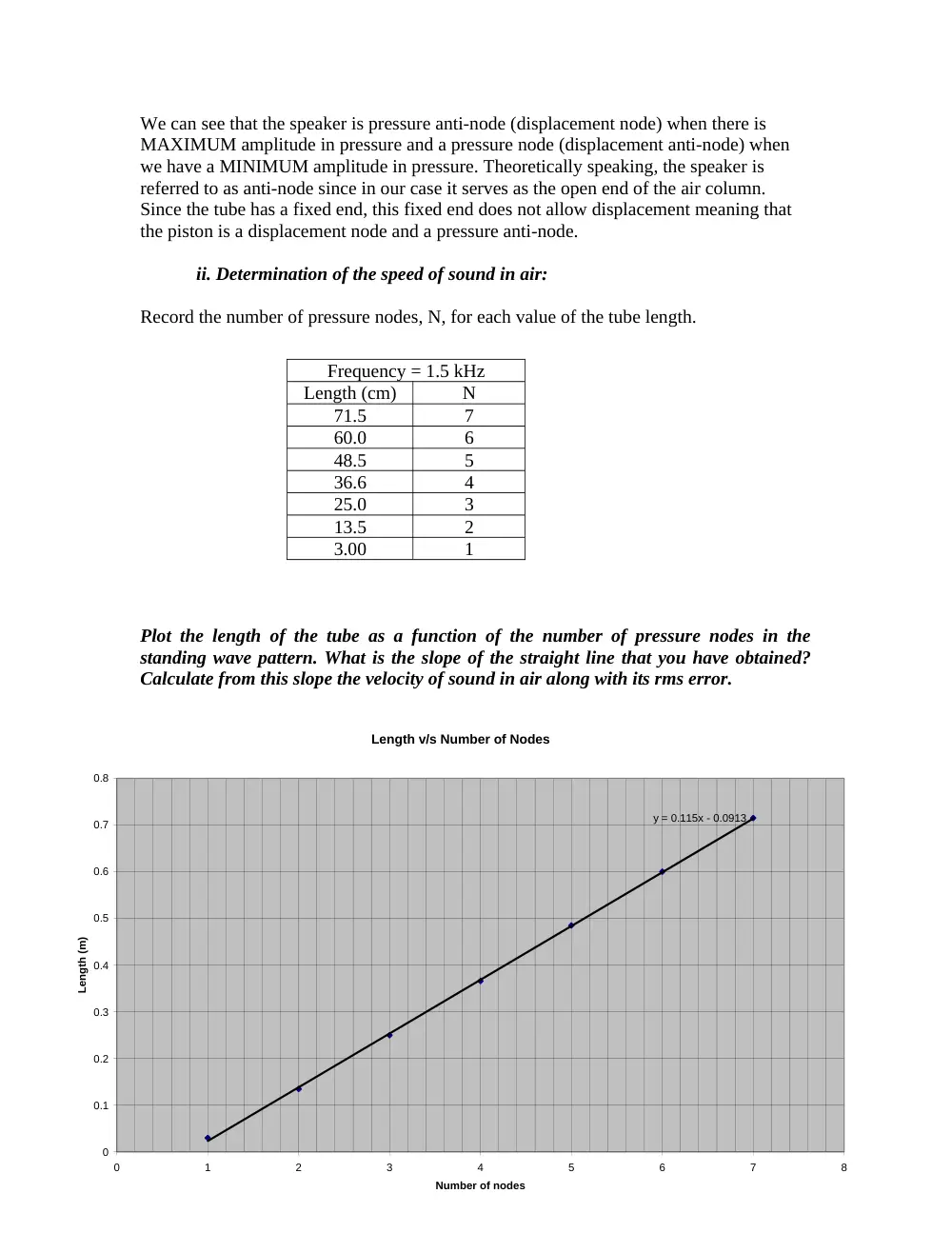
Plot the length of the tube as a function of the number of pressure nodes in the
standing wave pattern. What is the slope of the straight line that you have obtained?
Calculate from this slope the velocity of sound in air along with its rms error.
7
Length v/s Number of Nodes
y = 0.115x - 0.0913
0
0.1
0.2
0.3
0.4
0.5
0.6
0.7
0.8
0
1
2
3
4
5
6
7
8
Number of nodes
Length (m)
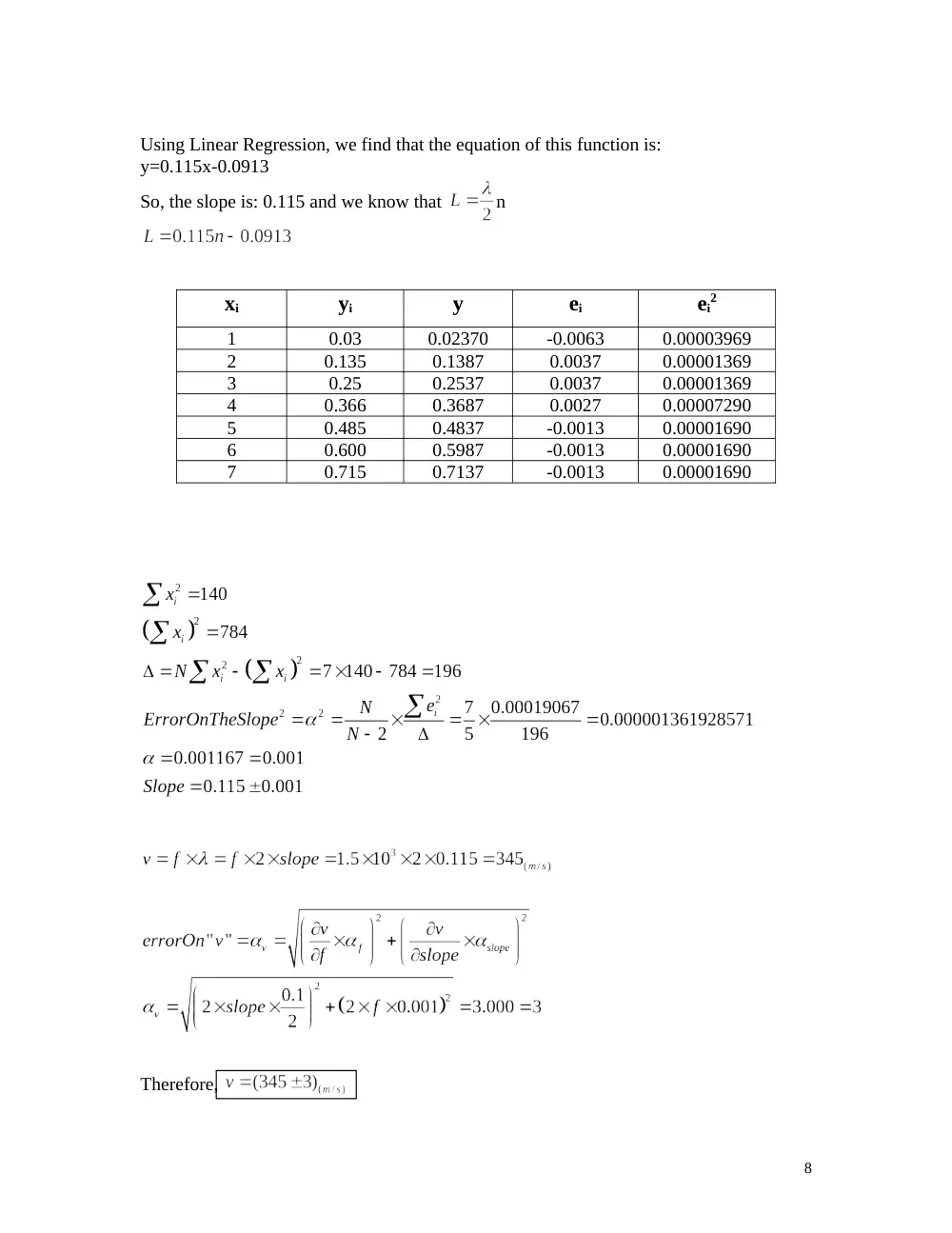
Using Linear Regression, we find that the equation of this function is:
y=0.115x-0.0913
So, the slope is: 0.115 and we know that
n
xi
yi
y
ei
ei
2
1
0.03
0.02370
-0.0063
0.00003969
2
0.135
0.1387
0.0037
0.00001369
3
0.25
0.2537
0.0037
0.00001369
4
0.366
0.3687
0.0027
0.00007290
5
0.485
0.4837
-0.0013
0.00001690
6
0.600
0.5987
-0.0013
0.00001690
7
0.715
0.7137
-0.0013
0.00001690
Therefore,
8
How does this value compare to the one determined in part (a) of the experiment and to
the accepted theoretical value? Comment.
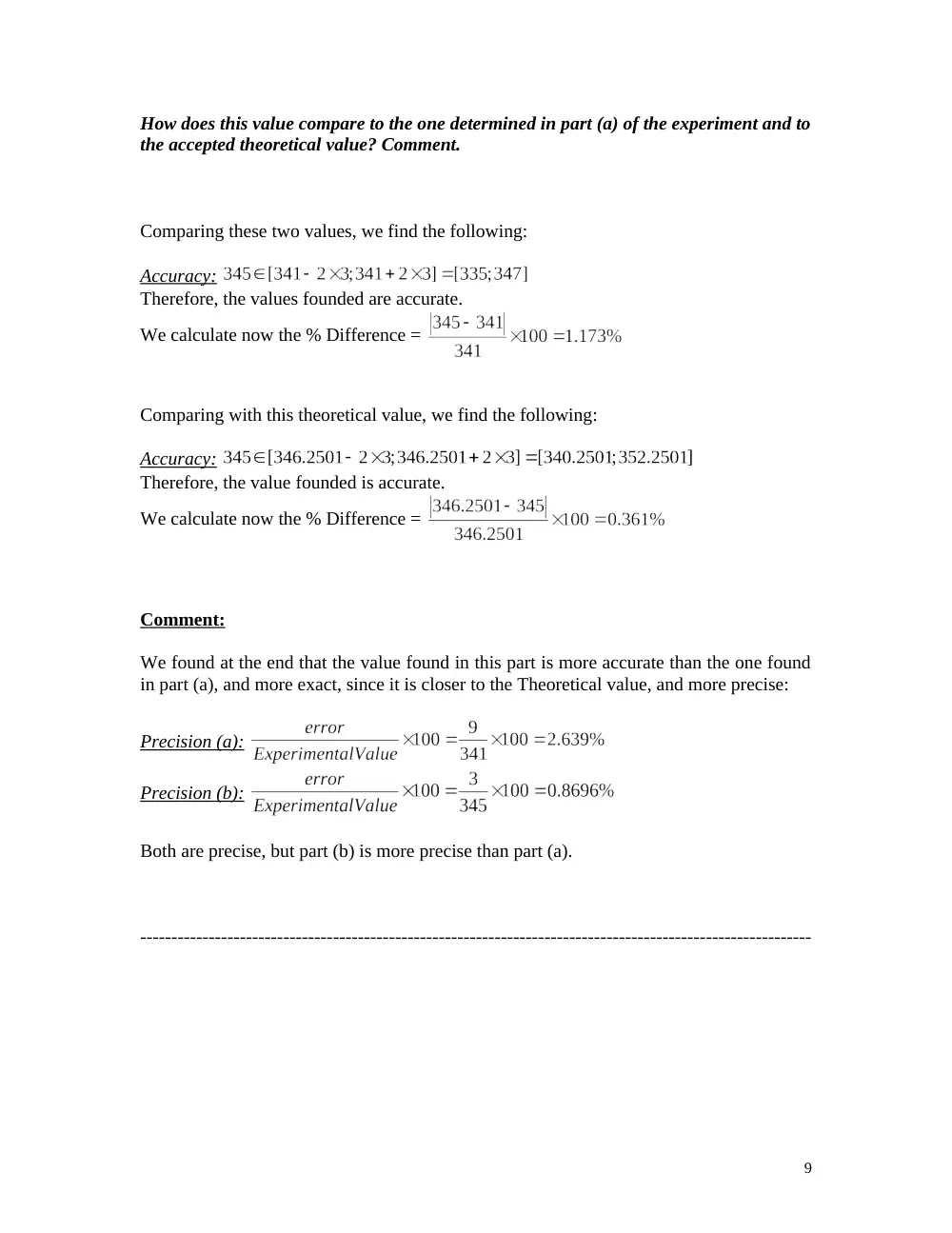
Comparing these two values, we find the following:
Accuracy:
Therefore, the values founded are accurate.
We calculate now the % Difference =
Comparing with this theoretical value, we find the following:
Accuracy:
Therefore, the value founded is accurate.
We calculate now the % Difference =
Comment:
We found at the end that the value found in this part is more accurate than the one found
in part (a), and more exact, since it is closer to the Theoretical value, and more precise:
Precision (a):
Precision (b):
Both are precise, but part (b) is more precise than part (a).
------------------------------------------------------------------------------------------------------------
9