
PHYS 210L Notes, Fall 2011
American University of Beirut · Introductory Physics Laboratory II · 12 pages


Showing the first 10 of 12 pages. Download the PDF to see all of it.
More PHYS 210L files
- Notes Data Analysis Formula Paper · Spring 2017NotesView
- Lab Report · Fall 2017LabView
- Notes Lab Summary for Final Revision (Fall 2015) · Fall 2015Final examView
- Final · Fall 2015Final examView
- Useful File Summary · Spring 2014FileView
- Lab Spectrometer · Fall 2014LabView
- Lab Solved Report Standing Waves String · Fall 2012Lab · with solutionView
- Lab Sound Waves Report Solution · Fall 2012Lab · with solutionView
Show the text of this notes
Thanks to Hagop M. Harfoushian
1) Atwood’s machine:
A. Formulas:
a.
i.
a =
gsin
ii. x =
B. Procedure:
a. Use siny and a=x to plot the curve. “g” is the slope of the curve. Use linear
regression to find its error.
C. Additional Notes:
a. When the photogate timer is set at the pulse mode, it measures the time it takes the
cart to cover the distance between the photgate timer and accessory photogate.
2) Conservation of mechanical energy:
A. Formulas:
a. V =
b.
We will use the area under the curve later. You don’t need this formula ;)
B. Procedure:
a. Potential Energy by the rubber band:
i.
Plot F(x) vs. x. F(x) is the force applied by the rubber band=weight of the
hanging masses. W=area under this plotted curve.
b. Work-Energy:
i.
Calculate the mass of the glider.
ii. Push the glider back a distance x and release it. Calculate v using eq. 1.
Calculate K.E. Compare to the results in part (a).
C. Additional Notes:
a.
A photo-cell responds to light falling on it. Your photo-cell is illuminated by
a flash light bulb (Fig. 2) and connected to a timer. When light shines on
the photo-cell it switches the timer off. When the light is blocked and none
falls on the photo-cell it switches the timer on. The photo-cell acts as a
switch that electronically turns the timer On and Off. Hence, when a glider
passes between the photo-cell and bulb it blocks the light and the timer is
turned On. It remains On until the glider passes through when the light
shines again on the cell the timer is turned off. Thus, the timer measures
the time T for the glider to travel its own length L.
3) Surface Tension and Viscosity
A. Formulas:
a.
b.
I’m not sure anyone can memorize this formula!
B. Procedure:
a. Surface Tension:
i.
First record the initial weight of the ring.
ii. Measure the radius of the ring.
iii. Record the room temperature.
iv. Calculate by using the 1st formula.
b. Viscosity:
i.
Measure the length and the radius of the capillary tube.
ii. Fill water to hi and record hi, and stop it from flowing with you finger.
iii. Release your finger and let water flow in a graduated cylinder for a time t.
Record t.
iv. Record the volume and the temperature of the water you have collected.
v. Calculate using eq. 2 with its error.
C. Additional Notes:
a. The surface tension increases when water is cooled and vice versa.
b. The surface tension decreases when we use soap.
4) Thermal expansion:
A. Formulas:
a.
B. Procedure:
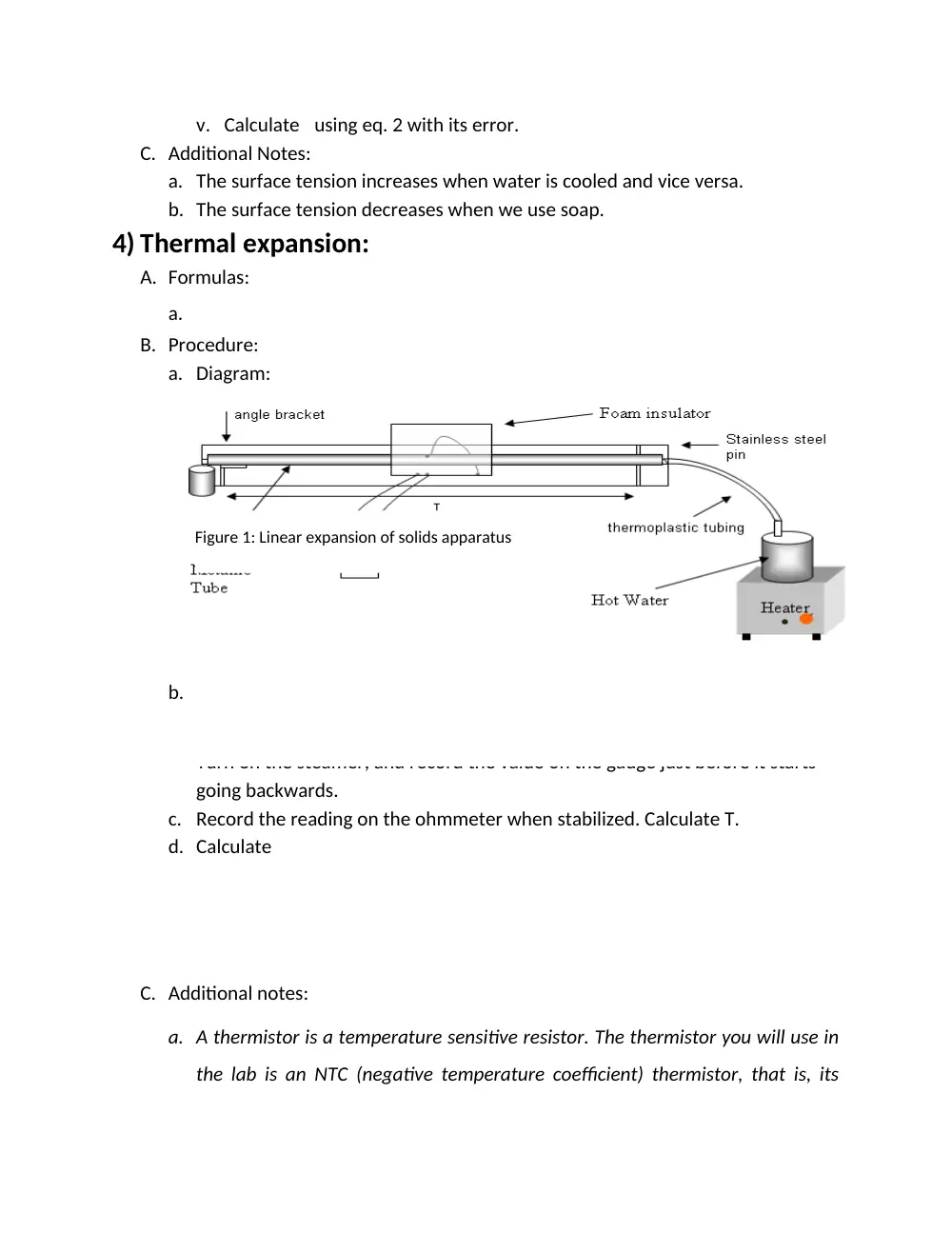
a. Diagram:
b. Mmmmmmmmmmmmmmmmmmmmmmmmmmmm
mmmmmmmmmmmmmmmmmmmmmmmmmmmm
Turn on the steamer, and record the value on the gauge just before it starts
going backwards.
c. Record the reading on the ohmmeter when stabilized. Calculate T.
d. Calculate
C. Additional notes:
a. A thermistor is a temperature sensitive resistor. The thermistor you will use in
the lab is an NTC (negative temperature coefficient) thermistor, that is, its
Figure 1: Linear expansion of solids apparatus
resistance decreases with the increase of temperature. If the resistance of the
thermistor is measured, the temperature is then found using the conversion
table on the thermal expansion base.
5) Mechanical Equivalent of Heat:
A. Formulas:
a. W = n 2r (Mg)
b. Q = mcT
B. Procedure:
a. Mechanical equivalent of heat:
i.
After measuring the radius of the cylinder, and its mass, use formulas 1
and 2 to determine the mechanical equivalent of heat, i.e. Q/W must give
about 4.186.
b. Molar Capacity of aluminum;
i.
Find the specific heat of aluminum experimentally by using the value of
mechanical equivalent of heat from part A.
ii. Multiply this value by the molar mass of aluminum to get its molar
capacity.
C. Additional Notes:
a. Remember how the boys suffered turning the knob 300 times :D
6) Standing Sound waves in air column:
A. Formulas:
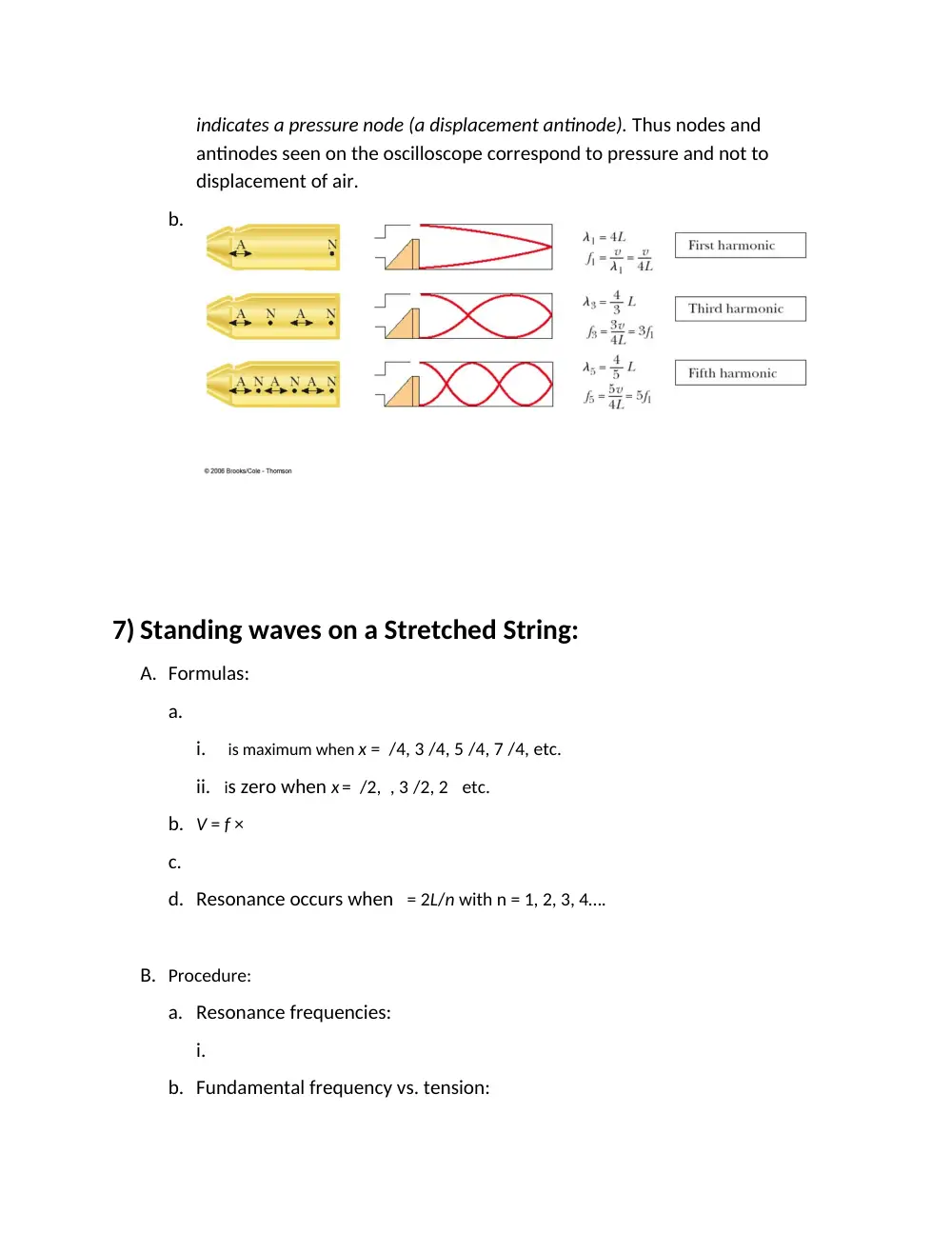
a. For a closed tube (one end closed) resonance occurs when λ= 4L/n with
n=1,3,5,…
b. At the closed end, air has nowhere to go, so there must be a displacement
node. At the open end, there is a pressure node since pressure stays pretty
much the same.
B. Procedure:
a. Tube length and resonance mode:
i.
Start by pushing the piston to the end so that the microphone has almost
touched the end of the column.
ii. After turning on all the stuff, bla, bla…, start pushing the piston back so
that the length of the air column increases.
iii. Record the length when you reach a maximum reading on the
oscilloscope.
iv. Use the first formula to find λ, and calculate v= λf.
b. Determination of the speed of sound in air:
i.
By sketching f(n)=oL, you’ll find that o=4/λ, therefore, the slope is 4/λ.
ii. Find v using v= λf relation and compare!
C. Additional Notes:
a. Note that the microphone is a pressure transducer so that a maximum signal
indicates a pressure antinode (a displacement node) and a minimum signal
indicates a pressure node (a displacement antinode). Thus nodes and
antinodes seen on the oscilloscope correspond to pressure and not to
displacement of air.
b.
7) Standing waves on a Stretched String:
A. Formulas:
a.
i.
is maximum when x = /4, 3/4, 5/4, 7/4, etc.
ii. is zero when x = /2, , 3/2, 2etc.
b. V = f ×
c.
d. Resonance occurs when = 2L/n with n = 1, 2, 3, 4….
B. Procedure:
a. Resonance frequencies:
i.
b. Fundamental frequency vs. tension:
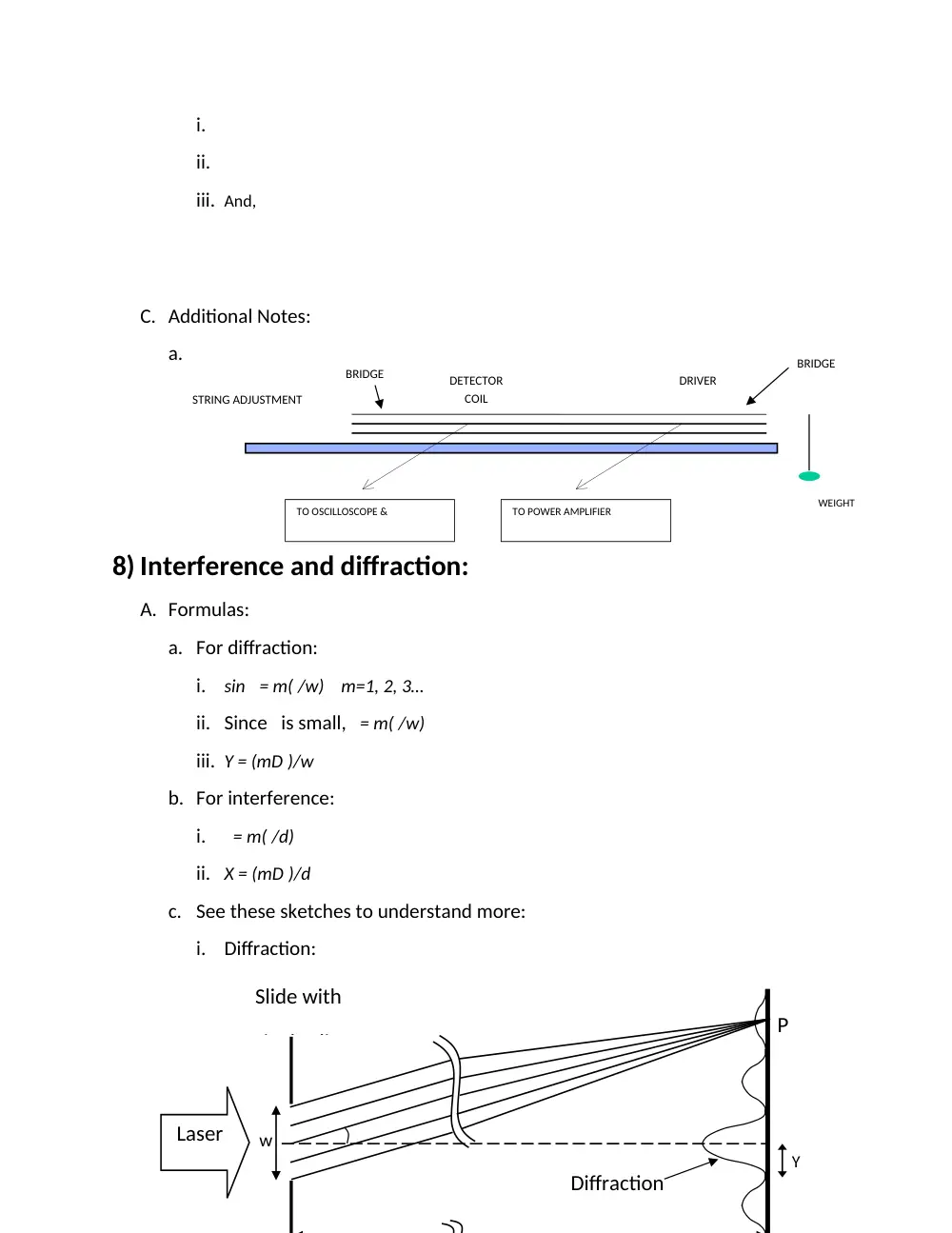
DRIVER
TO POWER AMPLIFIER
ANALOGUE CHANNEL A.
DETECTOR
COIL
TO OSCILLOSCOPE &
ANALOGUE CHANNEL B.
BRIDGE
WEIGHT
STRING ADJUSTMENT
BRIDGE
i.
ii.
iii. And,
C. Additional Notes:
a.
8) Interference and diffraction:
A. Formulas:
a. For diffraction:
i.
sin= m(/w) m=1, 2, 3…
ii. Since is small, = m(/w)
iii. Y = (mD)/w
b. For interference:
i.
= m(/d)
ii. X = (mD)/d
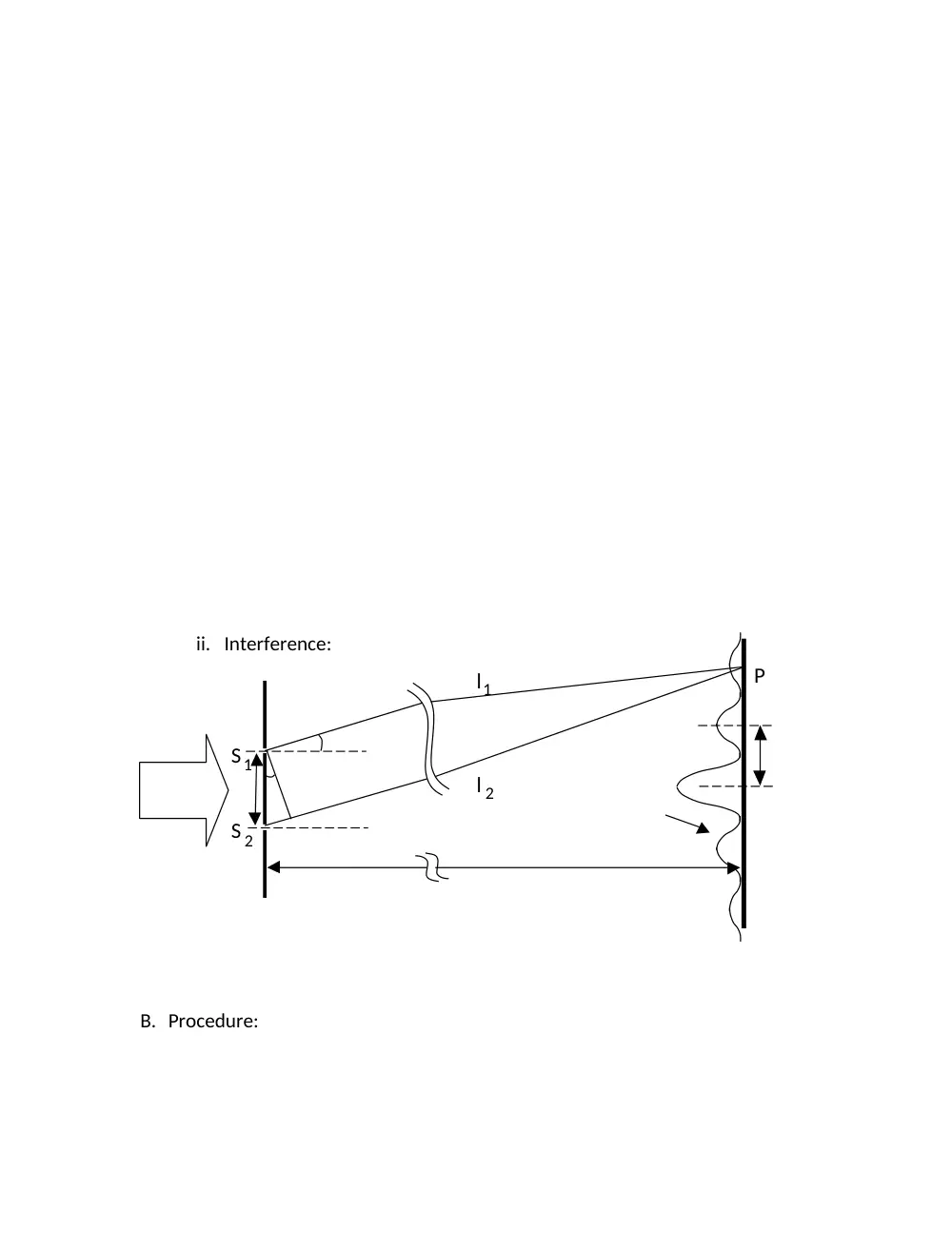
c. See these sketches to understand more:
i.
Diffraction:
Y
Diffraction
pattern
Slide with
single slit
P
w
Laser
ii. Interference:
B. Procedure:
2
1
P
2
1
S
S
l
l
a. Measure the distance of the 1st order dark fringe from both sides of the
central fringe and divide it by 2 to get the distance Y between the center of
the central fringe, and the dark fringe.
b. Use equation (a, iii.) to find the wavelength of the laser beam.
c. Almost the same thing with the interference experiment, use equation (b, ii)
to determine the wavelength.
9) Spectrometer:
A. Formulas:
a. d.sin = m. m = 0, 1, 2, 3, .................. where d is the distance separated(which
will be given) Note: they may give how many rays are passed in 1 mm, then
d=1/given-1 ( I don’t know why or if this is true, but just relying on memory).
b.
B. Nothing much to the procedure…
C. Additional notes:
a.
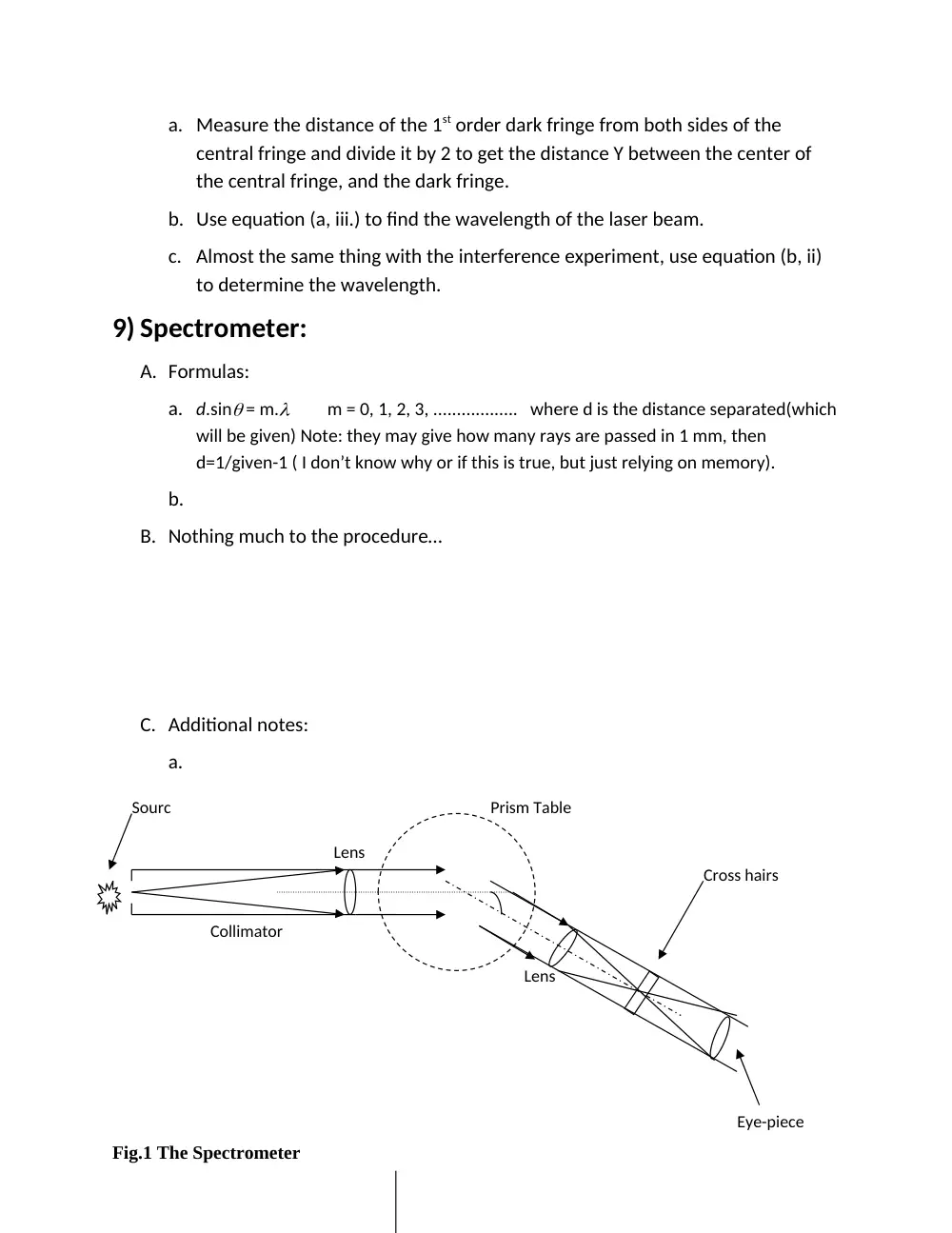
Fig.1 The Spectrometer
Prism Table
Sourc
e
Collimator
Lens
Eye-piece
Cross hairs
Lens
b.
10)
Michelson Interferometer:
A. Formulas:
a.
b. X = X0 +2L (nx – nAir) where nx=0 when it is evacuated
c.
d. again I doubt anyone can memorize this
B. Procedure:
a. Determination of the laser wavelength.
i.
dm of eq.1 is determined experimentally by counting the fringes by turning
the knob. m is the distance to the screen.
ii. Calculate
b. Determination of the index of refraction of air:
i.
Find N of eq.3 experimentally (by pumping air in the cell and counting the
fringes from a reference point), and calculate n.
c. Determination of the index of refraction of glass:
i.
Move with the rotational pointer after finding your origin, and count the
number of fringes N on the viewing screen from a reference point.
ii. Use the fourth equation to find nglass, where t is the thickness of the glass,
N is the number of fringes you counted, and is the angle you moved.
Examples of significant figures and digits after decimal:
0.42651 0.12345 0.430.12
0.42651 0.234
0.43+.23
0.426510.3456
0.40.3
0.3550.44222
0.40.4
// we round up because “3” before “5” is odd
0.6550.44222
0.60.4
// we round down because “6” before “5” is even
0.3550.1234 0.360.12
4241.23
= 0.424*1000 0.00123*1000
0.42*10000.00123*1000
425.441.23
426.41.2 // since “2” before “5” is even
426.461.23
426.51.2
426.53.23
4263