
PHYS 211 Final, Fall 2008
American University of Beirut · Electricity and Magnetism · 14 pages · Dr. Ghassan Antar



Showing the first 10 of 14 pages. Download the PDF to see all of it.
More PHYS 211 files
Show the text of this final exam
PHYSICS 211
Final EXAM FALL 2008-09
TIME: 120 minutes
January 27, 2009
DO NOT OPEN THIS EXAM BEFORE YOU ARE TOLD TO BEGIN
NAME________________________________________________
ID Number ________________________
Useful information
0=8.85x10⁻¹² C2/N.m2.
0=4p x 10-7 Tm/A.
q = 1.6 1019 C
me= 9.1x10⁻³¹ kg. mp= 1.67×10⁻²⁷ kg.
ke=8.9875x10⁹ Nm2/C2
The solution for the differential equation of the form
dy/dt + ay = b is y=(b/a)(1-exp(-at))
Grading
A
B
TOTAL
Score:________
Check if solution is continued on the back.
1
Part A: Multiple choice questions (20) each question has 2 points
1.
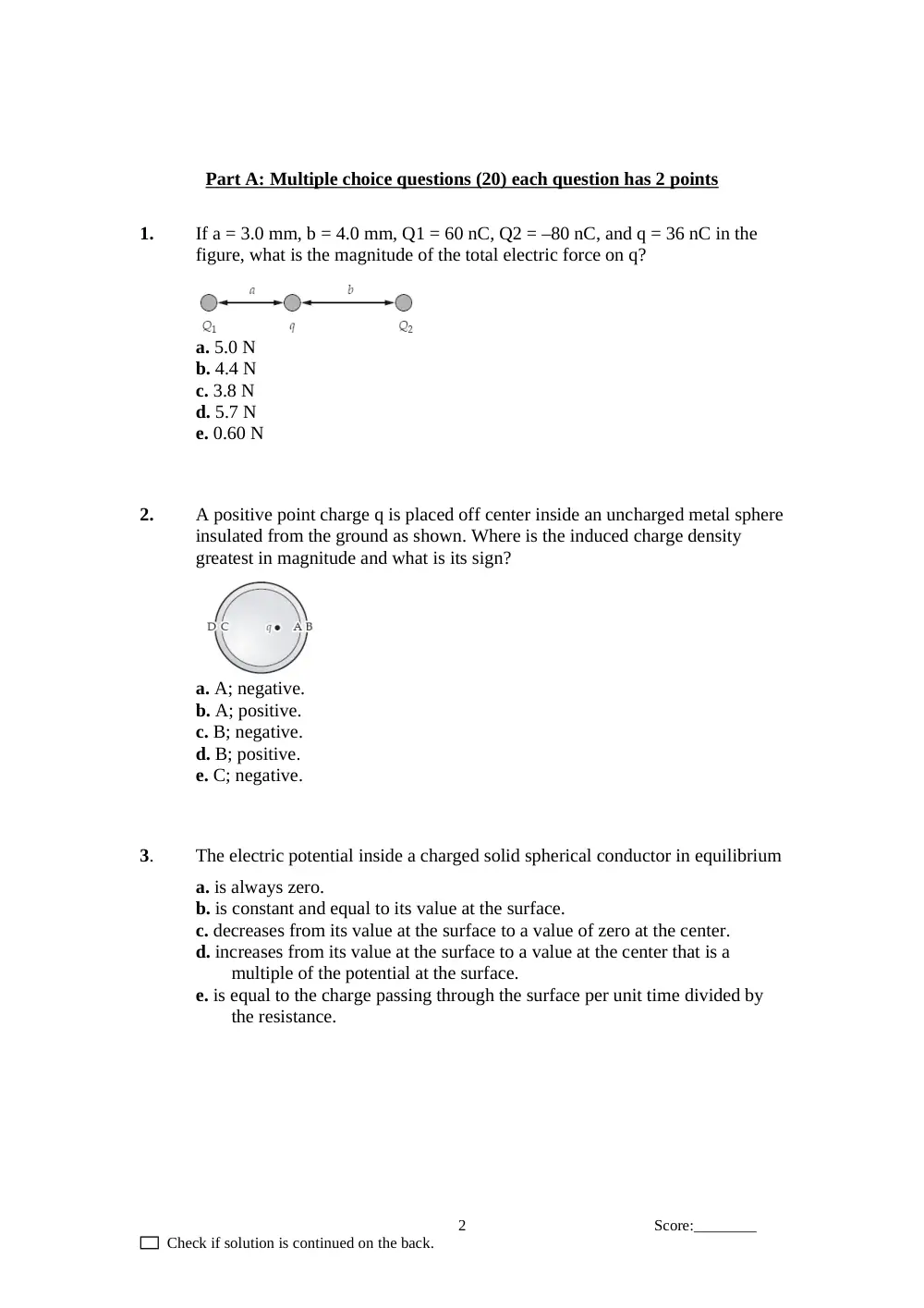
If a = 3.0 mm, b = 4.0 mm, Q1 = 60 nC, Q2 = –80 nC, and q = 36 nC in the
figure, what is the magnitude of the total electric force on q?
a. 5.0 N
b. 4.4 N
c. 3.8 N
d. 5.7 N
e. 0.60 N
2.
A positive point charge q is placed off center inside an uncharged metal sphere
insulated from the ground as shown. Where is the induced charge density
greatest in magnitude and what is its sign?
a. A; negative.
b. A; positive.
c. B; negative.
d. B; positive.
e. C; negative.
3.
The electric potential inside a charged solid spherical conductor in equilibrium
a. is always zero.
b. is constant and equal to its value at the surface.
c. decreases from its value at the surface to a value of zero at the center.
d. increases from its value at the surface to a value at the center that is a
multiple of the potential at the surface.
e. is equal to the charge passing through the surface per unit time divided by
the resistance.
Score:________
Check if solution is continued on the back.
2
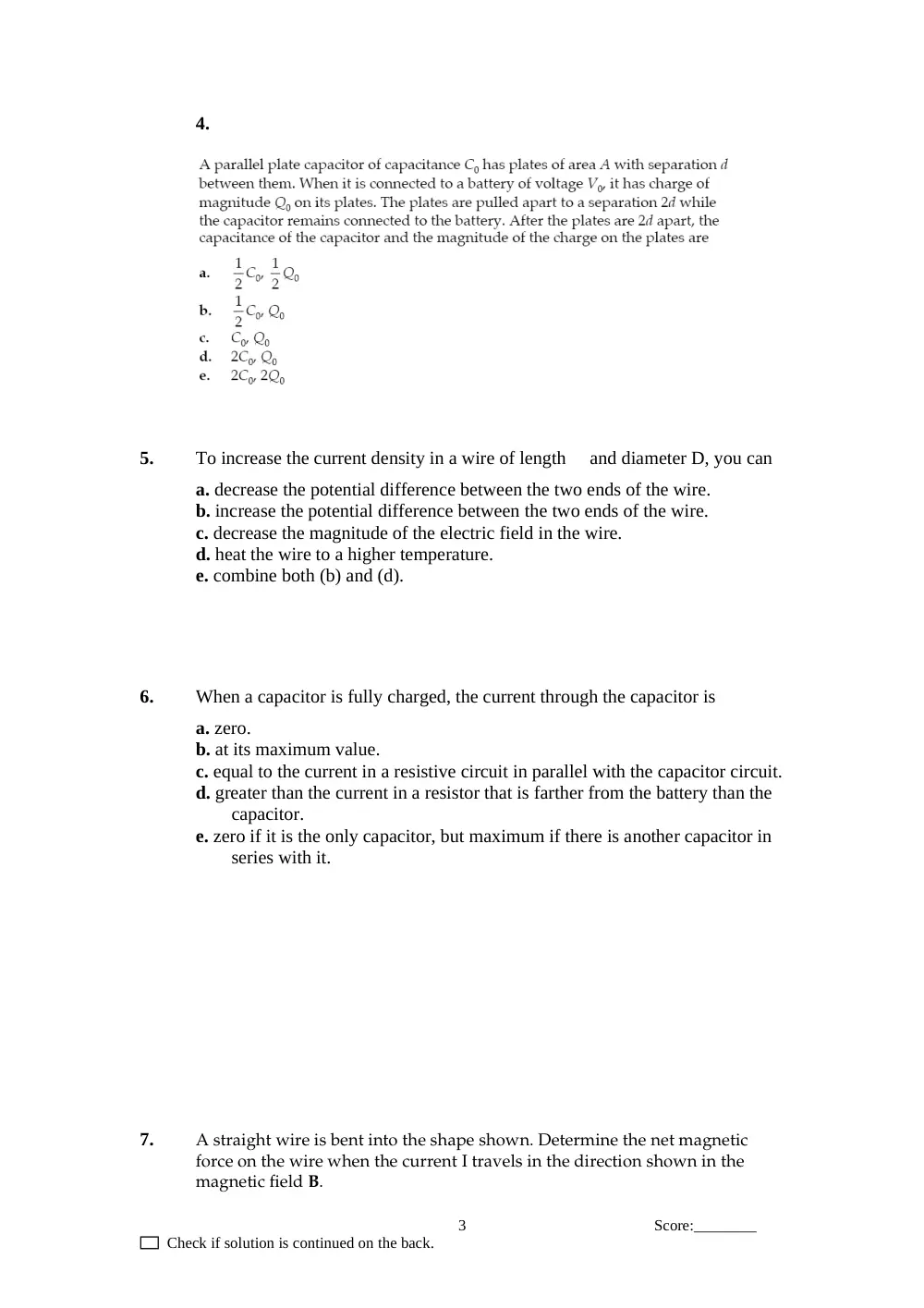
4.
5.
To increase the current density in a wire of length and diameter D, you can
a. decrease the potential difference between the two ends of the wire.
b. increase the potential difference between the two ends of the wire.
c. decrease the magnitude of the electric field in the wire.
d. heat the wire to a higher temperature.
e. combine both (b) and (d).
6.
When a capacitor is fully charged, the current through the capacitor is
a. zero.
b. at its maximum value.
c. equal to the current in a resistive circuit in parallel with the capacitor circuit.
d. greater than the current in a resistor that is farther from the battery than the
capacitor.
e. zero if it is the only capacitor, but maximum if there is another capacitor in
series with it.
7.
A straight wire is bent into the shape shown. Determine the net magnetic
force on the wire when the current I travels in the direction shown in the
magnetic field B.
Score:________
Check if solution is continued on the back.
3
a. 2IBL in the –z direction
b. 2IBL in the +z direction
c. 4IBL in the +z direction
d. 4IBL in the –z direction
e. zero
8.
9.
An induced emf is produced in
a. a closed loop of wire when it remains at rest in a nonuniform static magnetic field.
b. a closed loop of wire when it remains at rest in a uniform static magnetic field.
c. a closed loop of wire moving at constant velocity in a nonuniform static magnetic field.
d. all of the above.
e. only b and c above.
10.
Part B- Problems (80 %)
Score:________
Check if solution is continued on the back.
4
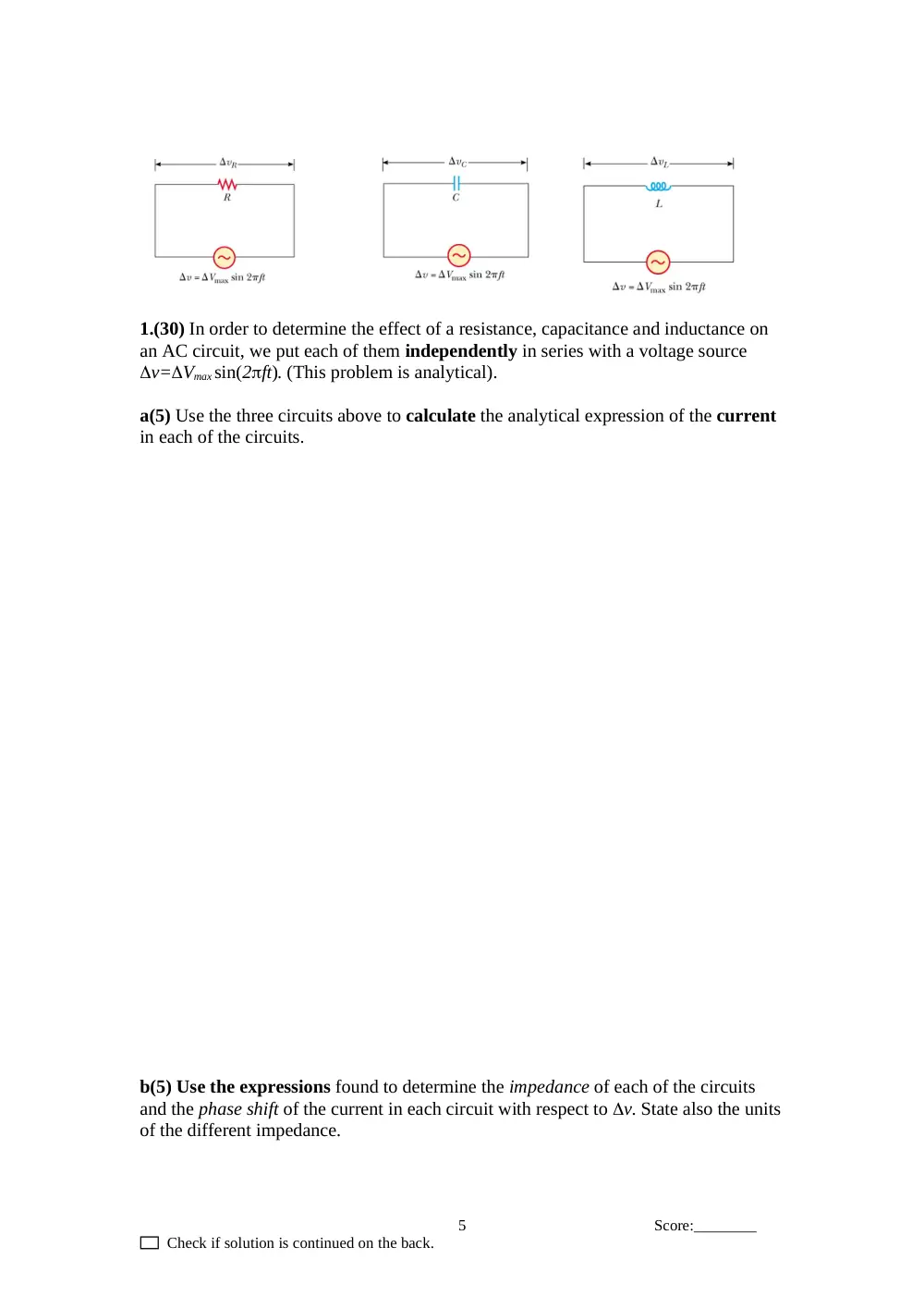
1.(30) In order to determine the effect of a resistance, capacitance and inductance on
an AC circuit, we put each of them independently in series with a voltage source
v=Vmax sin(2ft). (This problem is analytical).
a(5) Use the three circuits above to calculate the analytical expression of the current
in each of the circuits.
b(5) Use the expressions found to determine the impedance of each of the circuits
and the phase shift of the current in each circuit with respect to v. State also the units
of the different impedance.
Score:________
Check if solution is continued on the back.
5
c(5) Determine the analytical formula of the instantaneous power dissipated in each
of the circuits.
d(6) Demonstrate that the power integrated over one cycle is equal to zero when the
capacitor and the inductor are put in series with the power supply v=Vmax sin(2ft).
Score:________
Check if solution is continued on the back.
6
e(4) Determine the analytical expression of the average power dissipated as a
function of the three impedance (R, XL and Xc)
f(5) Calculate the frequency at which maximum power is dissipated.
Score:________
Check if solution is continued on the back.
7
2.(25) The switch in Figure below is open for t < 0 and then closed at time t = 0.
(a)(15) Use Kirchhoffs’ rules to find the current in the three resistors as a function of
time just after closing the switch.
Score:________
Check if solution is continued on the back.
8
(b)(10) The switch is opened, find the time dependence of three currents in the three
resistors just after.
Score:________
Check if solution is continued on the back.
9
3.(25%) A conducting rod of length ℓ = 35.0 cm is free to slide on two parallel
conducting bars as shown in the figure below. Two resistors R1 = 2.00 Ω and R2 =
5.00 Ω are connected across the ends of the bars to form a loop. A constant magnetic
field B = 2.50 T is directed perpendicularly into the page. An external agent pulls the
rod to the left with a constant speed of v = 8.00 m/s.
Score:________
Check if solution is continued on the back.
10
(a) (5)Determine the current directions on the two resistors.
(b) (10) Find the currents amplitude in both resistors
Score:________
Check if solution is continued on the back.
11
(c) (5)Find the total power delivered to the resistance of the circuit
(d) (5)Find the magnitude of the applied force that is needed to move the rod with
this constant velocity.
Score:________
Check if solution is continued on the back.
12
SCRATCH PAPER
Nothing on this page will be graded
Score:________
Check if solution is continued on the back.
13
Score:________
Check if solution is continued on the back.
14