
PHYS 211 Final with Solution, Fall 2011
American University of Beirut · Electricity and Magnetism · 7 pages · with solution




More PHYS 211 files
Show the text of this final exam
PHYSICS 211
Final EXAM, Fall 2011-20L2
TIME: 120 minutes
January 23,2012
DO NOT OPEN THIS EXAM BEFORE YOU ARE TOLD TO BEGIN
The usage of programmable calculators is strictly forbidden
ID Number
Useful information
es : 8.85x1
0-12
C2lNI.m2
Fo:4nx 10-7 Tm/A
q:1.6 x 10-re
C
mr:9.1x70-".5g
mn: l.67xl0-'' ks.
t"': g.qszsx 1 oe N=m2lC2
G
Part I (20)
Part II (20)
Part III (30)
Part IV (30)
Total
E
Check if solution is continued on the back.
Score:
It /nlaz'rt"rr't /{c oL"r/'rt
/t'/4
42'? at*'c 4*"s
&o fu=
Qs=
Ir17'ry ,yoo*.%'-*;:) I|a-tq
. z Jc_s.
b
'
+)-a y',*J-,
Zll at'{"b'2.
dr' Q, - /r' Q, r? d,' /r= o b"cqnc 7"t i
-, lt = !;u
?;n--
p m,,(
(b) (8) Show that the electric field outside the cylinder at a distance r from its axis
has the expression E =2nkpRzlr
7n flt,r-r*^ *fk
e ; /rrto, "n#
z> R , r/ i " V,M*
4e' q { 4,, Ar: t(sna{)-- !rR'{
4
an /,= /r=o
,t?o
= Z
z-
Part I: Gauss's Law (20)
Consider a long cylinder with radius R and a length / that is very large when
compared to R so as to neglect the cylinder's end edge effects. This long cylinder
has a volumetric charge density p.
(a) (7) Show that the electric field inside the cylinder at a distance r from its axis
I
has the expression E: (pl2es)r.
l
(c) (5) When {-0
the wire can be described by a linear charge density 1,, show
that )u:Q/L [Hint: Compare the electric field above to the one obtained with a
linear charge density l,]
Fa a /*;
"rAc, /,
/r-- o a'> V-g F
a> €= 24. &z
E, zlu% z tch. L4,
-f,
G 4e
f]
Check if solution is continued on the back.
4
t/4
4
t,
Qr'
=) Q,
( P"+ Q" i f,.
E (zrz€) = %a
=, Qln" TF"o
'f
q
- r'rn
2
Score:
q
Z
A,;
,r4c, /,
Aarnz"'at, .rVP-.
/U-
t/{n r?A;r-
lz 2l /'VAe
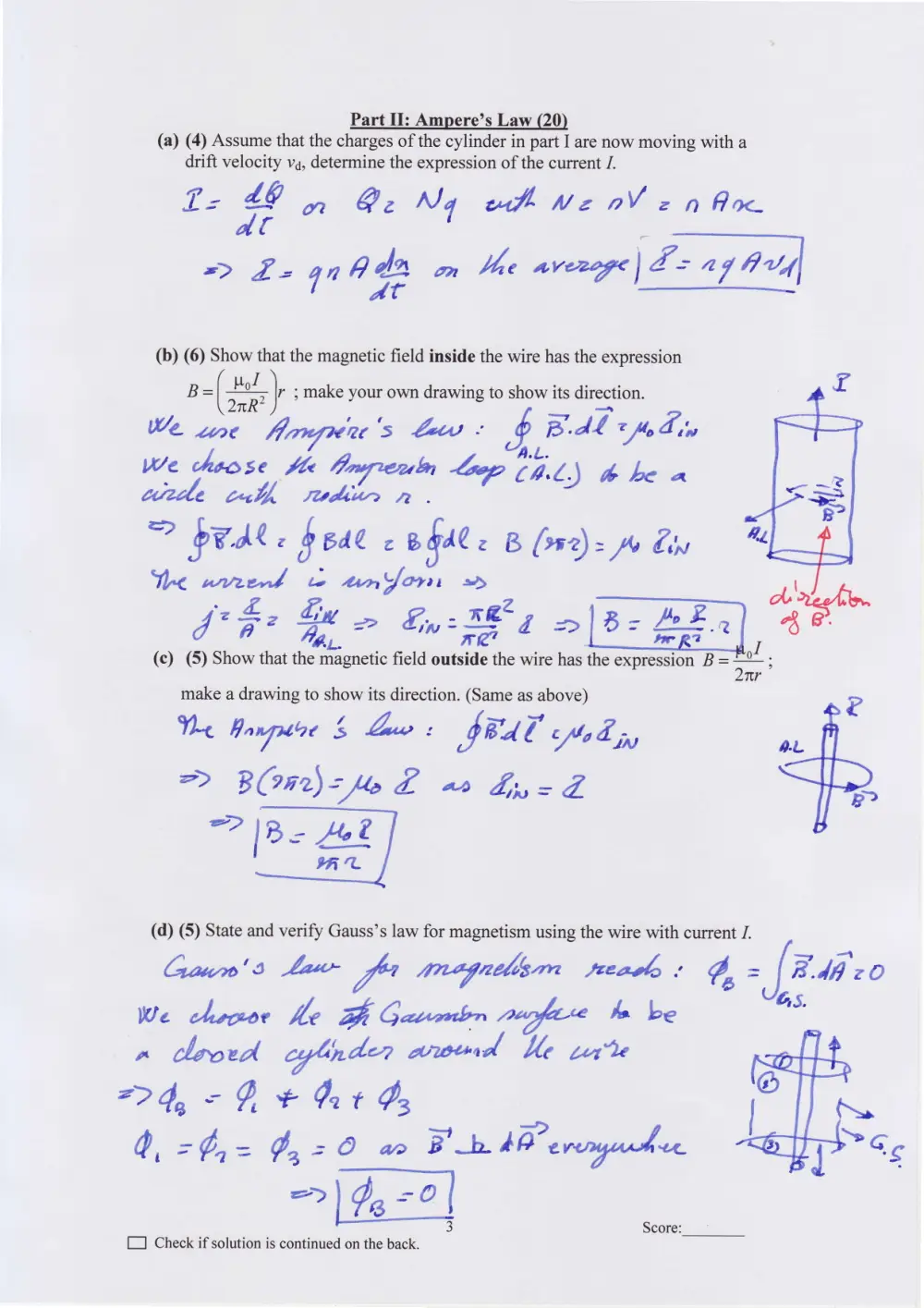
Part II: Ampere's Law (20)
(a) (4) Assume that the charges of the cylinder in part I are now moving with a
drift velocity v6, determine the expression of the current L
f - /0
& - -
olr
-) J:-
rt
4,
NI
tr// rt/e nV " n Qo<-
qne&
t
olf
(b) (6) Show that the magnetic field inside the wire has the expression
t =(*#],
; -ut. your own drawing to show its direction.
tr/z artr'" /-rf1zr3
44u
,f^ d.lV .7oZrh
We olrcs, /4, 4.r-Trerrg Zy
ib,aS d k a
an /,
a//,
ntdo'r,
n
a, il,
'oYeza/r<
I Z= " / A
a drawing to show its direction. (Same as above)
oayLte S Z,*, , jfrT
V,Zru
g(znz)'ft Z a4 f,;" = Z
(d) (5) State and veriff Gauss's law for magnetism using the wire with current /.
I
Gzrr.n'c ^/2.1- /
,frrnfoalg,rn ,r.o./" ' QU = . I F.ti,
O
^
t
../
--b..'t
.
t
|
,
UAS.
Wc ofupne /,
d C.r^.".h-, ."'gh-*
L be
-u'r'
t, &w"d
q4h/-z orro*r/ V, aa-lt
tg#t
=)4q.r n * Qzt 43
;t il (-=
Q, =h-- /q' o-3 .B---h-
l*.r-7rJ"^
'&qffi\cg
r-h
--
:>l?a=o I
3
Score:
fl
Check if solution is continued on the back.
make
w
z)
:> lBt,/aZ
|
-
3.(25) A conducting rod of length t = 35.0 cm is free to slide on two parallel conducting bars
as shown in the Figure below. Two resistors Rr = 2.00 O and I& = 5.00 O are connected across
the ends of the bars to form a loop. A constant magnetic field B = 2.50 T is directed
perpendicularly into the page. An extemal agent pulls the rod to the left with a constant
speed of z = 8.00 m/s.
5.00 {}
(d (a) Using Faraday's law, find the analytical expression and the value of the emf
caused by the motion of the bar.
Faradav's law states
where FB is the mapnetic flux
:-":i-::."]*l]''ffi9*'*'.
"**"" ""' rac'1'1ha'1'1he
u J BrvJ1g sar)$:*o n )(am *r 7*)*:.00 v
ft) (5) Consider the motion of free electrons in the bar. Show that the sane expression of
the emf can be found when equilibrium is reached between the electric and the
magnetic forces.
Two forces are acting on free electrons, the magnetic force
and the
electric force. At equilibrium, we have the sum of the forces is equal to 0 leading to
q E = q a B o r E = o B
The electric field is related to the potential difference across the ends of the conductor:
L V = E t = B t a
The left-hand loop contains decreasing
flux away from you, so the induced current in it will be (ii;
clockwise, to produce its own field directed away from you. Let -4 represent
the current flowing
T
rrr
F'
I ,
, t + | ,
I
i I I *
| . .tfN.'.
.
"
l*r,
l" 'luE
l '
' ! ; - o
-l.*_.
L=i
(c) (2) Show on the figure above the direction of the currents in the two resistors, and
justify below.
fl
Check if solution is continued on the back.
Score:
5
6
4
upward through the 2.00-0 resistor. The right-hand loop will carry counterclockwise current. Let 4 be
the upward current in the 5.00-0 resistor.
(d) (6)Determine the value of the current in both resistors.
Kirchhoffs loop rule then gives:
and,reffi
(e) (3) Find the total power delivered to the resistance of the circuit.
The total power dissipated in the resistors of the circuit is
(0 (5) Find the magnitude of the applied force that is needed to move the rod with this
constant velocity.
Method 1: The current in the slidine conductor is downward with value
The magnetic field exerts a force of
directed @
16*ut4 *"
right on this conductor. An outside agent must then exert a force of
F.zg N I to the left to keep the bar moving.
E
Check if solution is continued on the back.
Score:
4
5
6
we consider
a circuit "o-oo*dffi
supplying
a current
1:1.*sin(at), aresistor R and an inductor Z.
(a)(4\ consider that the resistance arone is connected to the power supply,
determine the expression of the potential difference across it.
Wc
iD
gh,m's 4zL,
Av z R Z
R
It_rd
b0(+)= Rfl,,n , ot|uast +\aVr
&c,L -- RZ'rn-*
7 4=o
(bx4) consider that the inductor arone is connected to the power supply,
determine the expression of the potential difference across it.
L
H,t -1/4/!
/rV
tu,Lc -/"o4
b
l-ap
arlrry/s ry
nu-zc -{ea4
b
I-rD|Irt
bVr- tfi=o
=> bV=aLf-2rr@,*+
l_@J
:)
AV " LraE,rrw ^n (urr4
"* $'":mr.t
-- Lqr Srnq
/
t
Q=+F/z
(c) (6) when both R and, L are put in series, determine the impedance of the
circuit.
. /-
,
-'*-r!uv
u't,wsarvs
ur uls
R
L
w;--'>, /, l*a/,b/n*,,fu
ffi
A\t c bVu + AVr<
r'
I
,-,, I
byu
02 bYn.
i-;=
dVfl= W.t,oo".
I =r' ,a
(dX5) Determine the expression of the circuit phase.
#.1 Q , 2/r"'I4*' .t !?E-6t- --/Q = E'/ry
\
o
5ve,,nea
"
RgE=l
:=
d (7).
Score:
IZ "t L?qt"
fl
Check if solution is continued on the back.
(e) (6) use the axes berow to prot the current 1r* vs. al assuming AZr* is
constant and discuss the behavio, oi,fri, circuit at low fr
at high frequencies (cl---+oo).
uuD urruulr at Iow liequencies (al-g) and
aaa2+o
-:+ 2aR
a,/onaa+W
ea eJ
>oo -:* ?
oa
*
Zn_o*gO
nl
lok^ //,
anglrler$eqlerrcy.
-
?':,
=
ttd
:t
bvqmoa -
-
Lut
=ffi
avn
Tlr;
Ahcr"r/ ce"2 /e *.rr'
aa a Jr,rl-
/ {h o,loz
muilW^
/uL< j, -o,r? tf?z
,rl
'qx?,*L, ;J
n1l,a.A
Score:-
o*on
/,
,ffit 6-",fzo];"7
L ut Z"rr.<
bvn
bVu, ,rr^,a
<
fl
Check if solution is continued on the back.
7
q)