
PHYS 211 Final, Fall 2009
American University of Beirut · Electricity and Magnetism · 11 pages · Dr. Ghassan Antar


Showing the first 10 of 11 pages. Download the PDF to see all of it.
More PHYS 211 files
Show the text of this final exam
Score:________
Check if solution is continued on the back.
1
PHYSICS 211
Final Spring 2009-2010
TIME: 90 minutes
February 5, 2010
DO NOT OPEN THIS EXAM BEFORE YOU ARE TOLD TO BEGIN
The usage of programmable calculators is strictly forbidden
NAME________________________________________________
ID Number ________________________
Useful information
0=8.85x10⁻¹² C2/N.m2
0=4p x 10-7 Tm/A
q = 1.6 1019 C
me= 9.1x10⁻³¹ kg
mp= 1.67×10⁻²⁷ kg
ke=8.9875x10⁹ Nm2/C2
Grading
A (24)
B (76)
TOTAL
Score:________
Check if solution is continued on the back.
2
Part A:
Multiple choice questions (24) each question is 2%
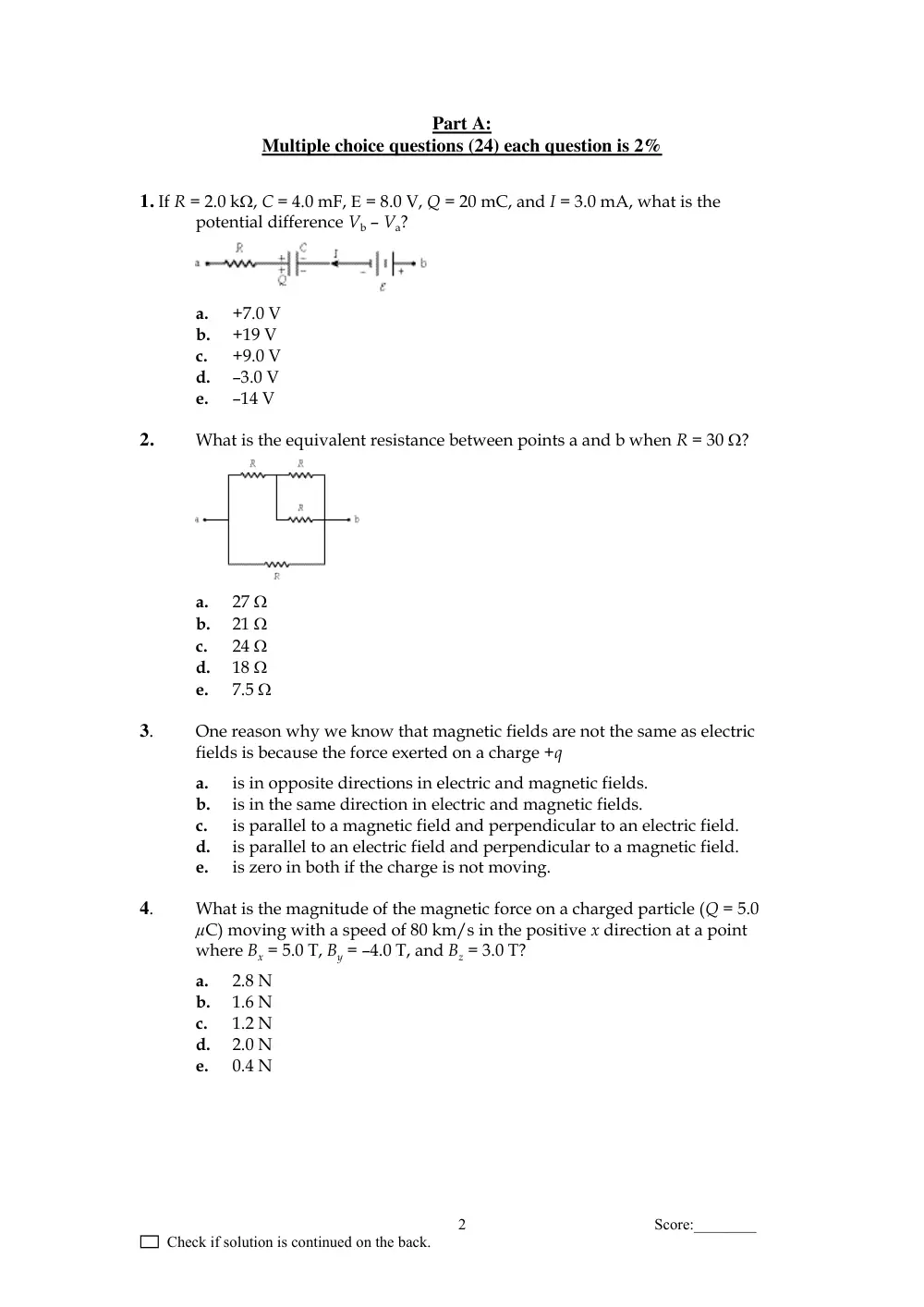
1. If R = 2.0 k, C = 4.0 mF, = 8.0 V, Q = 20 mC, and I = 3.0 mA, what is the
potential difference Vb – Va?
a.
+7.0 V
b.
+19 V
c.
+9.0 V
d.
–3.0 V
e.
–14 V
2.
What is the equivalent resistance between points a and b when R = 30 ?
a.
27
b.
21
c.
24
d.
18
e.
7.5
3.
One reason why we know that magnetic fields are not the same as electric
fields is because the force exerted on a charge +q
a.
is in opposite directions in electric and magnetic fields.
b.
is in the same direction in electric and magnetic fields.
c.
is parallel to a magnetic field and perpendicular to an electric field.
d.
is parallel to an electric field and perpendicular to a magnetic field.
e.
is zero in both if the charge is not moving.
4.
What is the magnitude of the magnetic force on a charged particle (Q = 5.0
µC) moving with a speed of 80 km/s in the positive x direction at a point
where Bx = 5.0 T, By = –4.0 T, and Bz = 3.0 T?
a.
2.8 N
b.
1.6 N
c.
1.2 N
d.
2.0 N
e.
0.4 N
Score:________
Check if solution is continued on the back.
3
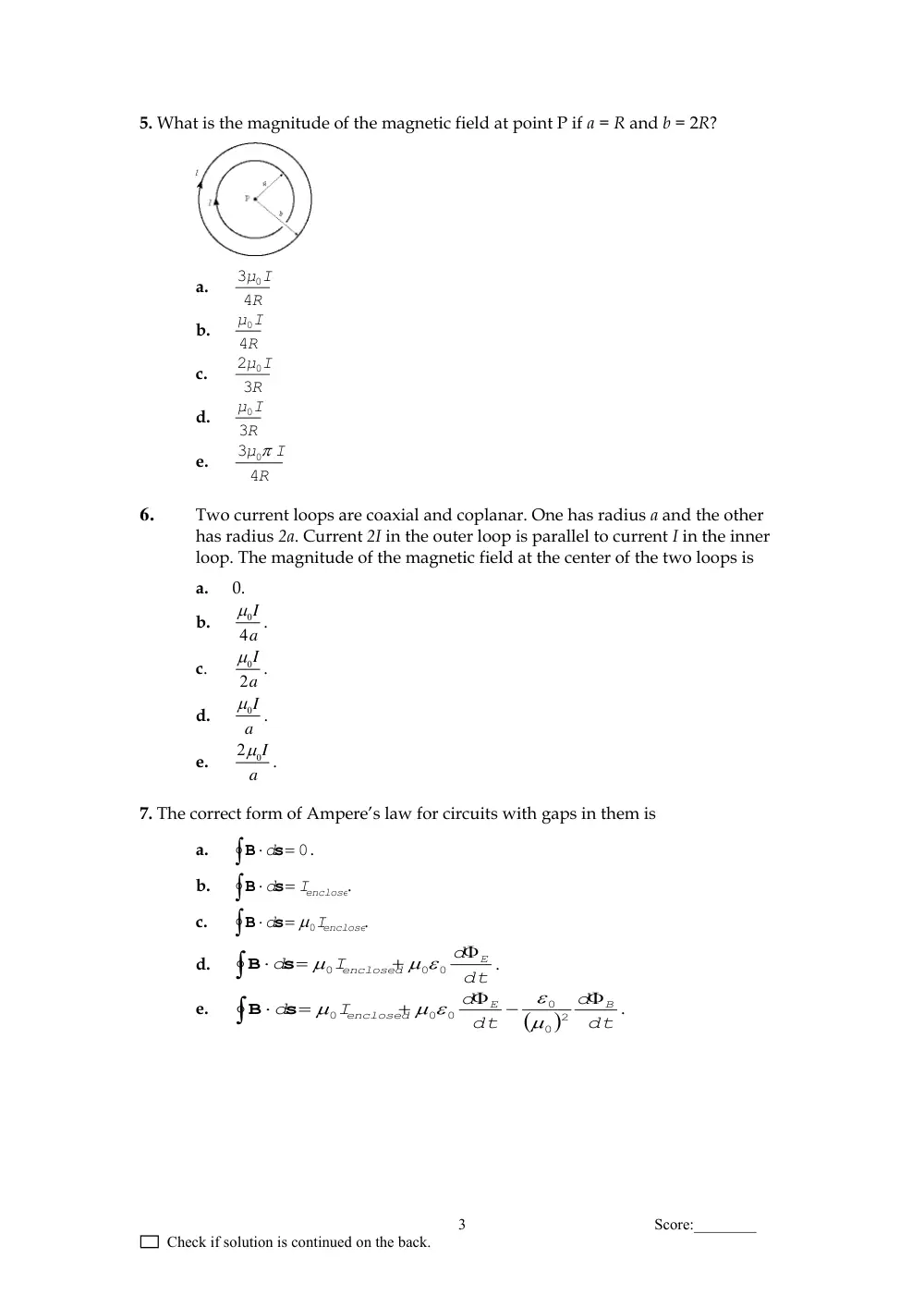
5. What is the magnitude of the magnetic field at point P if a = R and b = 2R?
a.
R
µ I
4
3 0
b.
R
µ I
4
0
c.
R
µ I
3
2 0
d.
R
µ I
3
0
e.
R
I
µ
4
3 0
6.
Two current loops are coaxial and coplanar. One has radius a and the other
has radius 2a. Current 2I in the outer loop is parallel to current I in the inner
loop. The magnitude of the magnetic field at the center of the two loops is
a.
0.
b.
0I
4a .
c.
0I
2a .
d.
0I
a .
e.
20I
a
.
7. The correct form of Ampere’s law for circuits with gaps in them is
a.
B ds 0
.
b.
enclosed
I
B ds
.
c.
enclosed
I
d
0
s
B
.
d.
dt
d
I
d
E
enclosed
0
0
0
s
B
.
e.
dt
d
dt
d
I
d
B
E
enclosed
2
0
0
0
0
0
s
B
.
Score:________
Check if solution is continued on the back.
4
8. A 50-turn circular coil (radius = 15 cm) with a total resistance of 4.0 is placed in
a uniform magnetic field directed perpendicularly to the plane of the coil.
The magnitude of this field varies with time according to B = A sin (t),
where A = 80 µT and = 50 rad/s. What is the magnitude of the current
induced in the coil at t = 20 ms?
a.
11 mA
b.
18 mA
c.
14 mA
d.
22 mA
e.
zero
9. When a switch is closed to complete a DC series RL circuit,
a.
the electric field in the wires increases to a maximum value.
b.
the magnetic field outside the wires increases to a maximum value.
c.
the rate of change of the electric and magnetic fields is greatest at the
instant when the switch is closed.
d.
all of the above are true.
e.
only (a) and (c) above are true.
10. A charge of 5.0 pC is distributed uniformly on a spherical surface
(radius = 2.0 cm), and a second charge of –2.0 pC is distributed uniformly on
a concentric spherical surface (radius = 4.0 cm). Determine the magnitude of
the electric field 3.0 cm from the center of the two surfaces.
a.
30 N/C
b.
50 N/C
c.
40 N/C
d.
20 N/C
e.
70 N/C
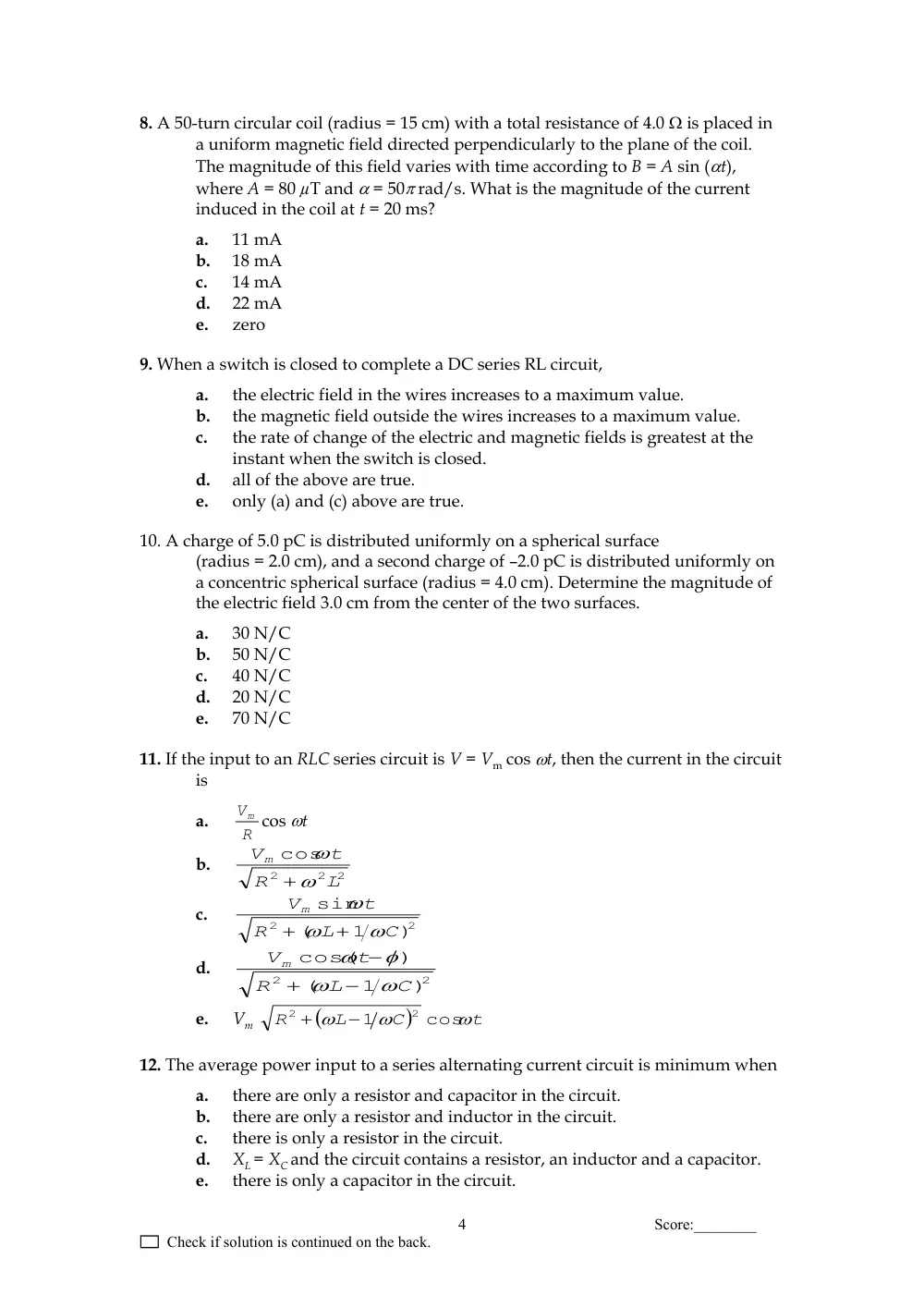
11. If the input to an RLC series circuit is V = Vm cos t, then the current in the circuit
is
a.
R
Vm cos t
b.
2
2
2
cos
L
R
t
Vm
c.
2
2
)
1
(
sin
C
L
R
t
Vm
d.
2
2
)
1
(
)
cos(
C
L
R
t
Vm
e.
Vm
t
C
L
R
cos
1
2
2
12. The average power input to a series alternating current circuit is minimum when
a.
there are only a resistor and capacitor in the circuit.
b.
there are only a resistor and inductor in the circuit.
c.
there is only a resistor in the circuit.
d.
XL = XC and the circuit contains a resistor, an inductor and a capacitor.
e.
there is only a capacitor in the circuit.
Score:________
Check if solution is continued on the back.
5
Part B- Problems (76 %)
1. (26) Consider a long cylinder with radius R and a length l that is very large
when compared to R so as to neglect the cylinders end edge effects. The charge
density distribution in the cylinder is not uniform but grows linearly with
radius according to (r) = r
(a) (5) Show that the electric field inside the cylinder at a distance r from its axis
has the expression E = (1/3)r2.
(b) (5) Show that the electric field outside the cylinder at a distance r from its axis
has the expression E =(1/3)R3/r
(c) (2) Assume that these charges are now moving with a drift velocity vd,
determine the expression of the current density inside the cylinder.
Score:________
Check if solution is continued on the back.
6
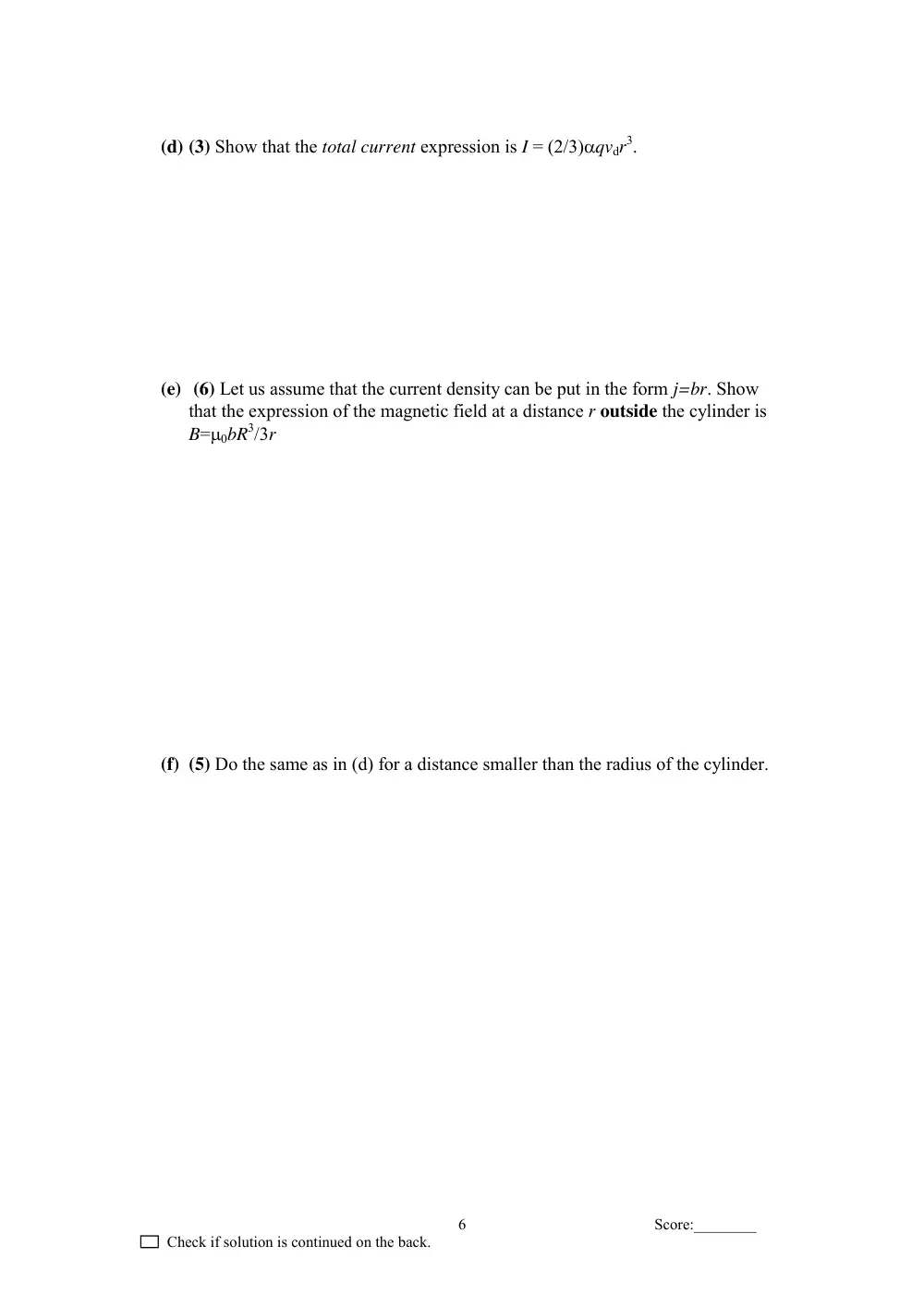
(d) (3) Show that the total current expression is I = (2/3)qvdr3.
(e) (6) Let us assume that the current density can be put in the form j=br. Show
that the expression of the magnetic field at a distance r outside the cylinder is
B=0bR3/3r
(f) (5) Do the same as in (d) for a distance smaller than the radius of the cylinder.
Score:________
Check if solution is continued on the back.
7
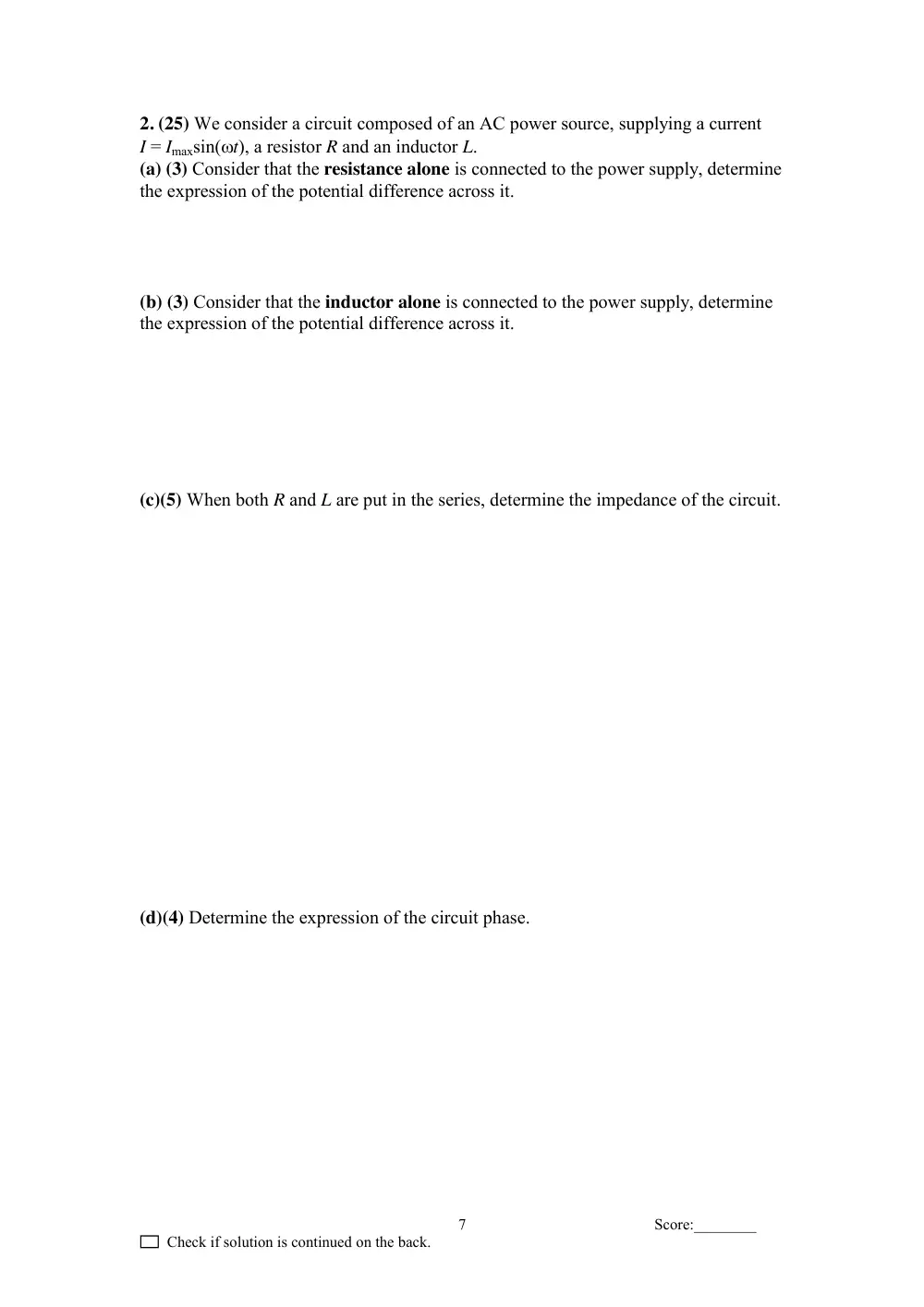
2. (25) We consider a circuit composed of an AC power source, supplying a current
I = Imaxsin(t), a resistor R and an inductor L.
(a) (3) Consider that the resistance alone is connected to the power supply, determine
the expression of the potential difference across it.
(b) (3) Consider that the inductor alone is connected to the power supply, determine
the expression of the potential difference across it.
(c)(5) When both R and L are put in the series, determine the impedance of the circuit.
(d)(4) Determine the expression of the circuit phase.
Score:________
Check if solution is continued on the back.
8
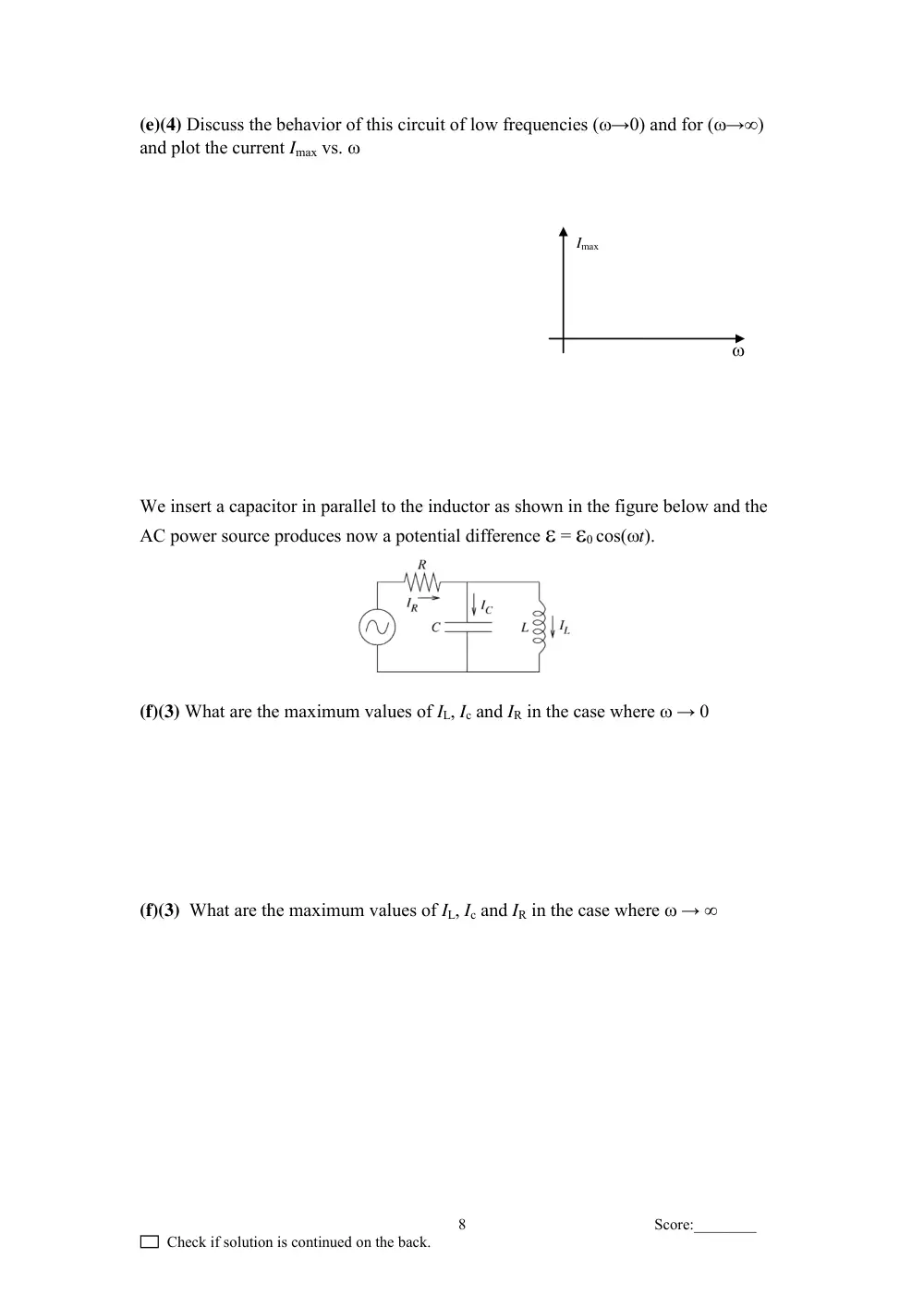
(e)(4) Discuss the behavior of this circuit of low frequencies (→0) and for (→∞)
and plot the current Imax vs.
We insert a capacitor in parallel to the inductor as shown in the figure below and the
AC power source produces now a potential difference = 0 cos(t).
(f)(3) What are the maximum values of IL, Ic and IR in the case where → 0
(f)(3) What are the maximum values of IL, Ic and IR in the case where → ∞
Imax
Score:________
Check if solution is continued on the back.
9
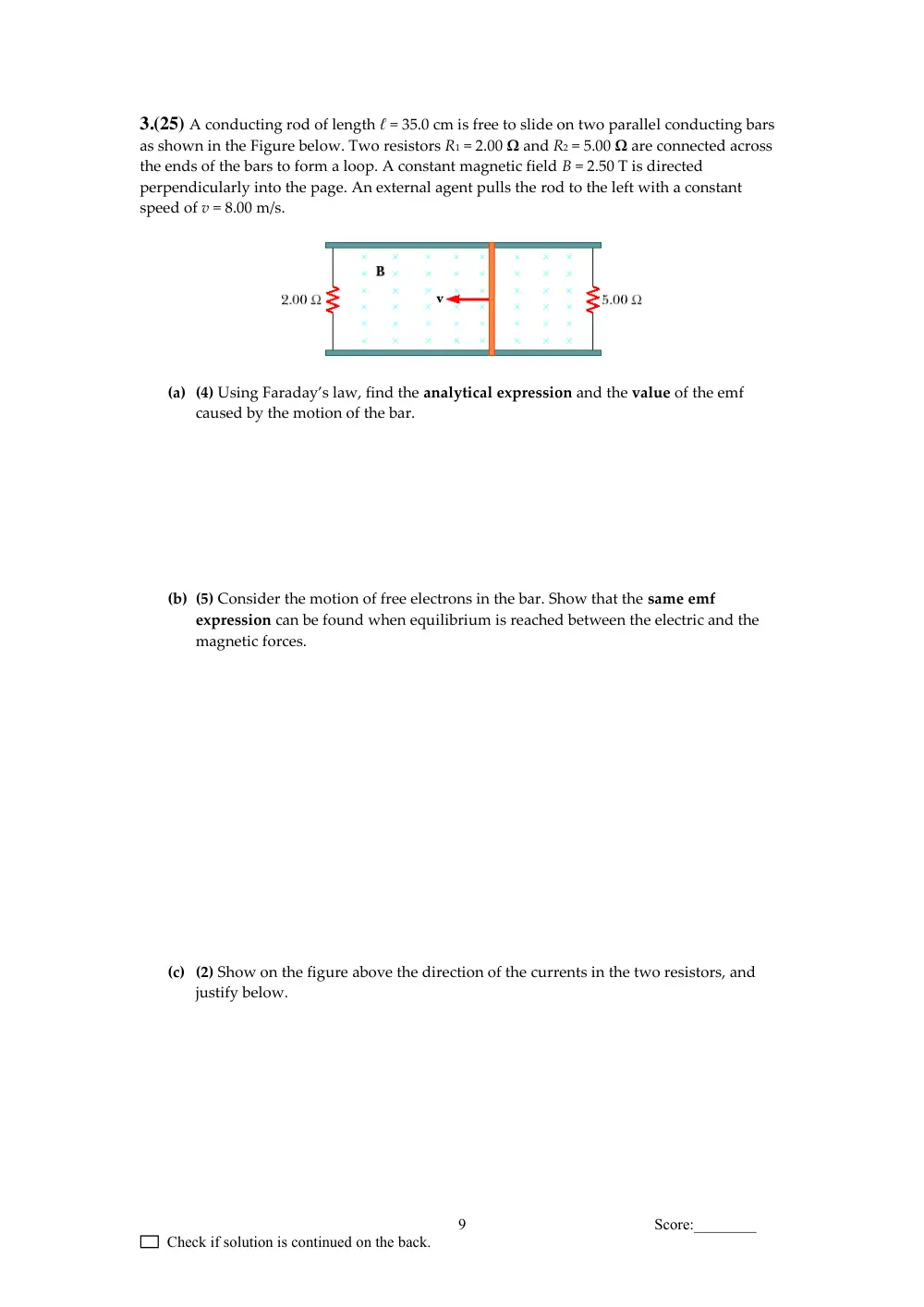
3.(25) A conducting rod of length ℓ = 35.0 cm is free to slide on two parallel conducting bars
as shown in the Figure below. Two resistors R1 = 2.00 Ω and R2 = 5.00 Ω are connected across
the ends of the bars to form a loop. A constant magnetic field B = 2.50 T is directed
perpendicularly into the page. An external agent pulls the rod to the left with a constant
speed of v = 8.00 m/s.
(a) (4) Using Faraday’s law, find the analytical expression and the value of the emf
caused by the motion of the bar.
(b) (5) Consider the motion of free electrons in the bar. Show that the same emf
expression can be found when equilibrium is reached between the electric and the
magnetic forces.
(c) (2) Show on the figure above the direction of the currents in the two resistors, and
justify below.
Score:________
Check if solution is continued on the back.
10
(d) (6) Determine the value of the current in both resistors.
(e) (3) Find the total power delivered to the resistance of the circuit.
(f) (5) Find the magnitude of the applied force that is needed to move the rod with this
constant velocity.
Score:________
Check if solution is continued on the back.
11
SCRATCH PAPER
Nothing on this page will be graded