
PHYS 216 Exam 2, Fall 2012
American University of Beirut · Mathematical Methods for Physics · 2 pages · Dr. Ali Chamseddine
More PHYS 216 files
- Exam 1 · Fall 2017ExamView
- Exam 1 · Fall 2017ExamView
- Exam 1 Solution · Fall 2017Exam · with solutionView
- Exam 1 Solution · Fall 2017Exam · with solutionView
- Exam 2 · Fall 2016ExamView
- Exam 2 · Fall 2016ExamView
- Exam 2 Solutions · Fall 2016Exam · with solutionView
- Exam 2 Solutions · Fall 2016Exam · with solutionView
Show the text of this exam
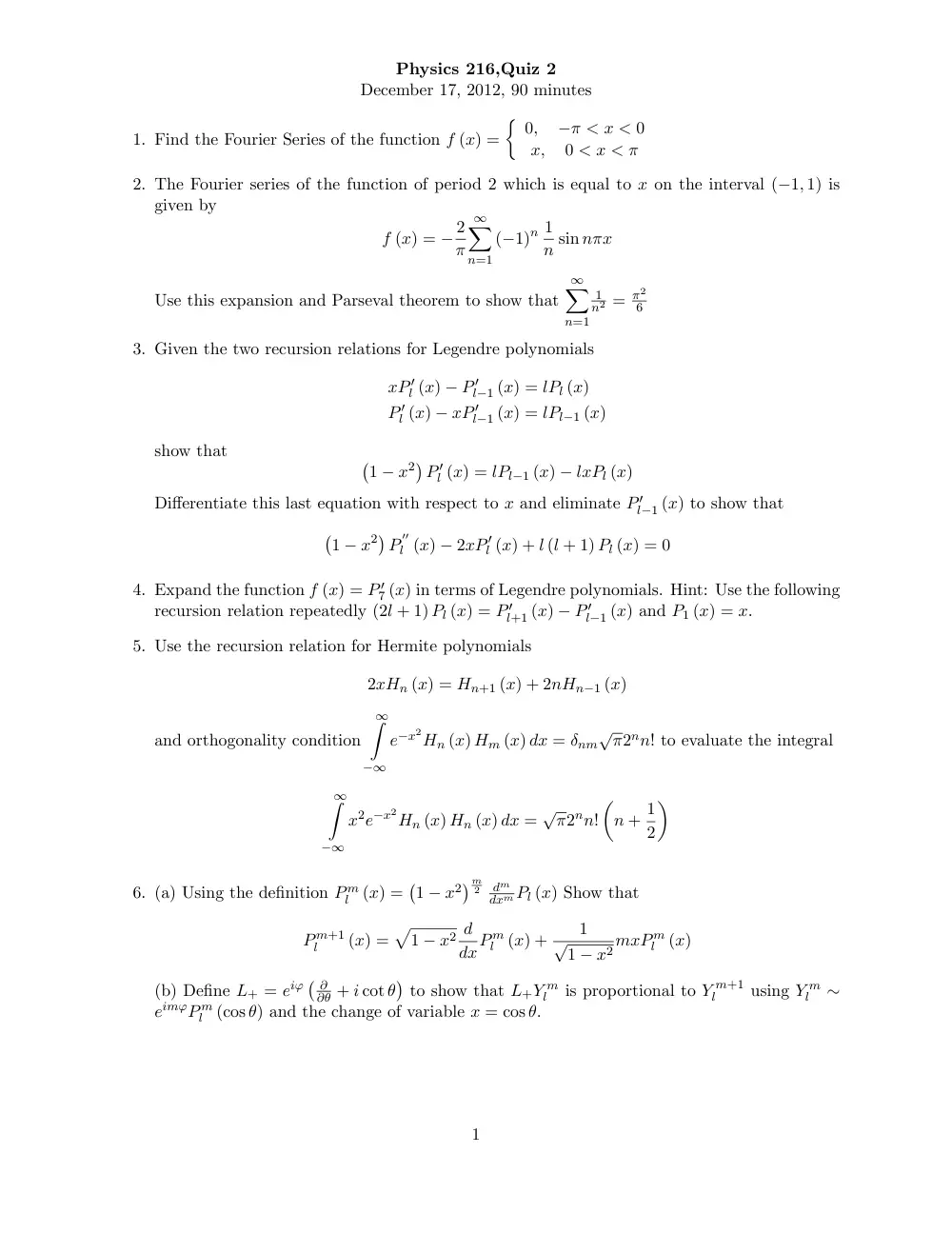
Physics 216,Quiz 2
December 17, 2012, 90 minutes
1. Find the Fourier Series of the function f (x) =
� 0,
−π < x < 0
x,
0 < x < π
2. The Fourier series of the function of period 2 which is equal to x on the interval (−1, 1) is
given by
f (x) = − 2
π
∞
�
n=1
(−1)n 1
n sin nπx
Use this expansion and Parseval theorem to show that
∞
�
n=1
1
n2 = π2
6
3. Given the two recursion relations for Legendre polynomials
xP ′
l (x) − P ′
l−1 (x) = lPl (x)
P ′
l (x) − xP ′
l−1 (x) = lPl−1 (x)
show that
�
1 − x2�
P ′
l (x) = lPl−1 (x) − lxPl (x)
Differentiate this last equation with respect to x and eliminate P ′
l−1 (x) to show that
�
1 − x2�
P
′′
l (x) − 2xP ′
l (x) + l (l + 1) Pl (x) = 0
4. Expand the function f (x) = P ′
7 (x) in terms of Legendre polynomials. Hint: Use the following
recursion relation repeatedly (2l + 1) Pl (x) = P ′
l+1 (x) − P ′
l−1 (x) and P1 (x) = x.
5. Use the recursion relation for Hermite polynomials
2xHn (x) = Hn+1 (x) + 2nHn−1 (x)
and orthogonality condition
∞
�
−∞
e−x2Hn (x) Hm (x) dx = δnm
√π2nn! to evaluate the integral
∞
�
−∞
x2e−x2Hn (x) Hn (x) dx = √π2nn!
�
n + 1
2
�
6. (a) Using the definition P m
l
(x) =
�
1 − x2� m
2
dm
dxm Pl (x) Show that
P m+1
l
(x) =
�
1 − x2 d
dxP m
l
(x) +
1
√
1 − x2 mxP m
l
(x)
(b) Define L+ = eiϕ � ∂
∂θ + i cot θ
�
to show that L+Y m
l
is proportional to Y m+1
l
using Y m
l
∼
eimϕP m
l
(cos θ) and the change of variable x = cos θ.
1
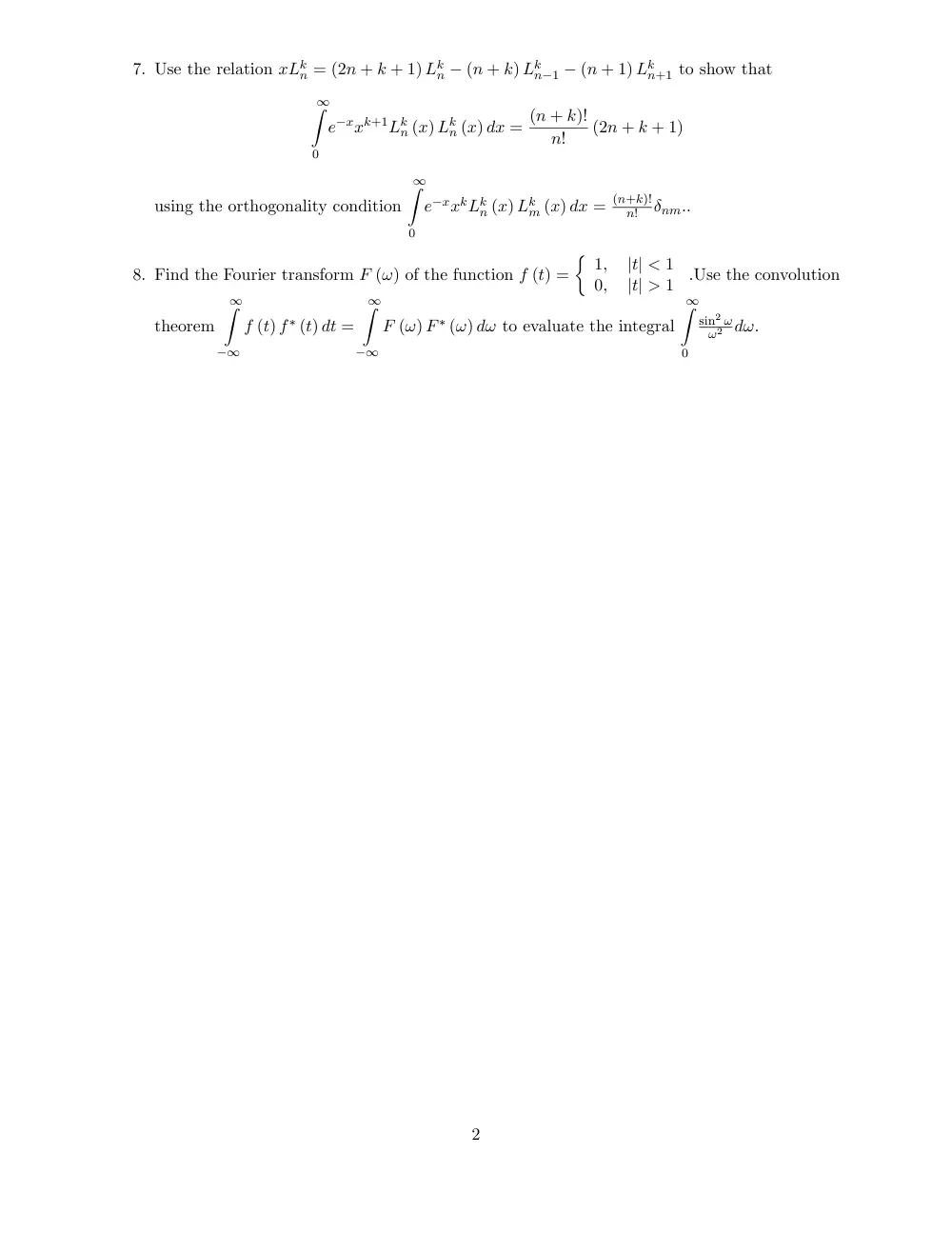
7. Use the relation xLk
n = (2n + k + 1) Lk
n − (n + k) Lk
n−1 − (n + 1) Lk
n+1 to show that
∞
�
0
e−xxk+1Lk
n (x) Lk
n (x) dx = (n + k)!
n!
(2n + k + 1)
using the orthogonality condition
∞
�
0
e−xxkLk
n (x) Lk
m (x) dx = (n+k)!
n!
δnm..
8. Find the Fourier transform F (ω) of the function f (t) =
� 1,
|t| < 1
0,
|t| > 1
.Use the convolution
theorem
∞
�
−∞
f (t) f∗ (t) dt =
∞
�
−∞
F (ω) F ∗ (ω) dω to evaluate the integral
∞
�
0
sin2 ω
ω2 dω.
2