
SOAN 201 Chapter 1, Fall 2012
American University of Beirut · Introduction to Sociology · 3 pages
More SOAN 201 files
- Useful File Reading Material · Spring 2016FileView
- Useful File Reading Material · Spring 2016FileView
- Useful File Reading Material · Spring 2016FileView
- Useful File Reading Material · Spring 2016FileView
- Useful File Reading Material · Spring 2016FileView
- Notes Chapter 2 · Fall 2013NotesView
- Notes Topic 2 · Fall 2012NotesView
- Notes Topic 3 · Fall 2012NotesView
Show the text of this chapter
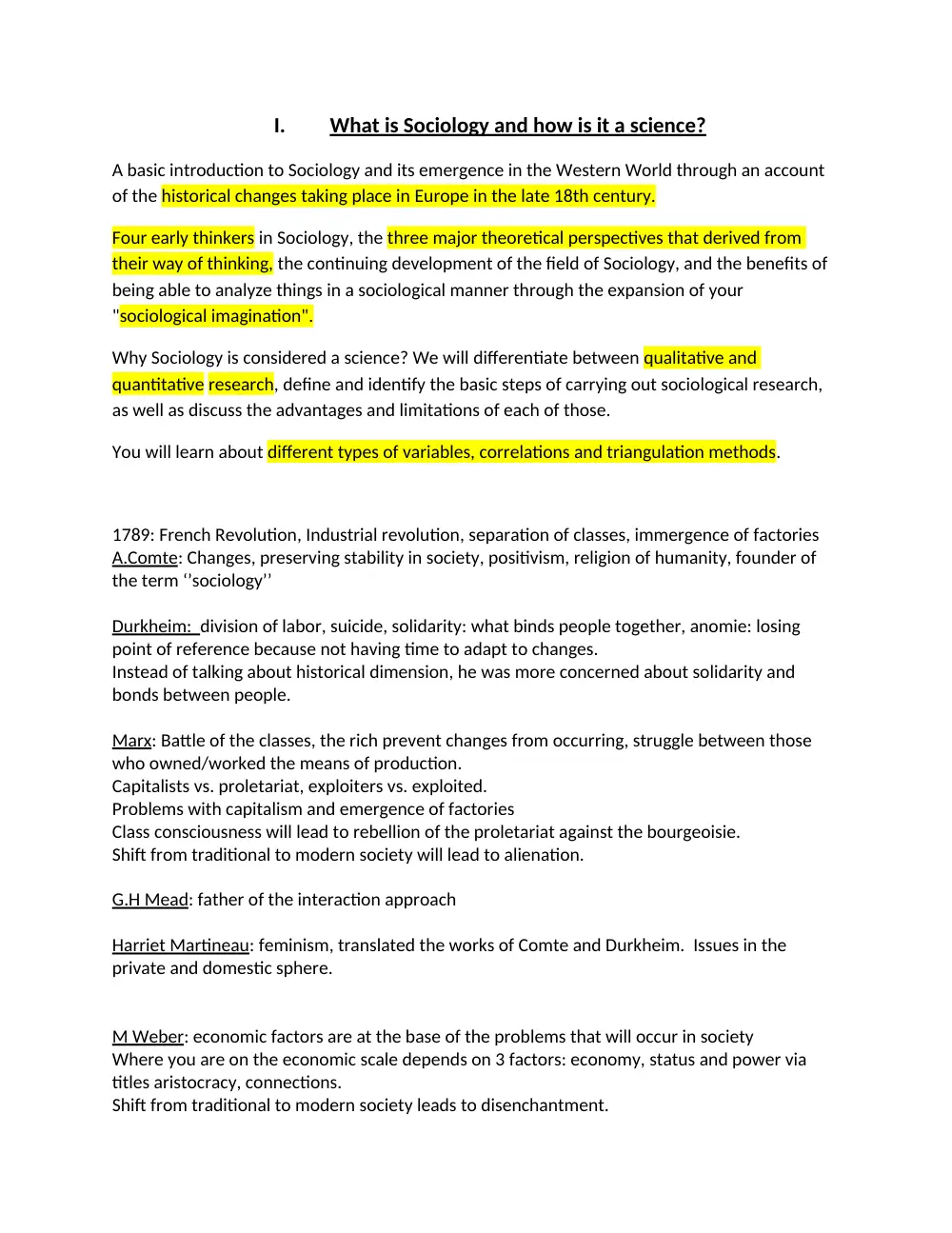
I.
What is Sociology and how is it a science?
A basic introduction to Sociology and its emergence in the Western World through an account
of the historical changes taking place in Europe in the late 18th century.
Four early thinkers in Sociology, the three major theoretical perspectives that derived from
their way of thinking, the continuing development of the field of Sociology, and the benefits of
being able to analyze things in a sociological manner through the expansion of your
"sociological imagination".
Why Sociology is considered a science? We will differentiate between qualitative and
quantitative research, define and identify the basic steps of carrying out sociological research,
as well as discuss the advantages and limitations of each of those.
You will learn about different types of variables, correlations and triangulation methods.
1789: French Revolution, Industrial revolution, separation of classes, immergence of factories
A.Comte: Changes, preserving stability in society, positivism, religion of humanity, founder of
the term ‘’sociology’’
Durkheim: division of labor, suicide, solidarity: what binds people together, anomie: losing
point of reference because not having time to adapt to changes.
Instead of talking about historical dimension, he was more concerned about solidarity and
bonds between people.
Marx: Battle of the classes, the rich prevent changes from occurring, struggle between those
who owned/worked the means of production.
Capitalists vs. proletariat, exploiters vs. exploited.
Problems with capitalism and emergence of factories
Class consciousness will lead to rebellion of the proletariat against the bourgeoisie.
Shift from traditional to modern society will lead to alienation.
G.H Mead: father of the interaction approach
Harriet Martineau: feminism, translated the works of Comte and Durkheim. Issues in the
private and domestic sphere.
M Weber: economic factors are at the base of the problems that will occur in society
Where you are on the economic scale depends on 3 factors: economy, status and power via
titles aristocracy, connections.
Shift from traditional to modern society leads to disenchantment.
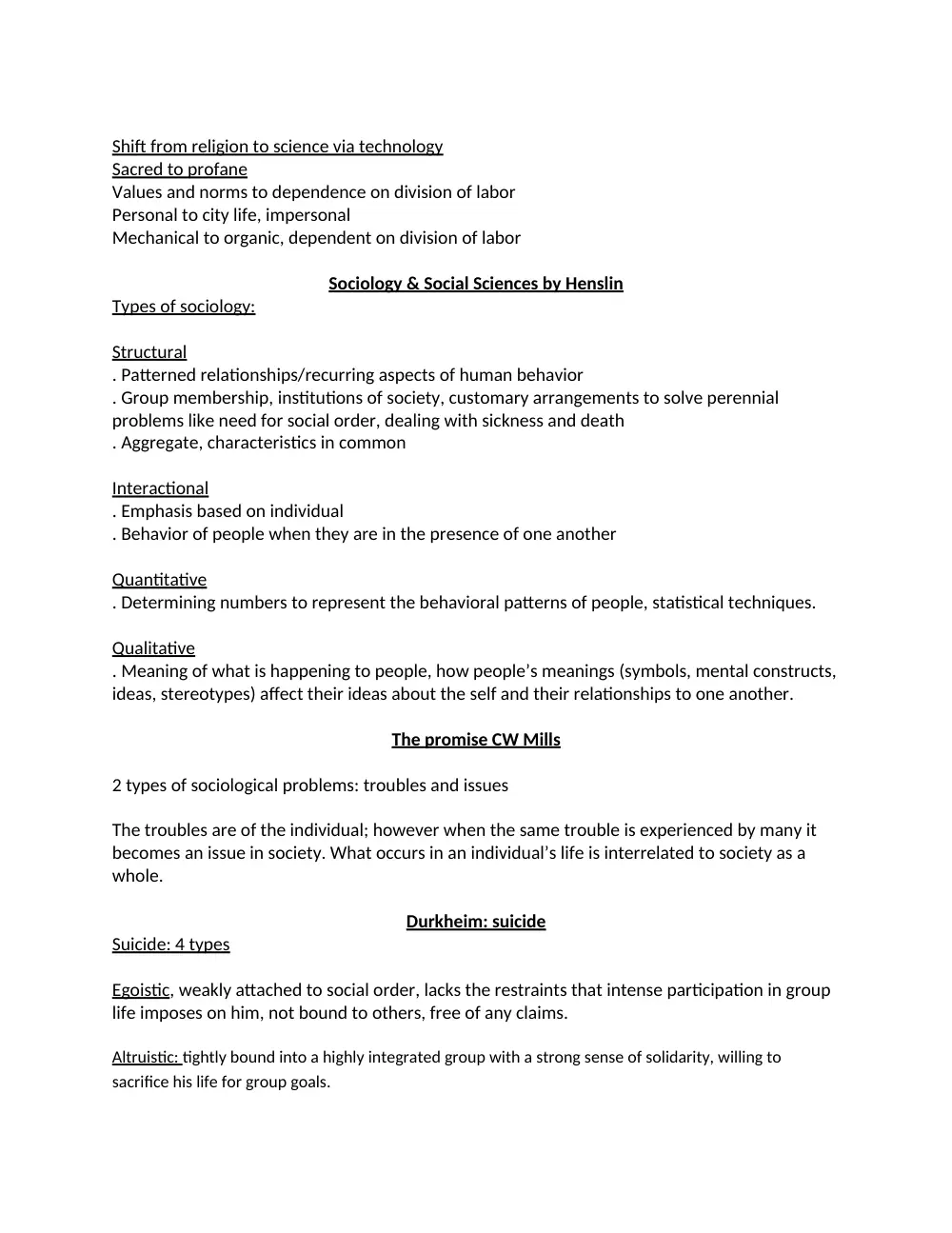
Shift from religion to science via technology
Sacred to profane
Values and norms to dependence on division of labor
Personal to city life, impersonal
Mechanical to organic, dependent on division of labor
Sociology & Social Sciences by Henslin
Types of sociology:
Structural
. Patterned relationships/recurring aspects of human behavior
. Group membership, institutions of society, customary arrangements to solve perennial
problems like need for social order, dealing with sickness and death
. Aggregate, characteristics in common
Interactional
. Emphasis based on individual
. Behavior of people when they are in the presence of one another
Quantitative
. Determining numbers to represent the behavioral patterns of people, statistical techniques.
Qualitative
. Meaning of what is happening to people, how people’s meanings (symbols, mental constructs,
ideas, stereotypes) affect their ideas about the self and their relationships to one another.
The promise CW Mills
2 types of sociological problems: troubles and issues
The troubles are of the individual; however when the same trouble is experienced by many it
becomes an issue in society. What occurs in an individual’s life is interrelated to society as a
whole.
Durkheim: suicide
Suicide: 4 types
Egoistic, weakly attached to social order, lacks the restraints that intense participation in group
life imposes on him, not bound to others, free of any claims.
Altruistic: tightly bound into a highly integrated group with a strong sense of solidarity, willing to
sacrifice his life for group goals.
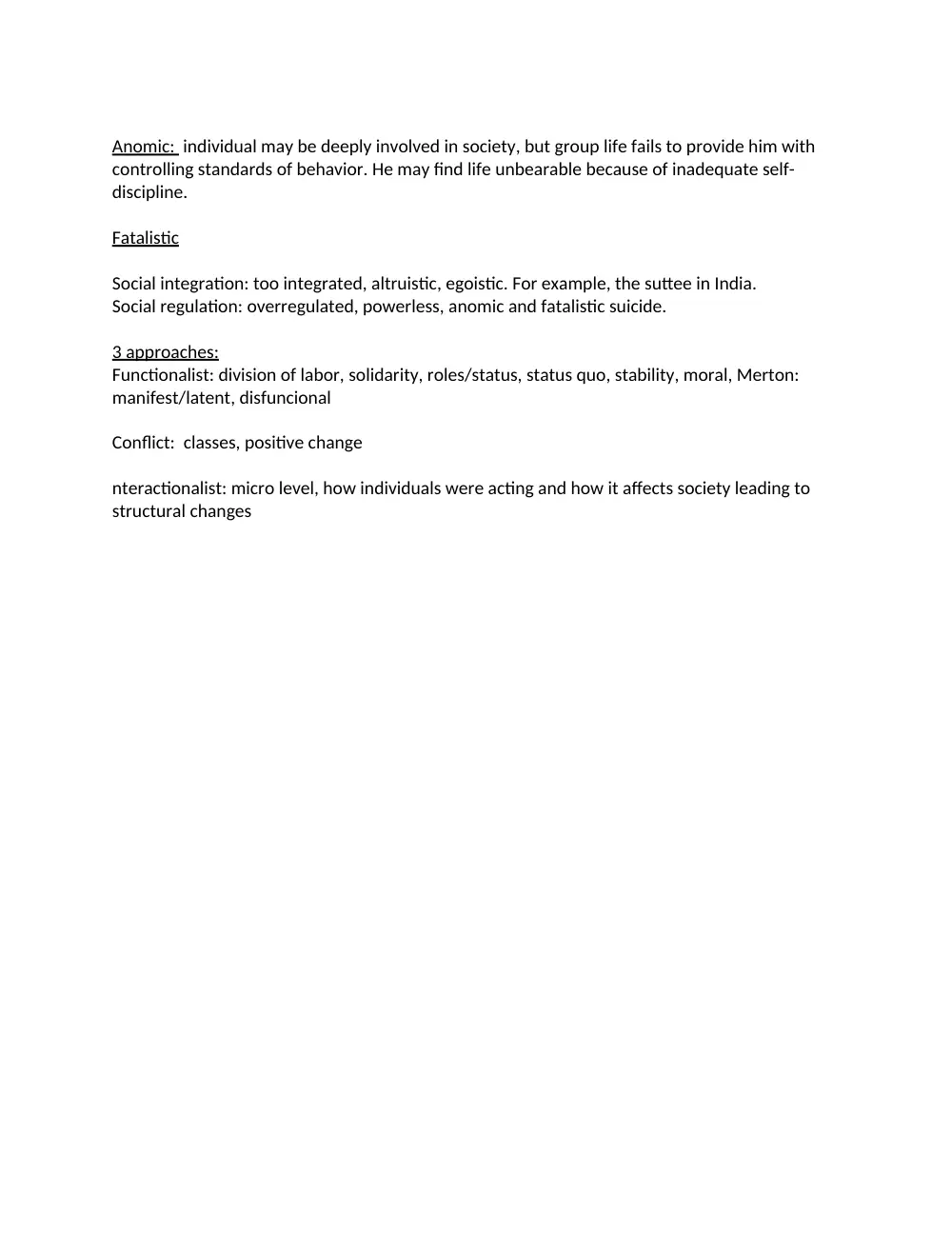
Anomic: individual may be deeply involved in society, but group life fails to provide him with
controlling standards of behavior. He may find life unbearable because of inadequate self-
discipline.
Fatalistic
Social integration: too integrated, altruistic, egoistic. For example, the suttee in India.
Social regulation: overregulated, powerless, anomic and fatalistic suicide.
3 approaches:
Functionalist: division of labor, solidarity, roles/status, status quo, stability, moral, Merton:
manifest/latent, disfuncional
Conflict: classes, positive change
nteractionalist: micro level, how individuals were acting and how it affects society leading to
structural changes