
STAT 230 Final, Spring 1998
American University of Beirut · Introduction to Probability and Random Variables · 2 pages
More STAT 230 files
- Final · Summer 2010Final examView
- Final with Solution · Summer 2010Final exam · with solutionView
- Final · Fall 2010Final examView
- Final · Summer 2010Final examView
- Final with Answers · Fall 2009Final exam · with solutionView
- Final with Solution · Summer 2009Final exam · with solutionView
- Final · Fall 2009Final examView
- Final with Solution · Fall 2009Final exam · with solutionView
Show the text of this final exam
\
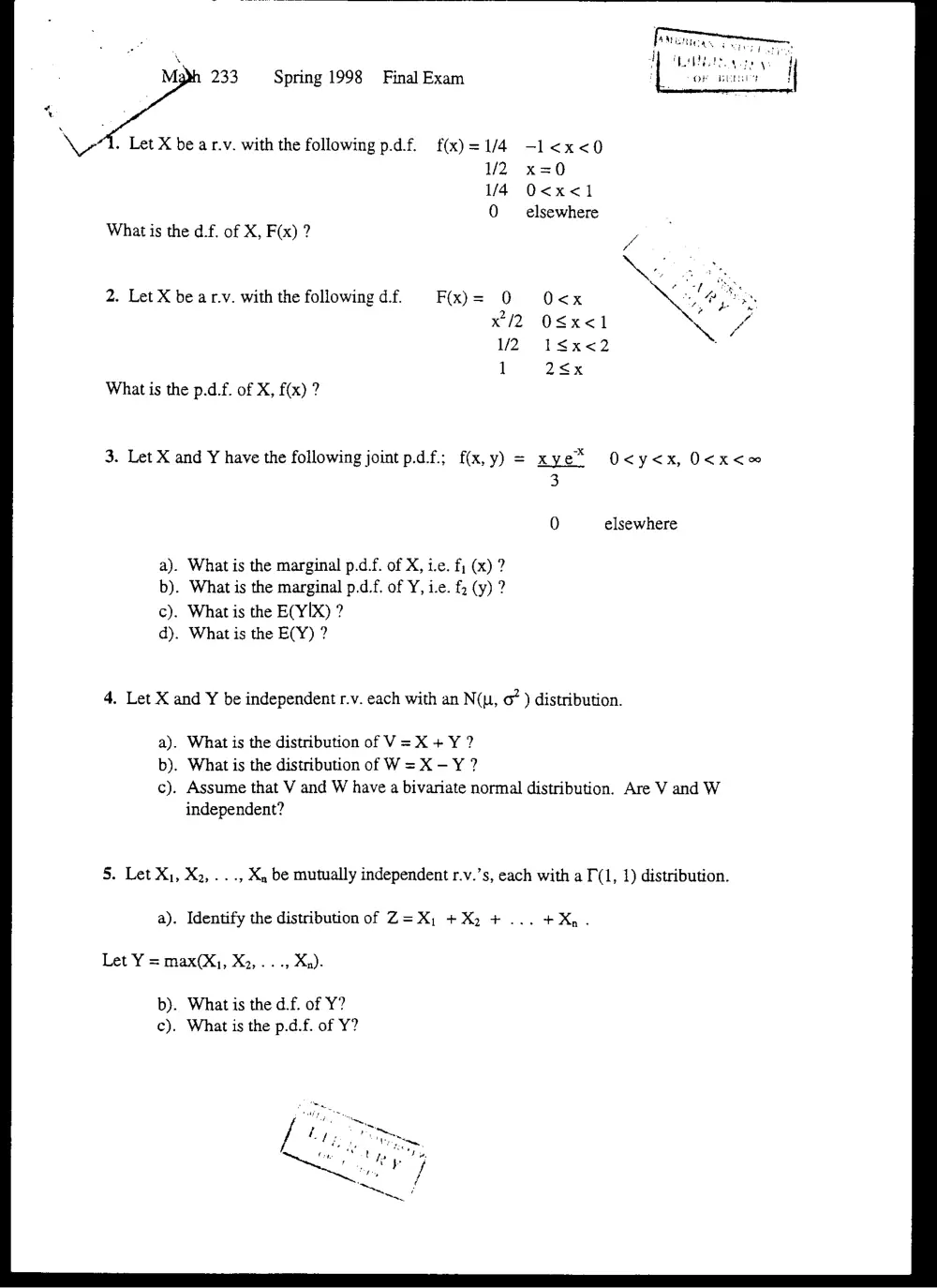
Mgyh 233 Spring 1998 Final Exam
Ve . Let X be ar.v. with the following p.df. f(x)=1/4 -l<x<0
W2 x=0
7/4 O<x<l
0 elsewhere
What is the d.f. of X, F(x) ?
2. Let X be ar.v. with the following d.f. F(x)= 0 O<x
¥/2 O<x«<l
/2 isx<2
1 2x
What is the p.d.f. of X, f(x) ?
3. Let X and Y have the following joint p.df.; f(x,y) = xye™ O<y<x, 0<x<m
3
elsewhere
a). What is the marginal p.d.f. of X, ie. f; (x) ?
b). What is the marginal p.d.f. of Y, ie. f; (y) ?
c). What is the ECYIX) ?
d). What is the E(Y) ?
4. Let X and Y be independent r.v. each with an N(u, o” ) distribution.
a). What is the distribution of V=X+Y?
b). What is the distribution of W =X - Y ?
c). Assume that V and W have a bivariate normal distribution. Are V and W
independent?
5. Let Xi, X2,..., X_ be mutually independent r.v.’s, each with a (1, 1) distribution.
a). Identify the distribution of Z=X, +X. +... +X,.
Let Y = max(X), Xz, ..., Xn).
b). What is the df. of Y?
c). What is the p.d.f. of Y?
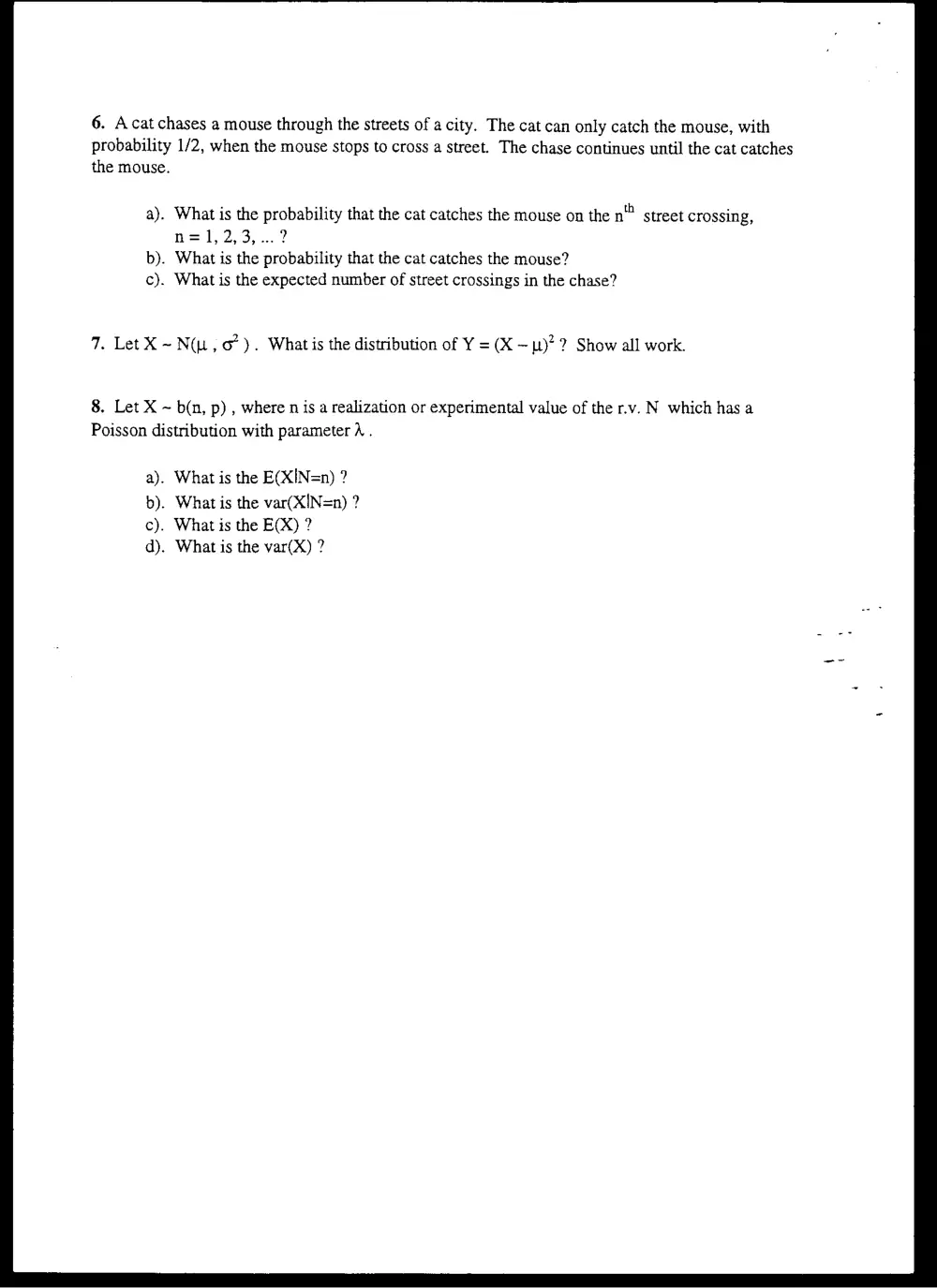
6. Acat chases a mouse through the streets of a city. The cat can only catch the mouse, with
probability 1/2, when the mouse stops to cross a street. The chase continues until the cat catches
the mouse.
a). What is the probability that the cat catches the mouse on the n™ street crossing,
n=1,2,3,...?
b). What is the probability that the cat catches the mouse?
c). What is the expected number of street crossings in the chase?
7. Let X ~N(u, 0”). Whatis the distribution of Y = (X — Ly? ? Show all work.
8. Let X ~ b(n, p), where n is a realization or experimental value of the r.v. N which has a
Poisson distribution with parameter A.
a). What is the ECXIN=n) ?
b). What is the var(XIN=n) ?
c). What is the E(X) ?
d). What is the var(X) ?