
ECO 226 Problems Chapter 11 Solution, Spring 2017
Haigazian University · Public Finance · 1 page · Mr. Garabed Boghossian · with solution
Stuck on a question? A tutor can walk you through it.
More ECO 226 files
- Problems Chapter 1 Solution · Spring 2017Chapter · with solutionView
- Problems Chapter 10 Solution · Spring 2017Chapter · with solutionView
- Problems Chapter 12 Solution · Spring 2017Chapter · with solutionView
- Problems Chapter 2 Solution · Spring 2017Chapter · with solutionView
- Problems Chapter 3 Solution · Spring 2017Chapter · with solutionView
- Problems Chapter 6 Solution · Spring 2017Chapter · with solutionView
Show the text of this chapter
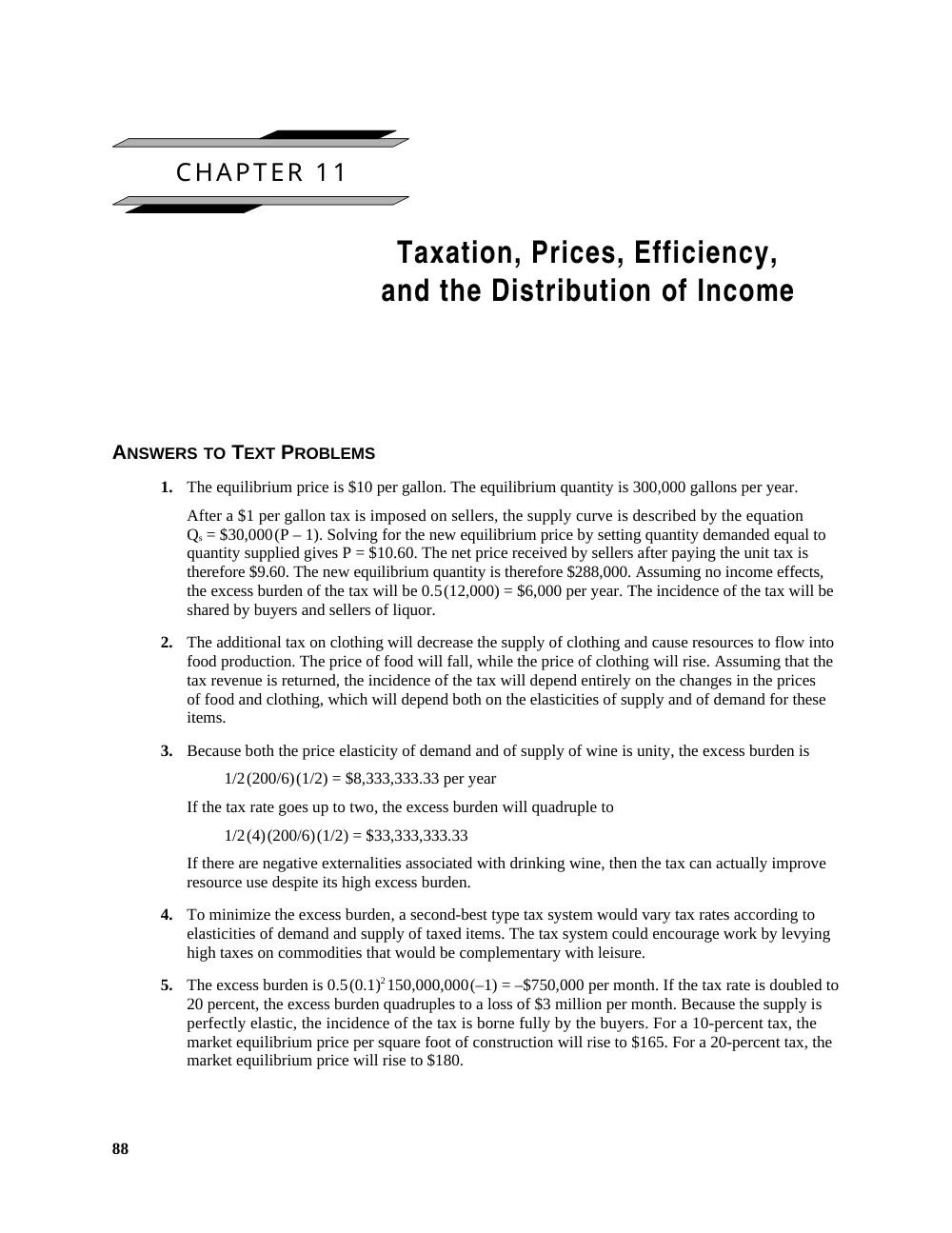
CHAPTER 11
Taxation, Prices, Efficiency,
and the Distribution of Income
ANSWERS TO TEXT PROBLEMS
1.
The equilibrium price is $10 per gallon. The equilibrium quantity is 300,000 gallons per year.
After a $1 per gallon tax is imposed on sellers, the supply curve is described by the equation
Qs = $30,000(P – 1). Solving for the new equilibrium price by setting quantity demanded equal to
quantity supplied gives P = $10.60. The net price received by sellers after paying the unit tax is
therefore $9.60. The new equilibrium quantity is therefore $288,000. Assuming no income effects,
the excess burden of the tax will be 0.5(12,000) = $6,000 per year. The incidence of the tax will be
shared by buyers and sellers of liquor.
2.
The additional tax on clothing will decrease the supply of clothing and cause resources to flow into
food production. The price of food will fall, while the price of clothing will rise. Assuming that the
tax revenue is returned, the incidence of the tax will depend entirely on the changes in the prices
of food and clothing, which will depend both on the elasticities of supply and of demand for these
items.
3.
Because both the price elasticity of demand and of supply of wine is unity, the excess burden is
1/2(200/6)(1/2) = $8,333,333.33 per year
If the tax rate goes up to two, the excess burden will quadruple to
1/2(4)(200/6)(1/2) = $33,333,333.33
If there are negative externalities associated with drinking wine, then the tax can actually improve
resource use despite its high excess burden.
4.
To minimize the excess burden, a second-best type tax system would vary tax rates according to
elasticities of demand and supply of taxed items. The tax system could encourage work by levying
high taxes on commodities that would be complementary with leisure.
5.
The excess burden is 0.5(0.1)2150,000,000(–1) = –$750,000 per month. If the tax rate is doubled to
20 percent, the excess burden quadruples to a loss of $3 million per month. Because the supply is
perfectly elastic, the incidence of the tax is borne fully by the buyers. For a 10-percent tax, the
market equilibrium price per square foot of construction will rise to $165. For a 20-percent tax, the
market equilibrium price will rise to $180.
88