
CSC 320 Problems + Solutions Prob Set 5 Datapath , the Processor, Spring 2014
Lebanese American University · Computer Organisation · 5 pages · Dr. Anonymous · with solution


More CSC 320 files
- Problems + Solutions Prob Set 7 Memory · Spring 2014Problems · with solutionView
- Problems + Solutions Prob Set 3 Instructions Languageof the Computer · Spring 2014Problems · with solutionView
- Problems + Solutions Problem Set 2 -Computer Abstractions and Technolgy · Spring 2014Problems · with solutionView
- Problems + Solutions Problem Set 1- Number Systems · Spring 2014Problems · with solutionView
- Problems + Solutions Prob Set 6 Arithmetics · Spring 2014Problems · with solutionView
- Problems + Solutions Prob Set 4 Language of the Computer · Spring 2014Problems · with solutionView
- Chapter #2 · Spring 2015ChapterView
- Chapter #5 · Spring 2015ChapterView
Show the text of this problems
Lebanese American University
School of Arts and Sciences
Department of Computer Science and Mathematics
CSC 320 – Computer Organization
Problem Set 5: The Processor
Exercise 1
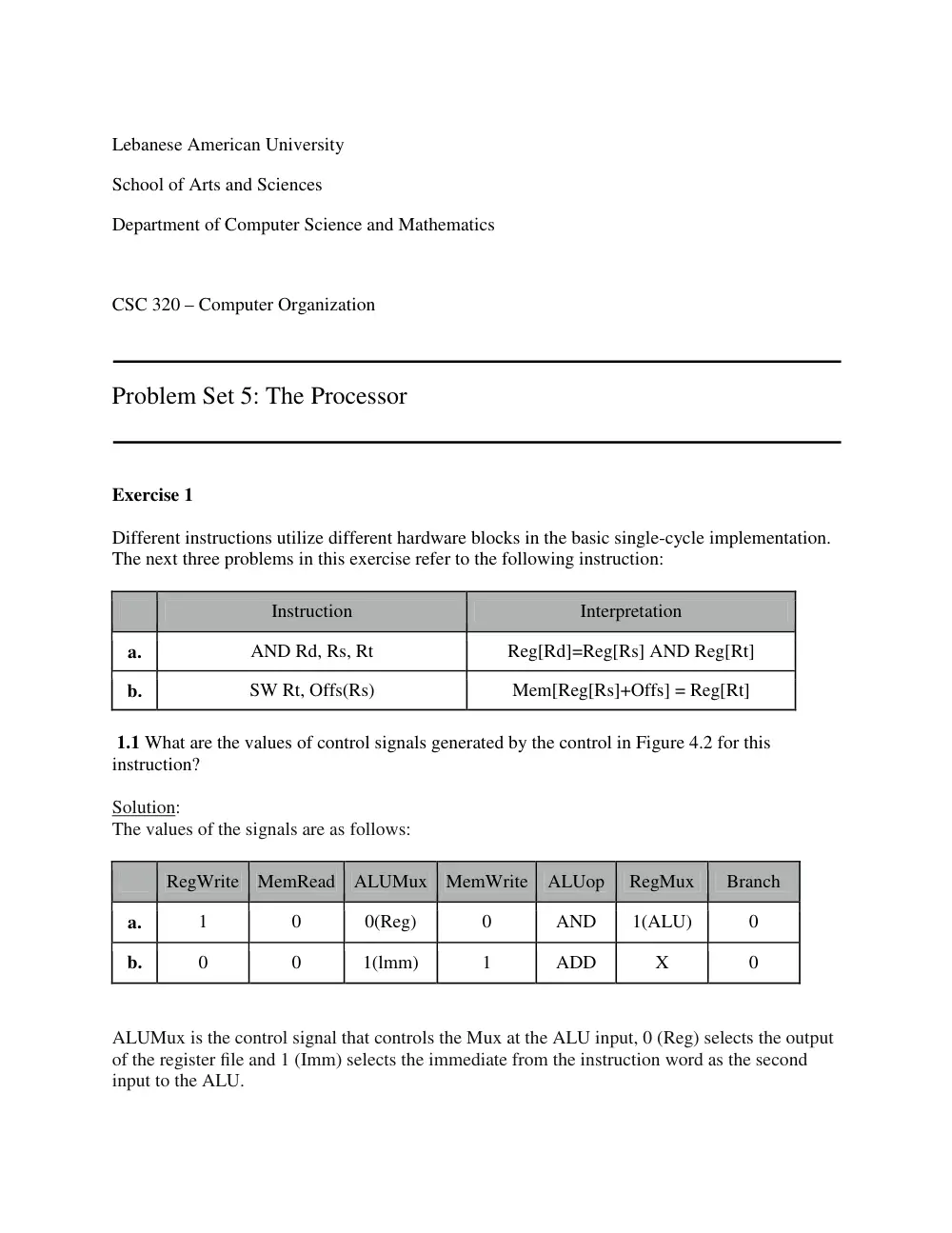
Different instructions utilize different hardware blocks in the basic single-cycle implementation.
The next three problems in this exercise refer to the following instruction:
Instruction
Interpretation
a.
AND Rd, Rs, Rt
Reg[Rd]=Reg[Rs] AND Reg[Rt]
b.
SW Rt, Offs(Rs)
Mem[Reg[Rs]+Offs] = Reg[Rt]
1.1 What are the values of control signals generated by the control in Figure 4.2 for this
instruction?
Solution:
The values of the signals are as follows:
RegWrite MemRead ALUMux MemWrite
ALUop
RegMux
Branch
a.
1
0
0(Reg)
0
AND
1(ALU)
0
b.
0
0
1(lmm)
1
ADD
X
0
ALUMux is the control signal that controls the Mux at the ALU input, 0 (Reg) selects the output
of the register file and 1 (Imm) selects the immediate from the instruction word as the second
input to the ALU.
RegMux is the control signal that controls the Mux at the data input to the register file, 0 (ALU)
selects the output of the ALU, and 1 (Mem) selects the output of memory.
A value of X is a “don’t care” (does not matter if signal is 0 or 1).
1.2 Which resources (blocks) perform a useful function for this instruction?
Solution:
Resources performing a useful function for this instruction are:
a.
All except Data Memory and branch Add unit
b.
All except branch Add unit and write port of the Registers
1.3 Which resources (blocks) produce outputs, but their outputs, are not used for this instruction?
Which resources produce no outputs for this instruction?
Different execution units and blocks of digital logic have different latencies (time needed to do
their work). In Figure 4.2 there are seven kinds of major blocks. Latencies of blocks along the
critical (longest -latency) path for an instruction determine the minimum latency of that
instruction. For the remaining three problems in this exercise, assume the following resource
latencies:
I-Mem
Add
Mux
ALU
Regs
D-Mem
Control
a.
200ps
70ps
20ps
90ps
90ps
250ps
40ps
b.
750ps
200ps
50ps
250ps
300ps
500ps
300ps
Solution:
Outputs That Are Not Used
No Outputs
a.
Branch Add
Data Memory
b.
Branch Add, write port of Registers
None (all units produce outputs)
puts That Are Not UsedNo Outputs
1.4 What is the critical path for an MIPS AND instruction?
Solution:
One long path for AND instruction is to read the instruction, read the registers, go through the
ALU Mux, perform the ALU operation, and go through the Mux that controls the write data for
Registers (I-Mem, Regs, Mux, ALU, and Mux). The other long path is similar, but goes through
Control while registers are read (I-Mem, Control, Mux, ALU, Mux). There are other paths but
they are shorter, such as the PC increment path (only Add and then Mux), the path to prevent
branching (I-Mem to Control to Mux, so the Mux can use the Branch signal to select the PC + 4
input as the new value for PC), and the path that prevents a memory write (only I-Mem and then
Control, etc.).
a.
Control is faster than registers, so the critical path is I-Mem, Regs, Mux, ALU, Mux.
b.
The two long paths are equal, so both are critical.
1.5 What is the critical path for an MIPS load (LD) instruction?
Solution:
One long path is to read the instruction, read registers, use the Mux to select the immediate as the
second ALU input, use ALU (compute address), access D-Mem, and use the Mux to select that
as register data input, so we have I-Mem, Regs, Mux, ALU, D-Mem, Mux. The other long path
is similar, but goes through Control instead of Regs (to generate the control signal for the ALU
MUX).
a.
Control is faster than registers, so the critical path is I-Mem, Regs, Mux, ALU, Mux.
b.
The two long paths are equal, so both are critical.
1.6 What is the critical path for an MIPS BEQ instruction?
Solution:
This instruction has two kinds of long paths, those that determine the branch condition and those
that compute the new PC. To determine the branch condition, we read the instruction, read
registers or use the Control unit, then use the ALU Mux and then the ALU to compare the two
values, then use the Zero out-put of the ALU to control the Mux that selects the new PC.
a.
The first path (through Regs) is longer.
b.
The two long paths are equal, so both are critical.
To compute the PC, one path is to increment it by 4 (Add), add the offset (Add), and select that
value as the new PC (Mux). The other path for computing the PC is to read the instruction (to get
the offset) and use the branch Add unit and Mux. Both of the compute-PC paths are shorter than
the critical path that determines
the branch condition, because I-Mem is slower than the PC + 4 Add unit, and
because ALU is slower than the branch Add.
Exercise 2
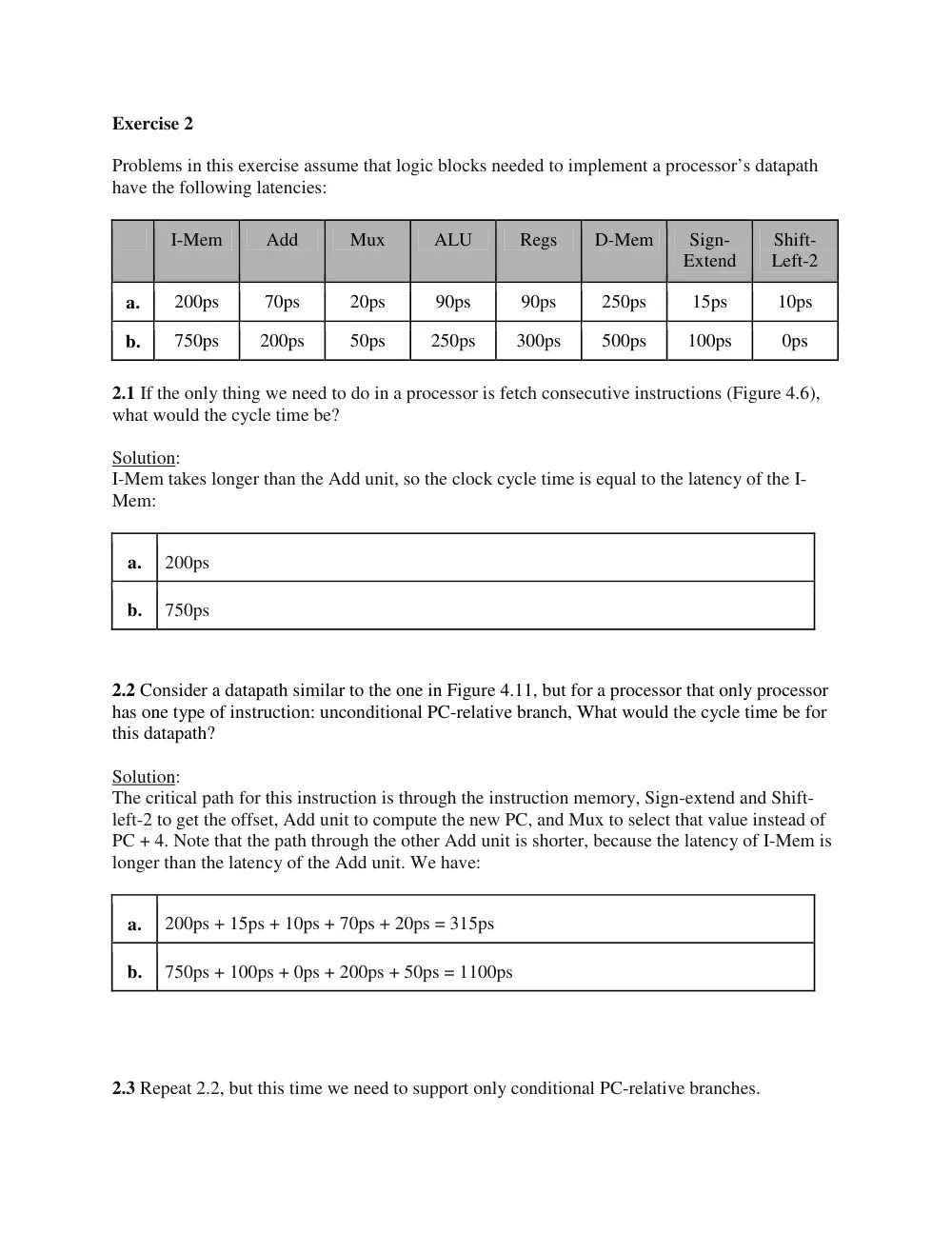
Problems in this exercise assume that logic blocks needed to implement a processor’s datapath
have the following latencies:
I-Mem
Add
Mux
ALU
Regs
D-Mem
Sign-
Extend
Shift-
Left-2
a.
200ps
70ps
20ps
90ps
90ps
250ps
15ps
10ps
b.
750ps
200ps
50ps
250ps
300ps
500ps
100ps
0ps
2.1 If the only thing we need to do in a processor is fetch consecutive instructions (Figure 4.6),
what would the cycle time be?
Solution:
I-Mem takes longer than the Add unit, so the clock cycle time is equal to the latency of the I-
Mem:
a.
200ps
b.
750ps
2.2 Consider a datapath similar to the one in Figure 4.11, but for a processor that only processor
has one type of instruction: unconditional PC-relative branch, What would the cycle time be for
this datapath?
Solution:
The critical path for this instruction is through the instruction memory, Sign-extend and Shift-
left-2 to get the offset, Add unit to compute the new PC, and Mux to select that value instead of
PC + 4. Note that the path through the other Add unit is shorter, because the latency of I-Mem is
longer than the latency of the Add unit. We have:
a.
200ps + 15ps + 10ps + 70ps + 20ps = 315ps
b.
750ps + 100ps + 0ps + 200ps + 50ps = 1100ps
2.3 Repeat 2.2, but this time we need to support only conditional PC-relative branches.
Solution:
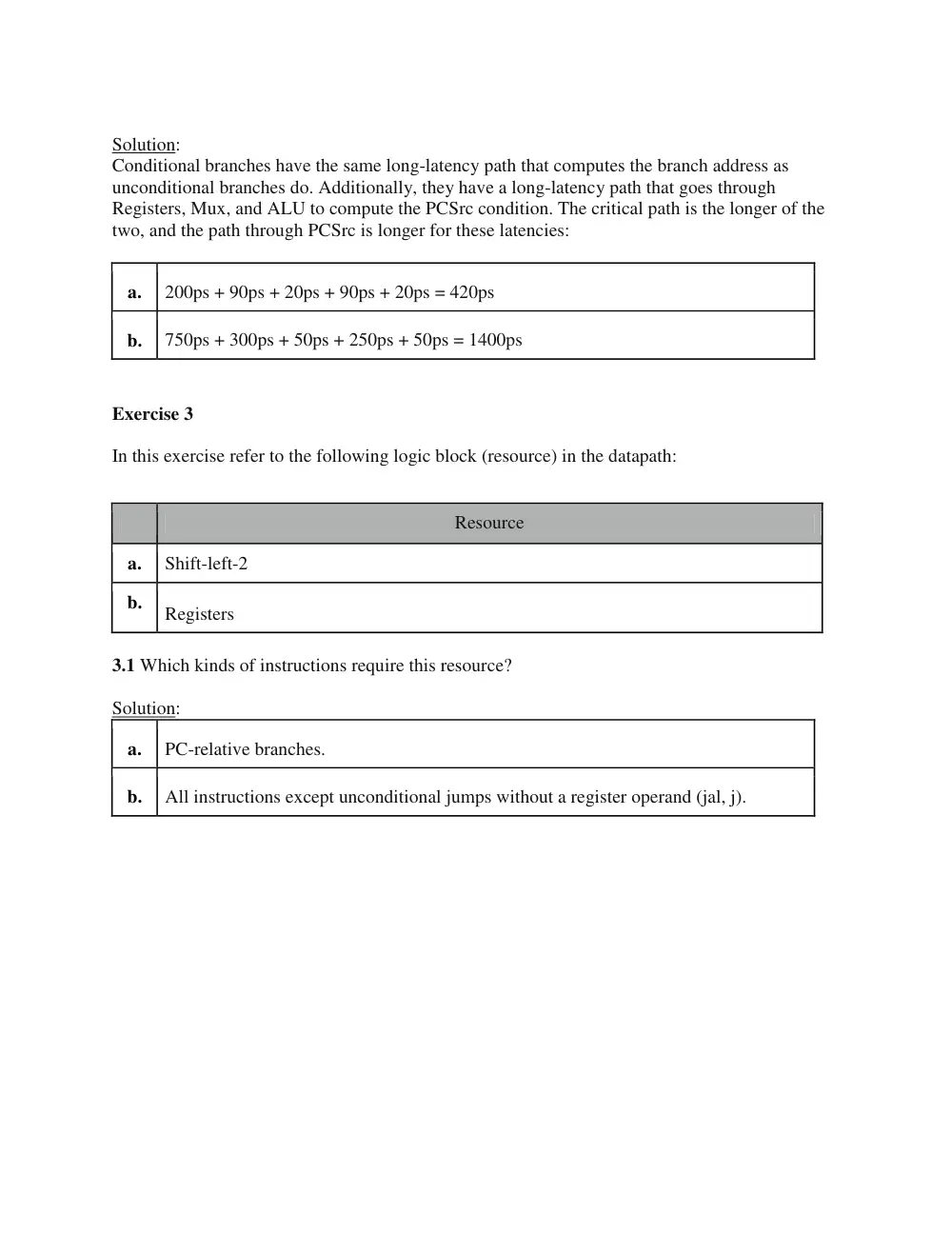
Conditional branches have the same long-latency path that computes the branch address as
unconditional branches do. Additionally, they have a long-latency path that goes through
Registers, Mux, and ALU to compute the PCSrc condition. The critical path is the longer of the
two, and the path through PCSrc is longer for these latencies:
a.
200ps + 90ps + 20ps + 90ps + 20ps = 420ps
b.
750ps + 300ps + 50ps + 250ps + 50ps = 1400ps
Exercise 3
In this exercise refer to the following logic block (resource) in the datapath:
3.1 Which kinds of instructions require this resource?
Solution:
a.
PC-relative branches.
b.
All instructions except unconditional jumps without a register operand (jal, j).
Resource
a.
Shift-left-2
b.
Registers