
CSC 320 Problems + Solutions Prob Set 7 Memory, Spring 2014
Lebanese American University · Computer Organisation · 4 pages · Dr. Anonymous · with solution
More CSC 320 files
- Problems + Solutions Prob Set 6 Arithmetics · Spring 2014Problems · with solutionView
- Problems + Solutions Prob Set 3 Instructions Languageof the Computer · Spring 2014Problems · with solutionView
- Problems + Solutions Problem Set 2 -Computer Abstractions and Technolgy · Spring 2014Problems · with solutionView
- Problems + Solutions Problem Set 1- Number Systems · Spring 2014Problems · with solutionView
- Problems + Solutions Prob Set 5 Datapath , the Processor · Spring 2014Problems · with solutionView
- Problems + Solutions Prob Set 4 Language of the Computer · Spring 2014Problems · with solutionView
- Chapter #2 · Spring 2015ChapterView
- Chapter #5 · Spring 2015ChapterView
Show the text of this problems
Lebanese American University
School of Arts and Sciences
Department of Computer Science and Mathematics
CSC 320 – Computer Organization
Problem Set 7: Large and Fast: Exploiting Memory Hierarchy
Exercise 1
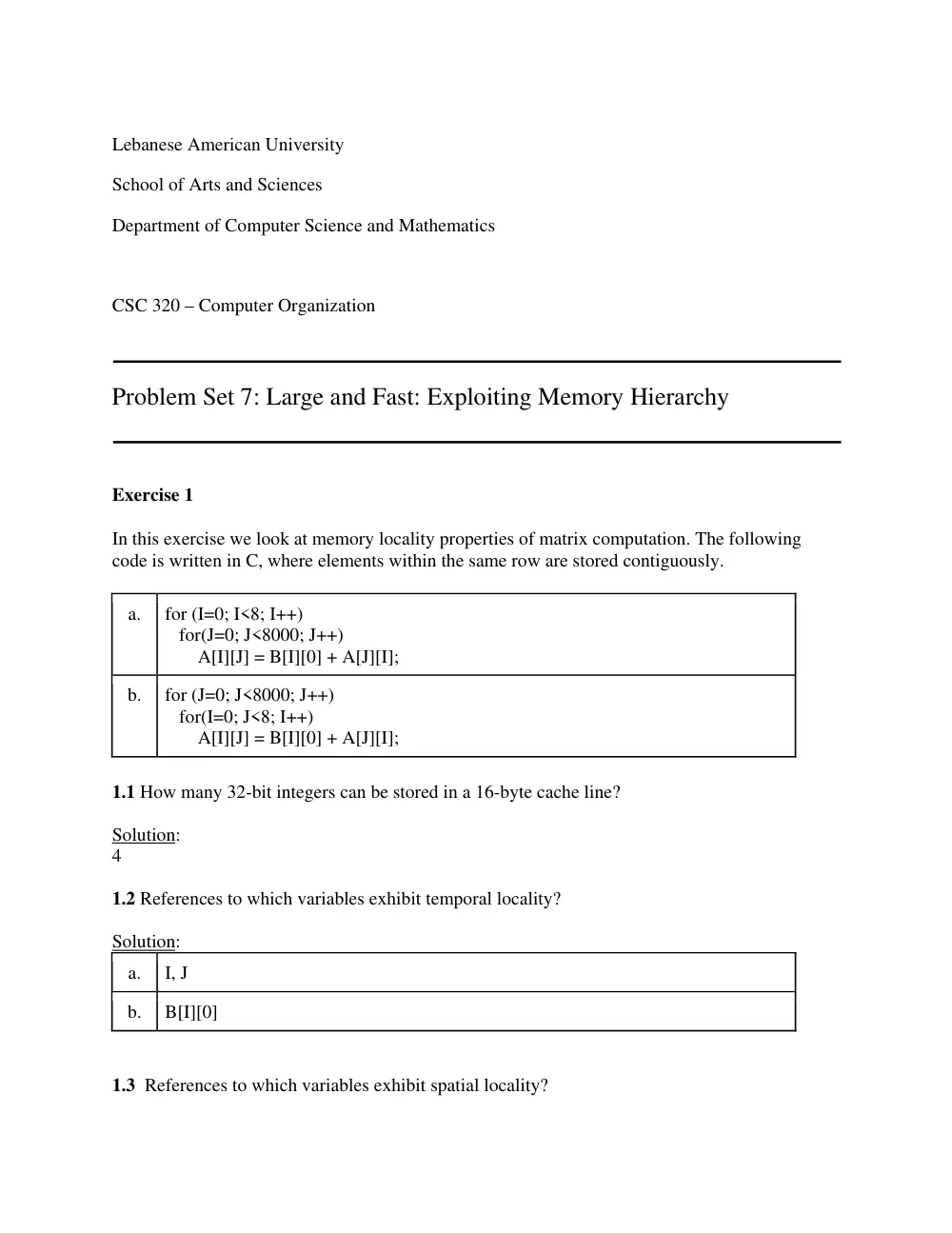
In this exercise we look at memory locality properties of matrix computation. The following
code is written in C, where elements within the same row are stored contiguously.
a.
for (I=0; I<8; I++)
for(J=0; J<8000; J++)
A[I][J] = B[I][0] + A[J][I];
b.
for (J=0; J<8000; J++)
for(I=0; J<8; I++)
A[I][J] = B[I][0] + A[J][I];
1.1 How many 32-bit integers can be stored in a 16-byte cache line?
Solution:
4
1.2 References to which variables exhibit temporal locality?
Solution:
a.
I, J
b.
B[I][0]
1.3 References to which variables exhibit spatial locality?
Solution:
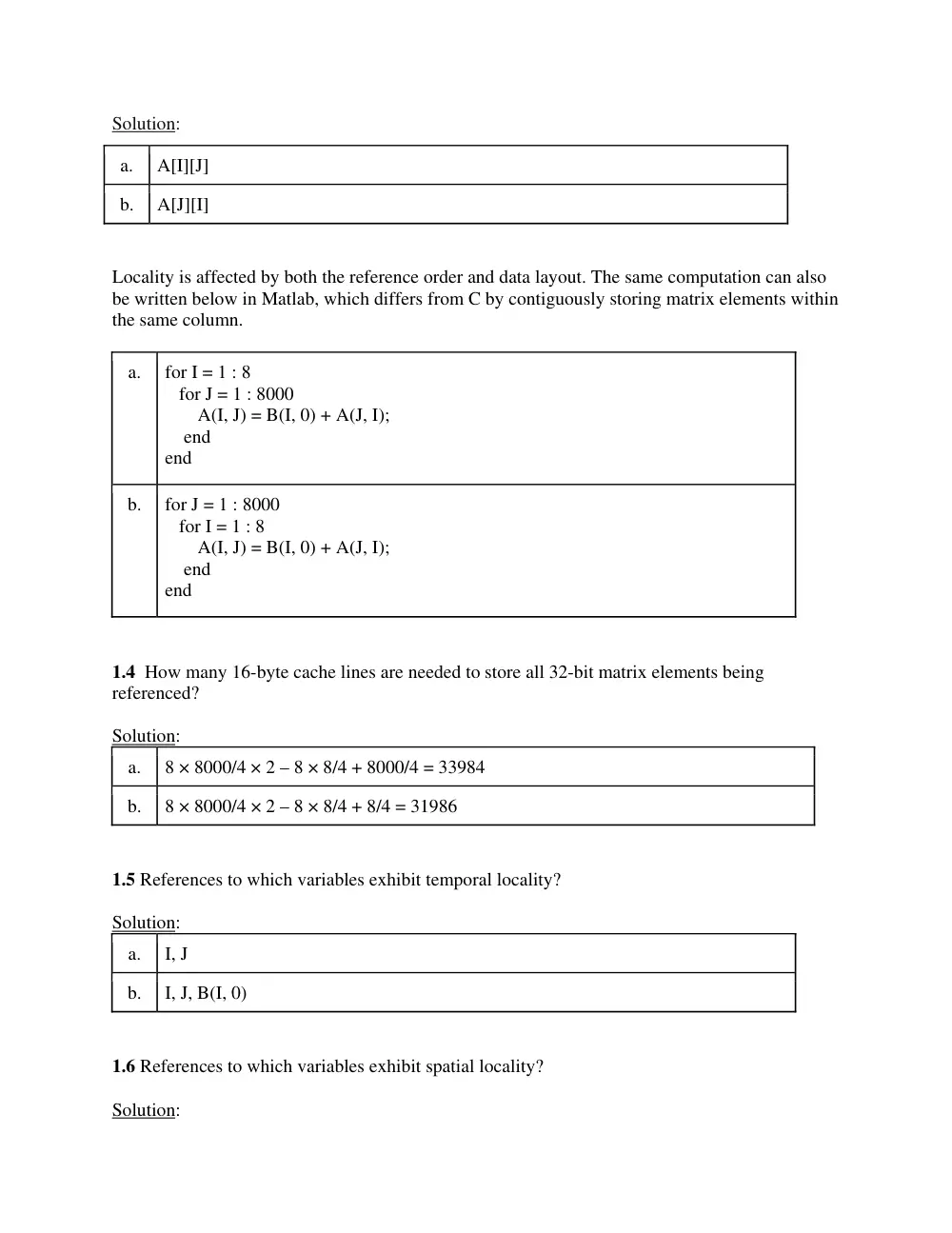
Locality is affected by both the reference order and data layout. The same computation can also
be written below in Matlab, which differs from C by contiguously storing matrix elements within
the same column.
a.
for I = 1 : 8
for J = 1 : 8000
A(I, J) = B(I, 0) + A(J, I);
end
end
b.
for J = 1 : 8000
for I = 1 : 8
A(I, J) = B(I, 0) + A(J, I);
end
end
1.4 How many 16-byte cache lines are needed to store all 32-bit matrix elements being
referenced?
Solution:
a.
8 × 8000/4 × 2 – 8 × 8/4 + 8000/4 = 33984
b.
8 × 8000/4 × 2 – 8 × 8/4 + 8/4 = 31986
1.5 References to which variables exhibit temporal locality?
Solution:
a.
I, J
b.
I, J, B(I, 0)
Outputs
1.6 References to which variables exhibit spatial locality?
Solution:
a.
A[I][J]
b.
A[J][I]
a.
A(J, I)
b.
A(I, J), A(J, I), B(I, 0)
Exercise 2
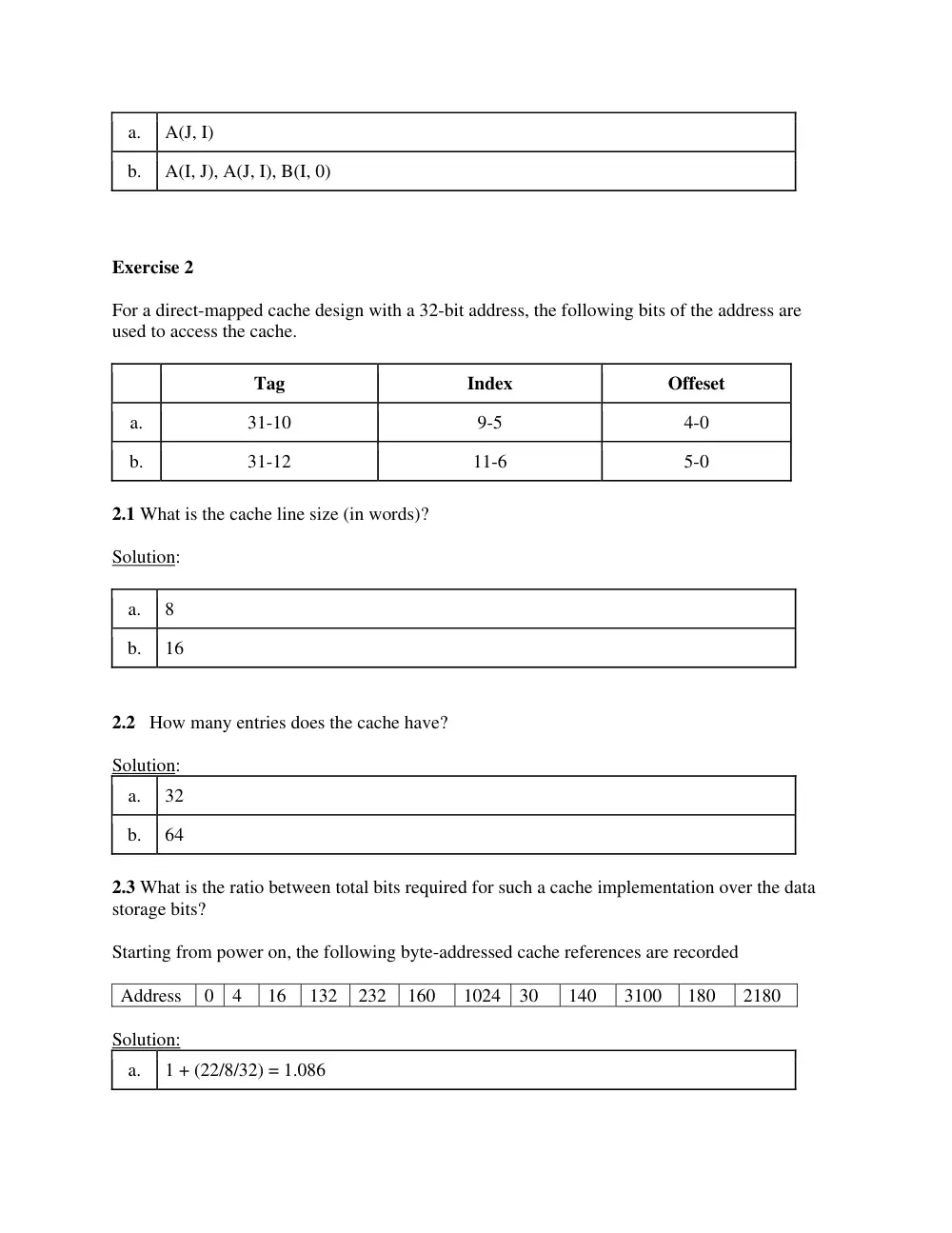
For a direct-mapped cache design with a 32-bit address, the following bits of the address are
used to access the cache.
Tag
Index
Offeset
a.
31-10
9-5
4-0
b.
31-12
11-6
5-0
2.1 What is the cache line size (in words)?
Solution:
a.
8
b.
16
2.2 How many entries does the cache have?
Solution:
a.
32
b.
64
2.3 What is the ratio between total bits required for such a cache implementation over the data
storage bits?
Starting from power on, the following byte-addressed cache references are recorded
Address
0 4
16
132
232
160
1024 30
140
3100
180
2180
Solution:
a.
1 + (22/8/32) = 1.086
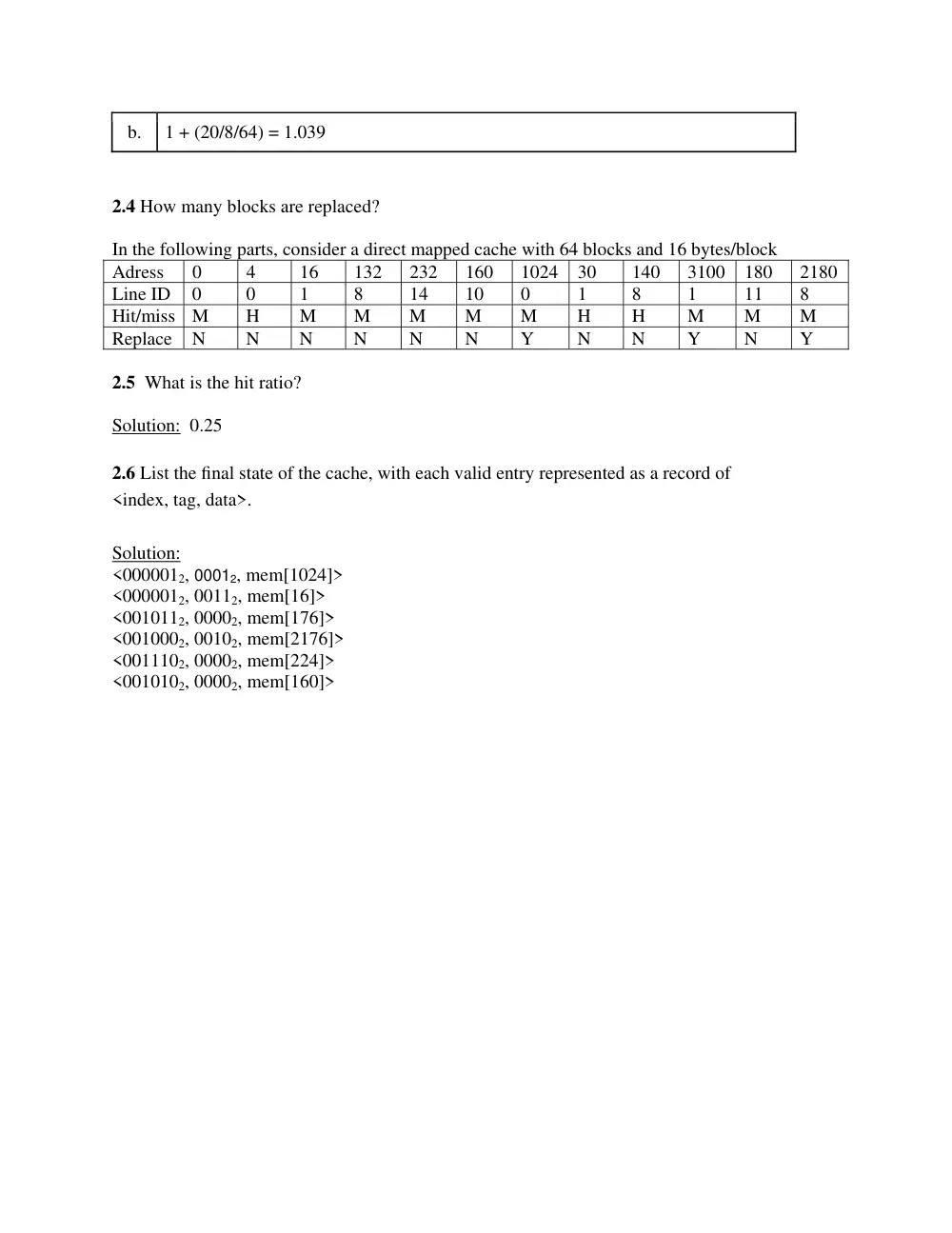
b.
1 + (20/8/64) = 1.039
2.4 How many blocks are replaced?
In the following parts, consider a direct mapped cache with 64 blocks and 16 bytes/block
Adress
0
4
16
132
232
160
1024 30
140
3100 180
2180
Line ID
0
0
1
8
14
10
0
1
8
1
11
8
Hit/miss M
H
M
M
M
M
M
H
H
M
M
M
Replace
N
N
N
N
N
N
Y
N
N
Y
N
Y
2.5 What is the hit ratio?
Solution: 0.25
2.6 List the final state of the cache, with each valid entry represented as a record of
<index, tag, data>.
Solution:
<0000012, 00012, mem[1024]>
<0000012, 00112, mem[16]>
<0010112, 00002, mem[176]>
<0010002, 00102, mem[2176]>
<0011102, 00002, mem[224]>
<0010102, 00002, mem[160]>